When you’re evaluating data center infrastructure, you need clear information to make confident decisions. Where are the facilities? What capabilities do they offer? How can they support your workloads? Most importantly, what’s the character and culture of the people behind it all?
We’ve launched our newly redesigned website to make those answers easier to find. With interactive maps, more detailed facility pages, valuable new content, and clearer navigation, you can explore your options and connect with DataBank more easily.
Our first major website redesign since 2022 was informed by feedback from several hundred IT decision-makers. Their input helped shape an experience built around how you research, compare, and select infrastructure.
Here are a few highlights of the new website.
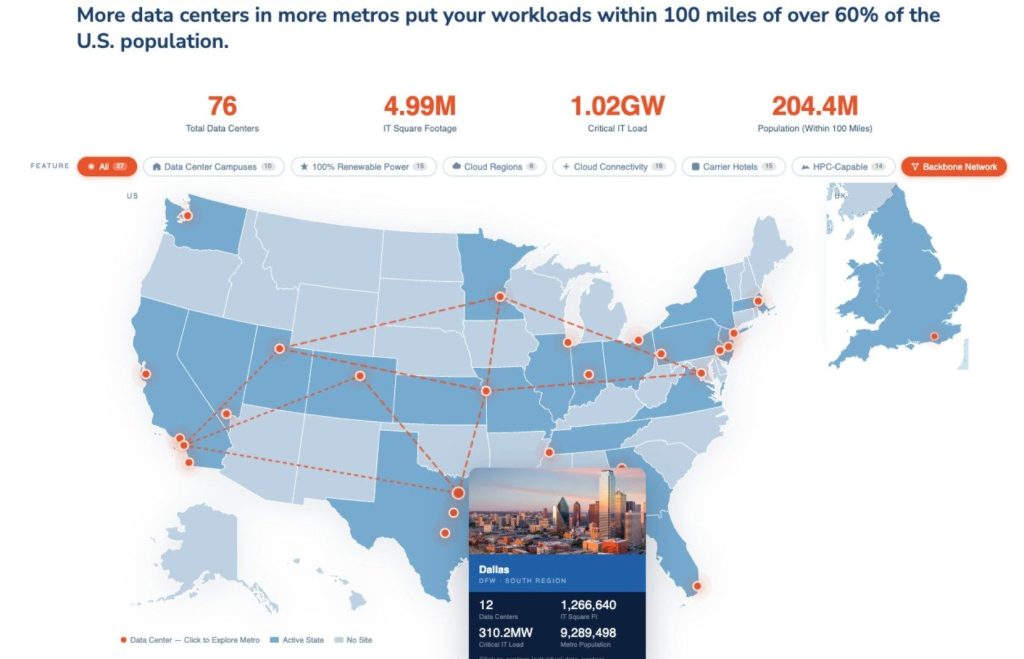
Whether you’re exploring a new market or looking for a specific facility, our redesigned national map helps you move quickly from the big picture to local details.
A New National Map: Find the Right Location More Easily
From the homepage, you can see DataBank’s footprint and the backbone network connecting sites. Select a city to open an interactive Google Map showing every DataBank data center or campus in that metro, making it easier to see where facilities are located and identify options in your target market.
Explore DataBank’s footprint and backbone network, find facilities by city, view site details, get directions, and request quotes — all from the interactive homepage map.
The map makes it easy to:
Explore locations by zooming in and out
Visit individual data center pages
Get driving directions
Request a quote
These options are available directly from the homepage map, so you can explore a market and take the next step without searching through multiple sections of the website.
It’s a faster path from exploring locations to finding detailed facility information and connecting with DataBank about your next deployment.
New Homepage: Get to Know the Team Behind the Technology
Our redesigned homepage brings more of DataBank’s people into view. In response to feedback requesting more video, we’ve added footage and images of DataBank team members, giving you a closer look at the people behind our services.
You’ll see new video footage at the top of the homepage featuring DataBank team members. We also plan to introduce a “Meet a DataBanker” feature, highlighting different team members through photos and videos and giving you a closer look at the people and culture that shape your DataBank experience.
Interactive 3D Diagrams: Explore a Data Hall Design That Fits Your Needs
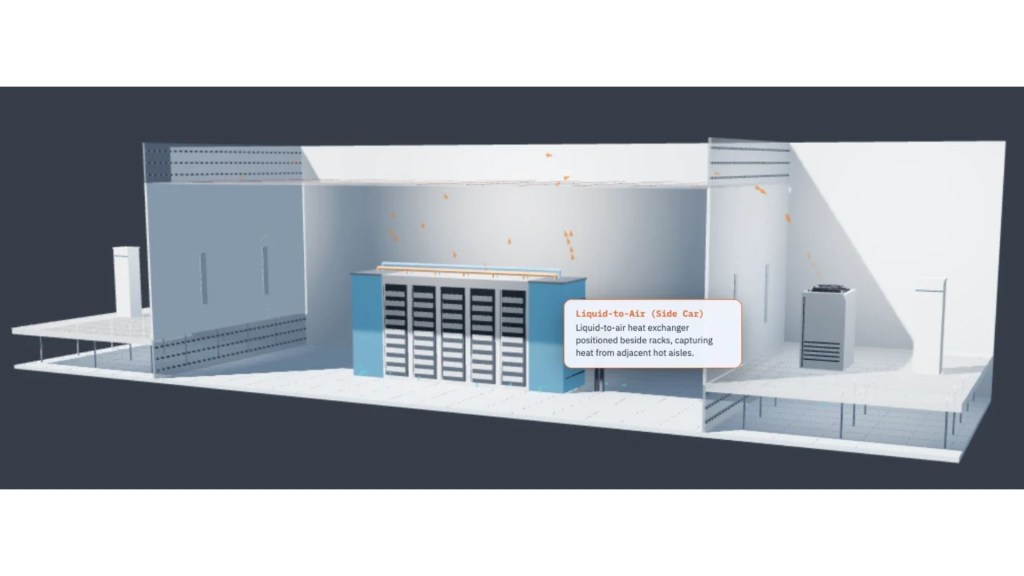
DataBank’s Universal Data Hall Design (UDHD) offers a flexible approach to configuring data center infrastructure around your requirements. Our redesigned homepage diagrams bring that flexibility to life with a 3D, interactive experience.
You can rotate the diagrams, zoom in for a closer look, and click through different configuration options to see how we power and cool even the most demanding workloads.
It’s a hands-on way to explore the possibilities and better understand how UDHD can support a data center build that works for you.
Data Center Evolved: Discover What Sets Your DataBank Experience Apart
Choosing a data center partner means looking beyond the facility itself. Our new Data Center Evolved section brings together eight factors that shape what you can expect from DataBank: our footprint, facilities, network, solutions, compliance, support, culture, and investors.
Accessible from the main menu and the rotating videos on the homepage, this section explores how we’ve evolved the data center experience around our customers’ needs. You can see all eight factors on a single page, making it easier to understand our approach and evaluate what matters most to your business.
Redesigned Metro and Data Center Pages: Get a Clearer View of Your Options
Within the Data Centers section, we’ve redesigned our metro and individual data center pages to make it easier to explore locations and find the information you need.
Each metro page now pairs an interactive Google Map on the left with a list of local data centers and their key specifications on the right. You can zoom in and out and click through to individual facilities, just as you can with the national map on the homepage.
Explore redesigned metro and data center pages with interactive maps, facility stats, photos, services, and certifications as well as convenient options for directions and tour requests.
Now you can select a data center listing to get driving directions, request a tour, or visit that facility’s dedicated page. There, you’ll find specifications, photos, videos, services, and compliance certifications together for an at-a-glance view of the location.
With locations and specifications together in one view, you can more easily compare facilities within a market and identify options that fit your requirements.
Updated Solutions Section: Find the Services and Tools You Need
Our redesigned Solutions section makes it easier to explore DataBank’s offerings and find information about the customer tools available to you.
An expanded portal subsection replaces the previous single Customer Portal page with dedicated pages for:
DataBank Customer Portal: Manage and monitor your DataBank infrastructure, submit support tickets, and access reports through a centralized portal to stay informed and in control of your services.
Platform DataBank Portal: Order and administer your cloud and bare metal services through a dedicated portal that brings infrastructure management and ordering together in one place.
DataBank Trust Center: Review compliance certifications, request security documentation, and explore DataBank’s security practices, policies, and controls to support compliance reviews and understand how we protect your data.
These pages help you understand what each portal offers and identify the right tool for the task at hand.
We’ve also grouped our Data Protection and Storage services into their own subsection, making it easier to explore options for protecting and storing your data.
Take a Look Around
We invite you to explore the new DataBank.com and hope you enjoy the updated experience. Whether you’re planning your next deployment or getting to know DataBank, we’re here to help you find what you need.
Cybersecurity awareness focuses on educating employees to recognize risks, follow security practices, and reduce human-related vulnerabilities.
By Calli Schlientz, Director of Compliance, DataBank
As Cybersecurity Awareness Month wraps up, it’s worth asking: Why is building effective cybersecurity so difficult for so many organizations? The answer usually isn’t technical. It’s cultural.
Too many organizations view their security and compliance teams as the “department of no,” the people who exist to tell everyone what can’t be done and why their preferred approach won’t work. This adversarial mindset creates exactly what it aims to prevent. When teams see security as an obstacle rather than a partner, they work around it, avoid conversations until it’s too late, and treat compliance as a burden rather than a useful framework.
The path forward requires integrating security into conversations from the beginning and moving from prohibition to collaboration. When security teams ask, “How can we make this work securely?” instead of simply saying “no,” organizations build stronger defenses while maintaining operational efficiency. This cultural shift improves security outcomes, business agility, and customer confidence simultaneously.
It All Starts with Leadership
Consider how you build a physical structure. Before construction begins, architects and engineers calculate load requirements, soil conditions, and structural integrity. Nobody questions whether foundation planning belongs in early conversations. The same principle applies to cybersecurity infrastructure.
Leadership makes this happen through visible participation, not mandates:
When executives complete security awareness training in the first week it’s available, completion rates across the organization increase dramatically
When senior leaders report phishing attempts using the same channels employees use, it normalizes the behavior
When project sponsors proactively request security architecture reviews, teams understand these aren’t bureaucratic obstacles but standard practice
People follow actions far more reliably than words. Leadership visibility transforms security from a requirement into an expectation.
From Policy to Practice: Making Documentation Useful
Most organizations have comprehensive information security policies that few employees have actually read. This isn’t a failure of discipline. It’s a failure of approach.
A 200-page security policy serves no practical purpose if people don’t know how to extract relevant information when they need it. The solution is teaching employees to treat security policies like reference tools they consult when needed, not documents they memorize. Show them how to use search functions effectively, understand how the document is organized, and locate specific guidance quickly.
Test whether your policies actually work as reference tools by creating quizzes that require employees to find information rather than recall it from memory. When people struggle, you’ve identified either a training gap or a documentation problem that needs fixing.
The security policy should answer questions, not create them. If employees can’t find guidance when they need it, even the most comprehensive or technically accurate policy has failed its purpose.
Compliance as Catalyst, Not Constraint
Compliance frameworks like SOC 2, FedRAMP, ISO, and PCI-DSS often get treated as burdens when they’re actually roadmaps that tell you exactly what needs protection and how to protect it.
Rather than viewing these as obstacles to overcome, use them as structured guides for building security practices. When frameworks mandate specific controls for patching, monitoring, or access management, they’re identifying security measures that actually matter based on industry experience and established risk patterns, not creating arbitrary work.
The key is integrating these requirements into planning conversations from the beginning. If you know FedRAMP compliance will eventually be required, design systems with those controls built in rather than retrofitting them later. When security and compliance participate in initial architecture discussions, evidence collection happens automatically throughout the year instead of becoming a scramble during audit season. This creates shared responsibility where everyone understands their role because they helped design processes from the start.
Frameworks and processes establish what needs to happen. Making it actually happen requires the human side of security.
Practical Best Practices for Building Security Culture
Building lasting security awareness requires three interconnected practices: helping people understand what they’re protecting, rewarding positive behavior, and creating safe reporting channels.
Start with the “why” behind security requirements. When employees understand that their actions protect customer data, intellectual property, or operational systems, they ask better questions and challenge processes that seem to bypass security controls. This isn’t a one-time training module but an ongoing conversation that evolves as systems change and new workflows emerge.
Reward people who identify security gaps or report potential issues. When someone flags a phishing email, acknowledge it publicly. When a team proactively requests a security review, recognize that initiative. Even when someone reports their own mistake that created a vulnerability, reward the transparency. Positive reinforcement encourages people to report problems rather than hide them.
Create environments where reporting feels safe by removing reprimand culture for honest mistakes. If employees fear consequences for admitting errors, security gaps stay hidden until they become incidents. The person who reports “I think I clicked a phishing link” deserves thanks for early warning, not punishment.
When Security Culture Becomes Customer-Facing
Internal security culture directly impacts customer relationships. When employees understand security principles and processes, they have better conversations with customers about protection, compliance, and risk management.
Sales teams educated in security fundamentals know when to involve specialists in customer discussions, creating comfort for customers to ask difficult questions about data protection, incident response, and compliance certifications. This proactive approach demonstrates that security isn’t an afterthought addressed when problems arise.
Transparency builds trust. Resources like trust centers that document security practices, compliance certifications, and privacy commitments give prospects detailed information without requiring custom responses for each inquiry. Security culture becomes a competitive advantage when customers see it reflected in every interaction, from initial sales conversations through ongoing service delivery.
Where to Begin
If you can only implement one security culture initiative, start with consistent micro-learning. Weekly security tips delivered via Slack, email, or team meetings work better than quarterly training marathons that nobody remembers.
Keep messages short and practical—badge security one week, phishing identification the next, password management the following week. Small, regular touchpoints build awareness over time without overwhelming people or disrupting workflows.
Make leadership participation visible. When executives complete training promptly, report suspicious emails, and request security reviews for their own projects, it signals organizational priority more effectively than any policy mandate.
Security awareness isn’t a destination you reach through annual training. It’s a culture you build through consistent, practical, positive reinforcement that makes security everyone’s responsibility, not just the security team’s job.
Multi-cloud compliance involves managing security controls, governance policies, and regulatory requirements consistently across multiple cloud and infrastructure environments.
By Calli Schlientz, Director of Compliance, DataBank
Compliance rarely drives the initial decision to move to the cloud. Organizations typically migrate for cost reduction, scalability, or operational efficiency. Compliance tends to be viewed as necessary but secondary.
Yet once the strategic decision to adopt cloud infrastructure is made, compliance becomes a critical differentiator. Organizations must choose which provider and deployment model best meets internal compliance processes and ultimately, regulatory requirements.
This decision creates immediate challenges for organizations transitioning from traditional on-premises infrastructure to the cloud. For example, in cloud partnerships, responsibility for compliance controls is divided between the customer and the provider through what’s known as the shared responsibility model. Security controls that the company once implemented and maintained now exist in hybrid frameworks where some responsibilities transfer to providers while others remain with customers.
Companies must reframe their understanding of compliance ownership, particularly when evaluating multiple cloud providers. Compliance processes and requirements may be handled differently by each vendor, leading to complex comparison challenges and potential issues down the road.
Critical Questions Organizations Should Ask
When evaluating cloud and infrastructure providers, organizations often struggle to know exactly what compliance questions to ask. Many companies understand they need “compliance” but aren’t sure how to evaluate whether a provider can deliver what they need. This uncertainty can lead to gaps in due diligence that create problems later.
The most important questions organizations should consider include:
What are the provider’s current audit exceptions? Look beyond certifications to understand other areas of non-compliance that could impact your data security.
How does the provider handle compliance gaps when they occur? The question isn’t whether issues will arise, but how transparently and effectively they’re managed.
What specific compliance responsibilities will transfer to the provider versus remain with you? Get detailed documentation showing exactly who handles what under different regulatory frameworks.
Can the provider participate directly in your compliance assessments? Beyond providing documentation, can they join auditor calls and provide real-time explanations of security controls?
How quickly does the provider resolve compliance issues? Understanding remediation timelines helps you assess potential risks to your own compliance posture.
These questions help organizations move beyond surface-level compliance discussions to understand how partnerships will function during actual regulatory assessments and ongoing compliance management.
What Leading Partners Bring to Compliance
The most valuable infrastructure providers go beyond providing secure facilities. They offer comprehensive compliance frameworks, structured sets of security controls and procedures that meet regulatory standards. Organizations can inherit or build upon these frameworks, transforming compliance from a wholly internal challenge into collaborative effort.
Transparency forms the foundation of effective partnerships. Leading providers should offer valuable resources such as trust centers (centralized portals containing compliance documentation and audit reports) and responsibility matrices that clearly delineate which compliance requirements they handle versus which remain with customers.
These documents should be framework specific. For example, they should recognize that FedRAMP requirements differ significantly from PCI DSS or HIPAA obligations. Service descriptions should reflect this tailored approach, with providers offering different recommendations based on specific compliance objectives rather than one-size-fits-all solutions.
Public Cloud Compliance Challenges
While public cloud providers offer extensive compliance certifications, they operate on fundamentally different models that can create challenges for organizations with specific regulatory requirements.
The challenge stems from how public cloud providers approach compliance. They build their frameworks to work for as many customers as possible, using a one-size-fits-all model.
This approach means organizations often get more compliance controls than they actually need while potentially missing specific requirements for their industry or regulatory environment. The standardized model can leave gaps for companies in heavily regulated sectors.
When Complexity Multiplies
While choosing the right provider helps address many compliance concerns, the complexity multiplies when organizations operate across multiple cloud environments. Many companies find themselves in multi-cloud scenarios due to acquisitions, specialized application requirements, or deliberate risk mitigation strategies that distribute workloads across different providers.
Each additional cloud environment introduces new compliance variables that compound the challenge. What appears straightforward with a single provider becomes exponentially more difficult when coordinated across multiple providers, each with different frameworks, documentation standards, and support models.
Different providers may handle identical compliance requirements through entirely different mechanisms, creating potential coverage gaps or unnecessary overlaps that waste resources. Organizations often discover these inconsistencies only during compliance assessments or when responding to security incidents that span multiple environments.
The Colocation Alternative
Instead of accepting these limitations, organizations can turn to colocation providers with comprehensive managed services that offer significant compliance advantages over both traditional hands-off models and public cloud approaches.
In these cases, colocation partners can assume substantial compliance responsibilities that would otherwise require dedicated internal expertise, including deploying pre-hardened operating systems, maintaining security patches, and managing ongoing compliance monitoring.
More importantly, colocation operators can customize solutions to address specific regulatory requirements rather than offering generic frameworks. This might mean tailored vulnerability scanning for PCI compliance or specialized background check requirements for criminal justice systems.
During compliance assessments, these providers can participate directly in auditor calls and provide real-time explanations of security controls, rather than simply directing customers to documentation or self-service portals.
For organizations already operating in multi-cloud environments, colocation providers can serve as a unifying platform that simplifies compliance management. Rather than maintaining separate compliance documentation and audit processes across multiple public cloud providers, organizations can consolidate workloads or use colocation as a compliance-consistent hub for hybrid architectures.
Partnership in Practice: A Federal Agency Case Study
The value of choosing the right compliance partner becomes clear through long-term relationships that evolve alongside changing regulatory requirements.
Consider the example of a federal agency that engaged with us before achieving their FedRAMP authority to operate (ATO), the formal approval required for government systems to process federal data.
This partnership began years before the agency secured compliance authorization, with us actively participating in audit calls, adjusting configuration settings based on auditor feedback, and redeploying test and production environments as requirements evolved. When the agency needed to migrate to our updated FedRAMP Rev. 5 environment, the transition was handled as a joint project rather than a vendor handoff.
The ultimate validation came when the customer’s agency granted authority to operate using the implemented and inherited controls, creating a shared compliance framework where both parties validated each other’s security controls. This demonstrates how compliance relationships can evolve from vendor-customer transactions into strategic collaborations that benefit both parties.
The Evolution of Compliance: What’s Coming Next
The compliance landscape is changing in two key ways. Organizations can expect new regulations targeting emerging technologies, particularly artificial intelligence, as regulators work to keep up with rapid technological changes.
More importantly, the industry is moving away from traditional annual audit cycles toward continuous compliance monitoring. Forward-thinking providers are already conducting audits throughout the year rather than concentrating everything into single periods. This approach makes more sense since compliance issues can arise anytime, not just during scheduled audit windows.
Privacy regulations are also expanding. While GDPR transformed data protection in Europe, comprehensive federal privacy legislation in the United States remains stalled. Meanwhile, individual states continue implementing their own privacy laws, creating a complex patchwork that will likely push federal lawmakers to act.
Building Resilient Compliance Strategies
Successfully managing compliance across multiple cloud environments comes down to choosing strategic partners who understand how modern infrastructure connects. Organizations that tackle shared responsibility challenges proactively and design systems that streamline audit processes position themselves better for both current requirements and future changes.
The key is thoughtful planning and selecting partners who have deep compliance expertise. Multi-cloud environments don’t have to compromise compliance, but they do require careful coordination and providers who know how to manage complexity effectively.
A compliance audit exception occurs when controls fail to meet regulatory or policy requirements during an audit review.
By Calli Schlientz, Director of Compliance, DataBank
What They Are, Why They Matter, and How to Respond
Compliance audits are a critical component of organizational governance, designed to ensure that companies adhere to established policies, procedures, and regulatory requirements. However, even the most well-intentioned organizations may encounter situations where actual practices don’t align perfectly with documented standards.
What Is an Audit Exception?
A compliance audit exception is a finding or deviation and occurs when an auditor, either internal or third-party (external), identifies a discrepancy or deviation from defined policies or procedures or required control parameters. Ultimately, this means something went wrong and what is required is not what is actually happening.
There are four key areas of an exception:
Nonconformance: The activity or evidence that did not meet the defined policy or compliance requirements (control).
Impact: The exception represents some sort of risk, inefficiency, or security vulnerability.
Documentation: The exception is formally documented by the auditor within the audit/assessment report.
Remediation: The organization receiving the exception is required to address the issue and implement corrective actions. Typically, this is done in the form of a management response, root cause analysis, and corrective action plan. These actions could be taken to correct the error, mitigate (or partially reduce the risk), or accept the risk posed by the deviation.
The following are real-life examples that might trigger these types of exceptions:
A terminated user account that wasn’t disabled within the documented service-level agreement (SLA) for that system.
An accounting process to change an ACH recipient was completed without validation and second-party verification as required by documented policies or procedures.
Configurations were not aligned with approved security baselines (e.g., firewall rules, system hardening, etc.).
Fire inspections that weren’t conducted within the annual timeline requirement.
Why Do Audit Exceptions Matter?
Audit exceptions, or non-conformities, matter because they highlight potential or actual weaknesses or failures in processes, policies, or controls. If they are left uncorrected, they can have a significant impact on the organization, and potentially, its customers. Additionally, an exception or non-conformity outlines what is not being done: where data is not protected, or where access points are weakened and easily exploited (physically or logically).
Depending on severity, these exceptions can:
Signal systemic process or training issues
Affect audit opinions, resulting in a qualified or adverse opinion:
Qualified: Everything is fairly presented except for a specific area where there is a limitation or deviation (“Mostly Compliant”).
Adverse: There are issues so serious that the report does not fairly present the organization’s controls (“Non-Compliant”).
Affect customer trust.
Impact customers’ or DataBank’s regulatory standing.
Lead to noncompliance penalties or overall audit failures.
Contribute to security breaches.
Result in financial loss due to incident cost, reputation damage, and customer turnover.
Cause business disruptions (which, if exploited can result in costly incidents).
How Should Organizations Handle Audit Exceptions?
Audit exceptions should be addressed in a timely manner with a well-documented and transparent response. One best-practice response is to follow a few steps that are well defined and repeatable (not that you want to have to repeat them).
Step 1: Validate and respond to the exception
Upon communication from the assessor, do not react immediately, but rather review it. Review internal data and documentation to validate the alleged exception.
Document for management all the data gathered during the internal investigation as part of the validation.
Draft a response for management’s review to respond to the alleged exception.
Step 2: Acknowledge the exception
Document the exception and management’s response to the exception by including what control(s) or processes were involved, a description of the issue, the date of discovery, and impact to the organization or system (risk level, all affected systems).
Step 3: Perform a root cause analysis (RCA)
Determine the reason why the control failed.
Consider if the failure was a process gap, human error, lack of resources or training, technical failure, system failure, vendor, or supply chain issue, etc.
Document the root cause and how it was determined.
Step 4: Create a corrective action plan (CAP)
Define specific steps to correct the issue, including:
Identifying the owner – who is responsible for each part of the correction.
Establishing the timeline for each step of the resolution.
Creating specific milestones – key points within the correction that should be targeted and any dependencies for each of these.
Documenting any changes to policy, procedure, or systems that are a result of this exception and action plan.
TIP: Your CAP should be auditor-ready and clearly assign responsibility and deadlines.
Step 5: Communicate transparently
Be honest with stakeholders. Customers and partners value remediation and accountability more than silence.
What to Look for in a Provider’s Audit Report
When reviewing a provider’s audit report, there will inevitably be several key red flags and confidence indicators within it. These should be brought up as part of each review, typically held annually, of all of your organization’s critical vendors. It is important to look for these, but if you have any questions, be sure to ask key vendors about exceptions and corrective action plans.
Where you’ll see exceptions documented:
SOC 1/SOC 2 reports
PCI-DSS ROC (Report on Compliance)
NOTE: Most providers will only give the Attestation of Compliance so ask for details related to areas of non-compliance
ISO 27001 certificates and reports
FedRAMP SAR (Security Assessment Report), RET (Risk Exposure Table), and POA&M (Plan of Action and Milestone) documents, which are accessible only through Connect.gov through the FedRAMP Access Request Process for those with a .mil or .gov email address.
Key evaluation factors:
Severity: Does the exception affect sensitive data or privileged access?
Frequency of numbers: Is it a one-time lapse, a single incident in a sample stack, or a recurring failure?
Cumulative numbers: Is the report littered with exceptions, or are there just one or two?
Remediation timeline: Is there a clear plan with ownership and due dates?
Management response: Is the organization proactive in resolving and documenting the issue?
Audit opinion: Is the audit opinion clean (unqualified) or qualified/adverse?
Ask this: “What actions has the provider taken since this exception was discovered?”
After collecting all of the data, your organization can make an informed decision on the level of risk that may impact your overall operations and whether or not a key vendor fits within your risk appetite.
Final Thoughts
Compliance audit exceptions are not just check-the-box findings as part of a larger compliance program. They are indicators of where systems, processes, or behaviors have deviated from expectations. Whether the result of human error, outdated procedures, or technical gaps, exceptions give organizations the opportunity to improve. When approached with transparency, accountability, and a structured response, exceptions can drive real progress toward a stronger security and compliance posture.
For both organizations and their partners, how exceptions are identified, managed, and resolved speaks volumes about operational maturity and risk awareness. Ultimately, a proactive approach to audit exceptions isn’t just about passing, it’s about building resilience, trust, and long-term success.
By Mark Houpt, Chief Information Security Officer, DataBank
Constant Changes Require Regular Policy Reviews
Change is constant in the world of IT. The same should hold true for your security policies. Any time your IT environment changes, it’s imperative to review your security policies practices before the IT changes. This will ensure that your IT systems are aligned with corporate and general best security practices that will curtail or prevent unwanted intrusions.
Perhaps, you plan to migrate from an on-premises architecture to a colocation scenario. You might also want to set up remote users or turn to a hybrid situation that includes public and private cloud platforms. No matter which changes you contemplate, it’s time to look at your security policies. The new architecture could impact your security posture and audits for regulatory requirements. You also need to know if your enterprise can still operate within the current policies or make the necessary changes that allow the business processes to function while protecting your data and digital assets. Assure that a gap analysis is part of a security assessment in which all the policies still work effectively inside the new environment. This environment may include another data center operator (colocation or managed services provider) handling some of the workload, while other functions may remain on premises or move to a cloud platform.
Determine the Impact of Moving Data
When infrastructure changes occur, companies may not understand the impact of the new environment and what they need to change with respect to security policies and data protection.
First, determine which regulations you are required to follow, such as PCI-DSS, HIPAA, and other privacy regulations. Then run an analysis, called a Business Impact Analysis (BIA), to determine the impact of moving data into the new environment. This includes considering what measures to implement to protect data to which the new colocation or cloud provider potentially has access.
You may determine, for example, that you want to use a different encryption level. If you are subject to HIPAA, you may need to have a Business Associate agreement that addresses the activities and responsibilities of your service provider partner. Be sure to look at the regulatory and business drivers as well as the requirements within your organization — legally and within business processes — that allow or disallow the use of the new environment. For example, data sovereignty, or the location of data, is an important factor in many regulations, especially those that are assigned by a State or the Federal Government.
Collaborate with Internal and External Resources
It’s a good idea to regularly connect and interface with partners with whom you share security responsibilities. This includes your auditors, vendors (and their subcontractors), and customers to find out how the new environment will affect their audits:
● Will it impact whether you pass audits?
● Will the cost or the length of time to complete audits increase?
● Does the changing environment impact the number of documents auditors will request?
● Is there a responsibilities matrix that defines which party is responsible for each aspect of the environment?
Also, collaborate with your internal business units as well. How will their processes and data be impacted when accessing systems inside the new environment? What’s the impact on the security postures of the environments in which they operate?
Perhaps, your most important allies are your colocation and cloud providers. This involves discussing their responsibility matrix, which influences how your security policies might need to change. The matrix outlines who is responsible for implementing, managing, and maintaining specific cybersecurity controls under the Cybersecurity Maturity Model Certification (CMMC) 2.0 program and the National Institute of Standards and Technology (NIST) SP 800-171 publication.
The provider may assume some of the security responsibilities for you, or it could put new responsibilities on your plate. For example, a colocation provider or a cloud provider will take on a portion of the physical security of the data center where the data resides. However, that doesn’t remove the security requirement from you totally; you still have people accessing that data on the back end.
It’s important to identify exactly what each provider delivers for security measures and what it claims are your responsibilities. Then check what the provider’s audits say and how they perform against those audits. Are there exceptions? Are there weaknesses that might create a vulnerability within your organization?
The Team Approach to Building Strong Security Policies
DataBank consults with many customers on our colocation environments and other environments to which our data centers connect. We clearly identify our security responsibilities and make our services easy to consume, taking the worry out of IT, as much as possible, within the security requirements. We also point out where the customer is responsible and where their cloud and SaaS providers are responsible.
In some cases, we participate in group calls with our customers and their other providers to understand where each party’s responsibilities begin and end. We offer our expertise and interact in a collaborative way to help all the parties in each customer’s ecosystem ensure the implementation of strong security policies.
This is helpful when discussing the transmission of data between colocation sites and a cloud platform. A colocation provider is not responsible for securing data transmissions. However, we recommend that our customers use AES-256 encryption or better for data at rest and in transit. If the cloud provider won’t handle the encryption, we can advise the customer how to configure the encryption.
Security Policy Recommendations for Government Data
In one case, we worked with an enterprise customer that handled federal government data. One of their on-premises data centers kept crashing, so they wanted to create a hybrid environment to share the workload.
To solve this challenge, we moved part of the infrastructure inside one of our colocation data centers, and the uptime increased. We also offered our expertise on the boundary line requirements. In addition, the customer valued our interpretation of the FedRAMP and FISMA requirements for handling data and maintaining the security of that data from physical and logical perspectives.
For customers not going through a change to their infrastructure, we still recommend reviewing and updating their security policies at least annually, even if just to confirm which systems are still active. In some cases, reviews should occur more frequently. For instance, enterprises should review artificial intelligence policies for security every quarter. The technology and the overall concepts change so rapidly.
When reviewing physical security policies, the concepts haven’t changed dramatically in years. You can validate the policy on an annual basis.
Developing a Security Policy Manual
Our information security policy standards manual update involves looking at all the regulations we need to comply with to determine which one is the most reasonable and the most stringent. We set our policies across the board at the most relevant and the most business applicable model and raise the bar when a regulation or situation dictates a higher control.
That’s because we don’t want to have a negative impact on the business. The regulation we conform to might not be the most stringent, but it is the most relevant to our environment. And then we have everything else comply under that unless there’s an item that’s a unicorn.
We set our policies for the NIST 800-53 Rev. 5 moderate level. However, if there’s a situation where we need to meet high criteria, we write a policy that takes us to that level for that specific matter. This occurs with penetration testing as an example. The NIST 800-53 moderate level says we need to conduct a penetration test only once per year. But PCI-DSS compels us to run these tests twice each year. The other standards are met by the moderate baseline, and then that one is bumped up to meet the PCI-DSS requirement.
Always remember: If you just migrated to a hybrid IT environment, or anytime you make changes to your infrastructure, the time to review and change your security policies is before and after the move. One ensures that your policies are up to date and ready, the other ensures that the policies are adhered to. Otherwise, you run the risk of a breach that could lead to the loss of data or regulatory violations.
By Dan Fuentes, Senior Vice President of Enterprise Sales
This valued customer is a small east coast-based software developer of tools to manage the largest, most complex multimedia datasets for law enforcement and national security customers in the United States and abroad.
BUSINESS PROBLEM
The customer was looking for a way to host and manage its critical IT infrastructure to increase its overall visibility and control over its IT assets.
As a smaller company, it lacked the budget needed to modernize and expand its facilities to achieve these goals, especially when it came to space, power, and networking capabilities. Similarly, the company had a small, but busy IT team, that didn’t have the time to stay on top of evolving security and data protection best practices.
Still, the company wanted to pursue a geographically diverse colocation strategy because this would be consistent with support uptime, disaster recovery, and company growth goals. The company also wanted to select a partner who could provide the widest variety of infrastructure hosting options and services, including colocation, cloud, and interconnections.
DATABANK SOLUTION
After moving their IT infrastructure to a DataBank data center, the customer saw improvements in the overall performance, agility, and scalability of its computing systems.
The company also gained real-time visibility into all IT assets. This alone has been a significant edge in improving its overall control over business-critical applications and systems as well as understanding and minimizing potential risk.
This software developer was also able to free its IT staff from the burden once associated with managing IT systems and can now focus on higher-value business objectives.
BUSINESS RESULT
Partnering with DataBank helped the customer achieve the following results:
•Gain access to multiple carriers and a larger interconnection ecosystem
•Monitor and control IT infrastructure remotely
•Rely on the DataBank services team for migration assistance and 24×7×365 technical help
•Improve their ability to achieve compliance with industry regulations such as FedRAMP, HIPAA, SOC, PCI-DSS, and GDPR
According to our customer, DataBank took the time to understand its business, respond to specific needs, and manage mission-critical IT infrastructure.
It’s what we do every day.
Ethical AI focuses on using artificial intelligence responsibly by addressing data privacy, security, transparency, and potential bias in automated systems.
Ethical AI: Balancing Innovation and Security
By Mark A. Houpt, Chief Information Security Officer and Jenny Gerson, Head of Sustainability & Corporate Responsibility – DataBank
Artificial intelligence is quickly transforming how businesses operate today. Powerful new AI tools have the potential to transform many business processes to enhance productivity, automate workflows, and generate valuable new insights.
At the same time, these AI tools and their many uses also present new and unpredictable risks. As a result, many organizations are currently wrestling with how to encourage and enable ethical AI adoption while making sure it remains secure and completely aligned with corporate risk management and governance policies.
The Security Dilemma: Enabling AI While Managing Risk
So many security leaders and professionals are skeptical about AI’s role in their organizations. This is not because they oppose innovation – especially when it’s proven to deliver so many benefits – but because there are simply too many unknowns related to its use.
Put another way: Security teams must do all they can to enable the business to use AI tools in a way that is as risk-averse and secure as possible. Still, the unknown and quickly changing aspect of AI is a security risk unto itself.
While AI tools such as ChatGPT and Microsoft Copilot can now provide a seemingly infinite range of new benefits, they also raise security concerns. Without the proper controls, these tools could inadvertently access and/or expose the organization’s most sensitive information.
For example, consider the case where a corporate attorney uses Microsoft Copilot to draft a summary of ongoing litigation for an internal briefing. Because Copilot is trained to find as much relevant information as possible, it scans the company’s emails, internal memos, and various legal documents stored in SharePoint to compile key details.
However, without strict access controls, this search includes privileged attorney-client communications and other highly sensitive information that was not properly secured. Copilot pulled these results into its summary document without the attorney realizing how sensitive this data was. Worse, the financial information was injected into Copilot’s public large language model (LLM) during an external source, resulting in the permanent loss of control of the information within the AI infrastructure.
The Challenges of Data Classification and Access Controls
Many organizations – especially those outside of highly regulated industries – still lack strong, comprehensive data classification policies, or have yet to implement them effectively. In contrast, government agencies and companies in highly regulated sectors have established processes and frameworks to help manage sensitive data.
As AI tools continue to proliferate and expand, organizations in all industries must now take a closer look at their approach to data security and governance.
More specifically, this now means Chief Information Security Officers (CISOs) and other security leaders should ask these questions:
What data is the AI tool accessing and compiling in response to various requests?
What might it share without our knowledge?
Where does this data go once it’s processed?
These concerns are more than theoretical possibilities since it’s likely the use of AI could lead to unintentional data leakages, breaches, and other adverse outcomes.
The Risk of Unintentional Data Exposure
Security teams must carefully consider how AI interacts with structured and unstructured data. Another example: Imagine the scenario where a marketing manager uses ChatGPT to help conduct a detailed market analysis report that includes the top 500 potential buyers of its new product.
Without the right security controls in place, ChatGPT may also pull external information that has been loaded into the LLM, including sensitive purchase histories, contract values and even personally identifiable information (PII).
Without realizing it, the marketing manager includes these AI-generated insights into the report, and in doing so, potentially exposes confidential customer data to unintended recipients. Not only does this violate internal security policies and present compliance concerns, but it also shares information about the company’s product and go-to-market strategies.
Here’s one more example. A healthcare company uses an AI tool to analyze various demographic data to begin determining how many individuals could be susceptible to a particular disease or condition. If sensitive information is not properly detected, it could result in the loss of data, representing a significant HIPAA compliance violation that exposes patients’ health and PII data and presenting the organization with very real legal issues and possible fines.
Ethical AI and Governance Challenges: Is AI Eating its Own Tail?
Beyond the immediate security risks, AI also presents a deeper challenge: governance and integrity. As businesses rush to adopt AI-driven tools, they must consider not just what these systems can do, but also how reliable their outputs really are.
One of the growing concerns in the AI space is that AI models are increasingly trained on AI-generated content, creating a kind of feedback loop – sometimes referred to as AI “eating its own tail.” The Atlantic recently explored this phenomenon in its article, “AI Is an Existential Threat to Itself,” highlighting the risk that future iterations of AI models will be trained AI-generated or poor-quality data. It’s the classic example of “garbage in, garbage out,” raising concerns about the accuracy and quality of AI results.
This raises a fundamental governance issue: How do organizations ensure that AI remains grounded in factual, high-quality information rather than recycling and amplifying any inaccuracies? If a significant portion of an AI model’s training data originates from other AI systems, it risks reinforcing biases, misinformation, and degraded content quality over time.
While AI developers don’t always disclose the exact sources of their training data, it’s a valid concern. Consider ChatGPT, which (as of now) has built-in knowledge only through 2021. If an enterprise relies on such a system without access to more recent data, is it truly a reliable platform for making critical business decisions?
Also, if the next versions of AI models are trained primarily on AI-created content, poor-quality information, or worse, deliberately infiltrated by a nation-state threat actor, how will that impact the integrity of the outputs?
From a governance perspective, companies need to take proactive steps:
Audit AI-generated outputs: Validate key insights rather than taking them at face value.
Set data sourcing policies: Ensure AI tools are trained on verifiable, high-quality, and up-to-date information.
Maintain human oversight: AI should assist, not replace, human decision-making, especially in critical areas like security, compliance, and risk management.
Governance is a core pillar of corporate responsibility, and AI must be held to the same standards as any other business initiative. Businesses that fail to address these issues may find themselves making strategic decisions based on AI-generated hallucinations – an outcome no CISO or governance executive wants to face.
Balancing Innovation and Responsibility
AI’s potential is undeniable, but its risks – both security related and ethical – cannot be ignored. Security leaders and organizations must recognize that AI is not just another “set-it-and-forget-it” tool. It requires carefully designed governance, continuous oversight, and a commitment to responsible adoption.
Striking the right balance means embracing AI’s advantages while mitigating its vulnerabilities, ensuring that innovation does not come at the cost of security, compliance, or trust. In an era where AI is shaping the future of business, those who proactively manage these challenges will be best positioned to lead with confidence.
By: Jai Nowlin, Compliance Engineer, DataBank
What Is a Smart City?
Cities across the globe deploy a wide range of smart devices connected to IoT networks. The devices feed data into databases to improve city services, reduce energy consumption, and increase safety. The devices include smart energy meters and traffic management systems as well as sensors to track air quality, water usage, weather, transportation systems, and waste.
Most of the information these systems collect is mundane. However, many systems collect personal information linked to other databases containing personal information. Should cybercriminals breach one component of an IT ecosystem, they may gain access to all the connected systems.
To analyze and process data, cities connect their databases to artificial intelligence (AI) models and machine learning algorithms. In addition, they store data in the cloud. All this increases attack surfaces for threat actors to gain access to private information.
The Long Reach of Compliance Laws
With all the data smart cities generate, city leaders need to consider the security and compliance ramifications. Sensitive data connected to individuals is subject not only to local privacy laws but also state, federal, and international regulations.
Consider a person renting a car in the U.S. and visiting a city in a state with privacy protection laws. As the driver runs a red light, a smart camera connected to an IoT network records his facial image and the car license plate. The database managed by the motor vehicle department stores the image and the plate number.
Eventually, the system connects with the car rental company to identify the driver and kick off a process to fine the driver. At the same time, the city has collected, stored, and processed personal information belonging to the driver.
Should the city mishandle the private information, or should hackers breach the IT system, the city could be subject to a privacy regulation fine. No doubt, that fine will cost a lot more than the ticket for running the red light.
Citizens Covered in Cities They Visit
This situation represents how privacy protection works in the U.S. With the California Consumer Privacy Act (CCPA), for example, citizens receive privacy coverage when they travel to California. Currently, 19 other states also have privacy protection laws. In addition to protecting state citizens, the regulations cover anyone visiting these states.
Without proper security controls that comply with state privacy regulations—as well as international laws such as the General Data Protection Regulation (GDPR)—cities could open the door to cyberattacks and compliance fines. The challenges lie in identifying all the systems containing protected data and determining the necessary controls to comply with the pertinent regulations.
Ultimately, it’s up to each city to know the types of data it processes and stores. However, colocation data centers can offer compliance experts to help IT teams work through the process. This includes identifying security gaps and recommending how to close them to achieve compliance with privacy regulations.
Privacy Compliance for Smart Cities
To help cities prove compliance with regulations, colocation providers identify the security controls they apply to their facilities and their infrastructures. In addition to physical security—such as surveillance cameras, security guards, and badge systems—providers offer redundant power and cooling to ensure servers do not shut down and lose data.
The leading colocation facilities also keep customer environments separated with interconnected network segmentation. If a city operates multiple server pods inside a data center, it can establish connectivity across environments without sending data to the Internet.
DataBank, for instance, provides a service to multi-tenant customers that runs copper fiber between environments. Cities can have multiple environments in the same data center and never leave the building. For cities with environments in multiple data centers, we can segment connections at the network layer, so the router ports at each data center talk only to the city’s routers in other data centers.
Taming the Compliance Arena
As cities plan their data management strategies, DataBank conducts exploratory sessions to identify data types and data processes. This includes identifying which data sets cities want to retain, for how long, and the purpose of that data—such as plans for processing or sharing.
We also help cities address how they share data with local, state, and federal agencies. There are also situations where cities send data outside the U.S. We can cover the necessary controls to keep this data secure as well.
One of the key guidelines DataBank adheres to is NIST 800-53. This cybersecurity framework provides standards adopted as guidelines for many compliance certification programs. These include FedRAMP, FISMA, CMMC, HITRUST, and ISO 27001. Cities that align with the NIST 800-53 guidelines meet the U.S. Department of Defense specs for achieving stricter policies in relation to the privacy and security of the data they store and collect.
How DataBank Keeps Data Secure
City leaders have the best intentions trying to stay ahead of compliance and privacy. Nobody wants to get caught in an attack. However, even if a city uses topline technology, there’s always somebody trying to get in.
To help cities take on this challenge, our DataBank security platforms keep an eye on all the data that goes through our data centers. Using artificial intelligence algorithms, our systems constantly learn what is common and what is a threat to servers, networks, and infrastructures. If our security teams receive an anomaly alert, they quickly conduct investigations to eliminate threats and keep customers secure.
Customers who want to learn more about how DataBank protects private information, visit the DataBank Trust Center within the Customer Portal. We provide insights and resources along with access to industry-leading security practices, policies, and controls. You can explore our security posture and discover how we uphold the highest standards of compliance to protect your data against potential threats. You can also review our certifications, request security documentation, and learn how we secure and manage your information.
By: Scott Palsgrove, vice president of sales, northeast, DataBank
BUSINESS PROBLEM
The company faced significant challenges that hindered its operational efficiency and long-term sustainability.
First, their data center, located in Dallas, Texas, was not designed to withstand freezing temperatures, leaving it non-operational after a rare week of below-freezing weather. This disrupted critical business processes.
Second, the IT infrastructure was outdated, with aging hardware and limited storage capacity, creating bottlenecks for growth and innovation.
Finally, the organization struggled with retaining technical talent, as skilled professionals were leaving for better opportunities. This exacerbated the strain on already overburdened systems and affected the company’s ability to adapt to changing technological demands.
Together, these issues created a pressing need for strategic investment in infrastructure and talent retention.
DATABANK SOLUTION
Databank addressed the company’s challenges through a comprehensive solution leveraging its hybrid colocation and cloud hosting services. The first step was building an infrastructure within Databank’s robust, highly available data centers, designed to remain operational even in extreme conditions. This included a secure 10-cabinet cage to host the physical or non-virtualized infrastructure, such as network switching and customer-provided backup devices.
Additionally, Databank deployed two managed, dedicated private clouds: one tailored for commercial workloads and another for FedRAMP-compliant U.S. government workloads. To address the company’s storage limitations, over a petabyte of storage was provisioned across two geographically diverse Databank locations, ensuring data backup redundancy.
The Databank migration team then helped the customer move the workload over to the new infrastructure. These efforts provided a resilient, scalable, and compliant infrastructure, laying the groundwork for future enhancements, including deploying disaster recovery as a service to fully fortify the company’s IT operations.
BUSINESS RESULT
The implemented solution delivered significant business results for the customer, enabling them to redirect their focus toward growth rather than managing complex IT infrastructure. By offloading infrastructure management to Databank, the customer gained peace of mind, knowing their mission-critical systems are monitored and maintained around the clock—24x7x365.
The scalable infrastructure allows the customer to purchase resources as needed, ensuring cost efficiency and agility in meeting evolving demands. This quick-delivery capability and Databank’s proven reliability have empowered the customer to operate with confidence, drive innovation, and prioritize their core business objectives without worrying about IT or technical talent constraints.
By: Calli Schlientz, Director of Compliance
ITAR Compliance Checklist
If your organization engages in exporting or importing defense articles, or furnishing defense services to foreign entities, you must achieve ITAR compliance.
The U.S. International Traffic in Arms Regulation protects national security and foreign policy interests by preventing the unauthorized transfer of sensitive technology. ITAR specifically controls the exporting and importing of defense items (called munitions). These can include technology like encryption algorithms and computer software. They also include bombs, guns, ships, tanks, and airplanes.
The actions of ITAR abusers can harm national security. Therefore, violations may result in severe civil and criminal penalties. Violators may also damage their brand reputations and lose licenses to export and import.
A Guide for Your ITAR Compliance Journey
To manage your IT environment to achieve and maintain ITRA compliance, the program you develop should focus on monitoring and controlling regulated import and export activities. To guide you on this mission, here’s a checklist covering the necessary high-level activities:
Establish an ITAR-specific compliance program—Understand how your business works to determine your risk areas. Many companies that don’t engage in manufacturing, exporting, or brokering must still maintain a compliance program to reduce the risk of violations.
Know your obligations—See the U.S. Munitions List to determine if your organization is subject to ITAR and what ITAR requires. This includes registration and obtaining approvals before engaging in export, import, and brokering activities.
Know your customers—This includes their intended use of the defense articles and services. Screen all parties involved in transactions. Also know which countries the U.S. government has denied approvals for receiving defense articles and services.
Document the licensing procedures—Keep detailed records of all defense-related exports and imports. This includes the registration of your corporate controller and the licensing of items and services
Categorize your munitions items—The munitions list spans 21 categories classified into 16 sections. The classification determines restrictions, exemptions, and licensing requirements.
Control access—Identify the access privileges of your internal users based on their job roles. Implement robust authentication methods.
Manage risks—Conduct a thorough assessment to determine the risks of unauthorized transfer of sensitive technologies. Then implement a plan to close any security gaps.
Coordinate incident response—Establish a plan for mitigating, reporting, and investigating data breaches.
Audit regularly—Verify your exports and imports of ITAR-controlled items. Create a system for investigating discrepancies.
Train your employees—Invest in staff training for ITAR and your related infrastructure to foster a culture of compliance across your enterprise.
Encrypt sensitive data—Use encryption to ensure only authorized recipients can decrypt data.
Control data sharing—Use technology to prevent the sharing of ITAR data with unauthorized individuals.
After working through this checklist, review the ITAR provisions and complete your registration with the Directorate of Defense Trade Control (DDTC). As part of this process, determine the legal authority over your product. A handy tool to work your way through the compliance process is the ITAR Risk Matrix. It outlines several elements to consider when building your program and how to assess your risk.
How DataBank Supports ITAR Customers
DataBank equips its colocation data center facilities to fully support ITAR compliance for our customers. We implement the required security protocols and demonstrate our capabilities through annual third-party audits.
Customers trust our compliance experts—including a dedicated CISO—to support their needs. Our customers also rely on our managed services security program that ensures compliance with ITAR. Our relevant certifications include a FedRAMP Authority to Operate (ATO) as well as SSAE 18 SOC 1 Type 2 and SOC 2 Type 2.
To learn more about how DataBank data centers can help your organization comply with ITAR and other regulations, contact DataBank today. In addition to achieving compliance, you can safeguard personal information and build confidence among your customers.