When Today’s Right Decision Becomes Tomorrow’s Constraint
Imagine signing a long-term lease for an office that fits your company perfectly. The layout works for your team, and the rent fits the budget. You move in, confident that you have made the right decision.
A few years later, the business has changed, but the space cannot change with it. The walls you need to move are structural, and your lease still has years to run. At renewal, the landlord tells you the rent is doubling. Staying strains the budget; leaving means a costly relocation.
Infrastructure decisions can create a similar bind. An environment that served you well can become harder to justify when licensing costs rise or application requirements change. Recent changes in the VMware ecosystem have made that exposure more apparent. The question becomes which parts of your environment warrant a change and how to pursue it without creating unnecessary operational risk.
At DataBank, we approach that decision workload by workload, with attention to the investments you already have in place. Some applications may justify remaining on VMware for years. Others may warrant evaluating an alternative sooner. Putting choice into practice requires understanding those differences and ensuring your provider relationship gives you a workable path to act on them.
Decide Where Change Actually Makes Sense
A higher renewal quote can prompt a review, but it does not tell you which workloads should move. That decision requires understanding what each application needs and whether the benefit of changing platforms justifies the work involved.
Start with questions that connect the immediate pressure to a possible course of action:
If licensing costs rise, which workloads still justify the expense of the current platform?
Which applications depend on integrations or support requirements that could make a move more difficult?
Where could you test an alternative hypervisor before committing production workloads?
If hardware replacement costs exceed your budget, which workloads could move to cloud instead?
Which changes offer enough value to warrant a migration, and which can wait?
The answers may support keeping parts of your environment exactly where they are. An application with extensive VMware integrations may justify its licensing cost, while another workload may warrant evaluating Nutanix or Proxmox. The business case should account for migration effort and ongoing support, not just the difference in platform pricing.
DataBank supports VMware, Nutanix, and Proxmox alongside cloud, bare metal, and colocation options. That gives us room to help you evaluate different paths within one provider relationship. You can retain a platform where it serves the business and investigate alternatives where the economics or requirements warrant a closer look.
Once you identify a candidate for change, establish what needs to be validated before moving it. Testing against application requirements and mapping dependencies can help your team determine whether to proceed and when. A selective approach allows you to build a plan around the workloads with a credible case for change.
Watch Choice in Practice
Explore how to evaluate platform alternatives and match workloads to the right environment. Watch DataBank’s on-demand webinar, Choice is the New Enterprise Cloud Strategy, for a closer look at the decisions shaping enterprise infrastructure.
Preserve What Works While Creating Options
Consider a company that needs to move its servers out of an office but still has several years of useful life remaining in the equipment. Moving everything into cloud immediately could mean retiring hardware before the business has realized the value of its investment. The company needs a solution that respects the equipment’s remaining life while accounting for its eventual replacement.
Colocation in a cloud-connected DataBank facility can meet that immediate need. The company continues using its hardware while working with DataBank to assess which workloads might eventually move into cloud. Planning can proceed while the existing environment continues serving the business.
As replacement approaches, the company can make decisions using current requirements. Some workloads may make economic sense in DataBank Cloud, while others may still warrant dedicated infrastructure. The company has time to evaluate those options and plan the transition around application dependencies and support deadlines.
Leave Room for What Comes Next
The best time to ask which walls can move is before signing the lease. Apply that same scrutiny to your infrastructure decisions. Know which workloads justify staying where they are and what would warrant a change. Confirm that your provider can support the alternatives you may need and that your agreement allows the transitions you anticipate.
At DataBank, we help you turn those considerations into a workable plan, grounded in application requirements and the investments you already have in place. Putting choice into practice means making informed decisions now while preserving the ability to act when circumstances change. Your next move should be planned around what serves your business, with a provider relationship that supports it.
With data centers increasingly in the headlines, it can be easy to assume they are all enormous facilities with extraordinary power demands. Coverage of large AI developments can reinforce that impression, but data centers also support the systems hospitals use to care for patients and the applications businesses rely on to operate.
Demand for this infrastructure was growing well before ChatGPT brought generative AI into the public spotlight in 2022. Today’s facilities serve different purposes, from housing equipment for regional businesses to training large AI models. Understanding those differences helps people make sense of the headlines and evaluate what a proposed facility could mean for their community.
The following sections explain the different types of data centers and offer examples of the work they support.
Multi-Tenant Colocation Data Center
Multi-tenant colocation is the model DataBank operates. In this shared environment, multiple organizations house their servers and networking equipment in a facility managed by a colocation provider. The provider supplies the power and cooling systems, along with physical security and digital security frames while customers generally manage their own equipment.
For businesses, colocation offers access to professionally managed infrastructure without the cost and complexity of building a dedicated data center. Customers lease space and power capacity that fit their requirements, with options to expand as their needs grow. This model serves organizations ranging from regional businesses to global enterprises.
Example:A colocation facility might house infrastructure for dozens of customers, including a regional bank running transaction systems and a healthcare organization supporting patient care applications. Each customer manages its equipment in designated space. The provider operates the facility and may offer connectivity services and on-site technical assistance, such as replacing a component.
Edge Data Center
An edge data center places computing infrastructure close to the people or systems it serves. These facilities are typically smaller and help reduce latency, the delay as data travels between locations. They can support applications that need a fast response.
Location is central to this model. Edge facilities can extend a provider’s computing footprint into areas where users would otherwise rely on more distant infrastructure.
Example:An edge facility located near a cell tower can bring computing capacity closer to mobile users. By processing certain workloads nearby instead of sending data to a distant facility, it can help improve response times for applications such as interactive gaming.
Enterprise Data Center
An enterprise data center is a private facility owned and operated by one organization to support its computing needs. It may be located on the company’s campus or at a separate site. These facilities may be less visible to the public when they are part of an existing corporate campus rather than a standalone development.
This model gives a company direct control over its infrastructure, along with responsibility for keeping it operating reliably. An enterprise data center can also be part of a larger technology strategy, with some systems housed internally and other workloads supported through colocation or cloud services.
Example:A large manufacturer might operate a data center on its campus to support engineering applications and production management systems. Its technology team maintains the equipment and plans capacity around the company’s needs, helping keep essential systems available as employees design products and oversee production.
Cloud Data Center
A cloud data center houses the physical infrastructure used to deliver computing services over the internet. Customers access resources such as storage or processing capacity without owning the underlying hardware, typically paying based on usage. Amazon Web Services, Microsoft Azure, and Google Cloud are well-known providers.
“Cloud” describes how customers access computing resources, while “hyperscale” (discussed next) describes the scale of the infrastructure supporting them. A cloud provider may operate large hyperscale campuses or lease space in colocation facilities. Although customers access the services remotely, they still depend on physical equipment housed in data centers.
Example:An online retailer preparing for a holiday shopping surge can use cloud services to increase computing capacity as traffic rises, then reduce it when demand falls. The cloud provider manages the underlying hardware, allowing the retailer to handle seasonal demand without purchasing and maintaining additional servers.
Hyperscale Data Center
A hyperscale data center supports computing operations at very large scale. Companies such as Amazon, Google, Microsoft, and Meta develop these facilities to support services used by millions of people. They may deliver cloud computing to business customers or power the company’s own platforms, such as search engines and social networks.
Hyperscale facilities are designed to accommodate enormous computing demands and expand as those demands grow. A campus may include multiple buildings developed in phases. Their substantial electricity requirements and physical size often attract public attention, although individual projects differ in design and resource use.
Example:A technology company might develop a multi-building campus to support its video streaming platform. As more people use the service, the company can add computing capacity to process and deliver video. The campus provides infrastructure for a global audience, rather than primarily serving businesses in the surrounding region.
AI Data Center
Large AI data center projects have attracted considerable attention, and their size and power demands can shape what people picture when they hear “data center.” Some of the most prominent developments support major technology companies training large language models, or LLMs, that power generative AI tools.
These facilities use specialized processors, often graphics processing units, or GPUs, to perform enormous numbers of calculations. Training a large model can require thousands of processors working together on extensive datasets. Concentrating that equipment creates high electricity demand and considerable heat, often requiring advanced cooling systems such as liquid cooling.
AI facilities also support running trained models, which can have different infrastructure requirements. These workloads may operate in dedicated facilities or colocation environments, so the scale and resource needs of an AI deployment depend on the work it performs.
Example:A major technology company might develop a dedicated AI facility to train its next large language model. Thousands of interconnected GPUs process training data, supported by high-capacity electrical systems and liquid cooling. This computing-intensive work requires a different infrastructure design than a facility primarily supporting everyday business applications.
Looking Beyond the Label
Data centers support everything from patient care to the development of new AI models. The largest projects may dominate the headlines, but they do not represent every facility or the work it performs.
For anyone evaluating a proposed development, the useful questions concern the project itself: What will it support? How much power and water will it require? How will it fit into its surroundings? Looking at those specifics helps communities weigh potential benefits and concerns with a clearer understanding of what is being proposed.
Want to better understand the different types of data centers and the work they support?DataBank Digestbrings you analysis, insights, and the latest developments across digital infrastructure, energy, and growth.
When you’re evaluating data center infrastructure, you need clear information to make confident decisions. Where are the facilities? What capabilities do they offer? How can they support your workloads? Most importantly, what’s the character and culture of the people behind it all?
We’ve launched our newly redesigned website to make those answers easier to find. With interactive maps, more detailed facility pages, valuable new content, and clearer navigation, you can explore your options and connect with DataBank more easily.
Our first major website redesign since 2022 was informed by feedback from several hundred IT decision-makers. Their input helped shape an experience built around how you research, compare, and select infrastructure.
Here are a few highlights of the new website.
A New National Map: Find the Right Location More Easily
Whether you’re exploring a new market or looking for a specific facility, our redesigned national map helps you move quickly from the big picture to local details.
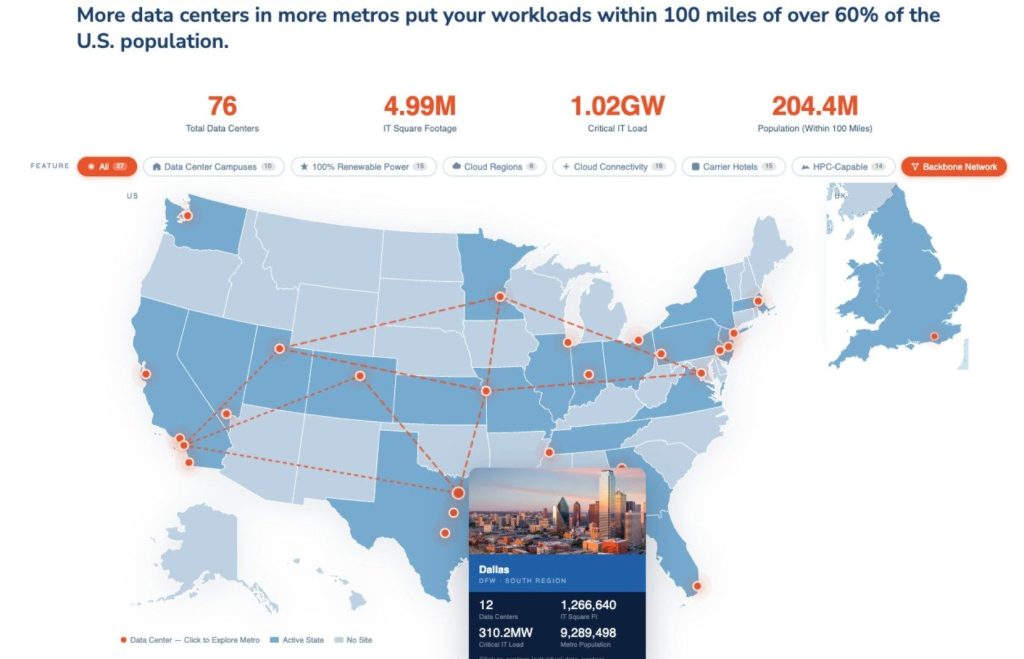
From the homepage, you can see DataBank’s footprint and the backbone network connecting sites. Select a city to open an interactive Google Map showing every DataBank data center or campus in that metro, making it easier to see where facilities are located and identify options in your target market.
Explore DataBank’s footprint and backbone network, find facilities by city, view site details, get directions, and request quotes — all from the interactive homepage map.
The map makes it easy to:
Explore locations by zooming in and out
Visit individual data center pages
Get driving directions
Request a quote
These options are available directly from the homepage map, so you can explore a market and take the next step without searching through multiple sections of the website.
It’s a faster path from exploring locations to finding detailed facility information and connecting with DataBank about your next deployment.
New Homepage: Get to Know the Team Behind the Technology
Our redesigned homepage brings more of DataBank’s people into view. In response to feedback requesting more video, we’ve added footage and images of DataBank team members, giving you a closer look at the people behind our services.
You’ll see new video footage at the top of the homepage featuring DataBank team members. We also plan to introduce a “Meet a DataBanker” feature, highlighting different team members through photos and videos and giving you a closer look at the people and culture that shape your DataBank experience.
Interactive 3D Diagrams: Explore a Data Hall Design That Fits Your Needs
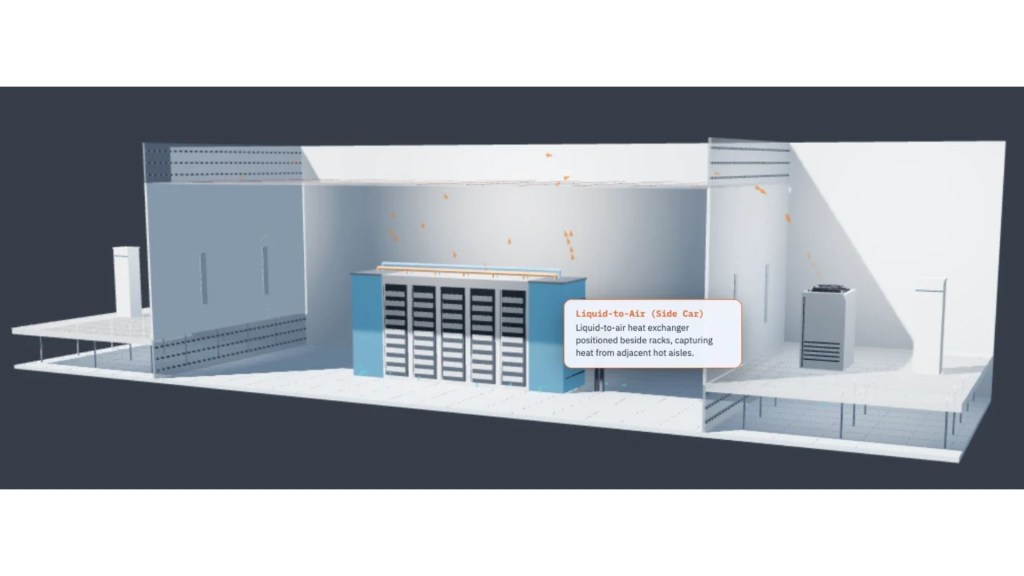
DataBank’s Universal Data Hall Design (UDHD) offers a flexible approach to configuring data center infrastructure around your requirements. Our redesigned homepage diagrams bring that flexibility to life with a 3D, interactive experience.
You can rotate the diagrams, zoom in for a closer look, and click through different configuration options to see how we power and cool even the most demanding workloads.
It’s a hands-on way to explore the possibilities and better understand how UDHD can support a data center build that works for you.
Data Center Evolved: Discover What Sets Your DataBank Experience Apart
Choosing a data center partner means looking beyond the facility itself. Our new Data Center Evolved section brings together eight factors that shape what you can expect from DataBank: our footprint, facilities, network, solutions, compliance, support, culture, and investors.
Accessible from the main menu and the rotating videos on the homepage, this section explores how we’ve evolved the data center experience around our customers’ needs. You can see all eight factors on a single page, making it easier to understand our approach and evaluate what matters most to your business.
Redesigned Metro and Data Center Pages: Get a Clearer View of Your Options
Within the Data Centers section, we’ve redesigned our metro and individual data center pages to make it easier to explore locations and find the information you need.
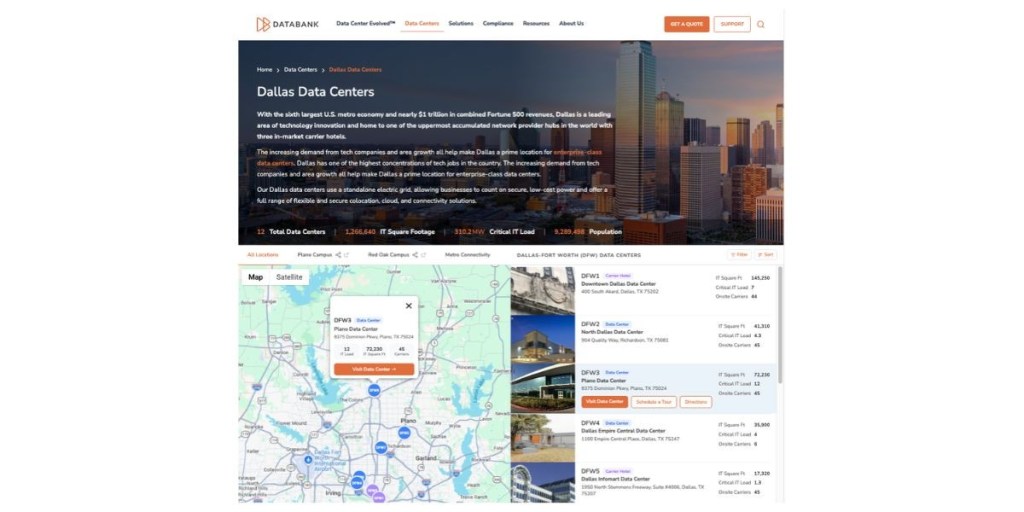
Each metro page now pairs an interactive Google Map on the left with a list of local data centers and their key specifications on the right. You can zoom in and out and click through to individual facilities, just as you can with the national map on the homepage.
Explore redesigned metro and data center pages with interactive maps, facility stats, photos, services, and certifications as well as convenient options for directions and tour requests.
Now you can select a data center listing to get driving directions, request a tour, or visit that facility’s dedicated page. There, you’ll find specifications, photos, videos, services, and compliance certifications together for an at-a-glance view of the location.
With locations and specifications together in one view, you can more easily compare facilities within a market and identify options that fit your requirements.
Updated Solutions Section: Find the Services and Tools You Need
Our redesigned Solutions section makes it easier to explore DataBank’s offerings and find information about the customer tools available to you.
An expanded portal subsection replaces the previous single Customer Portal page with dedicated pages for:
DataBank Customer Portal: Manage and monitor your DataBank infrastructure, submit support tickets, and access reports through a centralized portal to stay informed and in control of your services.
Platform DataBank Portal: Order and administer your cloud and bare metal services through a dedicated portal that brings infrastructure management and ordering together in one place.
DataBank Trust Center: Review compliance certifications, request security documentation, and explore DataBank’s security practices, policies, and controls to support compliance reviews and understand how we protect your data.
These pages help you understand what each portal offers and identify the right tool for the task at hand.
We’ve also grouped our Data Protection and Storage services into their own subsection, making it easier to explore options for protecting and storing your data.
Take a Look Around
We invite you to explore the new DataBank.com and hope you enjoy the updated experience. Whether you’re planning your next deployment or getting to know DataBank, we’re here to help you find what you need.
A hybrid or multicloud architecture can look reassuringly straightforward on a diagram. Connections link colocated infrastructure to cloud environments, redundant paths support resilience, and each component has a defined role. Then an application slows down, a routing change disrupts access, or a new connection takes weeks longer to activate than planned. For the business, that can mean interrupted customer transactions or a delayed service launch.
These are the moments when the operating model gets tested. Enterprise network engineers, cloud operations teams, and security teams each manage part of the environment, alongside colocation and connectivity providers. Each may understand its own responsibilities without having a complete picture of how the service behaves across organizational boundaries. When ownership is unclear, troubleshooting stalls and delays become harder to resolve.
A colocation, hybrid, or multicloud strategy, therefore, needs to account for operational handoffs: the points where one team or provider depends on another to move work forward. That might mean passing a provisioned connection to the cloud team for configuration, getting security approval for a routing change, or escalating an incident to a connectivity provider. Each handoff needs a clear owner and an agreed definition of completion.
Designing these handoffs alongside the network helps keep the environment manageable as it grows. This article explores practical ways to do that, from defining application requirements and traffic paths to sharing diagnostic evidence and testing recovery across teams.
Plan for Application Needs and Ownership
For an enterprise IT team deploying infrastructure in colocation, interconnection planning often starts with bandwidth and connectivity options. Those decisions should reflect the applications the connection will support. For example, a customer-facing application accessing a cloud-hosted database may be sensitive to latency, while an overnight backup transfer may depend more on having enough capacity to finish within its scheduled window.
Before ordering connectivity, agree on the performance targets and tests you’ll use to confirm the connection supports those applications. For the customer-facing application, that could mean testing response times from the colocated servers in the colocation facility under expected load. For the backup service, it could mean verifying that transfers finish on schedule without degrading other traffic. These checks give the team a practical way to determine whether the complete service is ready for use.
Next, map responsibilities across the connection. Depending on the service arrangement, the colocation provider might deliver the cross-connect, a connectivity provider might supply transport to the cloud, and the enterprise team might configure its own routers and cloud-side networking. Confirm those boundaries explicitly, including who validates each component and handles faults within it.
Assign an enterprise-side owner to coordinate delivery and end-to-end validation. If the cross-connect is complete but the cloud connection is still awaiting configuration, that person should know who needs to act and track the dependency through to resolution. The role can sit within an existing infrastructure or network team, provided it has clear escalation paths. This gives the business an accountable point of coordination while keeping each provider responsible for its contracted service.
Plan Traffic Paths and Access Rules
As an enterprise connects its colocation environment to additional clouds, routing changes can have unexpected effects. A backup connection may send traffic through a different firewall or a lower-capacity path. Document normal and failover paths and establish who approves changes. Test failover with application traffic to confirm that services remain reachable, and backup capacity is sufficient. Where firewalls are involved, verify that failover keeps both directions of traffic flowing through a firewall path that can maintain the connection
Apply the same discipline to access rules across the colocation and cloud environments. If an application in colocation needs access to a cloud-hosted database, specify which systems can connect and on which ports, then verify that each environment’s controls enforce that policy. Assign responsibility for reviewing exceptions and removing temporary access so permissions remain aligned with application needs as the environment changes.
Coordinate Visibility Across Providers
When an application slows down, an enterprise IT team may need evidence from several sources. The connectivity provider might report a healthy circuit between the colocation facility and the cloud, while the cloud team sees no platform incident. Neither finding rules out packet loss, congestion, or a problem with the application itself.
Before an incident, agree on how teams will investigate the connection from servers in the colocation facility to the affected cloud service:
Identify the traffic path. Record which connections the application uses and where responsibility passes between the enterprise and its providers.
Check recent changes. Keep routing and firewall change records accessible so investigators can compare them with the timing of performance problems.
Confirm available evidence. Determine which metrics each party can provide, such as interface utilization or packet loss, and where visibility is limited.
Set up information sharing. Establish escalation contacts and a secure way to exchange diagnostic records, including timestamps and affected endpoints.
Visibility will vary by provider and service. The goal is to give the enterprise team enough evidence to narrow the problem and coordinate the next action, without losing time finding contacts or requesting access during an outage.
Test Recovery Across Teams
Include operational handoffs in failover testing. For example, if the primary connection between the colocation facility and the cloud fails, can the enterprise team confirm that applications are using the backup path? If service remains impaired, does everyone know who leads the investigation and who can authorize changes?
Run that scenario with the relevant internal teams and providers where practical. Use the exercise to identify unclear responsibilities and update the recovery plan before an outage exposes those gaps.
Keep Operations Manageable as You Grow
A manageable colocation, hybrid, or multicloud strategy depends on clear responsibilities at every service boundary. Define what applications need, document traffic paths and access rules, and agree on how teams will share evidence when problems arise.
As connectivity expands, revisit those arrangements and test them alongside the technology. That preparation helps enterprise IT teams bring new services into operation with fewer avoidable delays and coordinate recovery more effectively when disruptions occur.
Want to learn more about connecting your colocation infrastructure to cloud environments and keeping your network ready for growth? Explore DataBank Digest for more insights on interconnection, network resilience, and hybrid IT strategy.
From Pearl River Day to the Little League fields, DataBank’s local involvement reflects a commitment to putting people first.
Being part of a community means more than operating a facility there. It means getting to know the people who live nearby, understanding what matters to them, and finding meaningful ways to contribute.
For DataBank, a recent opportunity to put that commitment into practice was Pearl River Day, where employees from our nearby LGA3 data center joined residents and local businesses for a day of conversation and community celebration.
Showing Up at Pearl River Day
Each fall, Pearl River Day brings approximately 25,000 people to Central Avenue to celebrate the businesses, organizations, and traditions that make the area special. With more than 200 businesses and vendors, food trucks, and live music, the festival gives neighbors a chance to connect — and businesses like DataBank a chance to introduce the people behind their local operations.
DataBank employees staffed a Pearl River Day booth to meet community members, answer questions, and build connections with local neighbors.
DataBank has been a premier sponsor of the festival for several years. This year, employees from our data center operations, construction, and sales teams also staffed a booth, spending the day meeting residents and introducing the people behind our local operations.
Despite cold, blustery weather, the team welcomed hundreds of visitors, answered questions, and handed out DataBank blankets, stadium cushions, and warm jackets that were particularly appreciated as temperatures dropped.
Alongside those giveaways, our employees distributed more than 150 copies of The Truth About Data Centers, providing a resource to help residents better understand these facilities, their role in everyday life, and important context needed in the public dialogue. Just as importantly, the booth created space for face-to-face conversations. Visitors could ask questions about DataBank and our local presence, while our employees had an opportunity to listen, learn, and get to know the people who live and work around LGA3.
That personal interaction matters, especially when development brings questions or concerns. A community festival offers something a website or project announcement cannot: an informal conversation with the people who work at a facility. Building trust takes time, and showing up is an important part of that work.
A Partnership Built Next Door
DataBank’s community connections also extend to the baseball fields neighboring our Orangeburg property. When work on the facility initially prompted concerns among local residents, conversations with Pearl River Little League representatives helped establish a relationship with an organization that has long been important to area families. Meeting league representatives during construction gave our team an opportunity to understand their needs and identify practical ways to help.
DataBank invested nearly $20,000 to help improve the dugout sheds and provide field lighting, contributing to facilities used by young athletes throughout the season. Our involvement has continued through approximately $5,000 in annual support for general sponsorship and student-athlete scholarships, helping sustain the partnership beyond that initial investment.
The relationship also includes a creative connection between the data center and the diamond: the “DataBank Dinger.” A poster on the facility gives players a home-run target, with qualifying home runs generating DataBank contributions toward scholarships. It adds excitement to the game while supporting opportunities for young people—a way to make the partnership both meaningful and memorable.
A Personal Connection to the Fields
For Ryan Buchan, a Junior Critical Infrastructure Engineer at LGA3, supporting Pearl River Little League is more than a workplace initiative. Ryan grew up in Orangeburg and played on these same fields. His father was also a dedicated league supporter and a member of its board, making the organization an important part of his family’s life. Today, Ryan works for a company helping care for the place where he once played.
Discover how DataBank supports Pearl River Little League through field improvements, sponsorships, and scholarships, and hear employee Ryan Buchan share his personal connection to the league.
“One of DataBank’s core values is ‘putting people first,’” Ryan says. “We want to be a positive influence on the community.”
For Ryan, that means supporting the people who live near the facility and contributing to the organizations that matter to them. Seeing DataBank help improve the fields where he played carries personal significance and connects his work today with his own childhood experiences. His story is also a reminder that the people working inside a data center can have deep roots in the surrounding area, with family histories and personal ties to the programs DataBank supports.
Continuing to Build Community Relationships
Pearl River Day and the Little League partnership put the same commitment into practice in different ways. One creates opportunities to meet residents, answer questions, and make our team accessible. The other supports an organization that brings families together and helps young athletes build confidence, learn teamwork, and make lasting memories. Both reflect the importance of listening and following through.
As DataBank continues its work in Orangeburg, we’ll keep looking for meaningful ways to support the people and programs that help the local community thrive.
Our recent food drive continued that commitment, bringing DataBankers together to support hunger relief in the communities we call home. Through hands-on volunteering, local food donations, and an Amazon wish list that let employees contribute from wherever they work, DataBankers supported a shared goal: helping our neighbors put food on the table.
Denver Volunteers Make a Hands-On Impact
Our Denver Metro team took a hands-on approach to hunger relief by volunteering at the Food Bank of the Rockies.
Employees volunteered their time sorting and packing food boxes for distribution to the community. During their shift, the team helped move 508 boxes containing 12,620 pounds of food — the equivalent of 10,516 meals.
Sorting and packing are essential steps in getting donated food to the people who need it. By taking on that work together, our Denver team helped the Food Bank of the Rockies get thousands of meals ready for local families.
Doubling Down on Giving in Dallas
Our Dallas Metro team built on last year’s food drive in a big way, collecting more than twice as much food.
The team delivered 440 pounds of food, representing 337 meals, to the North Texas Food Bank. The increase highlights how individual donations can add up to meaningful support our neighbors.
Participation also reached beyond the Dallas team. Through an Amazon wish list, employees across DataBank could purchase food and have it shipped directly to our Dallas headquarters. This gave DataBankers in other locations a straightforward way to join the effort and support hunger relief in the Dallas community.
Part of an Ongoing Commitment
The food drive is one of many ways DataBank Cares puts our commitment to our communities into action. Throughout the year, employees have opportunities to contribute their time and resources to causes that matter in the places where we live and work.
This year’s effort showed how different forms of participation can support a common goal. From packing food boxes in Denver to collecting donations in Dallas and contributing through the Amazon wish list, DataBankers helped provide food for neighbors facing hunger.
Thank you to everyone who volunteered, donated, or helped organize the drive. Your generosity made this effort possible and continues to shape a culture of giving back at DataBank.
This article continues our series on the facts shaping the debate around data centers and the grid. If you would like to follow the full discussion, you can read parts one, two, three, and four, or download The Truth About Data Centers for a more complete view of the topics covered so far.
Data centers have become an easy symbol for a power system under strain. They are large, visible, and many are tied to AI, which makes them a natural target in a public debate about electricity demand. Yet, the pressure showing up across the grid did not begin with data centers, and it will not be resolved by treating them as the main cause of the problem.
The bigger issue is structural. Much of the grid was planned for an era of slower load growth, more centralized generation, and fewer competing demands on the system. That planning model is now colliding with a very different economy, one shaped by online interactions, electric vehicles, building electrification, growth in domestic manufacturing, and a shift from traditional power plants toward a larger share of wind, solar, and battery storage. In that environment, the limiting factor is increasingly the network itself, especially transmission.
This is why the current conversation needs more context. The question is no longer simply how much electricity the economy will need. The harder question is whether the system can move power to the places where demand is rising, connect new loads and new generation fast enough, and do so with infrastructure that in many regions is already aging or congested.
A data center announcement is easy to see. A decade of underbuilt transmission is not.
Transmission Is Where Grid Stress Becomes Visible
That challenge is showing up across the country. Utilities are extending timelines for large new power connections. Developers are waiting years for transmission upgrades, new substations, and other system work needed before a project can be served reliably. Grid operators are also dealing with long backlogs of proposed power plants and battery projects that are waiting for approval to connect to the system.
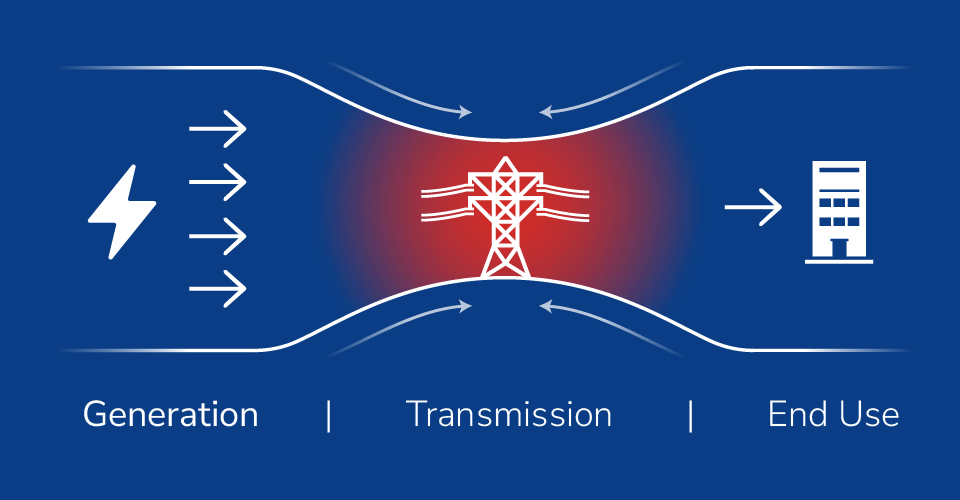
The real grid challenge is not only adding power, but expanding transmission so electricity can reach where growth is happening.
According to Lawrence Berkeley National Laboratory, interconnection queues in the United States now contain more than 2 terawatts of generation and storage capacity. That number reflects how much planned supply is waiting on grid readiness rather than market interest alone. The issue is often less about whether new projects exist than whether the system can accommodate them.
Transmission sits at the center of this problem. High-voltage lines move electricity from where it is produced to where it is needed, whether that means carrying wind power from remote areas to population centers or serving fast-growing regions with rising commercial and residential demand. When transmission capacity falls behind, the effects show up quickly. Congestion increases, project timelines stretch, reliability margins tighten, and costs rise as utilities are forced into more expensive fixes.
Part of the challenge is geography, but that is only one piece of it. The transmission system was largely built around older patterns of generation and demand. Many of today’s fastest-growing sources of electricity, especially wind and solar, are being added in places far from major load centers. At the same time, demand is rising in regions shaped by population growth, manufacturing investment, digital infrastructure expansion, and transportation electrification.
The infrastructure itself also takes a long time to expand. New transmission lines can take years to permit and build. Substations and transformers are expensive, specialized, and often in short supply. Local opposition can slow projects. So can the difficulty of coordinating approvals across utilities, regulators, landowners, and in some cases multiple states. Even when everyone agrees new capacity is needed, adding it is rarely quick.
That is why transmission has become such a critical pressure point. The grid needs more than enough generation on paper. It needs the physical network required to deliver that power where growth is happening.
Electrification Is Expanding Demand from Every Direction
The economic shift now underway is making existing grid constraints harder to ignore. Electric vehicle adoption is beginning to reshape both total electricity consumption and local demand patterns. Residential charging, fleet depots, and highway fast-charging all place new demands on local distribution systems.
Those changes also add up at the regional level. As EV adoption grows, utilities have to plan for more electricity demand, different daily load patterns, and new infrastructure in places that were not built for it. With gasoline and diesel prices remaining elevated in 2026, that shift may accelerate as more drivers and fleet operators look for alternatives.
Building electrification adds another layer of pressure as heat pumps, water heaters, and other electric appliances shift energy use away from fossil fuels and onto the grid. Manufacturing is doing the same in some regions, as companies expand domestic production and pursue lower-emissions operations. In many cases, that new demand is showing up in areas where transmission capacity was already tight.
Data centers belong in that mix, but they are one category of large load seeking access to a system with limited spare capacity in many places. Their growth is significant, particularly in concentrated markets such as Northern Virginia, Texas, and parts of the West. Goldman Sachs has projected that global power demand from data centers could increase by 50 percent by 2027 and by as much as 165 percent by the end of the decade. Those numbers deserve serious attention, especially for utilities and regional planners.
They also point to a larger reality: Data center growth is happening alongside a much wider expansion in electric demand across transportation, buildings, and industry.
Years of Deferred Grid Investment Is Catching Up
Another important part of this story is deferred investment. Transmission projects take years to permit, approve, and build. So do substation expansions, transformer replacements, and many other core upgrades. In periods of relatively modest demand growth, it was possible to delay some of that work.
Today, the cost of that delay is becoming visible. The American Society of Civil Engineers has repeatedly warned that much of the nation’s energy infrastructure is aging and in need of modernization, and utilities across multiple regions have reported that lead times for major electrical equipment have stretched sharply in recent years. A grid that was once managed through incremental upgrades is now facing simultaneous pressure from new loads, changing generation patterns, and equipment constraints.
This is one reason the public discussion can become misleading. A data center announcement is easy to see. A decade of underbuilt transmission is not. A new large customer can be tied to a location and a megawatt figure. The planning assumptions that failed to anticipate overlapping growth from EVs, electrified buildings, domestic manufacturing, and digital infrastructure are harder to see, even though they sit much closer to the heart of the problem.
What the Grid Debate Should Focus on Now
A more useful way to frame the issue is to ask what kind of grid a more electric economy requires. The answer begins with transmission, but it does not end there. It includes faster processes for connecting new generation and large loads, better regional planning, modernization of substations and local delivery networks, and a regulatory framework that supports investment before constraints become urgent.
The pressure on the grid is real, and so is the growth in data center demand. Focusing too narrowly on data centers reduces a much larger infrastructure challenge to a single category of customer. The more important question is whether the grid can keep pace with an economy that is becoming more electric, more digital, and more dependent on reliable power delivery across every sector.
Transmission is at the center of that challenge, but the larger issue is grid readiness. That is the work in front of utilities, regulators, developers, and large power users alike.
Looking for clearer perspective on the issues driving the data center debate? DataBank Digest brings you analysis, insights, and the latest developments across digital infrastructure, energy, and growth.
At DataBank, we believe community investment is most meaningful when it helps create lasting local impact. That is why we were proud to support the George Washington Carver Agriculture Research Center and its work to expand the Carver Food Enterprise Center in Culpeper, Virginia.
Founded in 2014, the George Washington Carver Agriculture Research Center (GWCARC) works to sustain, strengthen, and enhance agriculture and the environment in Virginia’s Northern Piedmont. Based at the historic George Washington Carver Center in Rapidan, the organization serves a five-county region through initiatives focused on agriculture, food security, workforce development, and research.
One of those initiatives is the Carver Food Enterprise Center (CFEC), a shared-use commercial kitchen and food business incubator created to strengthen the local food system. What began as a simple idea — giving local growers, food producers, and entrepreneurs a place to preserve, process, and create — grew over the course of eight years into a community-supported facility with the potential to make a lasting regional impact.
“This project will help expand opportunities for local farmers and food entrepreneurs while strengthening food access and support for schools across our region. We are deeply grateful to DataBank for its support and for helping encourage additional community investment at a critical time.”
— Gretchen Ledmor, Executive Director of the George Washington Carver Agriculture Research Center
Since opening the Carver Food Enterprise Center in 2023, the organization has:
Helped launch 36 new businesses and 133 new products
Supported the creation of 129 jobs and provided workforce training to 548 participants
Rescued more than 9,470 pounds of food, transforming it into 26,949 servings for the community
Produced approximately 8,000 Farm to School meals
These outcomes demonstrate the Center’s growing role as a driver of entrepreneurship, workforce development, food access, and regional agricultural resilience.
Strengthening Local Agriculture and Food Access
Today, the Carver Food Enterprise Center provides affordable, certified kitchen space, equipment, technical assistance, job skills training, and food processing support for farmers, food entrepreneurs, and community partners across Culpeper, Fauquier, Madison, Orange, and Rappahannock Counties.
Its work also helps address food insecurity by turning rescued produce into healthy meals for food pantries and hunger relief organizations, while supporting workforce development and value-added processing for local agriculture.
When the George Washington Carver Agriculture Research Center reached out to share that the Carver Food Enterprise Center expansion still faced a funding gap, we were glad to help. The project had already built strong momentum through federal support, local partnership, and community backing, and this final push represented a meaningful opportunity to help move an important regional resource closer to completion.
Our contribution supported the next phase of the Carver Food Enterprise Center’s expansion, part of a larger $1.2 million USDA Regional Food Systems Infrastructure initiative. This expansion will increase the Center’s ability to support local farms, food entrepreneurs, regional food manufacturing, and community-based programs such as Farm to School and Feeding 500.
“This project will help expand opportunities for local farmers and food entrepreneurs while strengthening food access and support for schools across our region,” said Gretchen Ledmor, Executive Director of the George Washington Carver Agriculture Research Center. “We are deeply grateful to DataBank for its support and for helping encourage additional community investment at a critical time.”
Expanding Impact Through Partnership
What made this opportunity especially meaningful was the collaboration behind it. In response to the project’s remaining funding gap, DataBank made a contribution and also helped encourage support from construction partners AE Comm/Tishman and Service Point. Together, those commitments helped build momentum for the next phase of the Carver Food Enterprise Center expansion.
That kind of partnership matters. Projects like the Carver Food Enterprise Center depend on organizations, local leaders, and businesses working together around a shared purpose. By helping bring additional supporters to the table, this effort shows how community investment can create momentum beyond a single contribution.
The Carver Food Enterprise Center is a long-term community asset designed to create opportunity, strengthen local supply chains, support schools and families, and build a more resilient regional food system.
Part of Our Commitment to Culpeper
Supporting the Carver Food Enterprise Center is one example of DataBank’s ongoing commitment to Culpeper and the surrounding community. As our presence in the region has grown, so has our focus on creating positive local impact beyond our core business operations.
That commitment includes helping create economic opportunity and workforce pathways in the area. Through our work in Culpeper, we have highlighted the ways data center investment can support job creation, career development, and long-term economic growth. We have also shared how strong local partnerships can help communities benefit from infrastructure investment in practical, lasting ways.
Our support for organizations and initiatives in Culpeper reflects that same mindset: Investing in projects that strengthen the community, expand opportunity, and create durable value for the future.
At DataBank, we are honored to support organizations like the George Washington Carver Agriculture Research Center that are building practical, lasting solutions in the communities they serve. We look forward to seeing the continued impact of the Carver Food Enterprise Center for years to come.
This is the fourth article in a series exploring the facts behind the data center debate. You can read parts one, two, and three, or download our full eBook, The Truth About Data Centers, for a closer look at the issues covered in this series.
Water consumption is one of the most emotionally charged concerns raised about data centers today, and it’s one of the most misunderstood. A single statistic can circulate for months before anyone checks where it came from, and by then it may have already shaped local debates and headlines.
The picture looks very different once you look at how these figures actually get built.
Cooling Isn’t One Thing
Lumping every data center into the same water conversation is where most confusion starts. There are three completely different approaches to cooling, and each comes with its own tradeoffs.
Air-based cooling uses no water at all, relying entirely on traditional air conditioning. It’s common in older and smaller facilities, although it becomes less practical as computing density rises.
Evaporative cooling trades water for efficiency. It’s a continuous process: Water goes in and doesn’t come back, and many large legacy facilities run this way because the energy savings are real.
Closed-loop cooling sidesteps that tradeoff entirely. Water (or in some systems, a glycol-based fluid) circulates inside a sealed system rather than getting released, so once the system is charged, ongoing consumption approaches zero.
That distinction is measured through Water Usage Effectiveness, or WUE, the industry’s standard for tracking how much water a facility uses relative to its size and output. DataBank’s standard facility design runs on closed-loop cooling, so new builds start service with a near-zero water footprint from day one, not something the facility works toward over time.
The inflated version counted water lost to evaporation at hydroelectric reservoirs as part of a data center’s footprint, water that evaporates off dammed rivers regardless of who’s drawing power from the dam. It’s a bit like arguing that a retail store uses water every time its cash register rings up a sale, since generating the electricity behind that transaction required water somewhere upstream.
Strip that out and the numbers change dramatically: Masley’s corrected estimate for onsite water use lands around 2.2 milliliters per prompt across the U.S. grid, or about 1/227th of a standard bottle. It’s the same underlying data, but just with a different definition of what actually counts as data center water use.
Real Numbers, Real Context
Compare data center water use against everyday consumption and even the larger figures shrink fast.
A less-discussed piece of this story is the power behind the water. Fossil fuel generation is water-intensive; yet, wind and solar are not. As the grid shifts toward renewables, a data center’s indirect water footprint shrinks along with its carbon footprint, even before accounting for cooling design. That’s a benefit that rarely makes it into the figures critics cite, even though it compounds every year renewable capacity grows.
Drought-prone communities are right to ask hard questions here, and those concerns reasonably extend beyond onsite cooling to the water used generating the electricity in the first place. The honest answer is that the industry isn’t moving at a uniform pace, which is exactly why specifics matter more than pledges.
The Bottom Line
Water figures that sound alarming often turn out to be measuring the wrong thing, not the wrong facility. Once the boundaries get examined, a modern, closed-loop data center tends to look a lot more like an office building than an industrial plant.
Data centers are essential infrastructure, and concerns about their footprint deserve real answers, not headlines that never checked their own math.
Want to stay ahead of the trends shaping digital infrastructure? DataBank Digest delivers analysis, insights, and the latest news from the world of colocation and digital infrastructure.
Network latency has quietly shifted from an operational metric to a strategic risk. For years, IT teams measured performance almost entirely in uptime, watching for outages, tracking service level agreements, and treating five nines on a dashboard as proof the network was doing its job. That measure is no longer sufficient. A network can be fully available and still be costing the business money every day, one slow response at a time.
That cost has a name: latency. It is the delay between a request and a response, and it rarely announces itself as a failure. Instead, it shows up as a checkout page that loads a second too slowly, a trading algorithm that reacts a few milliseconds too late, or a fraud detection system that flags a transaction after the damage is done.
These delays are easy to overlook because nothing technically breaks. They are also easy to underestimate, because the cost accumulates across thousands of small moments rather than one visible incident, which is exactly what makes it dangerous for leaders who are only watching uptime.
Where Latency Actually Comes From
Latency rarely comes from a single failure point. It accumulates anywhere data travels farther or through more steps than necessary, and most networks have several of these points built in without anyone noticing.
Public internet routing is the most common source. Traffic moving across the open internet takes an indirect path by design, hopping between networks before reaching its destination. Each hop adds delay, and each additional network in the path becomes a place where congestion or packet loss can slow things down further. The internet was built for resilience, not speed, and that tradeoff shows up as latency.
Physical distance compounds the problem. A request traveling from a data center on one coast to a cloud region on the other carries transmission time that no amount of software optimization can fully remove. Layer in the number of applications, APIs, and third-party services most businesses now depend on, and it becomes clear why latency compounds quickly across a modern technology stack, often in ways that are difficult to trace back to a single cause.
Why This Matters More Than It Used To
A decade ago, a little extra latency was a tolerable inconvenience, something IT teams optimized around when time allowed. That tolerance has disappeared. Across nearly every industry, latency has become a measurable competitive disadvantage, and the businesses that treat it as a minor technical detail are absorbing costs their competitors have already engineered away.
Financial services. Firms build entire infrastructure strategies around shaving microseconds off trade execution, because in that industry, microsecond translate directly into dollars.
Retail. A slower checkout experience leads to more abandoned carts and lower conversion rates.
Healthcare. Fast, reliable data exchange matters for systems where delay is not just inconvenient but potentially harmful.
AI workloads. Training large models and running real time inference both depend on moving enormous volumes of data quickly and predictably. When the network cannot keep pace, businesses either accept degraded performance or delay the AI initiatives they were counting on to drive growth.
None of this is hypothetical. Across these industries, the cost of latency shows up in lost revenue, lower conversion rates, and missed opportunities, and it rarely arrives with a clear root cause attached. That is what makes it dangerous. The businesses that get ahead of it are the ones actively looking for it, rather than waiting for it to show up on a balance sheet.
Interconnections Change the Equation
Interconnections solve the latency problem by giving data a more direct route instead of relying on the public internet to move information between applications, clouds, and partners. A few core approaches make this possible.
Cross connects. A direct, dedicated link inside a data center connects two networks directly, often reducing what would be a multi-hop journey to a single, predictable connection.
Direct cloud on-ramps. Rather than sending traffic out to the public internet to reach a cloud provider, a private connection carries that traffic straight to the cloud environment. The result is lower latency, more consistent performance, and fewer variables that can introduce delay.
Internet exchanges. Networks peer directly with each other, cutting out the transit providers that would otherwise sit in the middle of every exchange.
Together, these approaches replace an unpredictable, multi-hop path with a shorter, more direct one.
What This Looks Like in Practice
Consider a mid-size fintech firm running algorithmic trading systems. Every millisecond of delay between its systems and the exchanges it trades on represents a measurable financial risk, one that shows up directly in execution quality rather than as an abstract performance metric.
By colocating its infrastructure in a facility with direct, low latency connections to major exchanges, the firm removes the unpredictable variable of public internet routing entirely. Trades execute faster, risk models run closer to real time, and infrastructure costs become more predictable, since the firm is no longer paying for the inefficiencies of a longer network path or absorbing the cost of unplanned volatility in its connection quality.
That advantage compounds when the firm’s own infrastructure sits inside the same facility as its network provider. The connection is not just faster, it is also physically protected by the same power redundancy, cooling systems, and access controls that safeguard the network equipment itself. A firm relying on a remote connection back to its infrastructure is exposed to a failure at either end. A firm colocated alongside its provider closes that gap.
The underlying principle extends well past financial services. Any organization moving data between clouds, partners, or physical locations at meaningful volume is running the same risk calculation, even if the consequences are less immediately visible than a missed trade. A retailer’s fraud check, a healthcare system’s record exchange, and a manufacturer’s supply chain data feed all depend on the same fundamentals: shorter paths, fewer hops, and fewer variables outside the organization’s control.
The businesses that recognize this early are the ones designing their infrastructure around it, rather than discovering the cost after the fact.
The Real Return on Interconnections
Latency is often invisible until someone quantifies it, and by then the cost has usually already accumulated. The businesses that get ahead of the problem are the ones that treat connectivity as a strategic decision rather than an afterthought. Interconnections offer a proven way to shorten the distance between systems that need to talk to each other quickly, reliably, and without the unpredictability of the open internet.
The hidden cost of latency is real, but it does not have to be permanent. With the right interconnection strategy in place, it becomes a cost businesses simply stop paying.
Want to learn more about how DataBank’s interconnection ecosystem can help reduce latency across your network? Visit our Interconnections page or explore DataBank Digest for more insights on network performance and infrastructure strategy.