With data centers increasingly in the headlines, it can be easy to assume they are all enormous facilities with extraordinary power demands. Coverage of large AI developments can reinforce that impression, but data centers also support the systems hospitals use to care for patients and the applications businesses rely on to operate.
Demand for this infrastructure was growing well before ChatGPT brought generative AI into the public spotlight in 2022. Today’s facilities serve different purposes, from housing equipment for regional businesses to training large AI models. Understanding those differences helps people make sense of the headlines and evaluate what a proposed facility could mean for their community.
The following sections explain the different types of data centers and offer examples of the work they support.
Multi-Tenant Colocation Data Center
Multi-tenant colocation is the model DataBank operates. In this shared environment, multiple organizations house their servers and networking equipment in a facility managed by a colocation provider. The provider supplies the power and cooling systems, along with physical security and digital security frames while customers generally manage their own equipment.
For businesses, colocation offers access to professionally managed infrastructure without the cost and complexity of building a dedicated data center. Customers lease space and power capacity that fit their requirements, with options to expand as their needs grow. This model serves organizations ranging from regional businesses to global enterprises.
Example:A colocation facility might house infrastructure for dozens of customers, including a regional bank running transaction systems and a healthcare organization supporting patient care applications. Each customer manages its equipment in designated space. The provider operates the facility and may offer connectivity services and on-site technical assistance, such as replacing a component.
Edge Data Center
An edge data center places computing infrastructure close to the people or systems it serves. These facilities are typically smaller and help reduce latency, the delay as data travels between locations. They can support applications that need a fast response.
Location is central to this model. Edge facilities can extend a provider’s computing footprint into areas where users would otherwise rely on more distant infrastructure.
Example:An edge facility located near a cell tower can bring computing capacity closer to mobile users. By processing certain workloads nearby instead of sending data to a distant facility, it can help improve response times for applications such as interactive gaming.
Enterprise Data Center
An enterprise data center is a private facility owned and operated by one organization to support its computing needs. It may be located on the company’s campus or at a separate site. These facilities may be less visible to the public when they are part of an existing corporate campus rather than a standalone development.
This model gives a company direct control over its infrastructure, along with responsibility for keeping it operating reliably. An enterprise data center can also be part of a larger technology strategy, with some systems housed internally and other workloads supported through colocation or cloud services.
Example:A large manufacturer might operate a data center on its campus to support engineering applications and production management systems. Its technology team maintains the equipment and plans capacity around the company’s needs, helping keep essential systems available as employees design products and oversee production.
Cloud Data Center
A cloud data center houses the physical infrastructure used to deliver computing services over the internet. Customers access resources such as storage or processing capacity without owning the underlying hardware, typically paying based on usage. Amazon Web Services, Microsoft Azure, and Google Cloud are well-known providers.
“Cloud” describes how customers access computing resources, while “hyperscale” (discussed next) describes the scale of the infrastructure supporting them. A cloud provider may operate large hyperscale campuses or lease space in colocation facilities. Although customers access the services remotely, they still depend on physical equipment housed in data centers.
Example:An online retailer preparing for a holiday shopping surge can use cloud services to increase computing capacity as traffic rises, then reduce it when demand falls. The cloud provider manages the underlying hardware, allowing the retailer to handle seasonal demand without purchasing and maintaining additional servers.
Hyperscale Data Center
A hyperscale data center supports computing operations at very large scale. Companies such as Amazon, Google, Microsoft, and Meta develop these facilities to support services used by millions of people. They may deliver cloud computing to business customers or power the company’s own platforms, such as search engines and social networks.
Hyperscale facilities are designed to accommodate enormous computing demands and expand as those demands grow. A campus may include multiple buildings developed in phases. Their substantial electricity requirements and physical size often attract public attention, although individual projects differ in design and resource use.
Example:A technology company might develop a multi-building campus to support its video streaming platform. As more people use the service, the company can add computing capacity to process and deliver video. The campus provides infrastructure for a global audience, rather than primarily serving businesses in the surrounding region.
AI Data Center
Large AI data center projects have attracted considerable attention, and their size and power demands can shape what people picture when they hear “data center.” Some of the most prominent developments support major technology companies training large language models, or LLMs, that power generative AI tools.
These facilities use specialized processors, often graphics processing units, or GPUs, to perform enormous numbers of calculations. Training a large model can require thousands of processors working together on extensive datasets. Concentrating that equipment creates high electricity demand and considerable heat, often requiring advanced cooling systems such as liquid cooling.
AI facilities also support running trained models, which can have different infrastructure requirements. These workloads may operate in dedicated facilities or colocation environments, so the scale and resource needs of an AI deployment depend on the work it performs.
Example:A major technology company might develop a dedicated AI facility to train its next large language model. Thousands of interconnected GPUs process training data, supported by high-capacity electrical systems and liquid cooling. This computing-intensive work requires a different infrastructure design than a facility primarily supporting everyday business applications.
Looking Beyond the Label
Data centers support everything from patient care to the development of new AI models. The largest projects may dominate the headlines, but they do not represent every facility or the work it performs.
For anyone evaluating a proposed development, the useful questions concern the project itself: What will it support? How much power and water will it require? How will it fit into its surroundings? Looking at those specifics helps communities weigh potential benefits and concerns with a clearer understanding of what is being proposed.
Want to better understand the different types of data centers and the work they support?DataBank Digestbrings you analysis, insights, and the latest developments across digital infrastructure, energy, and growth.
Leadership development looks different depending on where you sit at DataBank. In construction, a mistake shows up in steel and concrete or on a deadline that will not move. In security, a mistake shows up in trust, in the confidential information customers hand over the moment they sign a contract. Different stakes, different daily pressures, and we feel both every day.
A few convictions show up again and again, whichever side of the business you’re on. In this article, we bring together perspectives from both sides to share the strategies and best practices that hold up across DataBank.
Prove It Before You Get the Title
The instinct in most organizations is to hand someone authority first and see what they do with it. We tend to run it the other way.
When a new team function grows from one person to four, and two candidates have equal standing, the answer is not a coin flip and it is not a title. It is six months of informal, shared leadership, with both people told plainly that one of them will end up running the group and the process itself will make it obvious who. Leading without authority is harder than leading with it, and asking someone to prove they can do the harder version first tends to produce a leader people actually want to follow, rather than one they are told to.
The same instinct shows up as patience elsewhere in the business. High potential is not something we spot in a single strong quarter. It takes time, and it takes more than one person’s opinion. A leader who is only impressing the person one level up, while treating peers poorly, is not showing high potential.
That’s something else entirely, and multiple perspectives are what surface the difference. Once a handful of people independently point to the same specific instances of strong judgment or capability, we consider that worth investing in. A gut feeling from one manager is not.
There is No One-Size-Fits-All Development Path
Most career ladders are built in fixed steps: analyst to manager to senior manager, in that order, whether or not the person climbing it actually wants what is waiting at the top. We start from a different question: what does this specific person want, and why?
That means pushing back gently when someone asks for the “logical next step.” Wanting authority is not, by itself, a reason to grant it. The better question is why someone wants the promotion in the first place. A strong individual contributor and a strong manager are frequently not the same skill set, and pushing someone into people-leadership because he or she excelled technically can be a set-up for failure.
It also means learning how each person actually receives feedback before delivering it. The same words, the same tone, land completely differently depending on who is hearing them. Two children raised in the same house, given the exact same sentence, can walk away with two different reactions.
A lot of that comes from raising many children (a total of seven from both executives), and a fair amount from Ted Lasso. Both taught us that you can’t lead everyone the same way and expect the same result. Knowing someone well enough to choose the right words is not a soft skill. It is what makes the rest of coaching possible.
Feedback Is a Question, not a Verdict
We don’t describe our harder conversations as confrontations. We describe them as questions and opportunities to learn and grow together.
Instead of opening with, “You did this wrong,” the more useful opening is, “Do you think we got the result we wanted?” That single question does two things at once: It tells us whether the gap was a skills problem or a communication problem, and it gives the other person room to arrive at the answer rather than defend against it.
One discovery we’ve made through exactly this kind of question is that a missed expectation isn’t always a performance issue. Sometimes it’s a failure to define what success looked like in the first place, which means the fix is a clearer conversation, not a disciplinary one.
Bad news doesn’t improve with time. If a piece of feedback is landing for the first time in a formal performance review, that review has already failed, which is a sign of poor leadership. The fix is small, frequent course correction, delivered as soon as the gap appears, framed around what support is needed rather than what went wrong.
Conflict itself isn’t the problem. Different perspectives are how we learn from each other. It only becomes a problem when it turns personal or chaotic, and that’s when a good leader steps in — not before.
Why the Stakes Shape the Approach
The two sides of our business feel this differently, and that difference is worth naming rather than smoothing over.
On the construction side, the pressure is external and immediate: a labor market stretched thin across general contractors and subcontractors, where people are routinely poached on compensation alone. Our counter to that isn’t matching every offer. It’s building loyalty that survives a competing offer, the kind where people choose to follow a leader they trust rather than stay for a transaction. Autonomy, real investment in someone’s goals, and a workplace people want to recommend to a friend all compound in a way a signing bonus doesn’t.
On the security side, the pressure is about trust. We hold information most people never see, and data centers themselves are increasingly viewed with suspicion by the communities around them. That makes integrity part of the leadership pipeline itself. Identifying high potential isn’t just about capability. It’s about whether someone will handle what they’re trusted with the way they say they will, in public and in private.
While the risks are different, the stakes are still the same: Will this person do right by what he has been given, whether that’s a team, a timeline, or a customer’s trust?
Different Hats, Same Habits
Strip away the hard hats and the security clearances, and the same three habits carry both sides of our business: earn the role before you’re handed it, build a development path around the individual instead of the ladder, and give feedback the moment it’s needed instead of saving it for a form. None of that is unique to data centers. What’s unique is how much is riding on getting it right, and it’s something we take seriously across the board.
Want to learn more about how DataBank’s leaders build and grow strong teams across the business? Visit our Leadership page or explore DataBank Digest for more insights on talent development and management strategies.
There’s a lot of talk these days about AI, cloud growth, and the future of digital infrastructure. The reality beneath all of it is something much more physical: data centers. Keeping those data centers running requires a workforce of skilled tradespeople and technicians who rarely make the headlines.
That’s why I believe we’re in the middle of a blue-collar gold rush.
As the data center industry grows, so does the demand for electricians, HVAC technicians, mechanics, facilities engineers, controls specialists, and other critical operations talent. In many of our high-growth markets, that demand is outpacing supply — and it’s changing the way we think about recruiting.
The reality is, this talent is in high demand everywhere. We’re not just competing with other data center companies. We’re competing with manufacturing, energy, semiconductor fabrication, telecom, and other industries attempting to hire from the same skilled labor pool.
The reality is, this talent is in high demand everywhere. According to a 2025 Deloitte survey, 63% of data center executives cite a shortage of skilled labor as their single biggest obstacle to securing talent. We’re not just competing with other data center companies. We’re competing with manufacturing, energy, semiconductor fabrication, telecom, and other industries attempting to hire from the same skilled labor pool.
So how are we responding?
First, we’ve had to widen the lens on where talent comes from. Great data center talent doesn’t always come from data centers. Some of the best candidates have transferable experience from adjacent industries — including military service — and bring the technical skills, discipline, and problem-solving ability needed to succeed in mission-critical environments.
Second, we’re spending more time building relationships before roles open. In fast-growth markets, reactive hiring isn’t enough. We’re investing in talent pipelines, workforce partnerships, and stronger connections with trade schools, technical programs, and local communities.
Our Critical Facility Manager there made a direct case for the economics: A student who joins the International Brotherhood of Electrical Workers (IBEW), completes trade training, and enters the workforce in four years can come out earning close to six figures, often with better long-term stability than a peer who spent the same four years accumulating college debt.
In Culpeper, Virginia, we partnered with the local career and technical education school, which happens to sit directly across the street from our data centers currently under construction. Over two days, 40 electrical students experienced the full arc of a data center career — from their own lab model of a data hall, to a live construction site, to a fully operational facility in Ashburn — hearing directly from construction managers and technicians about how their training maps to real careers. That kind of experience doesn’t come from a job posting.
Ultimately, these programs are a long-term investment in the workforce this industry will require.
The Stakes Are Real
The scale of what’s coming makes this more than a long-term investment. It’s an immediate operational priority. DataBank’s construction leadership has noted that peak crew sizes on major data center builds have grown from roughly 750 workers to 4,000 or more on a single campus. The second half of 2026 into 2027 will see massive capacity activation across the country, and the industry simply doesn’t have enough qualified workers to meet that demand.
The operators who secure skilled labor now, through early contractor commitments, trade school partnerships, and creative workforce strategies, will have significant advantages over those waiting until projects break ground.
Telling a Better Story
Just as importantly, we’re focused on telling a better story about these careers.
For too long, skilled trades have been overlooked in conversations about the future of work. These are high-impact, well-paying, highly technical roles with real long-term opportunity. In many ways, they are some of the most future-proof careers out there.
What’s happening in data centers is bigger than a hiring challenge. It’s a shift in how we value skilled labor and infrastructure talent. The companies that recognize that — and act on it — will be in the best position to grow.
Because at the end of the day, the future of digital infrastructure depends on the people who build it, power it, and keep it running.
This is the second in a series of articles exploring the facts behind the data center debate. Read part one here, and download our full eBook, The Truth About Data Centers, for a deeper look at the issues covered in this series.
Data centers are in the news for reasons that make a lot of people uncomfortable. New facilities are appearing in communities that weren’t expecting them. Electricity bills are rising. Questions about water use, noise, and neighborhood impact are real and deserve straight answers.
These are legitimate concerns, and DataBank is committed to addressing them directly rather than letting the debate outpace the facts.
Your Day Is Already Running on This Infrastructure
Most people think of essential infrastructure as the things they can see: power lines, water towers, roads and bridges. Data centers belong in that same category but they’re invisible by design. What powers your phone, your bank app, and your streaming service is a building full of servers running somewhere, around the clock, every day of the year.
Think about a typical day. Your alarm goes off, you check the weather, scan your email, and order coffee through an app on your way out the door. Every one of those interactions touches a data center. So does the navigation that reroutes your commute, the video call you join at the office, the prescription your pharmacy fills automatically, and the news alert that arrives while you’re making dinner.
By the time you fall asleep, you’ve touched data center infrastructure thousands of times. This is the infrastructure required for modern life as we all know it, and stepping away from it, even for a day, isn’t really an option anymore.
Download our full eBook, The Truth About Data Centers, for a deeper look at the facts behind the concerns communities are raising.
What 24 Hours Without Them Would Look Like
Data centers aren’t a new invention. They powered the early internet, enabled Web 2.0, made smartphones possible, brought streaming into living rooms, and kept businesses running when the world went remote during the pandemic. For decades, they have been the foundation beneath every major shift in how we live and work.
AI is the latest chapter in that story, accelerating demand faster than anyone anticipated, but the dependency was already there long before the first ChatGPT query was ever typed.
Consider what a single day without data centers would actually look like:
Stock markets halt and payroll systems go offline
At the office, shared documents are inaccessible and video calls won’t connect
Cash becomes the only payment option, at lunch, at the gas station, everywhere
Hospitals work from paper records and flights are grounded
The 911 dispatch system runs on backup protocols
Weather forecasting goes dark, and GPS navigation becomes unreliable
Your bank balance is inaccessible, and online pharmacies can’t fill prescriptions
This list doesn’t stop there. Data centers are woven into the fabric of modern life in ways most people never have reason to consider.
None of this is speculation about what might happen someday. It reflects what modern life already depends on and why getting this right matters for everyone.
The demand was already substantial before AI arrived. Now it is growing faster than at any point in the history of the internet.
Growth and Responsibility Aren’t Opposites
We understand why rapid data center expansion raises questions. It’s visible, it’s fast, and it’s happening in communities already managing real pressures around energy costs and land use. Those concerns are valid, and responsible operators have an obligation to take them seriously rather than expect the public to simply accept growth as inevitable.
Understanding why the demand exists is only part of the conversation. The questions communities are raising go further, touching on electricity costs, strain on local power grids, water consumption, and the overall impact of large facilities moving into their neighborhoods. Those concerns deserve the same honest, fact-based treatment as the demand argument.
In the next article in this series, we take a closer look at one of the most frequently misunderstood pieces of that puzzle: the relationship between data centers and your electricity bill.
Want to stay ahead of the trends shaping digital infrastructure? DataBank Digest delivers analysis, insights, and the latest news from the world of colocation and digital infrastructure.
At DataBank, doing the right thing does not always mean doing the easy thing. That belief was put to the test three years ago, when construction on two of our Atlanta data center facilities turned up something unexpected and set in motion one of the most meaningful environmental initiatives in our company’s history.
When Construction Met Conservation
While breaking ground on the property, we discovered Georgia Asters growing on the site. This rare wildflower is listed as a threatened species by the State of Georgia and serves as a critical late-season food source for Monarch butterflies during their annual migration. Pollinators like the Georgia Aster play an important role in our food supply since roughly one-third of the fruits and vegetables we consume depend on a healthy pollinator ecosystem.
To protect the threatened Georgia Aster discovered on our property, DataBank partnered with Pollinator Partnership to create a thriving native habitat in its place.
When development clears large tracts of land, the ecosystems and migration pathways pollinators depend on can disappear with them. Replacing them with a protected natural habitat matters well beyond the environment. In many cases, it is essential to preserving the food systems communities depend on.
We could have cleared the flowers from the site and moved on. Instead, we carefully relocated them to a protected area of the property, even though no regulation required us to do so. It was the right call, and it planted the seed for something bigger.
Building a Pollinator Habitat from the Ground Up
That decision led us to Pollinator Partnership, the leading nonprofit dedicated to protecting pollinator habitats across North America. Working with their team, we replaced what could have been vast areas of water-intensive sod grass on the property with a native wildflower mix that is better for the local ecosystem and more sustainable to maintain.
This past week, we took that commitment a step further by planting a manicured pollinator garden at the front entrance of two of our Atlanta facilities. It was a true community effort, with Atlanta-area DataBankers, local community members, and representatives from our neighbors at the American Legion all picking up shovels.
The work was not easy. The DataBank property sits in an area known as Boulder Park for good reason, and digging more than 60 holes through dense, rock-strewn Georgia red clay meant everyone earned their keep. More than a few people took a turn with the pickaxe.
The DataBank Way
Projects like this one reflect something we think about often: what it means to be a responsible neighbor in the communities where we operate. It would have been easier, and entirely legal, to clear that original patch of Georgia Asters without a second thought. We chose a different path.
DataBank employee-owners roll up their sleeves to plant a native pollinator garden at our Atlanta data center campus, part of our ongoing environmental stewardship efforts.
What started as a small act of environmental care has grown into a model for how we approach land stewardship across our portfolio. We are grateful to our sustainability team, our construction and landscape partners at Kimley Horn and Brasfield & Gorrie, the representatives from Pollinator Partnership, and the many DataBankers and community members who showed up and got their hands dirty. This one was a team effort in every sense.
Want to learn more about how DataBank is investing in the communities where we operate? Visit our Community Relations page or explore DataBank Digest for more stories about our people, our partners, and the neighborhoods we’re proud to call home.
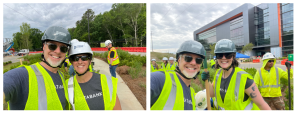
DataBank recently partnered with the Culpeper Technical Education Center (CTEC) in Culpeper, Virginia, as part of its ongoing commitment to engage and support the communities where we operate Over two days, this hands-on program gave 40 electrical students an up-close look at the data center industry and the career opportunities it holds.
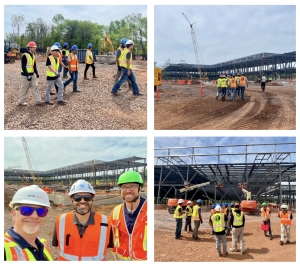
CTEC electrical students and DataBank team members tour the Culpeper campus currently under construction during a two-day career exploration program.
The Culpeper program is part of the same commitment: The view that being a good neighbor means investing in the people and places where we build and operate.
A Community Partnership Takes Shape
CTEC is a career and technical education school located directly across the street from our new Culpeper data centers currently under construction. Its electrical program students had built an impressive lab model of a data center data hall, complete with raised floors, electrical power and distribution systems, low-voltage and network cabling and conduit, backup power, cages, servers, and more.
DataBank wanted to support CTEC students and help expand their understanding of the data center industry. We saw an opportunity to do what good neighbors do: Open our doors, share what we know, and give these students a firsthand look at an industry that needs their talents.
Day One: Meeting the Students and the Site
On the first day, we brought together a team spanning operations and construction to make the trip to CTEC. Matthew Uveges, Regional Director of Data Center Operations for the Mid-Atlantic Region, and Thomas Barrett, Project Manager for our Culpeper campus, represented the hands-on expertise these students were hungry to learn from. We were welcomed by CTEC Principal Shaun Summerscales, Electrical Instructor Doug Keaton, and Bryan Rothamel, Director of Economic Development at Culpeper County and the Culpeper Tech Zone.
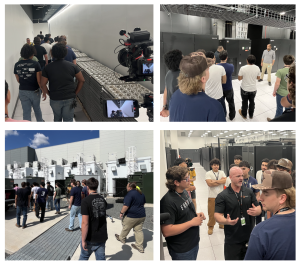
CTEC electrical students get an inside look at a fully operational DataBank facility in Ashburn, Virginia, during the second day of their career exploration program.
The DataBank team met with 40 Level 1 and Level 2 electrical students ranging in age from 16 to 18. After an overview of the data center business, Uveges and Barrett evaluated the students’ data hall model, offering feedback and noting how closely their work reflected a real-world facility.
The group then boarded a bus across the street to tour the Culpeper campus, where they met with construction teams and contractors, walked the site, and took in the scale of two facilities under development: a 72MW building currently under construction as well as planned 120MW data center.
Day Two: Seeing the Finished Product
On the second day, the older Level 2 students, those nearing graduation, traveled by bus to Ashburn to visit two of our operational facilities, IAD1 and IAD3, and see what a completed, fully operational data center looks like.
They met with Patrick Greene (Data Center Manager, IAD3), James Mathes (Data Center Manager, IAD1), and Mike Ocampo and Isaiah Benjamin (Data Center Technicians, IAD3), who shared their experiences and offered firsthand perspective on careers in data center operations. The conversations covered everything from day-to-day responsibilities and shift work to career progression, certifications, and what employers actually look for when hiring technicians.
Students also got a candid look at how their electrical training maps directly to the skills needed on the data center floor, and how quickly that training can translate into a stable, well-paying career.
From Blueprint to Operations: A Complete Picture in 48 Hours
In just two days, these students experienced the full arc of a data center: from a 30-foot-long lab model, to a 100-acre campus under construction, to a fully operational 40MW facility. They heard directly from construction and operations professionals about how their electrical training translates into immediate, well-paying careers in a growing industry.
That kind of end-to-end experience is rare, and it doesn’t happen without the right people saying yes. We’re grateful to the CTEC faculty and Culpeper County leadership for making this partnership possible, and proud of the DataBank team members who gave their time and expertise to make it meaningful.
Culpeper is one of more than 25 markets where DataBank operates across the United States, and programs like this reflect how we think about our role in each of them. Building data centers is what we do. Being a good neighbor is who we are. Whether that means opening our doors to students in Atlanta, bringing 3D printers to a library in Red Oak, or spending two days with 40 young people in Culpeper who are about to launch their careers, we believe the communities we operate in deserve more than our infrastructure. They deserve our investment.
We look forward to continuing our relationship with CTEC and finding new ways to support workforce development, STEM education, and career opportunity in Culpeper and beyond.
Want to learn more about how DataBank is investing in the communities where we operate? Visit our Community Relations page or explore DataBank Digest for more stories about our people, our partners, and the neighborhoods we’re proud to call home.
Artificial intelligence workloads are reshaping data center infrastructure in ways the industry couldn’t have anticipated, and this transformation continues to evolve rapidly as we learn new things about AI. With large-scale deployments still emerging, each implementation teaches us more about how to manage data centers for these demanding workloads.
The challenge begins with fundamentally different power demands. Until now, most enterprise applications used relatively steady power consumption to run email servers, host websites, serve up real-time digital experiences, and manage customer transactions.
AI changes this equation completely. We are seeing that these workloads now experience intense oscillation as neural networks dynamically allocate computational resources across thousands of processing cores and activate different pathways during training cycles or inference tasks.
The result? Power consumption that can fluctuate by more than 50% in mere microseconds. This creates violent power spikes that rise and fall with each computational task and happen much faster than traditional infrastructure was designed to handle.
Power Infrastructure Under Pressure
The consequences can be immediate and expensive. When AI workloads spike power consumption in microsecond bursts, uninterruptible power supply (UPS) systems can fault and dump the load directly onto backup batteries.
This constant battery cycling from microbursts can be devastating where it occurs, potentially reducing battery lifespan by 50% or more and transforming predictable three-to-five-year replacement cycles into 18-month emergency replacements. In response, UPS vendors are actively exploring capacitors and other alternatives. This creates an evolving landscape of innovation for data center equipment as the industry continues learning how to address these unique challenges.
For data centers already operating with constrained budgets, these unexpected maintenance costs and the need for infrastructure upgrades can create overwhelming financial pressure.
The Cooling Conundrum: When Minutes Become Seconds
The cooling challenges are equally dramatic. Everything changes when power density hits approximately 40 kilowatts per rack—the practical limit for traditional air cooling. Beyond that threshold, liquid cooling becomes mandatory.
Yet, AI deployments aren’t stopping at 40kW. Industry roadmaps show NVIDIA and other vendors targeting 600 kilowatts to one megawatt per rack. This means that the vast majority of each rack’s power consumption will require direct liquid cooling to computer chips.
This triggers a domino effect of infrastructure challenges. Existing buildings often lack the physical piping infrastructure needed for liquid-to-chip cooling systems. Retrofitting buildings with chilled water systems, coolant distribution units, and supporting infrastructure represents a massive capital expense that exceeds many facilities’ budgets, while others just don’t have the space for such extensive upgrades.
Perhaps, most critically, the margin of error has collapsed. Traditional data center workloads gave operators 20 to 30 minutes to respond to cooling system failures before reaching critical temperatures. High-density AI workloads compress that window to two minutes or less. The thermal runaway risk is so severe that cooling systems now require their own backup power, thermal storage tanks acting as batteries for cooling, and unprecedented levels of redundancy.
Even when operators try to build adequate thermal storage, physics works against them. Every two minutes of cooling backup requires massive water tank scaling, and most existing facilities simply don’t have the physical space for the storage volumes that would provide meaningful protection.
These infrastructure requirements would have seemed excessive just a few years ago and may still seem excessive to those who haven’t experienced a cooling failure in a high-density AI environment.
Building for the AI Future: Strategic Infrastructure Solutions
Rather than being caught off guard, innovative data center operators are already planning and building the specialized infrastructure that AI workloads demand.
The industry response is moving on multiple fronts simultaneously: making hard economic decisions about retrofits, designing purpose-built AI facilities, and pioneering modular approaches that deliver flexibility without sacrificing efficiency.
The economics of retrofitting existing infrastructure are driving operators toward a different approach. While some facilities can accommodate AI workloads with targeted upgrades, the real innovation is happening with purpose-built facilities designed from the ground up for AI requirements.
These new data centers are optimized specifically for AI workload characteristics, incorporating power delivery systems engineered to handle rapid fluctuations and cooling architectures that scale from air to high-density liquid cooling as needed. The designs prioritize modularity and flexibility, allowing operators to configure spaces for different AI applications without traditional one-size-fits-all constraints.
The performance gains are significant. These facilities achieve higher computational density per square foot, more efficient power utilization, and cooling systems that respond dynamically to workload demands while incorporating redundancy designed specifically for AI’s shortened response times.
Modular Construction: Building as You Grow
Modular design is emerging as a key sustainability and economic strategy. Rather than constructing massive facilities all at once, operators can now build incrementally based on actual demand. Standardized components deliver economies of scale, similar to apartment building construction where identical units drive down per-unit costs. This also allows operators to pack more computing power into buildings without expanding physical footprints to city-block proportions.
From a sustainability perspective, this represents a practical balance. While reusing existing infrastructure would theoretically be more environmentally friendly, legacy data centers simply cannot handle modern AI workload requirements cost effectively. The new modular designs are inherently more efficient and reduce cooling dependencies, creating long-term environmental benefits that offset the initial construction impact.
Rethinking Efficiency: More Computing, Not Just More Power
Perhaps, most importantly, the industry is beginning to properly measure the true efficiency gains that AI workloads deliver. While it’s true that AI systems draw more power than traditional computing, they deliver significantly more computational capability per kilowatt consumed. Graphics Processing Units (GPUs) optimized for AI workloads can process far more operations using the same energy as traditional CPUs handling equivalent tasks.
This efficiency paradox creates powerful business incentives for continued optimization. Data center operators profit from maximizing the computational output per unit of power consumed, naturally aligning business objectives with energy efficiency goals. As operators deploy more AI-optimized infrastructure, they’re achieving better overall energy utilization compared to traditional computing approaches.
The Infrastructure Evolution Ahead
The transformation of data center infrastructure for AI represents both an immediate challenge and a long-term opportunity. Data center operators succeeding in this transition understand that AI workloads demand fundamentally different approaches: from managing microsecond power fluctuations and less than two-minute cooling windows to building purpose-built facilities with modular designs that scale incrementally.
The future won’t be exclusively AI-driven since traditional workloads will persist because AI infrastructure remains expensive. However, enterprises are strategically shifting portions of their operations to AI as they recognize efficiency gains that offset higher infrastructure costs. The data centers that emerge will be more efficient, more flexible, and better positioned for whatever computational demands come next.
When Anthony Hayes, DataBank’s Critical Facility Manager in Atlanta, received a call from Dexter Edmonds of Opportunity Runway asking if DataBank would host a career exploration event, he didn’t hesitate.
The mission was simple but powerful: Open DataBank’s doors to young people, pull back the curtain on what data centers are, and show them that lucrative, fulfilling careers exist beyond the traditional four-year college path.
The event served two purposes. It would counter misconceptions about the data center industry while opening doors for the next generation. It also gave Hayes a chance to give back in a meaningful way. “What good is it for me to have this knowledge and these skills if I don’t share them?” Hayes said. “I wanted to tell my story, share my journey, and give young people different paths to success.”
Beyond the Headlines
The event, held on a Saturday at one of DataBank’s Atlanta facilities, drew nearly 20 young people eager to learn about an industry many had never considered.
For Hayes, it was a chance to move past the headlines and misconceptions about data centers –especially those related to water consumption and environmental impact— and focus on what matters most: the opportunities these facilities create for communities.
“A lot of the rhetoric about data centers comes from people who don’t understand the technology,” Hayes explained. “We wanted to show them real examples: what closed-loop cooling systems actually mean, how modern data centers operate, and most importantly, the career paths available in this industry.”
A Team Effort
The day featured multiple components designed to give attendees a comprehensive view of data center careers.
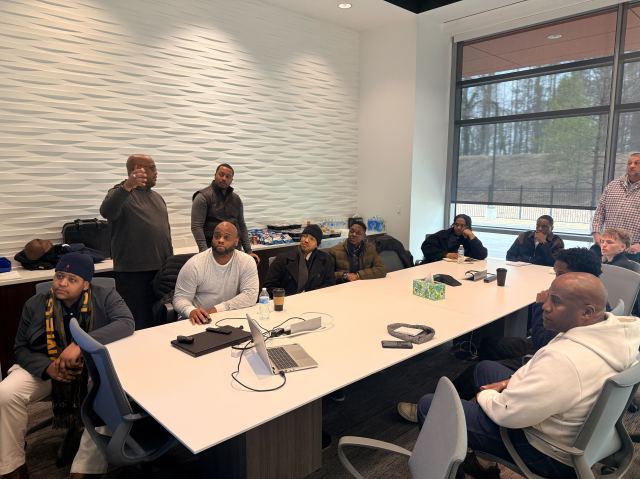
A data center industry expert from Method Experts, a training organization dedicated to equipping operators and technicians in mission-critical environments with essential skills for safety and operational excellence, delivered an educational session on data center fundamentals, their diverse applications, and the wide range of career paths available. He covered everything from physical security and cybersecurity to MEP (mechanical, electrical, and plumbing), operations, and rack-and-stack positions.
Brian Wilkerson from PRT Staffing, a placement service that works with the industry, provided lunch for attendees and even brought his 15-year-old son to the event—a powerful statement about the real conversations families are having about alternative career paths.
In this session, DataBank employees and data center experts presented career opportunities to students interested in learning more about the data center industry.
Hayes also invited members of his own team, Leon LaMar III and Clyde Ward, to share their personal journeys into the data center field. “Everybody in a data center has a unique story about how they got there,” Hayes said. “We’re in a field that didn’t exist 30 years ago, and now it’s exploding with opportunities young people may not even know exist.”
The Eye-Opening Reality
Hayes made a compelling case when he compared career paths side by side. The traditional college route often means four years of debt accumulation for a degree that might yield a $60,000 starting annual salary. Meanwhile, trade paths like becoming a journeyman or full electrician offer a dramatically different trajectory.
“You can join the IBEW, pay union dues, and get paid to learn,” Hayes told the group. “In the same four years someone else is in college, you can complete your training and come out making $45 to $55 an hour, which is close to six figures right from the gate.”
Hayes was also careful to note that choosing technical training doesn’t mean abandoning education entirely. Workers can return to school later to develop other skills like professional communication and presentation abilities. “The hard part is the technical knowledge,” he explained. “Once you have that, you can focus on perfecting your soft skills and positioning yourself for bigger roles over the years.”
The message clearly struck a chord. Many attendees connected with Hayes on LinkedIn after the event, staying behind to ask questions about what he looks for when hiring, whether he hires people without experience, and how they could break into the industry.
“The eye-opening realization that you don’t have to go to college but can still make real money,” Hayes said. “That was the biggest thing they took away.”
Creating Legacy
The event held special significance for Hayes. His own children are in high school, navigating similar decisions about their futures.
“It was an opportunity to show them that community is important, and that it’s important to have leaders who don’t gatekeep,” he said. “Your path might be different from mine, but it doesn’t hurt for you to understand my path and see there’s opportunities for you.”
Hayes also appreciates working for a company that actively supports community initiatives like this. “I really enjoy working for DataBank,” he said. “I’ve worked in toxic work environments before. This is so far from that. There’s a strong culture here that values giving back and investing in the communities where we operate, and that matters.”
Looking Ahead
The Atlanta event is just the beginning. Hayes continues to represent DataBank at career fairs and community events, partnering with organizations like Opportunity Runway to connect with young people exploring their career options.
“When we open our doors and share our story, we create pathways for others and strengthen the communities we call home,” Hayes said. “That’s what being a good neighbor really means.”
Want to see more stories about DataBank’s community involvement and industry leadership? Check out DataBank Digest for more insights on data center industry trends and infrastructure strategy.
Data center construction trends reflect changes in power density, cooling design, sustainability requirements, and deployment speed.
The data center construction industry enters 2026 facing challenges that would have seemed unimaginable just two years ago. Rapid growth is straining every aspect of traditional construction approaches, from securing skilled labor to managing unprecedented project scales.
The fundamentals that worked for decades no longer apply. Single campuses now require 4,000 workers instead of 750. Customer specifications shift mid-deployment as technology evolves faster than buildings can rise. Construction teams must adapt to a new reality where flexibility and forward planning matter more than following established playbooks.
Based on what we’re seeing across our projects, here are the trends that will define data center construction in 2026.
Talent Shortage Will Be the Biggest Challenge
The skilled labor shortage in the data center industry will intensify significantly in 2026 as leased capacity from 2024 and 2025 finally comes online. The second half of 2026 into 2027 will see massive activation across the country, and the industry simply doesn’t have enough qualified workers to meet demand.
Project scales have multiplied beyond recognition. Where peak crew sizes once reached 750 workers, sites like DataBank’s Red Oak campus will hit 4,000 to 5,000 workers by early 2026. That’s the size of a small city, requiring entirely different management approaches than data center builds in the past.
Labor costs are rising accordingly. Workers are relocating from markets like Arizona, where power constraints have slowed construction, to booming regions like Dallas. Increased wages, per diem expenses, and relocation costs are adding up. Some operators are even establishing on-site housing with high-end amenities to attract workers.
The operators who secure skilled labor now, through early contractor commitments and creative workforce strategies, will have significant advantages over those waiting until projects break ground.
Costs Will Continue Rising
Cost increases are hitting every aspect of data center construction: power, materials, and especially people. While DataBank maintains multi-year stocking programs to lock in material pricing and minimize tariff impacts, labor cost escalation is harder to control given the talent shortage.
The type of construction matters significantly for cost management. Operators building exclusively for AI workloads can opt for cheaper approaches like steel buildings with metal panels rather than robust precast structures. However, versatile construction capable of serving any client type costs more upfront while providing long-term flexibility.
Leasing rates are rising to reflect these realities. The question becomes whether operators can absorb increased costs or must pass them to customers. Those with strong vendor relationships, economies of scale through project bundling, and long-term procurement strategies will be better positioned to manage cost pressure than competitors making reactive, project-by-project decisions.
Construction Innovation Will Address Labor Challenges
The industry is turning to technology and new construction methods to offset the skilled labor shortage. AI tools are already analyzing pull schedules to identify float and delays that would take humans hours to find manually. Robotics like autonomous site scanners perform 360-degree analysis, comparing progress against 3D BIM models with greater accuracy than human inspections.
These tools won’t immediately replace construction roles. The industry still needs experienced boots on the ground, particularly the skilled general foremen and project leaders who manage complex deployments. Quality control and administrative positions may evolve over the next five years as AI handles more analytical work.
Modular construction and prefabrication are accelerating in parallel. Electrical components, power rooms, and building modules assembled in controlled factory environments address labor constraints more effectively than on-site work. A crew of 20 to 50 workers in a factory can be more productive than managing thousands on a sprawling campus, where workers lose two hours daily just commuting to and from the site.
Managing 4,000-plus workers on a single site can also lead to safety challenges that didn’t exist at smaller scales. Setting clear rules and maintaining safety protocols becomes critical when construction sites rival small cities in population.
Financial Pressure Will Drive Market Consolidation
Power infrastructure costs are creating a significant barrier to entry. Operators pursuing geothermal energy, high-pressure gas lines with turbines, or small modular reactors face capital requirements in the hundreds of millions before a single tenant moves in. Without committed customers, it’s a major challenge to secure approval for an additional $200 million to $300 million in power infrastructure on top of base construction costs.
Utility commitments amplify the risk. Non-refundable deposits of multi-millions of dollars force developers to decide who will roll the dice and who won’t. Operators with purchase power agreements and facility engineering agreements already locked in can build more speculatively because they’ve de-risked the power equation. Those without these commitments will struggle.
Creditworthiness issues compound the challenge. Many AI-focused tenants lack strong credit profiles, forcing hyperscale cloud providers to serve as backstops for lease financing. This dynamic will intensify in 2026, particularly for shorter-term leases. The combination of massive power infrastructure costs and tenant credit concerns will separate well-financed operators with proven execution from speculative players who entered the market recently. Some will exit entirely when the financial reality becomes insurmountable.
Customer Design Requirements Will Keep Changing
Every liquid cooling deployment involves different customer requirements, and specifications continue shifting mid-project as technology evolves. For example, at our Red Oak campus, a customer’s requirements shifted from nine liquid-cooled data halls to seven mid-deployment as network capacity needs outweighed GPU processing requirements.
Design variations are significant. Some deployments require complex programmable logic controller integration while others use simpler approaches. Cooling distribution unit placement varies from exterior-mounted to in-cabinet configurations. Air cooling remained relevant even in late 2025, with enterprise customers and some financial firms still specifying significant air-cooled capacity alongside liquid infrastructure.
The key is building flexibility into designs from the start rather than attempting expensive retrofits later.
Permitting and Community Engagement Will Intensify
Despite administration comments about fast-tracking AI data centers, the reality on the ground is moving in the opposite direction. Permitting processes are becoming more delayed, with additional third-party engineers reviewing applications and more stringent approval requirements. This trend will continue as a significant challenge over the next few years.
Community engagement has become essential to successful project development. Many communities harbor misconceptions about data centers, conflating them with AI development or robotics manufacturing rather than understanding they enable everyday digital services. Education and early relationship building with local stakeholders are now critical components of the development timeline, not optional add-ons.
Building for What’s Next
The only certainty in data center construction for 2026 is uncertainty. Technology will evolve faster than project timelines. Customer requirements will shift mid-deployment. Costs will surprise even the most careful planners.
Success belongs to construction teams built for adaptation rather than those optimized for efficiency in stable conditions. The ability to pivot quickly, maintain optionality in designs, and solve problems creatively matters more than following the playbook that worked last decade.
Want to see how DataBank is navigating the evolving data center construction landscape? Check out DataBank Digest for more insights on managing talent challenges, cost pressures, and the innovative approaches shaping infrastructure development in 2026.
Data centers drive economic impact through infrastructure investment, job creation, and support for digital services.
A version of this article first appeared in the Culpeper-Star Exponent.
Communities looking to attract business and technology investment face a common dilemma: how to drive economic growth while addressing concerns related to sprawl, the project’s potential impact, and whether the development efforts will truly benefit local residents.
Culpeper County, Virginia, is setting an example through strategic planning and partnership with DataBank, a data center provider seeking to expand responsibly in Virginia. The leaders of Culpeper County developed the Culpeper Tech Zone (CTZ), a model that addresses community concerns through intentional zoning, infrastructure planning, and workforce development.
DataBank’s approach to working with the CTZ exemplifies how the right partnership can deliver economic benefits that extend beyond tax revenue while keeping communities top of mind. This collaboration shows how municipalities and private partners can align on shared values to achieve responsible growth.
Strategic Planning in a Community
As data center development accelerated across Northern Virginia in the early 2020s, county leadership recognized an opportunity but needed to address the community’s concerns about scattered development and the overall impact of new infrastructure.
The strategic decision was to welcome data center development in a campus-style setting where infrastructure alignment made practical sense.
“We learned quickly that we didn’t want power lines crisscrossing throughout the entire county,” explains Bryan Rothamel, Economic Development Director for Culpeper County. “By identifying one electrical corridor and concentrating development where our community college and Route 29 already existed, we could centralize the infrastructure and maximize possible synergies.”
Culpeper identified a target area in close proximity to existing electrical service. It was also located along US Route 29, a four-lane highway for valuable transportation capacity. In addition to this, the adjacent community college and high school technical education program created natural workforce development opportunities.
The result was the CTZ, a 1,000-acre plot representing 0.4% of the county’s total land area. This strategic concentration meant the county could clearly communicate its vision: development in this specific area. By defining where development should happen, Culpeper could have productive conversations with potential partners rather than debating fundamental land use questions with every inquiry.
“Some companies wanted massive single-operator campuses,” says Rothamel. “That didn’t align with our vision for a concentrated technology zone serving multiple partners. We were comfortable saying no to proposals that didn’t fit, which actually strengthened our relationships with companies like DataBank that did.”
Why DataBank Chose Culpeper
From a private sector perspective, several factors made Culpeper attractive. DataBank already operates four data centers in Northern Virginia, making Culpeper’s location strategically valuable.
When data centers are located within close geographic proximity, they can efficiently sync data between facilities, provide backup during outages, and maintain redundant systems without the latency issues that come with longer distances. These cluster advantages make the infrastructure more reliable and responsive than isolated facilities.
Beyond geography, the CTZ offered something increasingly rare: process clarity. The streamlined approach from concept to groundbreaking eliminated uncertainty that typically plagues development timelines. When a developer asks, “Where would you like us to go?” and receives a clear answer, planning becomes dramatically more efficient.
The CTZ model demonstrated that local government had thought carefully about its infrastructure needs, community concerns, and long-term vision. This was proactive economic development, not reactive zoning. For companies evaluating multiple locations, this strategic thinking is the sign of a reliable partner, not just a jurisdiction that might shift direction mid-project.
Economic Impact: Beyond Tax Revenue
Data centers contribute substantial tax revenue during both construction and operational phases. However, focusing solely on tax dollars misses the larger, longer-term economic impact these facilities create.
The most direct benefit is employment. Data center operations need skilled technicians to maintain systems and keep facilities running 24/7. During the construction phase, projects employ local contractors, electricians, HVAC specialists, and construction workers—creating jobs long before the facilities open. These construction workers and ongoing employees also support local businesses, from coffee shops and restaurants to gas stations and retail stores, creating a ripple effect throughout the community’s economy.
Additionally, having the community college and educational institutions right in the CTZ creates immediate workforce development opportunities. The college can build training programs around what employers actually need, not abstract courses that don’t match real jobs. Students can meet potential employers while they’re still in school rather than hunting for jobs after graduation.
These connections are already happening. Companies operating in the CTZ are reaching out to meet with students and actively hiring from local educational programs. This creates a pipeline where young people can build careers without leaving the county, addressing the challenge many rural communities face when trained residents must relocate.
Community engagement extends beyond workforce development to include partnerships with local organizations, support for educational initiatives, and participation in county activities. Tax dollars generated in the CTZ can fund services, infrastructure, and programs throughout the county’s 383 square miles, allowing development and preservation to coexist.
A Framework for the Future
The Culpeper story extends beyond one county or one data center provider. It demonstrates what becomes possible when communities lead with clarity and companies respond with real partnership.
“We started every meeting with partners saying we’re looking for the best example of data center cluster development in the world,” Rothamel notes. “Working with DataBank, we’re building that together. It’s proof that rural communities can define their own terms for growth.”
The formula is straightforward: define your vision, plan deliberately, and choose partners accordingly. The Culpeper and DataBank relationship proves it’s more than possible – it’s achievable.