

Summarize with:
read in < 1 min


Headline figures and statistics rarely tell a complete story. Understanding what gaps they leave is a prerequisite for filling them. With that in mind, here is a comprehensive guide to compliance-ready enterprise cloud hosting. It explains what auditors check that vendor datasheets don’t mention.
Many enterprise cloud hosting vendors prominently display compliance badges and certifications on their websites. While certifications matter, auditors rarely stop at the certificate itself.
During an audit, the focus quickly shifts from what a provider claims to what evidence can be produced. Auditors want proof that security controls are operating effectively, that access is properly managed, and that policies are being consistently enforced.
This distinction is important because organizations in regulated sectors such as finance, healthcare, legal services, and government contracting are increasingly being asked to demonstrate continuous compliance rather than point-in-time certification.
The question auditors ask is simple:
“Can you prove that the controls described in your policies are actually being followed?”
When auditors begin examining cloud-hosted environments, they often request evidence across several key areas.
Auditors commonly review:
They are looking for evidence that access rights are granted appropriately, reviewed regularly, and removed promptly when no longer required.
If an organization cannot produce documented reviews or historical records, compliance gaps often emerge regardless of what the hosting provider’s marketing materials claim.
One of the most frequently examined areas is change control.
Auditors often request:
The objective is to confirm that infrastructure changes are controlled, documented, and approved before implementation.
For enterprise cloud environments, maintaining an auditable trail of every significant change is often just as important as the change itself.
Security monitoring capabilities may exist, but auditors want proof they are actively used.
Common evidence requests include:
Auditors often examine whether alerts are merely generated or whether they are investigated and resolved according to documented procedures.
Access logging is one of the most scrutinized areas during compliance assessments.
Auditors frequently ask questions such as:
Without comprehensive logging, answering these questions becomes difficult.
A mature cloud hosting environment should provide visibility into:
The ability to quickly retrieve historical logs is particularly important.
For many compliance frameworks, retaining logs for several months (or even years) is a requirement.
Many compliance frameworks require organizations to separate critical responsibilities.
Auditors often review:
The goal is to ensure that a single individual cannot initiate, approve, and execute sensitive actions without oversight.
In cloud environments, segregation of duties becomes especially important when managing:
Organizations should be prepared to demonstrate how these responsibilities are divided and monitored.
Backup capabilities are often advertised extensively by hosting providers.
Auditors, however, focus on validation.
Typical questions include:
Evidence may include:
A backup that has never been tested may not satisfy audit requirements.
Organizations often assume that compliance responsibility sits entirely with their hosting provider.
In reality, most frameworks operate under a shared responsibility model.
This means auditors may evaluate:
Understanding where responsibilities begin and end is critical for maintaining compliance.
Before selecting a hosting partner, IT and security leaders should ask practical audit-focused questions.
Can the provider supply:
Ask whether the provider can demonstrate:
Determine whether the provider can support audits by providing:
Organizations operating in regulated sectors often discover that audit support capabilities become just as valuable as the infrastructure itself.
A truly compliance-ready enterprise cloud environment is not defined by a logo, certification badge, or marketing statement.
It is defined by the ability to consistently produce:
Providers such as DataBank that prioritize operational transparency, governance, and evidence generation help organizations prepare for audits before they happen rather than scrambling when auditors arrive.
The result is a cloud environment that supports not only security and performance objectives but also the ongoing compliance requirements modern enterprises face.
When evaluating compliance-ready enterprise cloud hosting, look beyond certifications and datasheets. The real test comes when auditors request evidence.
The organizations that pass audits most efficiently are typically those that can quickly produce documented proof of access controls, change management processes, monitoring activities, backup testing, and governance procedures.
If your organization operates in a regulated industry, selecting a hosting partner that understands audit realities can significantly reduce compliance risk and administrative burden.
Ready to assess whether your cloud environment is truly audit-ready? Contact DataBank to discuss compliance-focused cloud hosting, governance controls, and infrastructure designed to support your regulatory requirements.

Sign Up For Our Resource Library
Enjoying our resource? Get the latest news and articles delivered straight to your inbox.
Can’t see the form? Click here.
Share Article
Popular Categories

Working with external service providers demands parties agree to shared but separate responsibilities. It’s vital that everybody is on the same page about what belongs in whose domain. With that in mind, here is a comprehensive guide to compliance and cloud hosting. It explains why 'we're compliant' isn't the same as 'you're covered'.
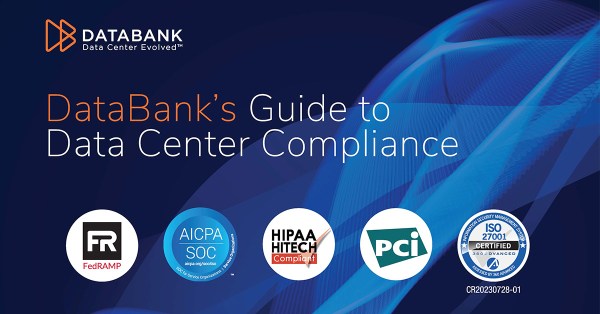
Explore the essentials of compliance: Its definitions, the methodologies for adherence, and the shared responsibilities of organizations and their solution providers in ensuring regulatory alignment.

ISO 27001 controls include policies, procedures, guidelines, and technical solutions aimed at safeguarding sensitive information, preventing unauthorized access, and ensuring the confidentiality, integrity, and availability of data.

Discover the DataBank Difference today:
Hybrid infrastructure solutions with boundless edge reach and a human touch.
Tell us about your infrastructure requirements and how to reach you, and one of team members will be in touch shortly.
Can’t see the form? Click here.
Let us know which data center you'd like to visit and how to reach you, and one of team members will be in touch shortly.
Can’t see the form? Click here.
Enjoying our resource? Get the latest news and articles delivered straight to your inbox.
Can’t see the form? Click here.
Can’t see the form? Click here.