

The data and insights featured below come from DataBank’s latest research report, “Accelerating AI: Navigating the Future of Enterprise Infrastructure,” which surveyed over 300 IT executives about enterprise AI adoption. Download the full report for complete findings.
While AI has been developing for decades, ChatGPT’s debut nearly three years ago suddenly made AI accessible to everyone and sparked the current enterprise adoption boom. It burst on the scene so quickly that many organizations found themselves scrambling to respond. Since then, organizations have been figuring out how to transform AI experiments into business-critical applications that generate real value. Now, that effort is paying off.
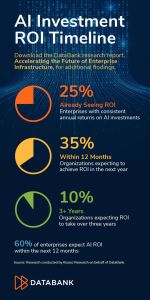
According to our recent survey of 304 senior IT professionals, 25% of enterprises are already achieving consistent annual returns on their AI investments, with another 35% expecting to hit profitability within the next 12 months. That means 60% of organizations surveyed are either seeing real money from AI or confident they will very soon.
These findings from DataBank’s new AI infrastructure report reflect real-world results from enterprise leaders who are making AI work today. Early AI adopters focused on what industry experts call the “low-hanging fruit”—straightforward automation and efficiency initiatives that deliver immediate, measurable value.
It’s clearly paying off. Consider the case of Visa, whose executives participated in our research roundtables and shared their AI journey. The company has been using AI for fraud detection for over 30 years but recently enhanced their models with deep learning and transformer technologies.
The result? $40 billion in prevented fraud last year alone. Visa has also deployed ChatGPT for employees, Microsoft Copilot for Office, and GitHub Copilot for developers to boost productivity across the organization.
ServiceNow, another executive participant in our study, offers an equally compelling example. Their AI transformation reduced response times in their finance department from four days to just 15 seconds while freeing up staff for higher-value work. The company reports over $350 million in enterprise value generated from AI implementations across their organization.
These early wins demonstrate that focused, practical AI implementations can deliver substantial returns, but industry leaders believe this is just the beginning of AI’s transformational potential.
While these quick wins demonstrate clear value, industry leaders believe we’re still in the early stages of AI’s potential impact. Shez Partovi, Chief Innovation Officer at Philips and another executive participant in our research, describes AI adoption as happening in three distinct phases or “lifts”:
“Most enterprises are still at a very early stage of AI adoption,” Partovi said, comparing the current state to 64K dial-up in the internet connectivity evolution. The greatest returns will come from that third lift when AI allows organizations to do things they simply couldn’t do before. This could include real-time personalization at massive scale, predictive maintenance that prevents problems before they occur, or AI-driven drug discovery that accelerates development timelines from years to months.
While AI ROI is accelerating, our research reveals that enterprises still face significant hurdles, including integration challenges, high costs, lack of clear use cases, and other issues. (More on these topics in our next blog).
However, there’s encouraging news in one critical area: enterprises have largely solved their data quality challenges. Only 18.5% of respondents cite poor data quality as a major blocker, a significant improvement that reflects years of investment in data infrastructure and governance.
This post is part of a five-part series examining key trends in enterprise AI adoption based on our 2025 AI infrastructure survey.

Sign Up For Our Resource Library
Enjoying our resource? Get the latest news and articles delivered straight to your inbox.
Can’t see the form? Click here.
Share Article
Popular Categories

New DataBank research reveals 60% of enterprises expect AI ROI within 12 months as organizations shift to hybrid infrastructure and expand geographically.

While AI has already changed so many processes in virtually every business and industry today, its use does raise real questions related to ethical AI, especially how companies can enable AI adoption in a secure, compliant way.

The combination of AI and edge computing has the potential to deliver impressive results for organizations in a wide range of industries. Just what is "AI at the edge?"

Discover the DataBank Difference today:
Hybrid infrastructure solutions with boundless edge reach and a human touch.
Tell us about your infrastructure requirements and how to reach you, and one of our team members will be in touch shortly.
Can’t see the form? Click here.
Let us know which data center you'd like to visit and how to reach you, and one of our team members will be in touch shortly.
Please understand that we might not be able to accommodate every request for a physical data center tour.
Please allow a minimum of 24-48 hours for a response.
Can’t see the form? Click here.
Enjoying our resource? Get the latest news and articles delivered straight to your inbox.
Can’t see the form? Click here.
Can’t see the form? Click here.