

A version of this article first appeared in the Culpeper-Star Exponent.
Communities looking to attract business and technology investment face a common dilemma: how to drive economic growth while addressing concerns related to sprawl, the project’s potential impact, and whether the development efforts will truly benefit local residents.
Culpeper County, Virginia, is setting an example through strategic planning and partnership with DataBank, a data center provider seeking to expand responsibly in Virginia. The leaders of Culpeper County developed the Culpeper Tech Zone (CTZ), a model that addresses community concerns through intentional zoning, infrastructure planning, and workforce development.
DataBank’s approach to working with the CTZ exemplifies how the right partnership can deliver economic benefits that extend beyond tax revenue while keeping communities top of mind. This collaboration shows how municipalities and private partners can align on shared values to achieve responsible growth.
As data center development accelerated across Northern Virginia in the early 2020s, county leadership recognized an opportunity but needed to address the community’s concerns about scattered development and the overall impact of new infrastructure.
The strategic decision was to welcome data center development in a campus-style setting where infrastructure alignment made practical sense.
“We learned quickly that we didn’t want power lines crisscrossing throughout the entire county,” explains Bryan Rothamel, Economic Development Director for Culpeper County. “By identifying one electrical corridor and concentrating development where our community college and Route 29 already existed, we could centralize the infrastructure and maximize possible synergies.”
Culpeper identified a target area in close proximity to existing electrical service. It was also located along US Route 29, a four-lane highway for valuable transportation capacity. In addition to this, the adjacent community college and high school technical education program created natural workforce development opportunities.
The result was the CTZ, a 1,000-acre plot representing 0.4% of the county’s total land area. This strategic concentration meant the county could clearly communicate its vision: development in this specific area. By defining where development should happen, Culpeper could have productive conversations with potential partners rather than debating fundamental land use questions with every inquiry.
“Some companies wanted massive single-operator campuses,” says Rothamel. “That didn’t align with our vision for a concentrated technology zone serving multiple partners. We were comfortable saying no to proposals that didn’t fit, which actually strengthened our relationships with companies like DataBank that did.”
From a private sector perspective, several factors made Culpeper attractive. DataBank already operates four data centers in Northern Virginia, making Culpeper’s location strategically valuable.
When data centers are located within close geographic proximity, they can efficiently sync data between facilities, provide backup during outages, and maintain redundant systems without the latency issues that come with longer distances. These cluster advantages make the infrastructure more reliable and responsive than isolated facilities.
Beyond geography, the CTZ offered something increasingly rare: process clarity. The streamlined approach from concept to groundbreaking eliminated uncertainty that typically plagues development timelines. When a developer asks, “Where would you like us to go?” and receives a clear answer, planning becomes dramatically more efficient.
The CTZ model demonstrated that local government had thought carefully about its infrastructure needs, community concerns, and long-term vision. This was proactive economic development, not reactive zoning. For companies evaluating multiple locations, this strategic thinking is the sign of a reliable partner, not just a jurisdiction that might shift direction mid-project.
Data centers contribute substantial tax revenue during both construction and operational phases. However, focusing solely on tax dollars misses the larger, longer-term economic impact these facilities create.
The most direct benefit is employment. Data center operations need skilled technicians to maintain systems and keep facilities running 24/7. During the construction phase, projects employ local contractors, electricians, HVAC specialists, and construction workers—creating jobs long before the facilities open. These construction workers and ongoing employees also support local businesses, from coffee shops and restaurants to gas stations and retail stores, creating a ripple effect throughout the community’s economy.
Additionally, having the community college and educational institutions right in the CTZ creates immediate workforce development opportunities. The college can build training programs around what employers actually need, not abstract courses that don’t match real jobs. Students can meet potential employers while they’re still in school rather than hunting for jobs after graduation.
These connections are already happening. Companies operating in the CTZ are reaching out to meet with students and actively hiring from local educational programs. This creates a pipeline where young people can build careers without leaving the county, addressing the challenge many rural communities face when trained residents must relocate.
Community engagement extends beyond workforce development to include partnerships with local organizations, support for educational initiatives, and participation in county activities. Tax dollars generated in the CTZ can fund services, infrastructure, and programs throughout the county’s 383 square miles, allowing development and preservation to coexist.
The Culpeper story extends beyond one county or one data center provider. It demonstrates what becomes possible when communities lead with clarity and companies respond with real partnership.
“We started every meeting with partners saying we’re looking for the best example of data center cluster development in the world,” Rothamel notes. “Working with DataBank, we’re building that together. It’s proof that rural communities can define their own terms for growth.”
The formula is straightforward: define your vision, plan deliberately, and choose partners accordingly. The Culpeper and DataBank relationship proves it’s more than possible – it’s achievable.

Sign Up For Our Resource Library
Enjoying our resource? Get the latest news and articles delivered straight to your inbox.
Can’t see the form? Click here.
Share Article
Popular Categories
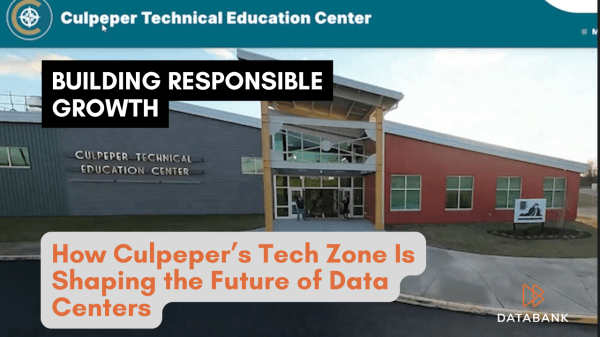
Culpeper County’s Technology Zone is redefining what responsible data center growth looks like. In this interview, Culpeper’s Economic Development Director and DataBank’s Public Policy Lead discuss how collaboration, planning, and community engagement can align technology investment with local values.

When a scheduled demolition became a rare training opportunity, DataBank partnered with local firefighters to turn a routine teardown into lifesaving skills practice.

From Denver to Salt Lake City, DataBank data center teams answered the call to fight food insecurity. Our employees donated thousands of pounds of food, clothing, and supplies to communities in need.
Discover the DataBank Difference today:
Hybrid infrastructure solutions with boundless edge reach and a human touch.
Tell us about your infrastructure requirements and how to reach you, and one of our team members will be in touch shortly.
Can’t see the form? Click here.
Let us know which data center you'd like to visit and how to reach you, and one of our team members will be in touch shortly.
Please understand that we might not be able to accommodate every request for a physical data center tour.
Please allow a minimum of 24-48 hours for a response.
Can’t see the form? Click here.
Enjoying our resource? Get the latest news and articles delivered straight to your inbox.
Can’t see the form? Click here.
Can’t see the form? Click here.