

Loading audio...
Growing Great Leaders: Talent Development Strategies That Work
Leadership development looks different depending on where you sit at DataBank. In construction, a mistake shows up in steel and concrete or on a deadline that will not move. In security, a mistake shows up in trust, in the confidential information customers hand over the moment they sign a contract. Different stakes, different daily pressures, and we feel both every day.
A few convictions show up again and again, whichever side of the business you’re on. In this article, we bring together perspectives from both sides to share the strategies and best practices that hold up across DataBank.
The instinct in most organizations is to hand someone authority first and see what they do with it. We tend to run it the other way.
When a new team function grows from one person to four, and two candidates have equal standing, the answer is not a coin flip and it is not a title. It is six months of informal, shared leadership, with both people told plainly that one of them will end up running the group and the process itself will make it obvious who. Leading without authority is harder than leading with it, and asking someone to prove they can do the harder version first tends to produce a leader people actually want to follow, rather than one they are told to.
The same instinct shows up as patience elsewhere in the business. High potential is not something we spot in a single strong quarter. It takes time, and it takes more than one person’s opinion. A leader who is only impressing the person one level up, while treating peers poorly, is not showing high potential.
That’s something else entirely, and multiple perspectives are what surface the difference. Once a handful of people independently point to the same specific instances of strong judgment or capability, we consider that worth investing in. A gut feeling from one manager is not.
Most career ladders are built in fixed steps: analyst to manager to senior manager, in that order, whether or not the person climbing it actually wants what is waiting at the top. We start from a different question: what does this specific person want, and why?
That means pushing back gently when someone asks for the “logical next step.” Wanting authority is not, by itself, a reason to grant it. The better question is why someone wants the promotion in the first place. A strong individual contributor and a strong manager are frequently not the same skill set, and pushing someone into people-leadership because he or she excelled technically can be a set-up for failure.
It also means learning how each person actually receives feedback before delivering it. The same words, the same tone, land completely differently depending on who is hearing them. Two children raised in the same house, given the exact same sentence, can walk away with two different reactions.
A lot of that comes from raising many children (a total of seven from both executives), and a fair amount from Ted Lasso. Both taught us that you can’t lead everyone the same way and expect the same result. Knowing someone well enough to choose the right words is not a soft skill. It is what makes the rest of coaching possible.
We don’t describe our harder conversations as confrontations. We describe them as questions and opportunities to learn and grow together.
Instead of opening with, “You did this wrong,” the more useful opening is, “Do you think we got the result we wanted?” That single question does two things at once: It tells us whether the gap was a skills problem or a communication problem, and it gives the other person room to arrive at the answer rather than defend against it.
One discovery we’ve made through exactly this kind of question is that a missed expectation isn’t always a performance issue. Sometimes it’s a failure to define what success looked like in the first place, which means the fix is a clearer conversation, not a disciplinary one.
Bad news doesn’t improve with time. If a piece of feedback is landing for the first time in a formal performance review, that review has already failed, which is a sign of poor leadership. The fix is small, frequent course correction, delivered as soon as the gap appears, framed around what support is needed rather than what went wrong.
Conflict itself isn’t the problem. Different perspectives are how we learn from each other. It only becomes a problem when it turns personal or chaotic, and that’s when a good leader steps in — not before.
The two sides of our business feel this differently, and that difference is worth naming rather than smoothing over.
On the construction side, the pressure is external and immediate: a labor market stretched thin across general contractors and subcontractors, where people are routinely poached on compensation alone. Our counter to that isn’t matching every offer. It’s building loyalty that survives a competing offer, the kind where people choose to follow a leader they trust rather than stay for a transaction. Autonomy, real investment in someone’s goals, and a workplace people want to recommend to a friend all compound in a way a signing bonus doesn’t.
On the security side, the pressure is about trust. We hold information most people never see, and data centers themselves are increasingly viewed with suspicion by the communities around them. That makes integrity part of the leadership pipeline itself. Identifying high potential isn’t just about capability. It’s about whether someone will handle what they’re trusted with the way they say they will, in public and in private.
While the risks are different, the stakes are still the same: Will this person do right by what he has been given, whether that’s a team, a timeline, or a customer’s trust?
Strip away the hard hats and the security clearances, and the same three habits carry both sides of our business: earn the role before you’re handed it, build a development path around the individual instead of the ladder, and give feedback the moment it’s needed instead of saving it for a form. None of that is unique to data centers. What’s unique is how much is riding on getting it right, and it’s something we take seriously across the board.
Want to learn more about how DataBank’s leaders build and grow strong teams across the business? Visit our Leadership page or explore DataBank Digest for more insights on talent development and management strategies.

Sign Up For Our Resource Library
Enjoying our resource? Get the latest news and articles delivered straight to your inbox.
Can’t see the form? Click here.
About the Authors


Share Article
Popular Categories

The future of digital infrastructure depends on electricians, HVAC technicians, and facilities engineers. Here's why data center careers are among the most future-proof in the trades.

Traditional leadership tends to fail in agile technical environments today. Collaborative leadership drives significant efficiency gains by breaking down silos and fostering cross-functional partnerships that drive innovation.
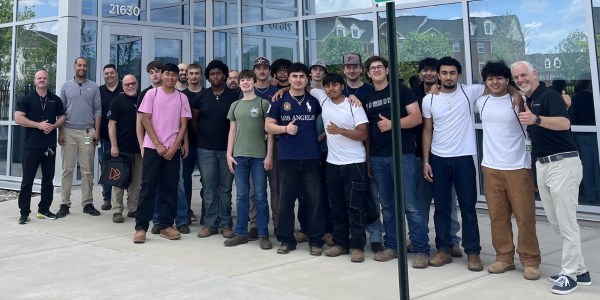
DataBank partnered with Culpeper’s CTEC trade school to give 40 electrical students a firsthand look at data center careers, from classroom model to operational facility.

Discover the DataBank Difference today:
Hybrid infrastructure solutions with boundless edge reach and a human touch.
Tell us about your infrastructure requirements and how to reach you, and one of team members will be in touch shortly.
Can’t see the form? Click here.
Let us know which data center you'd like to visit and how to reach you, and one of team members will be in touch shortly.
Can’t see the form? Click here.
Enjoying our resource? Get the latest news and articles delivered straight to your inbox.
Can’t see the form? Click here.
Can’t see the form? Click here.