Loading audio...
The Truth About Data Centers: Why Transmission is the Real Grid Challenge
This article continues our series on the facts shaping the debate around data centers and the grid. If you would like to follow the full discussion, you can read parts one, two, three, and four, or download The Truth About Data Centers for a more complete view of the topics covered so far.
Data centers have become an easy symbol for a power system under strain. They are large, visible, and many are tied to AI, which makes them a natural target in a public debate about electricity demand. Yet, the pressure showing up across the grid did not begin with data centers, and it will not be resolved by treating them as the main cause of the problem.
The bigger issue is structural. Much of the grid was planned for an era of slower load growth, more centralized generation, and fewer competing demands on the system. That planning model is now colliding with a very different economy, one shaped by online interactions, electric vehicles, building electrification, growth in domestic manufacturing, and a shift from traditional power plants toward a larger share of wind, solar, and battery storage. In that environment, the limiting factor is increasingly the network itself, especially transmission.
This is why the current conversation needs more context. The question is no longer simply how much electricity the economy will need. The harder question is whether the system can move power to the places where demand is rising, connect new loads and new generation fast enough, and do so with infrastructure that in many regions is already aging or congested.
A data center announcement is easy to see. A decade of underbuilt transmission is not.
That challenge is showing up across the country. Utilities are extending timelines for large new power connections. Developers are waiting years for transmission upgrades, new substations, and other system work needed before a project can be served reliably. Grid operators are also dealing with long backlogs of proposed power plants and battery projects that are waiting for approval to connect to the system.
According to Lawrence Berkeley National Laboratory, interconnection queues in the United States now contain more than 2 terawatts of generation and storage capacity. That number reflects how much planned supply is waiting on grid readiness rather than market interest alone. The issue is often less about whether new projects exist than whether the system can accommodate them.
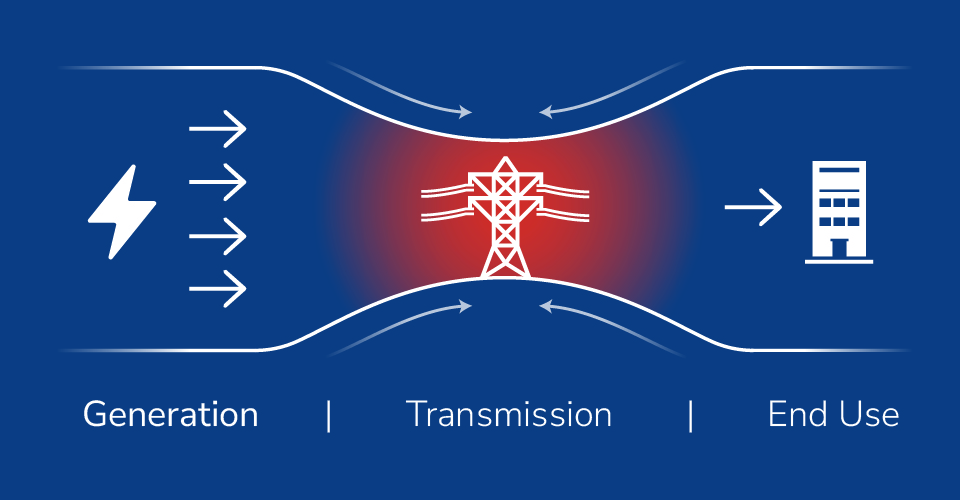
Transmission sits at the center of this problem. High-voltage lines move electricity from where it is produced to where it is needed, whether that means carrying wind power from remote areas to population centers or serving fast-growing regions with rising commercial and residential demand. When transmission capacity falls behind, the effects show up quickly. Congestion increases, project timelines stretch, reliability margins tighten, and costs rise as utilities are forced into more expensive fixes.
Part of the challenge is geography, but that is only one piece of it. The transmission system was largely built around older patterns of generation and demand. Many of today’s fastest-growing sources of electricity, especially wind and solar, are being added in places far from major load centers. At the same time, demand is rising in regions shaped by population growth, manufacturing investment, digital infrastructure expansion, and transportation electrification.
The infrastructure itself also takes a long time to expand. New transmission lines can take years to permit and build. Substations and transformers are expensive, specialized, and often in short supply. Local opposition can slow projects. So can the difficulty of coordinating approvals across utilities, regulators, landowners, and in some cases multiple states. Even when everyone agrees new capacity is needed, adding it is rarely quick.
That is why transmission has become such a critical pressure point. The grid needs more than enough generation on paper. It needs the physical network required to deliver that power where growth is happening.
The economic shift now underway is making existing grid constraints harder to ignore. Electric vehicle adoption is beginning to reshape both total electricity consumption and local demand patterns. Residential charging, fleet depots, and highway fast-charging all place new demands on local distribution systems.
Those changes also add up at the regional level. As EV adoption grows, utilities have to plan for more electricity demand, different daily load patterns, and new infrastructure in places that were not built for it. With gasoline and diesel prices remaining elevated in 2026, that shift may accelerate as more drivers and fleet operators look for alternatives.
Building electrification adds another layer of pressure as heat pumps, water heaters, and other electric appliances shift energy use away from fossil fuels and onto the grid. Manufacturing is doing the same in some regions, as companies expand domestic production and pursue lower-emissions operations. In many cases, that new demand is showing up in areas where transmission capacity was already tight.
Data centers belong in that mix, but they are one category of large load seeking access to a system with limited spare capacity in many places. Their growth is significant, particularly in concentrated markets such as Northern Virginia, Texas, and parts of the West. Goldman Sachs has projected that global power demand from data centers could increase by 50 percent by 2027 and by as much as 165 percent by the end of the decade. Those numbers deserve serious attention, especially for utilities and regional planners.
They also point to a larger reality: Data center growth is happening alongside a much wider expansion in electric demand across transportation, buildings, and industry.
Another important part of this story is deferred investment. Transmission projects take years to permit, approve, and build. So do substation expansions, transformer replacements, and many other core upgrades. In periods of relatively modest demand growth, it was possible to delay some of that work.
Today, the cost of that delay is becoming visible. The American Society of Civil Engineers has repeatedly warned that much of the nation’s energy infrastructure is aging and in need of modernization, and utilities across multiple regions have reported that lead times for major electrical equipment have stretched sharply in recent years. A grid that was once managed through incremental upgrades is now facing simultaneous pressure from new loads, changing generation patterns, and equipment constraints.
This is one reason the public discussion can become misleading. A data center announcement is easy to see. A decade of underbuilt transmission is not. A new large customer can be tied to a location and a megawatt figure. The planning assumptions that failed to anticipate overlapping growth from EVs, electrified buildings, domestic manufacturing, and digital infrastructure are harder to see, even though they sit much closer to the heart of the problem.
A more useful way to frame the issue is to ask what kind of grid a more electric economy requires. The answer begins with transmission, but it does not end there. It includes faster processes for connecting new generation and large loads, better regional planning, modernization of substations and local delivery networks, and a regulatory framework that supports investment before constraints become urgent.
The pressure on the grid is real, and so is the growth in data center demand. Focusing too narrowly on data centers reduces a much larger infrastructure challenge to a single category of customer. The more important question is whether the grid can keep pace with an economy that is becoming more electric, more digital, and more dependent on reliable power delivery across every sector.
Transmission is at the center of that challenge, but the larger issue is grid readiness. That is the work in front of utilities, regulators, developers, and large power users alike.
Looking for clearer perspective on the issues driving the data center debate? DataBank Digest brings you analysis, insights, and the latest developments across digital infrastructure, energy, and growth.

Sign Up For Our Resource Library
Enjoying our resource? Get the latest news and articles delivered straight to your inbox.
Can’t see the form? Click here.
Share Article
Popular Categories

The Truth About Data Centers: a factual response to legitimate concerns: tech demand, power, water, batteries, generators, community impact, and more.
Electricity bills are rising, and data centers often get the blame. Here’s what’s actually driving costs, and why data center growth doesn't always mean higher rates.
Alarming statistics about data center water use rarely survive a closer look. Here’s what closed-loop cooling, real methodology, and a few myth-busting numbers actually show.
Discover the DataBank Difference today:
Hybrid infrastructure solutions with boundless edge reach and a human touch.
Tell us about your infrastructure requirements and how to reach you, and one of our team members will be in touch shortly.
Can’t see the form? Click here.
Let us know which data center you'd like to visit and how to reach you, and one of our team members will be in touch shortly.
Can’t see the form? Click here.
Enjoying our resource? Get the latest news and articles delivered straight to your inbox.
Can’t see the form? Click here.
Can’t see the form? Click here.