

Summarize with:
read in < 1 min


New York has long been one of the world’s most important cities. The region’s data centers provide critical infrastructure for speed, connectivity, and reliability.
This article explores why New York remains a central hub for data and colocation, the region’s unique operational challenges, and how DataBank helps enterprises leverage high-density markets like New York for performance and growth.
New York sits at the intersection of global finance, communications, and media. As such, it has become one of the most connected digital markets in the world.
Here are three of the main reasons why New York is uniquely strategic for data infrastructure.
Financial concentration: Home to the New York Stock Exchange (NYSE) and NASDAQ, the city demands ultra-low-latency connectivity for trading, analytics, and transaction processing.
Population density: With over 20 million people in the metro area, the region generates enormous data volumes across consumers and businesses.
Gateway to Europe: Transatlantic fiber routes terminate in the New York–New Jersey corridor. This makes it a natural gateway for data exchange between North America and Europe.
According to CBRE’s 2024 Data Center Trends report, the New York–New Jersey market remains one of the top five data center hubs in the United States by capacity and absorption.
Its mix of financial services and hyperscale demand continues to attract new investment, though space and power remain at a premium.
Connectivity is the lifeblood of the New York data ecosystem. The metro area functions as a massive “carrier hotel” environment where thousands of networks, cloud platforms, and enterprise systems interconnect.
Here are four of New York’s key connectivity features.
Carrier density: Manhattan and nearby New Jersey facilities host dozens of major network providers, creating diverse routing options for redundancy and low latency.
Peering exchanges: Facilities in the region enable network operators to interconnect directly, reducing costs and improving performance.
Fiber infrastructure: Submarine cables connect New York to London and other European hubs, while dense terrestrial fiber networks link it to Philadelphia, Washington DC, and Boston.
Cloud on-ramps: Direct links to major public clouds like AWS, Microsoft Azure, and Google Cloud allow enterprises to extend workloads seamlessly between on-prem and cloud.
DataBank leverages this interconnected landscape through its East Coast colocation and network ecosystem, enabling enterprises to connect efficiently from New York and New Jersey into broader national and global platforms.
Using high-speed interconnect partners such as Megaport, DataBank extends reach into all major clouds and markets without requiring physical presence in every metro.
Running data centers in New York presents distinctive operational challenges that differ from lower-density U.S. markets. Here are the four main ones.
Limited real estate: The high cost of property in Manhattan and surrounding areas restricts data center footprints. Providers must build vertically or retrofit existing buildings.
Power constraints: New York City’s energy grid is among the most heavily loaded in the country, and obtaining high-density power permits can take months or years.
Cooling requirements: High floor loading and limited roof space complicate air handling and chiller plant installations, making energy efficiency critical.
Resiliency planning: With dense urban infrastructure, ensuring redundant power and network paths requires careful design and coordination with utilities and carriers.
To address these issues, DataBank designs facilities (both owned and partnered) with redundant power paths, N+1 cooling systems, and high-efficiency configurations that meet Tier III or higher reliability standards.
Even when DataBank clients deploy in third-party buildings within New York, the company ensures connectivity back into its national network of 70+ data centers. This gives customers regional resiliency beyond a single metro.
In dense metros like New York, enterprises typically choose between multi-tenant colocation and private suites or cages.
Multi-tenant colocation allows multiple organizations to share the same physical infrastructure while maintaining logical separation. It’s ideal for smaller deployments or hybrid workloads.
Private cages or suites offer isolated, secure environments for clients who need dedicated power and physical access control. These are common in financial trading or compliance-driven sectors.
DataBank provides both models through its modular colocation design. Clients can therefore start with a small footprint and expand within the same facility or across interconnected metros as needs grow. This flexibility is especially valuable in New York, where physical space is expensive but interconnection opportunities are vast.
The industries driving demand for New York colocation are among the most data-intensive in the world. Here are three of the main ones.
Financial services and trading: Colocation near financial exchanges allows trades to execute microseconds faster, which can mean millions in competitive advantage.
Media and content delivery: With proximity to advertising and production hubs, latency-sensitive video workflows benefit from local infrastructure.
Artificial intelligence and machine learning: Colocation facilities offering high-density power and cooling (such as those in DataBank’s ecosystem) simplify the deployment of dense compute clusters and high-bandwidth storage systems.
DataBank’s Cloud Direct Connect and Megaport-enabled services give clients secure, private connections to major public clouds. This approach reduces latency, improves security, and simplifies hybrid workload management.
This means businesses can colocate equipment in a DataBank facility on the East Coast and still connect directly into New York’s digital exchange ecosystem.
Consider a financial analytics firm headquartered in Manhattan. The company processes real-time trading data and relies on microsecond latency to stay competitive. Rather than hosting servers in an office tower, the firm colocates its compute nodes in a DataBank-connected New Jersey facility.
Through DataBank’s network, it establishes direct fiber routes into Manhattan exchange points while maintaining redundant paths to Philadelphia and Ashburn. The firm also connects privately to AWS for AI-driven trade forecasting models.
This approach delivers four major benefits.
Operating in high-density metros like New York demands precision engineering and network foresight. DataBank’s approach focuses on three priorities:
Connectivity first: Every facility integrates with DataBank’s national network backbone and carrier partners to ensure diverse routing and cloud access.
Resiliency: Each data hall uses N+1 or greater redundancy for power and cooling, backed by SLA guarantees.
Scalability: Modular buildouts allow clients to increase density without relocating hardware.
This design philosophy ensures that customers in metropolitan areas can always scale and interconnect seamlessly across DataBank’s nationwide footprint.
New York remains one of the world’s most strategic digital hubs. Operating infrastructure in such a dense, expensive region requires partners who can navigate the challenges of power, space, and connectivity.
DataBank helps enterprises tap into the New York metro’s immense connectivity while mitigating its operational challenges.
To learn how DataBank can support your enterprise’s presence in or around New York, visit databank.com or request a consultation with a DataBank colocation expert.

Sign Up For Our Resource Library
Enjoying our resource? Get the latest news and articles delivered straight to your inbox.
Can’t see the form? Click here.
Share Article
Popular Categories

In most cities, colocation facilities in the center of the city are more expensive than those further out. In essence, this is still true for colocation in New York City but there is a twist. The twist is that this principle applies to individual areas within New York City.

Overall, New York City is a fairly safe environment. With that said, it is still a city with all that implies for security. It’s therefore vital that any New York data center has robust physical defenses as well as effective cybersecurity.
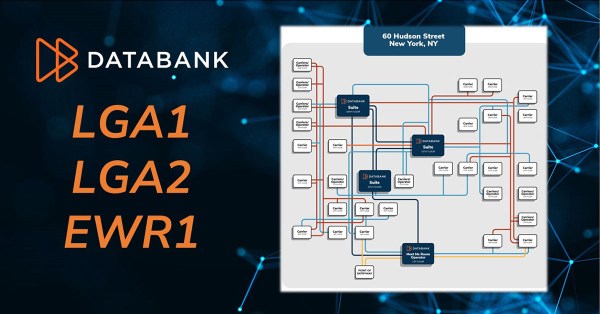
If you need infrastructure connections in New York City or Newark, DataBank has interconnection points where you need them at three carrier hotel data centers. Deploying your technologies in a carrier hotel data enables you to speed your time-to-market for new services, reduce latency, scale your applications without switching data centers, and lower your carrier costs.
Discover the DataBank Difference today:
Hybrid infrastructure solutions with boundless edge reach and a human touch.
Tell us about your infrastructure requirements and how to reach you, and one of team members will be in touch shortly.
Can’t see the form? Click here.
Let us know which data center you'd like to visit and how to reach you, and one of team members will be in touch shortly.
Can’t see the form? Click here.
Enjoying our resource? Get the latest news and articles delivered straight to your inbox.
Can’t see the form? Click here.
Can’t see the form? Click here.