

The data and insights featured below come from DataBank’s latest research report, “Accelerating AI: Navigating the Future of Enterprise Infrastructure,” which focused on enterprise AI adoption, ROI, and infrastructure challenges.
While AI can deliver significant business value, many organizations are still figuring out how to make it work for them. In our first post on AI adoption, we highlighted recent findings from our research report, “Accelerating AI: Navigating the Future of Enterprise Infrastructure,” and explored why 60% of enterprises are already seeing real ROI from their AI investments.
Now, in this second article in the series, we’ll examine what’s holding back the organizations that haven’t reached that point yet.
Most companies understand AI’s potential, but turning pilot projects into business-critical applications that generate real value involves overcoming several significant obstacles. Our survey of over 300 enterprise IT executives reveals exactly what those barriers look like today.
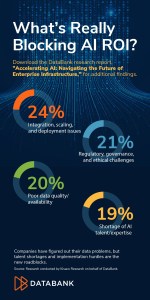
Here’s some encouraging news: Data quality is no longer the primary roadblock it once was. When we asked about major obstacles to AI adoption and ROI, only 20% of respondents cited poor data quality, availability, or labeling as a significant issue. This represents a dramatic shift from just a few years ago when data problems seemed to top virtually every list of AI challenges.
The survey results confirm this progress. One-third of respondents reported that their data and processes are “well-organized, governed, and ready for AI training and analysis.”
Another 34% said their data foundations were either “adequate or good but require some improvements in standardizing processes or data governance and structure.” Less than 10% described their processes and data as immature, fragmented, and siloed.
Now that companies have their data sorted out, different problems have moved to the front of the line.
Integration, scaling, and deployment issues top the list at 24% of responses, showing that the biggest hurdles aren’t just technical anymore—they’re organizational and cultural too.
The challenge stems from what experts call “pilot purgatory” where organizations can successfully run AI proof-of-concepts, but struggle to move those solutions into production systems that work across the enterprise. Research shows that scaling AI requires integrating new technologies with complex, aging IT landscapes including legacy ERP, CRM, and manufacturing systems that weren’t designed for modern AI applications.
Regulatory, governance, and ethical challenges represent the second-largest barrier at 21%. Organizations must navigate complex compliance requirements, including sovereign data requirements across different territories and new legislation like the EU AI Act.
For companies operating globally, these challenges multiply significantly. As one research participant noted, operating across 200+ countries means dealing with vastly different payment regulations in each territory. However, AI itself may help organizations manage these complexities by training systems to quickly answer regulatory questions that previously required extensive manual research.
The talent shortage rounds out the top concerns, with 19% citing lack of AI expertise as a significant blocker. This scarcity has sparked what industry observers call “AI talent wars” between major technology companies, including Meta and OpenAI.
“When I think of the current greatest headwind when it comes to AI, it’s about having the right talent in place, as well as having the right training and the right upskilling,” notes Philips’ Chief Innovation Officer Shez Partovi, who participated in the research process and executive roundtable. His perspective emphasizes the importance of prioritizing “people, process, platform, in that order.”
While data quality was once the primary concern for AI adoption, today’s landscape looks quite different. The barriers organizations face now center around people, processes, and organizational readiness rather than technical foundations. Integration challenges, talent shortages, and regulatory compliance have become the new focal points for companies working to scale their AI initiatives.
This shift suggests that AI technology itself has matured to a point where the human and organizational elements matter more than the underlying infrastructure. Companies investing in change management, building compliance frameworks, and developing internal AI expertise are positioning themselves to move beyond basic implementations toward more innovative applications.
Leadership plays a role, too. “Not unlike any other big change—whether it’s technology related or not—it comes down to leadership,” said Chris Bedi, Chief Customer Officer at ServiceNow, and another executive participant in the research survey. “It takes leadership courage to redefine a new mission, new roles, and new ways of working.”
In our next post, we’ll examine the shift from traditional AI and LLMs toward more innovative solutions that represent the next phase of enterprise AI adoption.
This post is the second in a five-part series examining key trends in enterprise AI adoption based on our 2025 AI infrastructure survey. You can read our first post on AI ROI findings or download the full report, “Accelerating AI: Navigating the Future of Enterprise Infrastructure.“

Sign Up For Our Resource Library
Enjoying our resource? Get the latest news and articles delivered straight to your inbox.
Can’t see the form? Click here.
Share Article
Popular Categories

New DataBank research reveals 60% of enterprises expect AI ROI within 12 months as organizations shift to hybrid infrastructure and expand geographically.

Nearly three years after ChatGPT's launch, enterprises are finally turning AI experiments into measurable business results. See the data behind AI's ROI breakthrough.

While AI has already changed so many processes in virtually every business and industry today, its use does raise real questions related to ethical AI, especially how companies can enable AI adoption in a secure, compliant way.

Discover the DataBank Difference today:
Hybrid infrastructure solutions with boundless edge reach and a human touch.
Tell us about your infrastructure requirements and how to reach you, and one of our team members will be in touch shortly.
Can’t see the form? Click here.
Let us know which data center you'd like to visit and how to reach you, and one of our team members will be in touch shortly.
Please understand that we might not be able to accommodate every request for a physical data center tour.
Please allow a minimum of 24-48 hours for a response.
Can’t see the form? Click here.
Enjoying our resource? Get the latest news and articles delivered straight to your inbox.
Can’t see the form? Click here.
Can’t see the form? Click here.