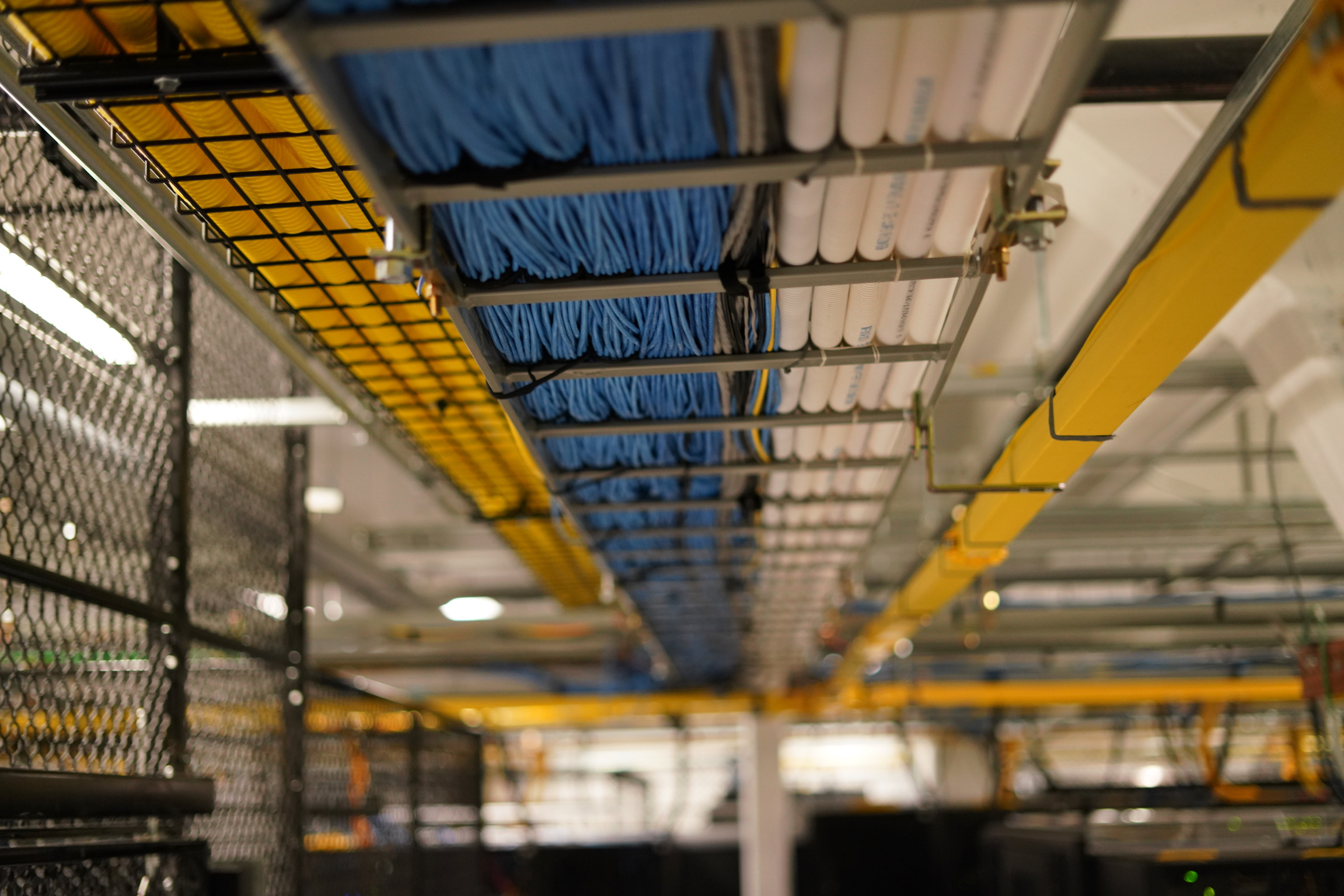
With data centers increasingly in the headlines, it can be easy to assume they are all enormous facilities with extraordinary power demands. Coverage of large AI developments can reinforce that impression, but data centers also support the systems hospitals use to care for patients and the applications businesses rely on to operate.
Demand for this infrastructure was growing well before ChatGPT brought generative AI into the public spotlight in 2022. Today’s facilities serve different purposes, from housing equipment for regional businesses to training large AI models. Understanding those differences helps people make sense of the headlines and evaluate what a proposed facility could mean for their community.
The following sections explain the different types of data centers and offer examples of the work they support.
Multi-Tenant Colocation Data Center
Multi-tenant colocation is the model DataBank operates. In this shared environment, multiple organizations house their servers and networking equipment in a facility managed by a colocation provider. The provider supplies the power and cooling systems, along with physical security and digital security frames while customers generally manage their own equipment.
For businesses, colocation offers access to professionally managed infrastructure without the cost and complexity of building a dedicated data center. Customers lease space and power capacity that fit their requirements, with options to expand as their needs grow. This model serves organizations ranging from regional businesses to global enterprises.
Example:A colocation facility might house infrastructure for dozens of customers, including a regional bank running transaction systems and a healthcare organization supporting patient care applications. Each customer manages its equipment in designated space. The provider operates the facility and may offer connectivity services and on-site technical assistance, such as replacing a component.
Edge Data Center
An edge data center places computing infrastructure close to the people or systems it serves. These facilities are typically smaller and help reduce latency, the delay as data travels between locations. They can support applications that need a fast response.
Location is central to this model. Edge facilities can extend a provider’s computing footprint into areas where users would otherwise rely on more distant infrastructure.
Example:An edge facility located near a cell tower can bring computing capacity closer to mobile users. By processing certain workloads nearby instead of sending data to a distant facility, it can help improve response times for applications such as interactive gaming.
Enterprise Data Center
An enterprise data center is a private facility owned and operated by one organization to support its computing needs. It may be located on the company’s campus or at a separate site. These facilities may be less visible to the public when they are part of an existing corporate campus rather than a standalone development.
This model gives a company direct control over its infrastructure, along with responsibility for keeping it operating reliably. An enterprise data center can also be part of a larger technology strategy, with some systems housed internally and other workloads supported through colocation or cloud services.
Example:A large manufacturer might operate a data center on its campus to support engineering applications and production management systems. Its technology team maintains the equipment and plans capacity around the company’s needs, helping keep essential systems available as employees design products and oversee production.
Cloud Data Center
A cloud data center houses the physical infrastructure used to deliver computing services over the internet. Customers access resources such as storage or processing capacity without owning the underlying hardware, typically paying based on usage. Amazon Web Services, Microsoft Azure, and Google Cloud are well-known providers.
“Cloud” describes how customers access computing resources, while “hyperscale” (discussed next) describes the scale of the infrastructure supporting them. A cloud provider may operate large hyperscale campuses or lease space in colocation facilities. Although customers access the services remotely, they still depend on physical equipment housed in data centers.
Example:An online retailer preparing for a holiday shopping surge can use cloud services to increase computing capacity as traffic rises, then reduce it when demand falls. The cloud provider manages the underlying hardware, allowing the retailer to handle seasonal demand without purchasing and maintaining additional servers.
Hyperscale Data Center
A hyperscale data center supports computing operations at very large scale. Companies such as Amazon, Google, Microsoft, and Meta develop these facilities to support services used by millions of people. They may deliver cloud computing to business customers or power the company’s own platforms, such as search engines and social networks.
Hyperscale facilities are designed to accommodate enormous computing demands and expand as those demands grow. A campus may include multiple buildings developed in phases. Their substantial electricity requirements and physical size often attract public attention, although individual projects differ in design and resource use.
Example:A technology company might develop a multi-building campus to support its video streaming platform. As more people use the service, the company can add computing capacity to process and deliver video. The campus provides infrastructure for a global audience, rather than primarily serving businesses in the surrounding region.
AI Data Center
Large AI data center projects have attracted considerable attention, and their size and power demands can shape what people picture when they hear “data center.” Some of the most prominent developments support major technology companies training large language models, or LLMs, that power generative AI tools.
These facilities use specialized processors, often graphics processing units, or GPUs, to perform enormous numbers of calculations. Training a large model can require thousands of processors working together on extensive datasets. Concentrating that equipment creates high electricity demand and considerable heat, often requiring advanced cooling systems such as liquid cooling.
AI facilities also support running trained models, which can have different infrastructure requirements. These workloads may operate in dedicated facilities or colocation environments, so the scale and resource needs of an AI deployment depend on the work it performs.
Example:A major technology company might develop a dedicated AI facility to train its next large language model. Thousands of interconnected GPUs process training data, supported by high-capacity electrical systems and liquid cooling. This computing-intensive work requires a different infrastructure design than a facility primarily supporting everyday business applications.
Looking Beyond the Label
Data centers support everything from patient care to the development of new AI models. The largest projects may dominate the headlines, but they do not represent every facility or the work it performs.
For anyone evaluating a proposed development, the useful questions concern the project itself: What will it support? How much power and water will it require? How will it fit into its surroundings? Looking at those specifics helps communities weigh potential benefits and concerns with a clearer understanding of what is being proposed.
Want to better understand the different types of data centers and the work they support?DataBank Digestbrings you analysis, insights, and the latest developments across digital infrastructure, energy, and growth.
Real-World Use Cases for High-Performance Computing in Edge AI
Today, the buzz surrounding AI may conjure images of futuristic robots and other sci-fi types of scenarios. While these may or may not come to life sometime down the road, there are still many practical applications. This is especially true in edge computing.
High-Performance Computing (HPC) at the edge, when combined with AI, already holds significant potential to revolutionize industries and solve real-world problems. Yet, to harness its true power, it’s essential to shift the focus from AI fantasies best served up in movies to more realistic, practical use cases.
Understanding HPC at the Edge
At its core, HPC at the edge refers to the processing power and computational capabilities deployed closer to where data is generated and/or needed. This approach minimizes latency, enhances efficiency, and enables real-time decision-making. All of this is critical in today’s fast-paced, high-tech world. AI empowers machines to learn from data, recognize patterns, and make intelligent decisions without explicit programming.
The market momentum tells the story. The global edge AI market was valued at $21.2 billion in 2024 and is now projected to reach $143.1 billion by 2034, which represents a 21% CAGR. This explosive growth reflects how organizations across industries are moving beyond experimentation to production-scale deployments.
Benefits and Challenges Related to HPC in Edge AI
Edge AI also empowers devices to perform complex tasks locally, reducing dependence on cloud services and enhancing privacy since sensitive data remains on-premises. With 5G rollouts enabling data rates 10 times faster than previous networks and latency below 10 milliseconds, edge computing can now handle increasingly sophisticated AI workloads in real time.
Despite its potential, deploying AI at the edge presents challenges including limited computing resources, energy constraints, and security concerns. All must be carefully addressed for seamless operation. Additionally, the diversity of edge environments requires adaptable solutions capable of meeting varying needs and conditions, from smart cities to remote industrial sites.
HPC Edge AI Use Cases
While AI has real potential, its implementation and adoption must be driven by real-world considerations. Fortunately, the combination of HPC and AI at the edge present many different possibilities for a wide range of industries. For example, in healthcare, the real-time analysis of patient data at the point of care can help with early diagnosis, personalized treatment plans, and remote monitoring.
The following are additional examples of edge AI use cases.
Healthcare and Research Computing
In healthcare and research, HPC at the edge enables breakthrough capabilities. Organizations like the University of Maryland leverage HPC infrastructure to support groundbreaking research in genomics, medical technology, and materials science. By deploying high-density computing power with optimal cooling solutions, research institutions can process complex datasets in real time, accelerating discoveries that would be impossible with traditional infrastructure.
Predictive Maintenance in Manufacturing
In industrial settings, edge AI can predict equipment failures and minimize downtime. Potential anomalies can be detected by analyzing sensor data in real time. This enables them to be addressed proactively, leading to improved efficiency and significant cost savings.
HPC at the edge can be employed to process sensor data from machinery and equipment within the manufacturing plant in real time. This data may include temperature, vibration, pressure, and other parameters indicative of the equipment’s health and performance.
Artificial intelligence algorithms deployed at the edge can analyze this data to detect patterns, anomalies, and early signs of potential failures. For example, machine learning models can identify deviations from normal operating conditions. Then they can predict when equipment is likely to fail and recommend proactive maintenance actions to prevent downtime.
Industrial Smart Grids
Smart grids are modern electrical grids that integrate advanced communication, control, and monitoring technologies to efficiently manage the generation, distribution, and consumption of electricity. HPC at the edge combined with AI can play a crucial role in optimizing energy usage and grid stability.
For example, HPC resources deployed at the edge can process data from smart meters, sensors, and other grid devices for real-time energy monitoring. AI algorithms can monitor energy consumption patterns, detect fluctuations in demand, and identify areas of inefficiency or potential grid congestion.
AI-powered edge computing can also help with fault detection and response. By analyzing data from grid sensors and devices, AI algorithms can identify anomalies indicative of potential problems and trigger automated responses or alerts for timely maintenance or repair.
Retail: Personalized In-Store Experiences for Shoppers
In retail, edge AI enhances customer experiences through personalized recommendations. Retailers can leverage AI algorithms to analyze vast amounts of customer data in real time. This could include browsing history, purchase behavior, demographic information, and real-time location data within the store.
This enables retailers to create personalized experiences for shoppers that enhance engagement, increase sales, and foster brand loyalty. For example, retailers can use this data to generate real-time product recommendations and discounts. These can then be delivered via mobile apps, digital signage, or in-store displays. This gives retailers the ability to direct shoppers toward products that they’re more likely to buy, increasing sales and fostering customer loyalty.
Autonomous Vehicles
Similarly, in autonomous vehicles, edge computing and AI enables the instant processing of sensor data. It’s an important advantage because autonomous vehicles require real-time processing of vast amounts of sensor data to navigate safely and make split-second decisions. Traditional centralized computing architectures may struggle to meet the stringent latency requirements for processing this data. This includes the need to send data back and forth to a distant data center can introduce delays that are unacceptable in safety-critical applications.
By leveraging edge computing, HPC resources can be deployed closer to the source of data generation, such as within the vehicle itself or at the edge of the network. Modern edge AI chips like NVIDIA’s Drive Thor deliver up to 1,000 tera operations per second (TOPS) of processing power, enabling faster sensor data processing and quicker decision-making without heavy reliance on centralized data centers.
HPC at the Edge: Shaping Future AI Use Cases
The convergence of HPC and AI at the edge holds tremendous promise for companies in virtually every industry. By focusing on practical use cases that can successfully address real-world challenges, companies can drive innovation, enhance efficiency, and improve outcomes.
By Joe Minarik, Chief Operating Officer, DataBank
“Location, location, location.”
While this adage has applied to property values and their overall desirability in traditional, brick-and-mortar real estate markets for generations, this saying can also be used to define success for the next generation of data centers operating at the edge.
To put it another way, where home and commercial real estate markets tend to focus on geography, edge data centers must now carefully factor population proximity into their decisions where to locate, as this will affect latency times. Making the right choices gives data center operators the best chance to deliver fast, reliable, and always-available digital experiences their customers and their end users demand.
Edge Growth Demands New Strategies
This shift in thinking is a response to an edge computing industry that now finds itself at a critical inflection point that may require new variables in strategic decision-making.
Both of these findings point to a new dynamic: The fact that the edge computing industry now faces new considerations that outweigh latency metrics and other variables used in the past.
Why Hyperscalers’ Economics Create Population Proximity Gaps
While companies providing digital services have long obsessed over geographic coverage and millisecond improvements, forward-thinking enterprises are now recognizing that population density – not just proximity – represents the true determining factor in their edge infrastructure ROI and overall success.
Hyperscalers face a fundamental economic challenge when it comes to population-dense markets. Their business model depends on massive scale to achieve cost efficiencies, requiring enormous facilities with substantial land footprints and power capacities. In population-dense urban areas, land costs, power infrastructure expenses, and regulatory complexity make these large-scale deployments cost-prohibitive.
This economic reality drives hyperscalers to build their major infrastructure in lower-cost rural or suburban locations where they can achieve the scale economies their model requires. While AWS, Microsoft, and Google could theoretically build in downtown areas, the cost structure doesn’t align with their massive infrastructure requirements and margin expectations.
For edge services specifically, hyperscalers typically rely on virtualized solutions and distributed computing zones that leverage existing telecommunications infrastructure or partner facilities. These software-defined edges – like AWS Wavelength zones, Microsoft Azure Edge Zones, and Google Distributed Cloud Edge – offer broad geographic reach but with limited physical presence in the most population-dense areas where latency matters most.
The Colocation Advantage: Multi-tenant Economics Enable Population Proximity
Colocation data centers solve the population proximity challenge through a fundamentally different economic model. While hyperscalers require massive scale at individual locations to justify their infrastructure investments, colocation providers achieve the necessary scale through multi-tenancy. In doing so, they can successfully spread the cost of population-dense real estate across multiple customers sharing the same facility.
This multi-tenant approach makes the economics work in expensive urban markets where hyperscalers can’t justify dedicated facilities. By serving dozens of customers from a single strategically located data center, colocation providers can absorb the higher costs of prime real estate, power infrastructure, and regulatory compliance that come with being close to major population centers.
The colocation model can deliver better population reach through dedicated physical infrastructure that is positioned where customers need it most. For example, DataBank’s data centers are within a 50-mile radius of 50% of the population in the United States and 100 miles from 60%. This positioning is economically viable because the infrastructure costs are shared across multiple tenants, where each accesses dedicated resources within the same facility.
When a colocation facility positions itself within optimal distance of major population centers, it provides the dedicated processing power, storage, and connectivity that more population-dense applications demand. Unlike hyperscaler edge zones that share resources across larger geographic regions, colocation facilities can dedicate specific capacity to individual customers while maintaining multi-tenant economics that make the location strategy more sustainable.
Most importantly, colocation providers can respond to population growth opportunities through this scalable economic model. As demographics shift and new urban centers emerge, colocation companies can deploy facilities in these markets by leveraging multi-tenancy to justify the higher costs. This approach allows them to capture population proximity advantages through shared infrastructure economics.
Positioning for Edge Computing’s Explosive Growth
As the edge computing market grows from $16 billion to $155 billion by 2030, success will belong to those who understand that location truly is everything. Hyperscalers may offer broad geographic coverage, but colocation providers deliver what matters more: infrastructure strategically positioned within optimal reach of the population clusters that drive tomorrow’s digital economy.
Autonomous Vehicle Cloud Platforms
Are you ready to ride in an autonomous vehicle? The world has a way to go before people fully trust self-driving cars and their use reaches critical mass. However, the global autonomous vehicle market continues to expand rapidly. Market analysts projected it to grow from $1.9 trillion in 2023 to $13.6 trillion by 2030, an average annual growth of 32.3%.
As the industry grows and data volumes balloon, the ability of autonomous vehicles to perform efficiently and safely hinges on the capacity of public cloud platforms. Whether controlling a handful or hundreds of cars all at once, the systems directing cars will need to tap into a scalable, on-demand IT infrastructure.
Massive Amounts of Data to Process
Ideally, that infrastructure is geographically dispersed across regional data centers to deliver compute power to the edge—as close as possible to the vehicles. Autonomous vehicles also require High-Performance Computing resources to process, store, and analyze massive amounts of data. Research from Lucid Motors (via Visual Capitalist) suggests modern software-defined vehicles produce anywhere between 1.4 and 19 terabytes of data an hour. That’s an increase of over 5,000% in just 10 years.
With this exponential increase in the amount of data, storing and managing it presents a formidable challenge. The data also needs significant processing power for real-time analysis. For these requirements, cloud infrastructures must offer speed, customization, reduced costs, and efficient processing.
How Public Cloud Providers Solve the Challenges
Public cloud providers have the answer to all these challenges. They allow self-driving vehicle management companies to offload, process, store, and access data from anywhere 7/24. Providers with High-Performance Computing capabilities can also enable machine learning and other artificial intelligence tools.
These technologies streamline information exchanges between traffic and vehicle data and permit autonomous vehicles to communicate and learn from each other. End-to-end cloud platforms also enable fleet management companies to develop, train, deploy, and improve AI algorithms and models continuously. This will increase passenger safety and improve driving experiences.
In addition, the cloud facilitates autonomous vehicle software enhancements. Over-the-air updates can take place constantly to improve functionality, resolve bugs, and adapt to changing road conditions.
Vehicle fleet managers also must consider security. Breaches could have dire repercussions. Public clouds solve this challenge, too, with advanced encryption and security protocols to protect sensitive information. They staff their data centers with dedicated security analysts to monitor and mitigate threats quickly.
Disaster recovery is vital for every business, but perhaps more so for the autonomous vehicle industry. Customers who get stuck in the middle of nowhere because a server goes down won’t be customers for long. The leading public cloud providers offer automatic server failover within their data centers as well as the ability to switch to a data center in another region should a natural disaster strike.
A Hybrid Option to Public Clouds
Besides public cloud providers, fleet management companies with autonomous vehicles also can turn to colocation data center providers that offer bare metal solutions. This hybrid hosting option combines colocation and public cloud infrastructure to deliver compute horsepower and the freedom to choose any operating system, application, and data management tools.
Bare metal environments enable business outcomes that are unique to the autonomous vehicle industry. Customers also can implement their preferred application containers, software architectures, end-user productivity platforms, databases, front-ends, back-ends, analytics, security controls, and automation.
To Learn More
Many companies unintentionally create a hybrid IT infrastructure that could add complexity, cost, and risk. However, with an intentional, proactive, and well-defined hybrid IT strategy—that includes on-premises, colocation, private, and public cloud options—your company can achieve the agility, performance, and security you require.
Last week, on May 9, 2024, DataBank was joined by its customers, construction partners, elected officials, and the media, to celebrate the dedication of its new data center campus in Orangeburg New York.
The 34-acre Orangeburg Campus will ultimately feature two data centers providing up to 200,000 sq. feet of data center capacity 40MW of critical IT power. The first facility on the campus – LGA3 – is already under construction and expected to begin operating in later 2024 or early 2025.
Accommodating HPC
Built to accommodate the most demanding, high-performance computing (HPC) platforms, most of LGA3’s capacity has been leased to a prominent cloud computing customer. LGA3, and the future LGA4, represent the cornerstone of IT infrastructure in New York’s Hudson Valley aligning with endeavors to establish New York as the national leader in technology research and innovation.
Celebration Recognized by Customers, Partners, Local Government, Press
To celebrate the dedication, DataBank’s CEO Raul Martynek was joined by four dignitaries, all of whom left their handprints in cement to make the campus’ status as a foundation IT infrastructure in NY state. They included Brandon Lloyd, Governor Hochul’s Representative from the Lower Hudson Valley; Bill Weber, NY State Senator from the 38th District; Lucy Redzeposki, Rockland County Director of Economic Development & Tourism; and Teresa Kenny, Orangeburg NY Town Supervisor.
The technology sector is known for being fast-moving and data centers need to keep up with it (or even lead it). With that in mind, here is a quick overview of the data center industry outlook for 2024 and beyond.
Data center industry outlook for 2024 and beyond
Here is a brief overview of the data center industry outlook for 2024 and beyond.
Current trends in the data center industry
The main current trends in the data center industry relate to improving efficiency, particularly flexibility.
Rise of colocation facilities
Colocation facilities provide data center infrastructure businesses can use to house their own equipment. Using colocation enabled businesses to leverage the benefits of private data centers without the commitment of building and running them.
Adoption of hybrid IT solutions
Hybrid IT solutions combine different IT environments so that they function as a single unit. They enable organizations to leverage the benefits of each environment however best suits their workloads. For example public clouds can be used for dynamic scalability and real-world data centers for high levels of customizability.
Growth of edge computing
Edge computing is revolutionizing data processing by bringing computing resources closer to the point of data generation and consumption. This trend is driven by the proliferation of Internet of Things (IoT) devices, real-time applications, and the need for low-latency processing. Edge data centers are deployed at the edge of the network, enabling faster data processing, reduced latency, and improved user experiences.
Focus on sustainability and energy efficiency
Sustainability and energy efficiency have become top priorities for data center operators as they strive to minimize environmental impact and reduce operational costs. This trend involves implementing energy-efficient technologies, such as advanced cooling systems, server virtualization, and renewable energy sources.
Emphasis on compliance and data sovereignty
Stakeholders from the general public to governments have become highly aware of data privacy issues. This is leading to increased compliance requirements and data sovereignty considerations. Data center providers are there continually updating their (aleady stringent) security protocols to ensure that they keep ahead of regulatory and governmental concerns.
Challenges facing the data center industry
The main challenges facing the data center industry relate to its phenomenal growth over recent years and the need to put this on a sustainable, long-term footing.
Strain on infrastructure and resources
Data centers consume vast amounts of energy to power servers, networking equipment, and cooling systems, leading to environmental concerns and escalating operational costs. Additionally, the limited availability of suitable locations for building new data centers exacerbates the strain on infrastructure and resources, necessitating innovative solutions for optimizing resource utilization and minimizing environmental impact.
Cybersecurity threats and data breaches
Data center operators face an escalating threat landscape characterized by sophisticated cyberattacks, malware, and ransomware incidents. Cybersecurity breaches can have devastating consequences, including data loss, financial damages, reputational harm, and regulatory penalties.
Protecting data center infrastructure, networks, and sensitive information from security threats requires robust cybersecurity measures, including intrusion detection systems, firewalls, encryption, and regular security audits. Moreover, ensuring compliance with industry standards and regulations is essential for safeguarding data integrity and privacy.
Skills gap and workforce challenges
The data center industry is facing a shortage of skilled professionals with expertise in areas such as network engineering, cloud computing, cybersecurity, and data management. Recruiting and retaining qualified personnel to design, deploy, and manage data center infrastructure poses a significant challenge for organizations.
Moreover, the rapid pace of technological innovation and evolving industry trends necessitate ongoing training and upskilling initiatives to address the skills gap and ensure a competent workforce capable of meeting the demands of the data center industry.
Future projections for the data center industry
The key future projections for the data center industry relate to doing more with less.
Expansion of edge computing networks
The growth of the IoT shows no sign of abating, quite the opposite. It is very much continuing to expand both in terms of the number of IoT devices and in terms of the number of IoT applications. In particular, there is likely to be strong growth in applications requiring superfast processing. This will drive the continued growth of edge computing.
Integration of AI and automation
Artificial intelligence (AI) and automation will play a pivotal role in optimizing data center operations, enhancing efficiency, and reducing operational costs. AI-powered analytics and predictive maintenance algorithms will enable proactive monitoring, fault detection, and performance optimization. Automation tools will streamline routine tasks, improve resource utilization, and enable self-healing capabilities to ensure uninterrupted service delivery and enhance the overall resilience of data center infrastructure.
Emergence of quantum computing
Quantum computers have the potential to solve complex problems exponentially faster than classical computers. This will open up new opportunities for data-intensive applications, such as those used in cryptography, and scientific research. As quantum computing technologies mature, data center operators will explore ways to integrate quantum systems into their infrastructure to leverage their transformative potential.
By Dan Fuentes, SVP Enterprise Sales
In a rapidly evolving digital landscape, businesses are increasingly turning to hybrid IT strategies to stay competitive.
Hybrid IT, which combines on-premises and colocation infrastructure with public and private cloud services, offers the flexibility, scalability, and agility that modern businesses need.
However, integrating these diverse systems presents its own set of challenges, including complexity and security concerns.
Understanding Hybrid IT and Colocation
Hybrid IT is an infrastructure design that allows for a more dynamic IT environment. It enables companies to leverage both their existing on-premises resources and the scalability of cloud services, providing the best of both worlds.
Yet, managing this hybrid environment requires a nuanced approach to ensure efficiency and security. Colocation facilities provide a bridge in this hybrid ecosystem.
These data centers are where businesses can rent space for servers and other computing hardware, offering the benefits of enhanced security, increased connectivity, and greater scalability.
Colocation acts as the physical backbone that supports the seamless integration of cloud and on-premises solutions, ensuring businesses can achieve their hybrid IT objectives.
The Strategic Advantages of Colocation
Integrating colocation into a hybrid IT strategy brings several key benefits:
Seamless Connectivity: Colocation facilities are interconnected hubs that facilitate efficient data exchange between cloud environments and on-premises infrastructure, ensuring high-speed access to applications and services.
Robust Security and Compliance: With advanced physical security measures and compliance certifications, colocation centers ensure that sensitive data is protected according to industry standards.
Cost-Effective Scalability: By leveraging the shared infrastructure of a colocation facility, businesses can scale their IT resources up or down as needed, without the capital expenditure of expanding their data centers.
Guaranteed Uptime: High operational reliability is critical for business continuity. Colocation offers SLAs that guarantee uptime, minimizing the risk of downtime and its associated costs.
Real-World Success Stories
Case studies across industries—from finance to healthcare and e-commerce—demonstrate how colocation can enhance hybrid IT strategies.
Businesses have realized improved operational efficiency, enhanced security posture, and significant cost savings by leveraging colocation as part of their hybrid IT infrastructure.
The Future of Hybrid IT with Colocation
As businesses continue to navigate the complexities of digital transformation, colocation stands out as a strategic enabler of hybrid IT strategies.
Looking Ahead
Colocation is a strategic approach that enables businesses to harness the power of hybrid IT. As we move into the next decade, the role of colocation in supporting digital infrastructure will continue to grow in importance.
For businesses exploring how to optimize their IT strategies, colocation offers a compelling solution. Whether you’re looking to enhance connectivity, ensure security, achieve cost efficiency, or guarantee operational uptime, colocation can support your hybrid IT goals.
Explore How Colocation Can Transform Your IT Strategy
Interested in learning more about how colocation can benefit your business? Contact our team for a consultation and to discover the potential of integrating colocation into your IT infrastructure.
The integration of edge computing and data centers is significantly altering digital infrastructure, responding to the increasing demands for agility, scalability, and user proximity.
This strategic collaboration is crafting a future where digital systems are more distributed, facilitating swift innovation and improved user experiences.
The Convergence of Edge Computing and Data Centers
Edge Computing: This technology transforms data processing by relocating it closer to the data source or user, significantly reducing latency and enabling real-time analysis for a wide array of applications, from IoT devices to autonomous driving.
Data Centers: These facilities have evolved from central computing and storage hubs into crucial elements of a broader, more dispersed network.
They now enhance edge computing’s capabilities, supporting the expanding data and processing requirements of contemporary digital applications.
Enhancing Real-time Data Processing
In our rapidly evolving digital landscape, instant data processing and minimal service delays are invaluable.
Sectors reliant on real-time data, like smart cities, healthcare, and autonomous vehicles, greatly benefit from edge computing’s capacity for quick, localized processing.
Importance of Immediate Processing: Applications needing quick feedback, such as emergency services or real-time analytics, gain significantly from reduced data processing times.
Operational Advantages: Decreasing the data travel distance for processing not only accelerates response times but also reduces core network strain, optimizing system performance.
Synergy for Enhanced Digital Infrastructure
Integrating edge computing with data centers fosters a relationship that boosts digital infrastructure with more adaptability, efficiency, and scalability. This strategy allows businesses to deploy services more tactically, ensuring accessibility and responsiveness.
Expanded Capabilities: This approach marries the centralized resources of data centers with the localized computing power of edge solutions, enabling robust and agile services.
Strategic Benefits: Businesses enjoy reduced bandwidth costs, heightened service reliability, and ultra-low latency delivery, directly benefiting user satisfaction.
5G Networks: 5G technology facilitates edge computing with higher connectivity speeds, reduced latency, and increased device connectivity, enhancing edge solutions.
AI and IoT Growth: AI’s expanding capabilities and the proliferation of IoT devices thrive on the immediate data analysis enabled by edge computing, fostering smarter, autonomous systems.
Demonstrating Value Through Real-World Applications
Combining edge computing with data centers is proving beneficial across diverse sectors, showcasing marked improvements in service delivery and operational efficiency:
Healthcare: Instantaneous data analysis for more timely care and personalized treatments.
Retail: Leveraging IoT for better inventory management and customer insight, optimizing operations and enriching shopper experiences.
Navigating the Challenges of Integration
Merging edge computing with data center operations entails navigating complexities:
Security Risks: Distributed data processing heightens the need for robust security across numerous sites.
Compliance and Management: Ensuring data legality and managing an extensive, decentralized network demand advanced strategies.
Future Outlook for Digital Infrastructure
The deepening relationship between edge computing and data centers, driven by technological progress, is set to transform digital services into more personalized, efficient, and scalable offerings.
Empowering Future Digital Infrastructure
DataBank stands prepared with Cloud and Bare Metal solutions that enable businesses to tap into the transformative potential of edge computing and data centers. Our expertise ensures that organizations are well-equipped for innovation and expansion in the digital age.
The synergy between edge computing and data centers marks a pivotal shift towards a future where digital infrastructure is ubiquitous, intelligent, and tailored to evolving business and consumer needs. By leveraging these advancements, companies can achieve new levels of operational efficiency and market position.
Explore with DataBank how this shift in digital infrastructure can revolutionize your business operations and strategic direction.
To learn more about our services, contact us here and be sure to follow us on LinkedIn to stay up to date.
Expanded Compute Resources & Enhanced Connectivity to Drive Data Science Initiatives
Salt Lake City’s tech boom calls for greater compute capacity and enhanced connectivity to drive data science initiatives, and a key player in the technology ecosystem is the DataBank SLC1 data center. Located in the heart of downtown, SLC1 features easy access to the city’s business district.
The data center operates within the primary carrier hotel for the Salt Lake City area—populated with multiple Tier-1 and Tier-2 network providers entering the building through multiple access points. As a data center within a carrier hotel, SLC1 delivers five key benefits to DataBank customers:
Fast Delivery: Quick installation intervals that speed time-to-market for new services
Carrier Selection: A diverse range of telecommunications service providers
Low-Latency Performance: Direct access to carrier backbones
Arbitrage Costs: Competition among carriers drives down customer connectivity pricing
Scalability: Flexibility to select carriers without physically moving equipment to another data center
The carrier hotel was built in 1957 and is located one block from the Mountain States Telephone & Telegraph Building. The Salt Palace Convention Center is also nearby, and the Salt Lake City International Airport is just eight miles away.
SCL1 – 179 Social Hall Avenue, Salt Lake City
SLC1 serves multiple Internet Exchanges along with many peering participants, Internet service providers, and carriers. As with all carrier hotels, SLC1 connects to extensive fiber paths as well as multiple points of entryway and the numerous networks residing in these locations.
Twenty one carriers connect directly into the SLC1 network—including Zayo, AT&T, Comcast, and Lumen—while Packet Fabric (Unitas Global) provides SLC1 with a direct cloud on-ramp. Other accessible cloud on-ramps include Megaport, which is reachable via interconnect services, and Console Connect, an extended location in the carrier hotel that’s just a local loop away.
For interconnection services, peering occurs directly within SLC1 via the Salt Lake Internet Exchange and Mountain West Internet Exchange. With multiple points of entryway, carriers can also easily reach their outside plant fiber cables, ensuring fast delivery and performance.
To tether to other data centers, DataBank offers colocation services within Suite 200 at the carrier hotel, with extensive interconnectivity to the DataBank Granite Point Campus between Salt Lake City and Utah’s Silicon Slopes—where five DataBank data centers operate. Customers within SLC1 can link to each other through cross-connects, and SLC1 offers 1G MPLS and 10G WAVE connectivity to 10 DataBank data centers in Dallas, Kansas City, and Minneapolis as well as Ashburn, Virginia.
A Go-To Data Center Destination for Innovators
Praised by Forbes as the “Best State for Business” and “Least Debt Burdened,” Utah makes for easy accessibility to the West Coast and Rocky Mountain communities. Recognizing this trend many carriers and Internet Service Providers, which comprise the majority of the 81 customers within SLC1, have turned to DataBank’s data center resources. As these customers demonstrate, the Utah region is a go-to data center destination, not only for local Silicon Slopes innovators but also for those seeking an alternative to expensive data centers in California.
Look for SLC1 and other carrier hotels in DataBank’s portfolio of data centers on the interactive map on this website’s home page. You can also check below for related resources.
Milliseconds No Longer Suffice in Today’s Accelerated Digital Environment
By Gregory Ryman, DataBank Solutions Engineer
Application and database latency are critical factors for enterprises across many industries. A delay of mere milliseconds can break a business when it comes to financial transactions, real-time data analytics, and online gaming. As a result, the demand to reduce latency is on the rise. Whereas milliseconds were once acceptable, microsecond responses are now required.
The first step in solving the latency challenge is understanding the drivers behind the demand for faster response times. In this blog, we delve into five use-cases that illustrate the factors fueling the need for microseconds over milliseconds. We also examine how data center colocation companies play a pivotal role in meeting these evolving requirements.
Microsecond latency refers to data transmission delays measured in millionths of a second. This is a performance threshold that might sound like engineering overkill until you understand which industries live and die by it. In high-frequency trading (HFT), for example, the difference between executing a trade in 10 microseconds versus 100 microseconds can be the difference between profit and loss. Trading firms co-locate their servers inside data centers physically adjacent to exchange matching engines for exactly this reason. Online gaming and real-time multiplayer platforms also demand sub-millisecond response times to keep gameplay fair and immersive. A 50ms lag spike is noticeable to players, and consistent microsecond latency is what separates a great gaming experience from a frustrating one. In healthcare, real-time diagnostic imaging, robotic surgery systems, and intensive care monitoring all require near-instant data processing where delays could have serious patient safety consequences. Achieving microsecond-level performance requires a combination of geographic proximity (servers close to end users), optimized networking hardware (FPGA-based processing, fiber interconnects), and purpose-built data center infrastructure designed to minimize every possible delay. As AI inference workloads, autonomous systems, and real-time analytics become mainstream across US industries, the demand for microsecond latency infrastructure will only intensify in the coming years.
Use-Case #1—High-Volume Trading: Every Nanosecond and Microsecond Counts
In the realm of high-volume trading, microseconds are the new currency. (A microsecond equals one one-millionth of a second) Financial institutions rely heavily on lower-latency connections to gain a competitive edge in executing trades.
This has driven the need for closer proximity to major exchanges and trading platforms and has led to the rise of specialized data center colocation facilities—strategically located near financial hubs. These facilities provide low latency connectivity, enabling traders to capitalize on market opportunities faster, mitigate risks, and improve overall trading performance.
Financial services, high‑frequency trading, and edge AI inference demand true microsecond latency. Providers leverage direct interconnection, on‑site accelerators, and edge pods to meet sub‑microsecond requirements by 2026.
Use-Case #2—Cloud and Edge Computing: Revenues Rely on Superior User Experiences
The proliferation of cloud computing and the emergence of edge computing contribute significantly to the demand for reduced latency. In industries such as e-commerce, online gaming, and streaming media, even a few milliseconds delay can result in a subpar user experience—leading to lost revenue and diminished customer satisfaction.
To solve this challenge, data center colocation providers strategically position their facilities near major network interconnection points, reducing the distance and necessary network hops between end-users and cloud resources, resulting in faster response times and higher throughputs. Many cloud service providers host applications and store data in these large-scale data centers to reduce latency for users accessing compute resources, providing an improved customer experience with higher customer satisfaction..
Use-Case #3—Internet of Things and Analytics: Real-Time Decision-Making Required
The rapid growth of Internet of Things (IoT) devices and the need for real-time analytics further intensify the demand for reduced latency. Industries such as manufacturing, healthcare, and logistics rely on IoT sensors and devices to collect and transmit data in real-time. This data is often processed and analyzed to make immediate decisions, monitor equipment performance, and optimize supply chain operations.
With the increasing volume and velocity of data generated by IoT devices, minimizing latency is crucial to ensure timely insights and actions. Data center colocation companies, equipped with robust network connectivity and edge computing capabilities, answer the challenge by offering the infrastructure to process and analyze data closer to the source. This will enable real-time decision-making of the future, such as managing smart cities and edge-based infrastructures for oil and water pipelines.
Use-Case #4—Interactive Applications: Streamlining Productivity and Collaboration
End-users are accustomed to instantaneous responses from the applications they use daily. Whether it’s a messaging app, video conferencing, or online collaboration, users expect seamless and lag-free experiences. Any delay or latency can hinder productivity, collaboration, and user satisfaction.
To meet these heightened expectations, companies developing interactive applications seek data centers with high-performance networks and fast interconnections. By locating their infrastructure in these colocation facilities, software development firms can deliver superior experiences and retain users to gain a competitive advantage.
As technology continues to advance, new applications and technologies will demand even faster response times. Innovations such as augmented reality, virtual reality, autonomous vehicles, and 5G networks will rely heavily on low latency to function seamlessly.
Colocation providers with advanced infrastructure and connectivity options are positioned to support these emerging technologies. By deploying infrastructures in these data centers, enterprises can future-proof their business and ensure they are well-equipped to embrace user demands.
Colocation Data Centers Play Key Role
In today’s digital landscape, microseconds matter. That’s why enterprises across almost every industry are increasingly prioritizing reduced latency to gain a competitive advantage, enhance user experiences, and drive business growth.
Data center companies play a vital role in meeting these evolving demands. By strategically locating their facilities, investing in high-performance networks, and embracing edge computing, colocation providers offer the infrastructure to minimize delays and enable real-time data processing and transmission. As the demand for microseconds over milliseconds continues to grow, enterprises can rely on colocation data centers to provide the required low-latency connectivity to thrive in today’s fast-paced, interconnected world.
To learn how DataBank can help your business leverage the benefits of reduced latency and enhanced operations to stay ahead of your competition, contact us today.
About the Author: Gregory Ryman has had the pleasure of working in the hosting and data center industry for over 20 years in support roles and director level engineering positions. His passion for technology is rooted in a lifelong pursuit of continuous learning and building meaningful solutions that solve real world problems.