By Rob Lerner, Vice President of Sales and Cloud Strategies, DataBank
Rob Lerner, Vice President of Sales and Cloud Strategies at DataBank, stresses the concept of application portability and shows how it can help companies generate a win-win-win in terms of cost, performance, and geography.
As companies think about designing and hosting applications, workloads, and other assets, many already understand the benefits in options such as hybrid hosting models or environments designed to support agile development methods. Yet, we now think the industry should focus on a new paradigm above all else: design for portability.
As the name suggests, portable application design gives companies the ability to move applications and data from one type of compute environment—cloud, hybrid cloud, on-premises, or co-location—to another with minimal disruption. This architecture strategy delivers maximum flexibility and best positions companies to quickly shift services to meet changing business needs in the future.
Consider the case of a company developing a brand-new application, such as a SaaS solution. In the beginning, it makes sense for this company to host the application in the cloud, especially if the company doesn’t have resources or budget to support on-premises hosting and management. However, as the application becomes more popular, it begins to collect and store much more data, which can lead to surprisingly high egress and other transaction fees that often come as a shock. Worse, cloud-native products and code are not easy to port into another cloud provider’s technology, contributing to vendor lock-in and the loss of technology flexibility.
Fine Tune the Metrics that Matter Most
Portable design overcomes these issues and helps companies strike the balance between three critical measurement “dials”: cost, performance, and geography. For example, if companies are looking to reduce costs, they can migrate data-intensive workloads to a lower-cost provider or alternative hosting model. If they want to increase performance, they can move a performance-demanding workload to a best fit cloud provider in real time. If they want to host applications in a particular region—to improve network latency times or reach consumers at the edge—they could use cloud partners in the ideal location or locations.
Best of all, portable application design enables companies to optimize the results across the three dials. It doesn’t force IT leaders to rank priorities, but instead, provides the complete flexibility to help them achieve the balance that is right for their business on an ongoing basis.
It is important that companies start thinking about portable application design as early as possible, though. If they rely too much on tools that are native to one specific cloud provider, they are inadvertently painting themselves into a corner because it simply may be too expensive or difficult to re-design to a portable architecture later. (We’ll describe this in more detail below.)
Portable Applications at a Glance
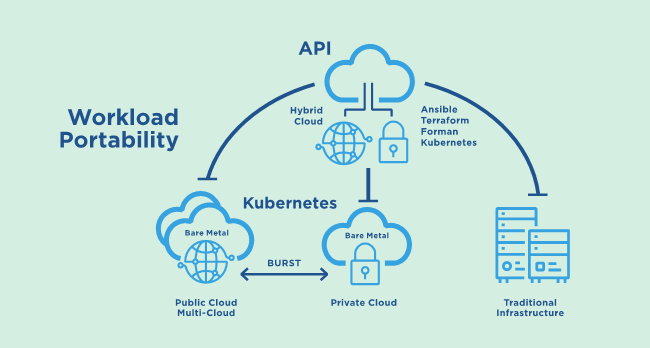
The image below depicts a portable workload infrastructure, which balances auto-scaling with the cost savings of better-utilized resources by sharing workloads across the infrastructure:
Within this architecture, if your business experiences periodic spikes in activity, bursting workloads to the public cloud during those times offers the best economics. When the workload is relatively consistent, a private cloud or a colocation data center will, most likely, reduce the long-term costs.
Native Cloud Technologies Reduce Portability
To demonstrate the importance of portability, consider the case of an IoT company that deploys thousands of thermostats, motion sensors, cameras, and microphones for customers who manage multi-building properties such as hotels, casinos, and college campuses. Knowing that services might need to scale quickly during busy periods for customers—such as a big event at a hotel or casino or the beginning of a college semester—the IoT company decided to develop its platform to manage and monitor the devices using technologies that were native to its hyperscale public cloud platform.
The platform-native approach seemed to make sense at first. After all, it was easy to quickly deploy applications in the cloud infrastructure, but one year later, the hyperscale environment was needed only 20% of the time. During the remaining 80%, the IoT company was essentially paying an elasticity tax on compute resources that were dormant during low workload time periods. Plus, the cost to host the environment increased rapidly as the infrastructure began to accumulate large data sets.
This is a case in which, once the initial workload stabilized, it would have made sense to move the base infrastructure into a virtual private cloud where the compute costs are lower. The IoT company could also set up on-ramp interconnects to a hyperscale cloud platform to expand compute capacity cost-efficiently when the workload spikes occur. However, this approach is predicated upon developing an initial environment utilizing application container management tools, such as Kubernetes, and provisioning tools, such as Ansible and Terraform, which are open source and can function in any cloud, on-premises, or colocation data center.
In this case, the IoT company relied on technologies that were native to the cloud platform provider. Porting such an environment to another cloud provider or a colocation or on-premises data center would be costly. If the company had avoided the native approach, they would have had the flexibility to easily port their applications to any cloud environment and leverage a hybrid approach that allows them to migrate workloads according to user demand.
Upfront Sacrifice Generates Long-Term Savings
The cloud is a great place to give birth to an application. It’s the fastest way to make the application available to end-users, and if the workload demand explodes, you can easily scale compute resources to ensure positive user experiences.
However, as the application workload begins to mature by stabilizing and accumulating large data sets and transactions, the costs of the cloud can quickly escalate. That’s when it often makes sense to move a portion of the infrastructure to a colocation data center or private cloud environment.
The key is to design for that portability now. As you evaluate IT infrastructure partners, assure they have these now or within their product roadmap:
Industry-standard APIs using open source technologies for mobility among environments in the cloud, on-premises, and in colocation data centers
Containerization so that your virtualized infrastructure shares the same operating system
Cloud on-ramps to facilitate your application’s portability
Security to protect your data as it moves to and from the cloud
By avoiding the temptation to develop applications with technologies that are native to a particular cloud platform you might sacrifice the ease of deployment upfront, but you can generate long-term cost savings for your company while giving your business the flexibility it needs—now and in the future.
About the Author: Rob Lerner is a 22-year industry veteran who has held leadership positions in solutions engineering and sales, always holding a customer-first mentality.
Aligning your workloads to the right infrastructure environments gives you the ability to balance application performance, scalability, control and costs. But oftentimes, CIOs and other IT leaders feel the pressure to move all workloads to the public cloud, thinking it will deliver these attributes. More often than not, the ideal approach is a hybrid infrastructure that spans not only the public cloud, but also private cloud, on-premises, and colocation data centers.
The key is to determine the right hybrid mix for each application workload, which starts with asking the right questions. It also helps to put your situation into context—by considering scenario use-cases encountered by other businesses that have taken on the same challenge.
Here’s a rundown of several situations that outline primary alignment issues and the approach to address those concerns:
Consistent Workloads—If your application workload requires roughly the same compute resource capacity every day, then the cost to run it in the public cloud vs. a data center will be significantly more expensive. You may also run into issues if you expect consistent performance from servers in the cloud. Conversely, dedicated servers in an on-premises or colocation data center that you control will deliver more predictable performance. A related scenario involves static workloads, such as databases and back-office systems, that run all day long. From a cost standpoint, they are best served in a colocation data center. Compared to the public cloud, it’s less expensive to buy and deploy gear in a colocation rack, let it run for three to five years, and then replace it with new technology.
Noisy Neighbors—When sharing servers in the public cloud, the performance of virtual machines can change drastically, depending on whether you have co-tenant “noisy neighbors” that use up extra network bandwidth and storage I/O, or memory and CPU resources on the same server. This means the resources you have access to will decrease. It’s also difficult to know in advance that such resources are not available until your users (or your customers) try to access the servers. Performance could suddenly decrease by 50% or more.
High Throughput Requirements—The big public cloud providers charge high fees to push bandwidth out to the Internet. In some cases, they charge you when transferring data from one of their data centers to another. So if your application requires high throughput at a consistent and predictable level, an on-premises or colocation data center is your least-expensive option. You might also consider a Content Delivery Network provider, which focuses on throughput delivery and costs much less than a public cloud platform.
Application Scalability vs. Resource Efficiency—If scalability is the primary driver for your workloads, you may head down a path of applications that run inefficiently. That’s because developers tend to write code for cloud applications as though there will always be unlimited compute resources. They sometimes build inefficient software that automatically scales the workload demand without considering the required resources. If the application is used heavily, the resources will continue to scale, and costs will spin out of control. As an alternative, if the application is built under the premise of eventually moving to a data center, the compute resources can scale…but only if IT makes the conscious decision to buy and deploy another server. This approach forces developers to build applications to run more efficiently so they consume only available compute resources.
Development Costs—When developing an application, a colocation data center can be expensive. The compute resources might cost $500K to stand up the infrastructure and then develop and test the application. It’s less expensive to rent the workload from a public cloud provider where development and testing environments can connect more easily, and there’s someone in the middle to orchestrate the development lifecycle.
Security and Compliance—Mission-critical systems and sensitive data are not always appropriate to run in the public cloud. At the same time, from a cost standpoint, a company may not want to build a data center where it needs to own the gear and provide resources to manage the data center. The best alternative is a private cloud managed by a partner with expertise across the entire technology stack—including the operating system, disaster recovery, security, and compliance. For developing the software that runs in a private cloud, be sure to connect to a public cloud that can seamlessly upload updates to the private cloud.
Misconfigured Environment—If one of your applications does not perform at expected levels, it’s critical to diagnose the cause before you migrate to a new environment and add compute resources, which will increase costs dramatically. You may discover you do not need a new environment but rather a reconfiguration of your environment. Sometimes, companies using a public cloud provider keep adding CPUs and memory because their application is not working. After the compute costs skyrocket, they take a step back and realize the infrastructure was not configured properly. If the issue is load balancing, for example, this can be remedied with properly managed services.
Cost Optimization vs. Peace-of-Mind—If your application is subject to unexpected and sudden spikes in activity, worrying whether your servers will crash can keep you up at night. This is especially true if the application is used by customers to purchase products and services. In cases like these, where cost is a secondary consideration, the public cloud or a private cloud are usually the best options. Access to additional compute resources is virtually unlimited, and infrastructures can be designed to scale and balance workloads automatically.
The Benefits of the Hybrid Approach
Using the public cloud as your only infrastructure environment may simplify your infrastructure operations. But it also decreases your control, and while it may generate cost savings, it could also actually increase costs.
As the use-cases above illustrate, a hybrid infrastructure approach is often best for creating the optimal environment for your application workloads. Hybrid environments that include private cloud and colocation infrastructures give you the convenience of auto-scaling and the cost savings of better-utilized resources by sharing different workloads on the same infrastructure.
Private clouds and colocation data centers also give you the ability to cost-optimize for consistent performance by avoiding “noisy neighbors” entirely. And if your workload is relatively consistent, you will reduce your long-term infrastructure costs.
If you run applications in the public cloud and find it too expensive, unreliable, or unable to scale the way you expect, you don’t necessarily need to move out of the cloud completely. By working with an infrastructure partner to analyze your application scenario and its implications, you may discover you need a mix of infrastructure options that can include a private cloud, a colocation data center, or an on-premises data center.
This approach, referred to as hybrid IT, is gaining in popularity. A survey of enterprises by the Everest Group found 72 percent of respondents described their cloud strategy as hybrid-first or private-first. That same survey revealed 58 percent of enterprise workloads are currently running in, or expected to soon be in, a hybrid or private environment.
Linked Environments Increase Your Agility
When determining the best way to align your IT workloads to infrastructures in a way that ensures application performance while controlling costs, the answer is almost always a hybrid environment. Rarely does it make sense to run all applications on one infrastructure.
Different applications and even application components are usually best served by splitting them across public clouds, private clouds, colocation data centers, and on-premises data centers. And to bring end-users as close to the edge of your network as possible, you may also need to deploy workloads across multiple data centers or even a modular data center pod.
Another key is linking all environments together. This gives you the agility to move workloads back and forth among environments as requirements change.
Key Infrastructure Partner Attributes
Your infrastructure partner should be able to advise you on the ideal hybrid infrastructure for your workloads. An infrastructure partner offering hybrid cloud options provides the flexibility to adapt as business requirements evolve. They should also offer a range of IT environments to complement any public cloud deployments you might already have deployed. Here’s a rundown of the key services to gain access to:
Colocation data centers covering the entire geographic area of your customer base
Multi-tenant and private cloud environments for the flexibility to adjust to security requirements
On-ramp interconnects to public cloud platforms to accelerate file and data exchanges
Edge modular data centers to reduce application latency for clustered and rural users
The range of services your infrastructure partner provides is also an important consideration. This includes helping you plan and migrate applications from one environment to another. Your partner should also ensure a strong security posture for your environment, compliance with any pertinent regulations and corporate policies, 24×7 monitoring, and server maintenance through regular updates and patches.
Consider the Logistics
While the technical components and expert services your infrastructure partner offers play an important role, relationship logistics are also key. You want to find a partner who is easy to work with. Try to avoid getting locked into any environments by insisting on portable infrastructure contracts that don’t charge you extra to move your workloads among private cloud and colocation data centers.
Another key logistic is visibility. Check to see if your partner provides a portal or dashboard access so you can see how your infrastructure is performing in all environments. This also helps you determine when your hybrid balance may need to be adjusted, or when it’s time to move a workload from one environment to another.
In the end, infrastructure agility is the key. What you need today could change drastically tomorrow as your business requirements change.
For more information on how to align your workloads to the appropriate IT infrastructures to ensure application performance and to control infrastructure costs, contact DataBank today.
DataBank, a leading provider of enterprise-class colocation, interconnection, and managed cloud services, broke ground on a 200,000 sq. ft. data center in Northern Virginia, the world’s largest data center market. The groundbreaking event on December 1, 2021 featured local dignitaries including Buddy Rizer, executive director of the Loudon County Department of Economic Development.
DataBank’s new facility, IAD3, will be built on the DataBank-owned land adjacent to its current site in Ashburn, VA. IAD3 will offer 4MW of power initially with the ability to deliver up to 40MW of power. The facility will be ready for service in Q1 2023.
An area rich in fiber connectivity and tech talent, Northern Virginia has a high concentration of enterprises, technology, cloud computing, hyperscale cloud providers, and content providers that require dense interconnection and proximity to best-in-class data center infrastructure.
“We are investing extensively across our portfolio nationwide, and IAD3 represents a tremendous opportunity for our clients to take advantage of Ashburn’s location and proximity to 70% of the world’s Internet traffic. This Ashburn data center more than doubles our colocation footprint in Louden County, providing a high-quality colocation solution for cloud, content, technology and Fortune 500 customers,” said Raul Martynek, CEO of DataBank.
DataBank’s facility will incorporate the latest modular design and energy-efficient technologies available today and demonstrates DataBank’s commitment to building environmentally sustainable data center solutions.
More than 70 percent of the world’s internet traffic routes through Northern Virginia’s “Data Center Alley.” As the velocity and volume of data are rapidly increasing, Web-Scale IT organizations must have access to low latency connectivity coupled with high capacity infrastructure designed to meet stringent compliance and security requirements. IAD3 will bolster DataBank’s significant presence in this region, including its two existing facilities in Ashburn and McClean with a total of 22.5 MW of power across 111,000 sq. ft. of raised floor data center space.
DataBank’s facilities are compliant with FedRAMP, HIPAA, PCI-DSS, FISMA, SSAE-18, ITAR, NIST 800-53, Flips 140-2. The company offers the full spectrum of cloud services, including Hybrid, Public, Private, Managed, IaaS, PaaS, Storage as a Service. Its 60+ data centers across 29 markets are all carrier-neutral and collectively support 30,000+ interconnections, along with robust connectivity options such as Metro Transport, Nationwide MPLS, Managed Internet, and Cloud Direct Connect.
For more information on DataBank’s interconnection and data center ecosystem, please visit https://www.databank.com or call 800-840-7533.