While companies in a wide range of industries could benefit from reliable, high-performance, for today’s gaming companies this is especially true. These requirements are much more than a “would be nice to have” item on the business’s wish list; in gaming, they can make the difference between success and failure.
One way gaming companies can ensure they have IT infrastructure that meets their needs is to partner with a colocation data center provider. Such a strategy makes sense, both to realize the many benefits from offloading on-premises IT assets but also to make better decisions about where to host critical workloads, systems, and data.
This article explores the many advantages the right colocation strategy can provide for today’s gaming companies, paving the way to better experiences, more efficient operations, cost savings, and revenue growth.
The Many Benefits of Colocation in the Gaming Industry
For those unfamiliar with colocation: This is the concept and practice of moving a company’s servers and other IT equipment into a data center owned and operated by a third party (such as DataBank). This hosting strategy reduces the complexity associated with managing on-premises IT assets by moving it to a provider who specializes in maintaining and optimizing data environments.
Colocation makes strategic sense for gaming companies. The first benefit – and perhaps the most valuable – is geographic diversity. This allows companies to choose where they want their data to be located. For many companies, these decisions support strategies for disaster recovery; yet, for gaming companies they choose to host workloads and applications at the edge. Edge computing allows gaming companies to minimize latency, take advantage of 5G, and reach their customers in their target areas for the best experiences possible.
Colocation partners also deliver an entire system of network interconnections for increased access to carriers. These interconnections help further reduce latency and provide better user experiences.
Colocation provides many significant advantages and benefits for gaming companies.
• Improved reliability and uptime: Clearly, it’s vitally important for gaming companies to have reliable, uninterrupted service because freezes, lags, slow speeds, and downtime can have negative consequences for the player experience. These issues also can lead to a bad reputation for the company, which can have a disastrous impact on revenue.
Colocation data centers are designed with redundant power, cooling, and network connectivity. Colocation vendors also provide service level agreements (SLAs), often to the “five nines” – 99.999% uptime – to support reliability and performance. All of this helps minimize the risk of service interruptions and enables the gaming company to provide a stable, consistent service for players.
• Access to high-performance IT infrastructure: Picking the right colocation partner gives gaming companies access to a wide range of high-performance infrastructure options. For example, in addition to space and power, some colocation providers offer a variety of server, storage, and networking options, which can be customized to fit the company’s specific objectives. This includes high-density servers that can manage large amounts of traffic and high-performance storage solutions that can handle massive volumes of game data.
• Enhanced security: Colocation data centers have many layers of physical and network security to help protect against unauthorized access, theft, and cyberattacks. This includes security measures such as 24/7 surveillance, biometric access controls, advanced fire suppression, and a portfolio of managed cybersecurity services. Such a comprehensive focus on security helps gaming companies protect valuable IT assets – and the business itself – from physical as well as cyber threats.
• Improved scalability: Like many other businesses in other industries, gaming companies must be able to quickly scale up (or down) their IT infrastructure to meet constantly changing demands. The right colocation partner can offer the best mix of services beyond space and power to help these companies quickly and easily add or remove servers, virtual machines, data storage, and networking resources as needed. This helps them respond to spikes in player demand and ensure they can provide a seamless and consistent gaming experience.
• Cost savings: Building and managing an in-house data center can be extremely expensive. Choosing to go the colocation route allows gaming companies to benefit from the economies of scale by sharing the cost of infrastructure with other tenants. This means gaming companies can access high-performance IT infrastructure at a lower, more predictable cost than they might face by purchasing servers, related software, and the real estate to house them.
• Support services: Colocation also offers the advantage of access to experienced support staff and other services professionals. For example, colocation data center providers employ teams of highly skilled IT professionals who specialize in maintaining and optimizing data center environments as well as their clients’ workloads, systems, and overall environment. These experts can provide around-the-clock support, ensuring that any issues are quickly resolved, and minimizing potential downtime. This frees the gaming company’s staff from the burden related to IT management so they can focus on core business operations.
With all of these capabilities and business benefits, colocation data centers can be the best strategy for gaming companies looking to better manage infrastructure and even gain a new competitive edge.
To learn more about DataBank and how our colocation data centers help gaming companies – and businesses in virtually every industry – accomplish their most critical objectives, please visit www.databank.com today.
The terms “cloud” and “cloud computing” have become popular in recent years as individuals and businesses have become more familiar with the many benefits cloud services can provide. Yet, for many people, cloud computing is still a vague and confusing concept.
If you’re not completely sure what cloud computing is, how it works, and which model is right for your business, don’t worry, you’re not alone. This article will break down the basics of cloud computing by describing how it works and the many benefits various cloud computing models can provide. I’ve also described one or two surprises that still catch many businesses off guard and may indicate that some cloud computing models may not be a perfect fit for your business.
The Benefits of Cloud Computing
First things first: What is cloud computing exactly? At its core, cloud computing is the practice of using remote servers to store, manage, and process data and perform other computing functions instead of using on-premises servers. For many companies, cloud computing is an attractive option over traditional on-premises infrastructure since it can deliver many valuable advantages and business benefits.
1. Scalability: Businesses can easily scale their infrastructure up or down as needed, without worrying about investing in expensive hardware or maintaining a complex network of servers and related software.
2. Flexibility: Since cloud computing approaches give companies access to their data, applications, and other infrastructure assets from anywhere, using virtually any device, businesses can enjoy more flexibility when it comes to business processes and options.
3. Cost-effectiveness: At face value, cloud computing services can be more affordable than traditional on-premises infrastructure because companies pay for only what they use and don’t have to worry about the cost of purchasing and maintaining hardware.
However, companies should be very careful when evaluating and understanding certain policies and charges. For example, many public clouds have data ingress and egress fees that can add up quickly and become an unpleasant surprise.
4. Improved security and data backup: Cloud computing providers typically offer powerful security measures and automatic data backup, which can help protect data from cyber threats and disasters. In many cases, these security measures can be stronger than what a company could achieve on its own, helping avoid data breaches, ransomware, and other cyber-attacks as well as comply with stringent data privacy regulations.
Once companies have decided that cloud computing is right for them, they should then begin to plan and evaluate how to select and deploy the best model possible.
Cloud Computing Models
There are many different types of cloud computing models and approaches, each with its own benefits and challenges. Here is a closer look at three of the most common:
1. Public cloud: This generally refers to services such as Amazon Web Services, Microsoft Azure, and Google Cloud (hyperscale cloud providers), which provide shared, multi-tenant access to servers and other computing resources over the internet.
For many, the word “public” may seem counter-intuitive since public clouds keep each company’s data and applications hidden – seemingly “private” – from other customers. This may seem to be private clouds, but in this case, the term, public cloud simply refers to a cloud computing model that shares computing services with many different companies.
Still, public clouds can present some challenges. For example, it may not be as easy as it may seem to set up, deploy, and manage public cloud infrastructure, especially if the client company doesn’t have the experienced IT staff required. Additionally, while hyperscaler vendors promote public clouds as being less expensive than on-premises infrastructure, data ingress and egress fees can add up quickly and become an unpleasant surprise.
2. Private cloud: A private cloud is a dedicated cloud infrastructure that is designed and managed for a specific business, either as on-premises infrastructure or through a third-party provider. Since the company has more control over private clouds, it can offer more flexibility to meet the business’s specific demands and can also be more secure. Be aware that a private cloud infrastructure can also be more expensive and difficult to manage.
3. Hybrid cloud: As the name suggests, a hybrid cloud combines elements of public and private cloud computing models. This approach can give the company maximum flexibility over its IT infrastructure to meet its specific goals related to cost, scalability, performance, security, and control.
Each one of these models offers its own advantages as well as complicating factors. They should all be carefully considered as part of a larger IT strategy to make the best decisions possible.
The DataBank Difference
Interested in learning more about DataBank and our approach to cloud computing and infrastructure platforms? Please visit www.databank.com today.
If you need to catch an infrastructure connection in New York City or Newark, DataBank has just the right carrier hotel data center for you. Deploying your IT compute resources in a carrier hotel gives you several benefits:
• Fast Delivery: Quick installation intervals speed your time-to-market for new services
• Carrier Selection: A diverse range of many telecommunications service providers
• Low-Latency Performance: Direct access to carrier backbones
• Arbitrage Costs: Competition among the carriers drives down customer pricing
• Scalability: Flexibility to select carriers without physically moving equipment to another data center
Whether you need to connect to an internet service provider, network service provider, or peering exchange, DataBank has interconnection points where you need them at our three carrier hotel data centers serving the greater NYC area:
LGA1 – 60 Hudson Street, New York City
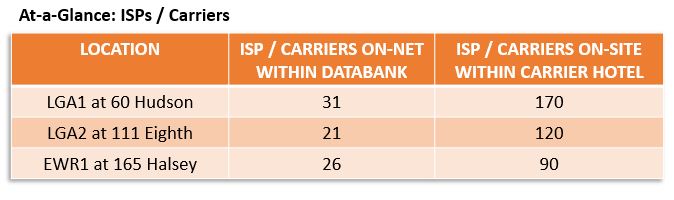
More than 100 domestic and global telecommunications companies have established colocation interconnects inside DataBank’s secure LGA1 environment. This data center is located in one of North America’s premier carrier hotels in the Tribeca neighborhood of Manhattan. Previously, the building was the headquarters of Western Union and known worldwide for providing telegraph services.
With 700,000 square feet of floor space, the building is 24 stories tall and remains a well-recognized communications center with a nerve system of wires and cables reaching every corner of the nation and the world. Since the late 1990s, 60 Hudson Street has housed colocation operators and is recognized today as the main internet hub in the Northeast U.S. DataBank has unique responsibilities here since the 60 Hudson Meet Me Room is operated by DataBank. This means the 100+ domestic and global telecommunication companies that have a presence in the building can get interconnected via DataBank maintaining a carrier-neutral site.
LGA2 – 111 Eighth Avenue, New York City
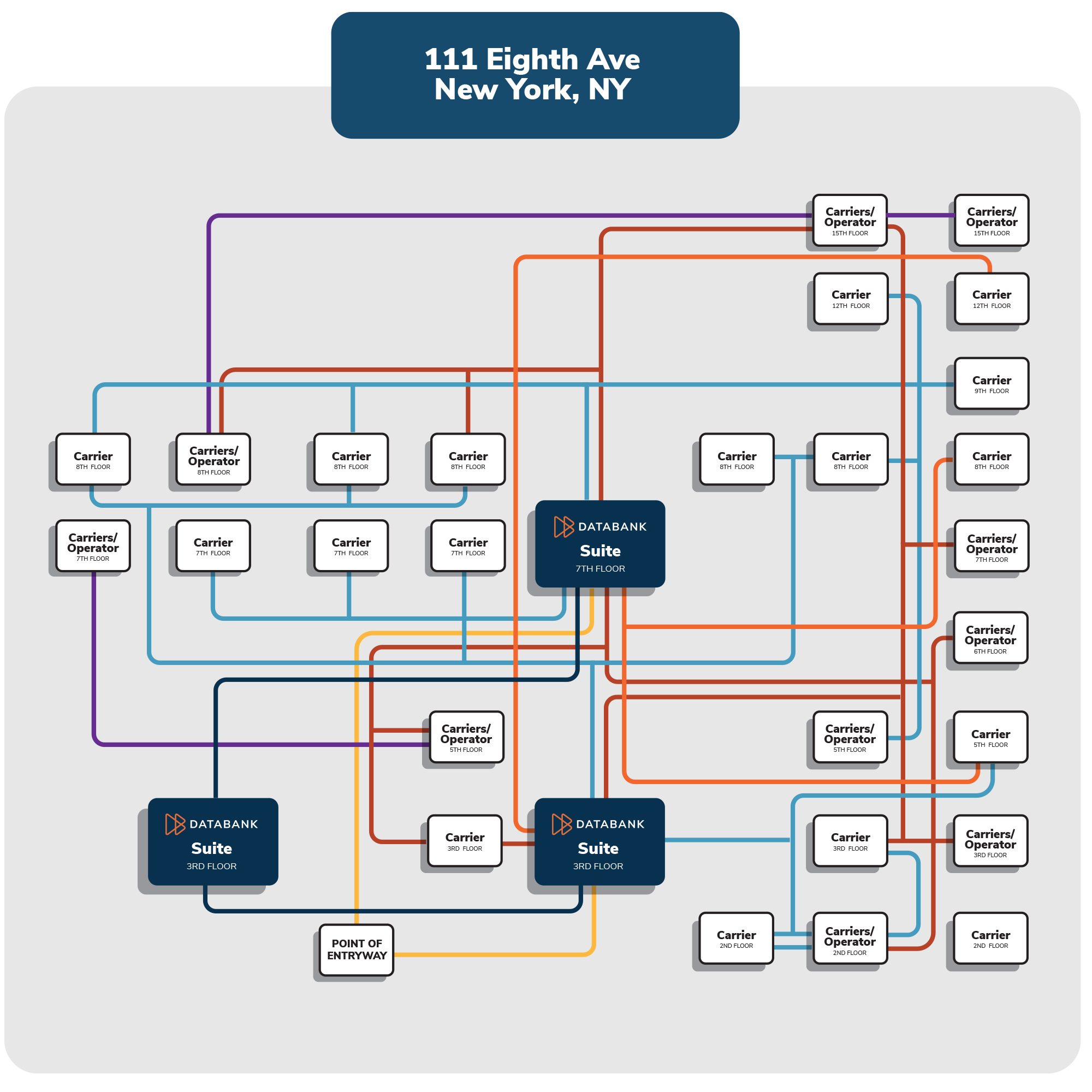
Also located in Manhattan, LGA2 is in a carrier hotel building that’s bigger than the Empire State Building and currently serves as the Google NYC headquarters. The building was originally the core piece of a plan created by the NYC Port Authority to reshape the region’s transportation network.
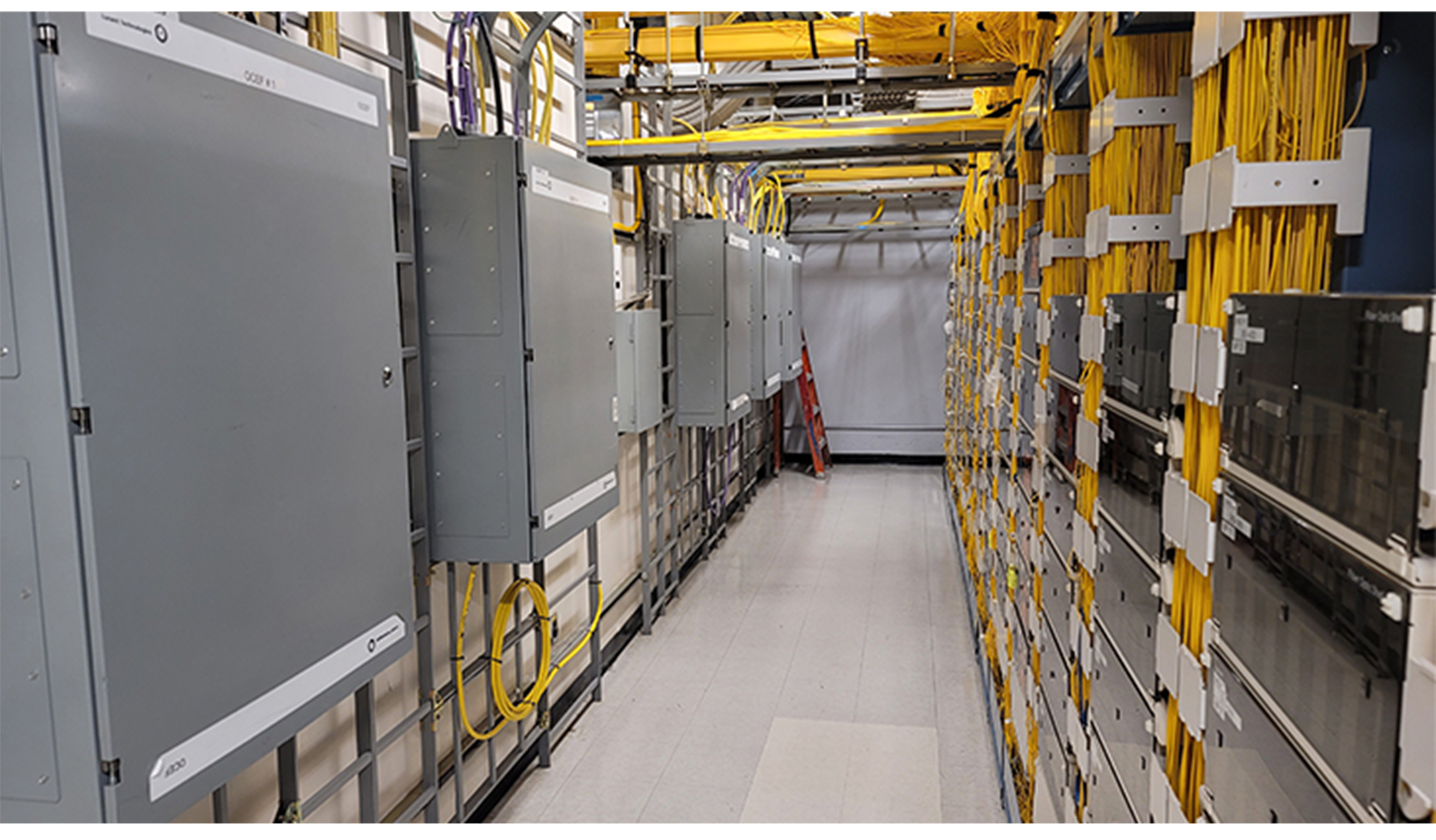
At 2.9 million square feet of floor space and 16 stories high, 111 Eighth Avenue has one of the largest footprints in Manhattan, taking up an entire city block. Some call it a skyscraper built on its side. In 1998, the building owners started bringing in the backbone infrastructure of the internet and internet tenants, and today the location is adjacent to trunk fiber optic lines—with access to 13 carrier hotels and 100 enterprise buildings in NYC and northern New Jersey.
Connectivity at LGA2
EWR1 – 165 Halsey Street, Newark
This carrier hotel, EWR1, formerly known as the Bamberger Building, was initially designed as a department store. The 14 stories span 1.2 million square feet covering an entire block, and large open areas make it ideal for telecommunications equipment and data center operations.
As a major colocation center for the New York metropolitan area, the building is among the world’s largest carrier hotels and the principal access point of the Apollo optical submarine communications cable system crossing the Atlantic Ocean. Major financial exchanges have established a presence in the building, including the New York Stock Exchange and Nasdaq.
All three current data centers provide four internet exchange points, including a direct connection to DE-CIX Internet Peering Exchange, the fourth largest exchange in the U.S., and the largest neutral exchange on the Eastern seaboard. The data centers also leverage numerous submarine cable connections to accelerate communications and data exchanges across the Atlantic.
Interconnection Services
· Access to multiple entryway points, diverse riser paths, and numerous fiber networks.
· Console Connect and Megaport cloud on-ramps—using a combination of virtual cross-connects, intra-building risers, and local loop connectors.
· Extensive internal cross-connects and risers among DataBank data center rooms and with other data center operators in the carrier hotels.
Coming Soon: Expanded Capacity in New York
The three DataBank data centers at carrier hotels in NYC and Newark provide infrastructure services to more than 175 customers—spanning telecom, mobile carriers, entertainment, healthcare, media, IT, and other industry sectors.
For added compute capacity and data backups, DataBank is building LGA3 in Orangeburg, NY, and tethering it to LGA1 and EWR1 upon opening in early 2024. LGA3 will offer 40 MW in over 200,000 square feet as a greenfield build where the benefits of these highly connected carrier hotels will be available via DataBank’s managed interconnection services. With over 45 network providers combined within LGA1 and EWR1, LGA3 customers will have immediate access to these providers with many providers having diverse Points Of Presence within LGA1 and EWR1.