The tech talent gap refers to the shortage of skilled IT professionals needed to support modern infrastructure and digital transformation.
The technology hiring landscape has fundamentally changed in the past few years. Following the pandemic reopening, tech job postings more than doubled as remote work exploded, venture capital flooded the sector, and low interest rates fueled aggressive growth. Yet, when the Federal Reserve raised interest rates in 2022, tech job listings plummeted. The collapse continued through 2023 and then stabilized at significantly lower levels.
Now, tech job postings sit roughly 35% below pre-pandemic levels and have stayed relatively steady since mid-2025. Even with widespread layoffs and economic uncertainty, companies still struggle to attract and retain the technical talent they need to grow. The challenge isn’t volume since recruiting teams are usually flooded with applications. The market itself has shifted. While there’s a surplus of candidates for generalist technical roles, deeply specialized positions remain extremely difficult to fill.
For talent acquisition leaders, the pressure is mounting from multiple directions. Hiring managers want specific skill sets, finance wants lower costs, and leadership wants faster time-to-hire. One thing is clear: Success isn’t about offering the highest salaries. It’s about rethinking your entire approach to finding, evaluating, and keeping technical talent.
Here are the strategies and practices that are actually producing results in today’s technical hiring market.
Stop Hunting for Unicorns
The unicorn hunt needs to stop. Too many organizations create job descriptions that read like impossible checklists: seven years of experience with a framework that’s only existed for four, mastery of twelve different programming languages, expert-level knowledge in cloud architecture, DevOps, security, and data science. These descriptions tend to screen out anyone who doesn’t tick every box, even when most of those skills are transferable or learnable in weeks.
This approach ignores how fast technology changes. Today’s must-have stack could be outdated in 18 months. More importantly, it prices you out of the market. When you’re looking for candidates with every possible qualification, you have to pay premium rates. Then you’re stuck choosing between people you can’t afford and roles that stay open for months.
The better approach? Work with the hiring manager to identify three non-negotiables and evaluate everything else based on adaptability and learning ability. A strong engineer who knows how to learn will outperform someone with the perfect resume but no curiosity.
What Actually Attracts Technical Talent
Candidates need to understand their “why.” Technical talent wants to know why this role matters to them personally. What problem will they solve? How does their work connect to the bigger picture? What impact will they have if they succeed? If hiring managers can’t articulate this clearly during the interview process, they’re already losing people.
Demonstrate autonomy and trust early. Top performers want the freedom to solve problems their way, not follow a prescribed playbook. They want to put their fingerprints on something and make it uniquely theirs. That means giving them ownership over projects, not just tasks. The interview process itself should reflect this culture. Talk about how decisions get made, how much independence technical employees have, and what kind of trust they’ll be given from day one.
Make career growth concrete and visible. Technical candidates want to know what certifications and training you’ll support, what skills they can develop, and what their trajectory could look like in the first year. Vague promises about “growth opportunities” don’t resonate with people who are evaluating multiple offers. Be specific about what advancement actually looks like in your organization and show them there’s a clear path forward, not just a job.
Making the Final Decision: What Tips the Scale
Executive engagement makes a bigger difference than most companies realize. For a recent VP-level hire, the candidate had multiple offers on the table, including ones that paid more. What made the difference? Direct conversations with the CEO about vision and strategy, a meeting with the CFO to discuss equity and long-term value, and time with peers to understand the team dynamics and day-to-day reality of the role.
Flexibility on the logistics mattered as well. In this case, being willing to accommodate specific needs during the transition showed good faith. It’s not about bending over backward for every candidate but demonstrating that you’re willing to work with people when it matters.
Why Technical Employees Stay (or Leave)
Career growth opportunities and autonomy drive retention more than anything else. Technical employees want to see a clear path forward, whether that’s deepening expertise, taking on leadership responsibilities, or moving into new technical domains. They also want the freedom to make something uniquely theirs. Ownership over projects and outcomes matters far more than perks or ping pong tables.
One of the most underrated retention factors is cross-organizational collaboration. When employees feel siloed or stuck working only within their immediate team, they start looking elsewhere. Technical talent stays engaged when they can reach out to anyone across the organization for support, regardless of department or hierarchy. That kind of collaborative environment is evidence of a culture where problem-solving matters more than politics.
For our company, data center tours can be very effective, too. Seeing the actual facilities, understanding the scale of operations, and grasping how their role would impact real infrastructure makes the position more tangible for prospective employees. In these cases, candidates can visualize their contribution in a way that phone screens and slide decks never could.
Navigating AI in the Hiring Process
AI has changed resume screening and interviewing in ways that create new challenges for recruiters. Resumes now include obvious AI-generated content that doesn’t match the candidate’s actual experience. Interview red flags include unusual pauses, backgrounds that seem to shift or flicker, and responses that feel too polished or generic. When candidates are using AI assistance during live interviews, it becomes impossible to assess their real capabilities.
The human element remains essential despite these technological shifts. While AI tools can help with initial resume screening and ranking candidates against job requirements, someone still needs to read each application with an eye for potential. A candidate might not match the current role perfectly but could be ideal for another open position, and AI consistently misses those connections.
Authenticity has become non-negotiable in the hiring process. Clear evidence that a candidate is using AI during interviews or has fabricated his or her resume with AI-generated content leads to immediate disqualification. The focus has shifted to verifying that the person you’re interviewing is the same person who will show up on day one.
Getting Technical Hiring Right
If I had one piece of advice for organizations trying to attract and hire top technical talent, it would be this: The “why” discussed earlier needs to extend beyond the interview process. Create it for every role and make sure the candidate fully understands it before he or she accepts an offer. Help candidates see their piece of the bigger picture. Walk them through what the first 30, 60, and 90 days actually look like. Explain how they can grow within the company and what success means in concrete terms.
Too many candidates accept offers without truly understanding the daily reality of the work or how their contribution matters. When that clarity exists from day one, you get better hires who stay longer and perform at a higher level. Everything else flows from that foundation.
Data center construction trends reflect changes in power density, cooling design, sustainability requirements, and deployment speed.
The data center construction industry enters 2026 facing challenges that would have seemed unimaginable just two years ago. Rapid growth is straining every aspect of traditional construction approaches, from securing skilled labor to managing unprecedented project scales.
The fundamentals that worked for decades no longer apply. Single campuses now require 4,000 workers instead of 750. Customer specifications shift mid-deployment as technology evolves faster than buildings can rise. Construction teams must adapt to a new reality where flexibility and forward planning matter more than following established playbooks.
Based on what we’re seeing across our projects, here are the trends that will define data center construction in 2026.
Talent Shortage Will Be the Biggest Challenge
The skilled labor shortage in the data center industry will intensify significantly in 2026 as leased capacity from 2024 and 2025 finally comes online. The second half of 2026 into 2027 will see massive activation across the country, and the industry simply doesn’t have enough qualified workers to meet demand.
Project scales have multiplied beyond recognition. Where peak crew sizes once reached 750 workers, sites like DataBank’s Red Oak campus will hit 4,000 to 5,000 workers by early 2026. That’s the size of a small city, requiring entirely different management approaches than data center builds in the past.
Labor costs are rising accordingly. Workers are relocating from markets like Arizona, where power constraints have slowed construction, to booming regions like Dallas. Increased wages, per diem expenses, and relocation costs are adding up. Some operators are even establishing on-site housing with high-end amenities to attract workers.
The operators who secure skilled labor now, through early contractor commitments and creative workforce strategies, will have significant advantages over those waiting until projects break ground.
Costs Will Continue Rising
Cost increases are hitting every aspect of data center construction: power, materials, and especially people. While DataBank maintains multi-year stocking programs to lock in material pricing and minimize tariff impacts, labor cost escalation is harder to control given the talent shortage.
The type of construction matters significantly for cost management. Operators building exclusively for AI workloads can opt for cheaper approaches like steel buildings with metal panels rather than robust precast structures. However, versatile construction capable of serving any client type costs more upfront while providing long-term flexibility.
Leasing rates are rising to reflect these realities. The question becomes whether operators can absorb increased costs or must pass them to customers. Those with strong vendor relationships, economies of scale through project bundling, and long-term procurement strategies will be better positioned to manage cost pressure than competitors making reactive, project-by-project decisions.
Construction Innovation Will Address Labor Challenges
The industry is turning to technology and new construction methods to offset the skilled labor shortage. AI tools are already analyzing pull schedules to identify float and delays that would take humans hours to find manually. Robotics like autonomous site scanners perform 360-degree analysis, comparing progress against 3D BIM models with greater accuracy than human inspections.
These tools won’t immediately replace construction roles. The industry still needs experienced boots on the ground, particularly the skilled general foremen and project leaders who manage complex deployments. Quality control and administrative positions may evolve over the next five years as AI handles more analytical work.
Modular construction and prefabrication are accelerating in parallel. Electrical components, power rooms, and building modules assembled in controlled factory environments address labor constraints more effectively than on-site work. A crew of 20 to 50 workers in a factory can be more productive than managing thousands on a sprawling campus, where workers lose two hours daily just commuting to and from the site.
Managing 4,000-plus workers on a single site can also lead to safety challenges that didn’t exist at smaller scales. Setting clear rules and maintaining safety protocols becomes critical when construction sites rival small cities in population.
Financial Pressure Will Drive Market Consolidation
Power infrastructure costs are creating a significant barrier to entry. Operators pursuing geothermal energy, high-pressure gas lines with turbines, or small modular reactors face capital requirements in the hundreds of millions before a single tenant moves in. Without committed customers, it’s a major challenge to secure approval for an additional $200 million to $300 million in power infrastructure on top of base construction costs.
Utility commitments amplify the risk. Non-refundable deposits of multi-millions of dollars force developers to decide who will roll the dice and who won’t. Operators with purchase power agreements and facility engineering agreements already locked in can build more speculatively because they’ve de-risked the power equation. Those without these commitments will struggle.
Creditworthiness issues compound the challenge. Many AI-focused tenants lack strong credit profiles, forcing hyperscale cloud providers to serve as backstops for lease financing. This dynamic will intensify in 2026, particularly for shorter-term leases. The combination of massive power infrastructure costs and tenant credit concerns will separate well-financed operators with proven execution from speculative players who entered the market recently. Some will exit entirely when the financial reality becomes insurmountable.
Customer Design Requirements Will Keep Changing
Every liquid cooling deployment involves different customer requirements, and specifications continue shifting mid-project as technology evolves. For example, at our Red Oak campus, a customer’s requirements shifted from nine liquid-cooled data halls to seven mid-deployment as network capacity needs outweighed GPU processing requirements.
Design variations are significant. Some deployments require complex programmable logic controller integration while others use simpler approaches. Cooling distribution unit placement varies from exterior-mounted to in-cabinet configurations. Air cooling remained relevant even in late 2025, with enterprise customers and some financial firms still specifying significant air-cooled capacity alongside liquid infrastructure.
The key is building flexibility into designs from the start rather than attempting expensive retrofits later.
Permitting and Community Engagement Will Intensify
Despite administration comments about fast-tracking AI data centers, the reality on the ground is moving in the opposite direction. Permitting processes are becoming more delayed, with additional third-party engineers reviewing applications and more stringent approval requirements. This trend will continue as a significant challenge over the next few years.
Community engagement has become essential to successful project development. Many communities harbor misconceptions about data centers, conflating them with AI development or robotics manufacturing rather than understanding they enable everyday digital services. Education and early relationship building with local stakeholders are now critical components of the development timeline, not optional add-ons.
Building for What’s Next
The only certainty in data center construction for 2026 is uncertainty. Technology will evolve faster than project timelines. Customer requirements will shift mid-deployment. Costs will surprise even the most careful planners.
Success belongs to construction teams built for adaptation rather than those optimized for efficiency in stable conditions. The ability to pivot quickly, maintain optionality in designs, and solve problems creatively matters more than following the playbook that worked last decade.
Want to see how DataBank is navigating the evolving data center construction landscape? Check out DataBank Digest for more insights on managing talent challenges, cost pressures, and the innovative approaches shaping infrastructure development in 2026.
Corporate social impact programs highlight how organizations support communities, education, and social initiatives.
At DataBank, we believe that being a good neighbor means more than just operating reliable infrastructure. It means showing up for the communities where our teams live and work, supporting the people who need it most, and creating a culture where giving back is woven into everything we do.
DataBank Cares empowers employees to give back through volunteer time, charitable donations, and community partnerships across all our locations.
2025 was a remarkable year for DataBank Cares, our company-wide initiative that empowers employees to lead community engagement efforts through volunteer time, organized campaigns, and direct support. From coast to coast, DataBank teams demonstrated what’s possible when technology companies commit to making a tangible difference beyond the data center walls.
The numbers tell an impressive story: 857 hours of Volunteer Time Off (VTO) contributed across dozens of initiatives, thousands of pounds of food and supplies donated, hundreds of letters written to troops overseas, and a groundbreaking employee hardship fund that raised over $40,000.
Yet, behind every statistic are the people who made it happen: employees who chose to give their time, energy, and resources to support their neighbors.
Here’s how DataBank teams showed up in 2025.
Environmental Stewardship: Earth Day and Beyond
We kicked off the year in April with Earth Day initiatives that demonstrated our commitment to environmental responsibility in the communities we serve. Teams across our network organized cleanup events and donation drives that made immediate, visible impact.
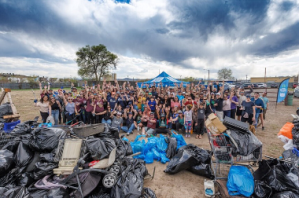
In Denver, our metro team joined forces with 250 volunteers in partnership with Protect Our Rivers, removing nearly 5,000 pounds of trash from local waterways. The effort represented hours of hands-on environmental work that directly improved the natural spaces on which our community depends.
DataBank employees joined 250 volunteers in partnership with Protect Our Rivers to remove nearly 5,000 pounds of trash from local waterways during Earth Day 2025.
Meanwhile, at our Salt Lake City campus, the team organized a comprehensive donation drive for the SLC Rescue Women’s Shelter, collecting 24 bags and 7 boxes of clothing and feminine products, along with $400 in cleaning supplies. The initiative addressed immediate needs while demonstrating how data center teams can mobilize resources to support vulnerable populations.
Kindness in Action: Supporting Women Experiencing Homelessness
These weren’t just supply kits. They were carefully curated packages of essential items that provide dignity and support during difficult circumstances. The campaign brought together employees from multiple locations who shared a commitment to addressing homelessness with compassion and practical assistance.
Women of DataBank employee resource group members assemble Kindness Kits during a company-wide initiative that created over 650 kits for women experiencing homelessness across four cities.
The initiative reflected DataBank’s belief that employee resource groups aren’t just internal networks. They’re engines for community impact. When employees lead efforts they’re passionate about, the results are more authentic, more meaningful, and ultimately more effective.
Fighting Food Insecurity Across Four Markets
From August through September, DataBank launched a company-wide food drive that mobilized teams across our 65+ data center locations. The results exceeded our own expectations:
Denver led the charge again, donating 1,806 pounds of food to the Food Bank of the Rockies. That’s enough to provide 1,500 meals for families facing food insecurity across the Rocky Mountain region.
Salt Lake City collected 554 pounds of food and raised $300 for Tabitha’s Way, a Utah organization serving families in need. The team went further by contributing 43 bags of clothes and six boxes of additional items to Tabitha’s Way, plus approximately 25-30 handmade fleece blankets and clothing for Primary Children’s Hospital, bringing comfort to young patients during difficult times.
Houston gathered 286 pounds of food for the Houston Food Bank, carefully assembling donations that included over 130 cans of soup and chili, more than 100 cans of vegetables, 70-plus boxes and bags of pasta and rice, dried fruit, juices, and 12 bottles of prenatal vitamins, essential nutrition for expectant mothers.
Dallas-Fort Worth contributed 174 pounds of food to the North Texas Food Bank, translating into 145 meals for families in need. The team extended its giving through a month-long Season of Giving initiative that included toy drives benefiting Toys for Tots.
Orangeburg, New York delivered a diverse collection of food items to the Church of the Ascension in New Milford, New Jersey, partnering with local faith organizations to maximize community impact.
DataBank employees across eight locations wrote over 500 letters of gratitude to U.S. military service members through A Million Thanks.
Research consistently shows that letters from home significantly boost morale and mental wellbeing for deployed troops. These personal connections remind service members that their sacrifices are recognized and valued by the communities they protect.
The campaign also highlighted individual dedication, like Senior Security Architect Stephen Maiorca, who has been handcrafting wooden pens for deployed service members since 2017. Each pen requires about two hours of work, and Maiorca donates them to “For The Troops,” a Simi Valley organization that creates care packages. His ongoing commitment, inspired by veterans in his own family, exemplifies the personal passion many DataBank employees bring to community service.
During the launch event for the library’s STEAM (Science, Technology, Engineering, Arts, and Mathematics) class, students gathered to watch the technology in action, selecting from pre-loaded designs and learning how these machines transform digital files into physical objects. Each student left with a 3D-printed holiday figurine he or she painted and personalized. Yet, more importantly, students left with deeper understanding of modern manufacturing technology and the creative possibilities it opens up.
DataBank partners with Red Oak Library to bring hands-on STEAM learning and 3D printing technology to local students.
The take-home aspect makes this program is particularly impactful. By allowing families to check out the printer kits, the library removes barriers to technology access and gives students the chance to experiment at their own pace. When you’re building significant infrastructure like our Red Oak campus—a 292-acre development that will deliver eight data centers and 3.4 million square feet of AI-ready infrastructure— being a good neighbor means investing in the young people who represent the future workforce.
Holiday Season Giving
DataBank teams closed out the year with widespread holiday initiatives. Across eight data centers, employees donated over 500 toys and $200 to the U.S. Marine Corps Toys for Tots drive, spreading holiday joy to children in need.
Throughout the year, DataBankers also participated in the #DataCentersSleevesUp2025 virtual blood drive and helped build homes for the Sleep in Heavenly Peace Foundation, demonstrating the breadth of causes our teams support.
Supporting Each Other: The DataBank Cares Fund
Perhaps, the most significant development in 2025 was the launch of the DataBank Cares Fund, created to help employees facing unforeseen disasters or personal hardships. The fund relies on support from DataBank Holdings Ltd. and individual donations from employees, partners, and the general public.
Launched in November 2025, the employee giving campaign exceeded all expectations. DataBank employees gave anonymously and surpassed the company’s internal goal, raising nearly $23,000. DataBank matched these donations, creating a fund of over $40,000 to assist any DataBank employee in need.
This initiative reflects a fundamental truth: When we take care of each other, we build stronger teams and stronger communities. Every donation contributes to a safety net that provides grants when they’re needed most.
A Culture of Giving Back
The success of DataBank Cares in 2025 demonstrates what happens when employees lead initiatives about which they’re passionate. From employee resource groups organizing Kindness Kits to individuals handcrafting gifts for troops, these efforts reflect genuine commitment rather than corporate obligation.
Operating critical infrastructure comes with responsibility to support the communities where we’re located. DataBank teams find meaningful ways to give back year-round—from food banks and schools to children’s hospitals and our own employee support systems.
We’re proud of what our teams accomplished in 2025 and grateful to the organizations serving people in need. As we look toward 2026, we remain committed to being the neighbors our communities deserve—present, engaged, and ready to help when it matters most.
Together, we’re building stronger communities, one act of service at a time.
Want to see more stories about DataBank’s community involvement and industry leadership? Check out DataBank Digest for more insights on data center industry trends and infrastructure strategy.
AI-powered network operations use machine learning and automation to monitor, optimize, and manage network performance at scale.
Today, enterprise AI deployments are reshaping network demands faster than traditional infrastructure management can adapt.
Consider the scale: Machine learning models require massive datasets to move quickly between storage, compute, and processing nodes, often saturating network links for hours or days during training runs. Additionally, inference workloads add another layer of complexity, demanding microsecond-level latency to deliver real-time results.
As organizations scale from pilot projects to production AI, these demands multiply across hundreds or thousands of interconnected systems, creating network complexity that manual management simply can’t handle.
When Manual Management Hits Its Limits
For data center providers, this creates a difficult equation. Customers expect their AI workloads to run at peak performance with minimal latency and zero downtime. However, delivering that level of service means managing exponentially more network traffic, monitoring thousands of potential failure points, and responding to issues before they can affect workloads.
Yet traditional network operations approaches such as reactive monitoring, manual optimization, and scheduled maintenance windows simply can’t scale to meet these demands without adding substantial cost and operational overhead.
The answer lies in applying AI to the very infrastructure that supports AI workloads. By using machine learning to monitor network health, predict bottlenecks, and automatically adjust configurations, data center operators can deliver the performance AI customers require while maintaining operational efficiency. This approach rests on three fundamental capabilities: observability, optimization, and automation.
The Three Pillars of AI-Powered Network Operations
These three pillars work together to transform how data centers manage connectivity infrastructure. Observability provides deep visibility into network performance and behavior. Optimization uses that visibility to continuously improve how the network operates. Automation reduces manual intervention while enabling faster, more consistent responses to changing conditions. Together, they allow operators to maintain the performance and reliability AI applications require at scale.
Here’s a closer look at how each capability works in practice.
Observability
Traditional network monitoring provides basic metrics like bandwidth utilization and uptime percentages. Yet AI workloads create traffic patterns that shift dynamically based on training schedules, data pipeline flows, and inference request volumes. Understanding network health requires deep visibility into these patterns.
AI-powered observability platforms process massive amounts of network telemetry data in real time, detecting anomalies before they become problems. Machine learning models can detect subtle patterns that indicate a switch is beginning to fail, a fiber connection is degrading, or traffic is routing suboptimally. This level of insight allows operators to understand not just what is happening on the network, but why it’s happening.
The result is a shift from reactive troubleshooting to proactive management. Instead of waiting for customers to report performance issues, operators can see problems developing and address them before they impact workloads.
This visibility becomes especially critical as AI deployments scale and network complexity grows beyond what manual monitoring can effectively track. Strategic interconnection decisions that reduce latency and improve path diversity make this observability even more valuable, allowing operators to optimize performance across increasingly complex network topologies.
Optimization
Network optimization has traditionally relied on periodic analysis and manual configuration changes. Engineers review performance data, identify bottlenecks, and adjust routing or bandwidth allocation during maintenance windows. This approach works for relatively stable workloads but struggles with the dynamic demands of AI infrastructure.
AI-powered optimization operates continuously, analyzing traffic patterns and automatically adjusting network configurations to improve performance. Machine learning algorithms can predict when certain network paths will become congested and proactively reroute traffic. The right connectivity architecture makes this optimization possible by providing the diverse paths and direct connections AI workloads require. They can allocate bandwidth dynamically based on workload priority, ensuring critical AI training jobs get the resources they need while maintaining service levels for other applications.
This continuous optimization delivers measurable improvements in network efficiency and application performance. Latency drops, throughput increases, and resource utilization improves without requiring constant manual intervention.
Automation
Network engineers spend significant time on routine tasks like responding to alerts, updating configurations, and troubleshooting connectivity issues. As network complexity grows with AI workload demands, these manual processes become bottlenecks that limit how quickly operators can respond to problems or scale infrastructure.
AI-powered automation handles many of these routine tasks without human intervention. Systems can automatically remediate common issues, adjust configurations based on changing conditions, and even predict maintenance needs before equipment fails. This reduces the operational burden on engineering teams while improving response times from hours or days to minutes or seconds.
Automation also brings consistency to network operations. Configurations are applied uniformly across infrastructure, reducing the risk of human error. Engineers can focus on strategic initiatives rather than firefighting daily issues, improving both operational efficiency and service quality.
Together, these three capabilities create a network management approach that matches the scale and complexity of modern AI workloads. Observability reveals what’s happening across the infrastructure, optimization ensures it operates efficiently, and automation enables rapid response without manual intervention.
Infrastructure Ready for AI’s Future
As AI workloads continue to grow in scale and complexity, the network infrastructure supporting them must evolve beyond traditional management approaches. AI-powered network operations provide the observability, optimization, and automation capabilities needed to deliver the performance and reliability enterprise AI applications demand.
By applying intelligence to the network layer itself, data center operators can meet customer expectations while maintaining operational efficiency at scale. The result is infrastructure that doesn’t just support AI workloads but adapts and improves alongside them.
Want to stay ahead of infrastructure technology trends like these? Check out DataBank Digest for more insights on data center industry trends and infrastructure strategy.
Corporate community programs support education and workforce development by providing resources, technology access, and learning opportunities.
When you think about what makes a community thrive, technology access is often at the top of the list. That’s why we’re excited to share that DataBank recently partnered with the Red Oak Public Library in Texas to help bring hands-on 3D printing technology directly into the hands of young students.
Through DataBank’s sponsorship, the library was able to purchase five 3D printers that students can check out and use at home. During the recent launch event for the library’s STEAM (science, technology, engineering, arts, and math) class, students gathered around the printers to watch the technology in action, selecting from pre-loaded design options and learning exactly how these machines transform spools of filament into finished objects.
DataBank’s partnership with Red Oak Library brings cutting-edge STEAM resources and hands-on learning to local students.
Each student left with a 3D-printed holiday figurine (a snowman or gnome) that they painted and personalized. Even better, they left with a deeper understanding of how modern manufacturing technology works and the creative possibilities it opens up.
Taking Technology Home
The take-home aspect of this program is particularly meaningful. By allowing families to check out the 3D printer kits, the library is removing barriers to technology access and giving students the chance to experiment and create at their own pace.
“We’re thrilled to offer these take-home 3D printers to our community,” said Heather Fuller, Red Oak Public Library Director. “When students can take this technology home and experiment at their own pace, it opens up possibilities that go far beyond a single class session. They’re not just learning how the technology works, they’re discovering what they can create with it.”
Building Community Through Infrastructure
This partnership reflects DataBank’s commitment to supporting the communities where we operate. Red Oak is home to our newest data center campus—a 292-acre mega-development that will deliver eight data centers and 3.4 million square feet of AI-ready infrastructure.
When you’re building something this significant in a community, being a good neighbor means more than just construction jobs and tax revenue. It means investing in the people who live here, especially young students who represent the future workforce. Programs like this 3D printing initiative give students hands-on access to technology that builds skills and sparks curiosity—the same innovative thinking that drives the work happening at our campus. When students in our communities have access to tools that open doors to technical careers, everyone benefits.
We’re proud to support the Red Oak Library’s STEAM programming and look forward to seeing what these young innovators create.