Community outreach programs address local needs through employee participation and organizational support initiatives.
By Steve Phillips, Vice President of Human Resources, DataBank
At DataBank, we’re more than digital infrastructure. We’re neighbors, community members, and partners in the cities where our data centers operate. From Dallas to Minneapolis, Phoenix to Northern Virginia, our facilities are woven into the fabric of local communities, and we take that responsibility seriously. Being a good neighbor means showing up when it matters most.
That’s why we launched our company-wide food drive from August through September 2025, inviting teams across our 65-plus data center locations to organize local food donation and other efforts. Food insecurity affects millions of Americans, and the need becomes even more urgent during the fall and winter months when families face additional financial pressures. We wanted to mobilize our national footprint to make a tangible difference where our people live and work, serving the communities we’re proud to call home.
While participation was voluntary, several of our data center teams stepped up in a big way. The results remind us that when you combine local knowledge with genuine commitment, even small actions create meaningful impact.
Here are some highlights from DataBank teams who answered the call.
Denver: Feeding the Rockies
The Denver metro team made a massive impact, donating 1,806 pounds of food to the Food Bank of the Rockies. This generous contribution translated into 1,500 meals for families across the Rocky Mountain region facing food insecurity. The drive brought so many employees together around a shared commitment to community service.
Salt Lake City: Supporting Families and Young Patients
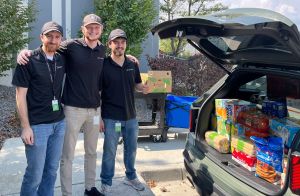
Our Salt Lake City team collected 554 pounds of food and raised $300 in donations for Tabitha’s Way, a Utah organization serving families in need. The team also contributed 43 bags of clothes and six additional boxes of items to Tabitha’s Way.
DataBank SLC team members load donated food items into a vehicle during the company’s 2025 food drive.
Beyond food and clothing security, they demonstrated care for young patients by donating approximately 25-30 handmade fleece blankets along with clothing to Primary Children’s Hospital, bringing comfort to children during difficult times.
Houston: Feeding Families with Variety
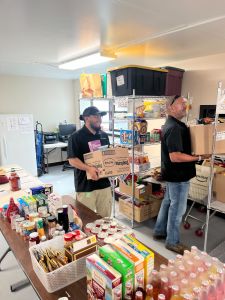
The Houston team collected an impressive 286 pounds of food for the Houston Food Bank, carefully assembling donations that provide balanced nutrition for families.
Five DataBank Houston team members stand with donated food items collected during the company’s 2025 food drive.
Their haul included over 130 cans of soup and chili, more than 100 cans of vegetables, 70-plus boxes and bags of pasta, rice, and mac and cheese, a full tote of dried fruit and juices, and 12 bottles of prenatal vitamins — essential nutrition for expectant mothers.
Dallas-Fort Worth: Meals That Matter
Teams across the Dallas-Fort Worth metro came together to donate 174 pounds of food to the North Texas Food Bank. These contributions translated into 145 meals for families facing food insecurity in North Texas.
A DataBank team member delivers donated food items to the North Texas Food Bank, supporting families facing food insecurity across the Dallas-Fort Worth region.
The giving didn’t stop there. The Dallas team also kicked off a full month-long Season of Giving initiative that included toy drives benefiting Toys for Tots to help spread holiday joy throughout the community.
Orangeburg, New York: Community Connections
Our Orangeburg team gathered a diverse collection of food items and delivered them to the Church of the Ascension in New Milford, New Jersey.
Two DataBank Orangeburg team members deliver donated food items to the Church of the Ascension in New Milford, New Jersey.
By partnering with local faith organizations, the team provided donations to the families who need them the most. This collaboration demonstrates how data center teams or other organizations can take advantage of community networks to maximize their total impact.
A Commitment that Extends Beyond our Facilities
The success of our food drive reflects what we believe at DataBank: operating critical infrastructure comes with a responsibility to invest in the communities where we’re located. From supporting local food banks and children’s hospitals to partnering with volunteer fire departments and youth sports leagues, our teams look for meaningful ways to give back throughout the year.
This food drive is just one example of how DataBank employees engage with their neighbors. Our commitment to community partnership doesn’t end when the donations are delivered. It’s how we operate year-round. We’re proud of what our teams accomplished this fall, and we’re grateful to the organizations that work tirelessly to serve families in need. Together, we’re building stronger communities, one act of service at a time.
October was Cybersecurity Awareness Month, but if you missed it, don’t worry. The truth is that cybersecurity education doesn’t have an expiration date. Also, what often gets overlooked is the fact that not everyone learns the same way, and not everyone faces the same threats.
For example, a sixth grader trying to figure out if a Roblox link is legitimate has very different needs than his grandmother who may be dealing with sophisticated phone scams.
This is why we created this list of free or low-cost cybersecurity resources, all organized by age group. Whether you’re looking to protect your kids, help your parents, or increase your own cybersecurity awareness and safety, this list has something for everyone.
Cybersecurity threats don’t stop when you leave work. The same phishing tactics and other threats that target you in the workplace can also show up in personal inboxes, text messages, and social media feeds. When your friends and family know how to spot a scam—no matter their age—everyone benefits.
The resources below aren’t boring training videos or dry compliance courses. Many are interactive games, hands-on simulations, and practical tutorials that actually keep people engaged. Dive in and see what works for the people in your life who need it most.
For Older Children (Upper Elementary and Middle School)
These resources turn cybersecurity lessons into adventures and games, making it easier for kids to learn about phishing, passwords, and online safety without it feeling like homework.
KC7 Cyber Detective: This interactive story-based game allows players to investigate cyber incidents using real-world data.
Education Arcade: Short educational games covering phishing, passwords, and online safety.
KnowBe4: A free cybersecurity kit that includes downloadable activities with puzzles, games, videos, and a Roblox game (Hack-a-Cat) that focus on phishing, passwords, and cyberbullying prevention.
Cyber101: Quick video modules (under five minutes each) also covering phishing and password safety as well as malware and multi-factor authentication (MFA).
Trend Micro Cyber Academy: Interactive lessons and animated videos for children on online safety, privacy, and security basics.
For Teens and Young Adults
Teens and young adults benefit from hands-on training that mirrors real-world threats they’ll encounter in college, first jobs, and daily digital life.
Wizer Security Awareness: Bite-sized, animated modules and phishing simulations that make learning engaging and practical. (Requires free sign up.)
CanIPhish: Hands-on phishing and cybersecurity education with gamified quizzes that test your ability to spot threats. (Requires free sign-up.)
DoD Cyber Awareness Challenge: Mission-based training developed by the Department of Defense covering phishing, malware, data protection, and social engineering through interactive scenarios.
SANS Cyber Aces: Free cybersecurity tutorials covering operating systems, networking, and security fundamentals with hands-on exercises for those interested in cybersecurity careers.
HP LIFE: Interactive course where learners take on the role of an entrepreneur, making security decisions and learning to identify threats like phishing and malware.
CISA Training & Exercises: Government-developed cybersecurity training exercises and resources for building practical security skills. (Requires free sign up.)
Terranova Cyber Games: Immersive 3D game scenarios that put players at the center of real-world cyber threats, teaching detection and response skills through gameplay.
Seniors are increasingly targeted by sophisticated scams, making accessible, straightforward cybersecurity education essential for protecting personal information and finances.
Cyber-Seniors Cybersecurity Center: YouTube videos and downloadable guides designed specifically for older adults learning to navigate online safety.
CISA Older American Resources: Government-curated collection of helpful links and PDF downloads covering common fraud schemes, identity protection, and mobile security.
Internet Safety 101: Comprehensive guide covering everything from password security to credit card scams, with practical tips for staying safe online.
Terranova Social Engineering Kit: Free training videos explaining how scammers manipulate people into sharing confidential information and how to recognize these tactics.
These resources work across age groups and skill levels, offering everything from foundational awareness training to advanced competitions for aspiring cybersecurity professionals.
Amazon Security Awareness (via NIST NICE): Free, digestible cybersecurity awareness training developed by Amazon and aligned with NIST standards, covering phishing, social engineering, data privacy, and secure communication in 17 languages including ASL.
Competitions and Games (NICCS): Directory of cybersecurity competitions spanning all skill levels, from middle school students to federal professionals, including capture-the-flag events, defense challenges, and national competitions.
NIST Online Learning Content: Comprehensive collection of government-curated cybersecurity learning resources, training materials, and career development tools from the National Initiative for Cybersecurity Education.
CyberCIEGE Game: Strategic simulation game developed by the Naval Postgraduate School where players build and defend networks while balancing budget, productivity, and security against real-world attack scenarios.
Building a Safer Digital Future, One Person at a Time
Cybersecurity threats don’t discriminate by age, but the way we learn to defend against them should. Whether you’re helping a child spot suspicious links, guiding a college student through their first phishing simulation, or supporting an older family member in recognizing phone scams, these resources offer practical, engaging ways to build digital safety skills. The best defense against cybercrime starts with education, and it’s never too early or too late to get started.
DataBank’s Red Oak campus is a 3.4-million-square-foot, AI-ready data center development spanning 292 acres. This article goes behind the scenes of the construction, with the numbers and engineering behind one of DataBank’s largest builds.
Phase 1 will expand DataBank’s Dallas market presence to 12 data centers across the metro, with room on the campus for four additional buildings as demand grows. Construction is already underway, powered by a 400MW Oncor substation delivering up to 240MW of critical IT power in Phase 1 and scaling to 480MW at full buildout.
Each two-story building offers 425,000 gross square feet, including 200,000 square feet of data center space. Initial Ready for Service is targeted for Q2 2026.
What does it take to build 3.4 million square feet of AI-ready infrastructure? Our specific construction numbers tell the story.
By the Numbers: The Scale of Construction
The infrastructure going into the ground reveals just how massive this project is.
The electrical backbone:
19,008 power whips requiring over a million feet of Sealtite conduit (198 miles, enough to stretch from Austin to Dallas).
The copper wire inside those whips totals 990 miles (enough to stretch from New York City to Jacksonville, Florida).
The fiber optic network:
1,760,000 feet of 864-count fiber optic cable (333 miles of high-density fiber).
If you connected each individual strand end-to-end, the result would wrap around the Earth 11.5 times.
“Projects like Red Oak don’t just happen because you have land and power available,” said Justin Puccio, executive vice president of corporate strategy. “The infrastructure complexity required to deliver 480 megawatts of AI-ready capacity is enormous. We’re talking about miles of copper, hundreds of miles of fiber, and construction coordination that has to be flawless. This is what it takes to meet the infrastructure demands the AI era is creating, and Dallas is exactly where this capacity needs to be.”
Growing the Dallas Footprint
Red Oak has become a major sub-market near Dallas, attracting some of the world’s largest cloud and technology providers. The new campus expands DataBank’s already substantial presence in the market, which includes its headquarters location (DFW1) and eight other data centers across the metro.
The Red Oak development is DataBank’s third major campus announcement in the past year, following acquisitions in Atlanta and Northern Virginia. When all three sites are fully developed, they’ll add more than 450 acres, 5.8 million square feet of data center space, and 792MW of power to DataBank’s portfolio.
The campus will leverage DataBank’s award-winning Universal Data Hall Design (UDHD), built to meet the demanding sustainability and performance requirements of enterprises, hyperscale cloud providers, and AI applications that need maximum power and cooling density.
Red Oak isn’t just big. It’s 990 miles of copper wire, 333 miles of fiber, and 198 miles of conduit big. That’s the kind of infrastructure the AI era demands.
By Tony Qorri, Vice President of Construction, DataBank.
The artificial intelligence revolution has completely changed so many aspects of virtually every industry today. Organizations have already achieved game-changing, permanent improvements and continue to envision more innovations and benefits.
At the same time, AI is so transformative that it also presents new questions as many companies must develop strategies to take advantage of all it has to offer, outpace their competition or both.
The data center industry is no different, and one subset of our business —data center design and construction— could be affected even more than most. Like any other business, we’re accustomed to responding to market demands and other external factors to constantly pivot when building traditional enterprise data centers.
If those past conditions represented once-predictable winds of change, AI has now created a perfect storm of innovation, opportunity and transformation when designing and building the next generation of AI data centers. Once-standard, long-accepted practices and approaches have now become outdated almost overnight, forcing data center operators and their customers to come up with new ways of thinking related to data center construction.
AI Infrastructure Flexibility
This new environment calls for infrastructure flexibility that adapts as customers’ changing requirements. That means offering multiple configurations for power, space and cooling to accommodate their future computing needs without complete redesigns.
While that flexibility to date has served enterprise and hyperscale customers effectively, AI workloads are now presenting an entirely new dimension. Data center builders are now experiencing “hard right and hard left” requests from different customers. For example, one might need complete air-cooling for network infrastructure while another is looking for extensive liquid cooling equipment for GPU-intensive operations.
These aren’t minor variations. They represent fundamentally different infrastructure approaches and completely new construction strategies.
AI data centers require specialized approaches that go far beyond traditional design considerations and project management approaches. In some cases, they present logistical and technical complexities that didn’t exist just a short time ago.
Liquid Cooling
The shift to liquid cooling represents one of the most dramatic construction changes. Until recently, most traditional data centers used raised floors and perimeter cooling, but more intense AI workloads are now causing facilities to replace computer room air handler units with cooling distribution units. Those systems use secondary chilled water loops made from welded stainless steel components.
This change creates a domino effect that now requires specialized welding capabilities and stronger structural designs to support heavier thermal storage systems. These implications are affecting once-standard construction timelines and processes. It’s more challenging to attempt to fit more specialized work into the same schedules while also engineering new structural designs.
Supply Chain Constraints
Supply chain constraints add another layer of complexity to AI data center construction. Past procurement approaches can be inadequate when attempting to source specialized materials such as high-grade copper components or stainless steel piping and control valves. As a result, we face the risk of dealing with limited availability and extended lead times.
In response, data center builders need to go two to three tiers deeper into the supply chain than in the past. For example, instead of working exclusively with switchgear vendors, form direct relationships with breaker manufacturers and cable suppliers. It’s evidence of more dominos falling: We need to forecast facility requirements years in advance and begin negotiating letters of intent for raw materials before the actual contracting occurs.
This deeper engagement creates a partnership model where suppliers now actively participate in the success of the project as opposed to simply fulfilling purchase orders. This new approach still requires careful attention to economies of scale, but it helps improve the supply chain security that AI infrastructure timelines now demand.
Labor Challenges
Specialized mechanical and electrical trades are in critically short supply today, creating the most challenging aspect of AI data center construction.
Estimates suggest that in North America an additional 439,000 new workers are required to meet pending construction demand for data center projects. Additional research showed the total number of unfilled skilled trade jobs could hit two million by 2033.
If not managed effectively, this growing gap can force construction timelines and costs into unpredictable territory where past relationships with general contractors and current project management processes could come up short.
Builders need to forecast labor requirements up to three years ahead and, if appropriate, bring contractors into pre-construction activities three to six months earlier. Instead of following conventional bidding procedures, owners should engage contractors in design evolution and resource planning before breaking ground.
The scale of this challenge is evident across the industry. Projects that begin with predictable labor costs often face dramatic shifts as construction progresses. It’s not uncommon to see 20% to 30% price increases for mechanical and electrical trades between phases of the same development.
That’s just the new reality of sourcing qualified workers from other markets with increased per diem costs and competitive wages. It’s reached the point where labor escalation is now recognized in multiple active developments and markets.
Adapting to the Speed of AI
One thing is clear: Data center construction needs to quickly adapt to keep pace with the AI revolution. While these new challenges are unprecedented, they may also present new opportunities for operators who can identify new solutions early in the process.
Success now requires treating every aspect of construction—from supply chains to labor partnerships—as strategic investments rather than transactional relationships. As AI workloads continue to evolve, the data center operators who thrive will be those who view adaptation not as an obstacle but as a potential differentiator in an industry being redefined in real time.
DataBank recently published a white paper examining the reality of cloud repatriation, exploring why enterprises are moving workloads back from public cloud, the hidden challenges of repatriation itself, and strategies for avoiding these pitfalls altogether. To learn more, download “The Reality of Cloud Repatriation” now.
Cloud repatriation has moved from exception to expectation. According to recent research from Barclays, 86% of enterprise CIOs plan to move at least some public cloud workloads back to private cloud or on-premises infrastructure. This represents the highest percentage on record as well as a fundamental shift in how organizations think about infrastructure strategy.
Yet what is does mean is that enterprises are refining their strategies based on hard-earned experience, moving from blanket “cloud-only” thinking to strategic workload placement based on actual business requirements.
Our new white paper examines cloud repatriation from three critical perspectives:
Part 1: Examples of the reasons why enterprises are moving workloads back: cost overruns, security complexities, and support limitations driving infrastructure reconsideration.
Part 2: Hidden repatriation challenges such as data egress fees, vendor lock-in, and required architectural changes.
Part 3: Prevention strategies, including flexible infrastructure planning, vendor agnosticism, and strategic workload placement.
Download the full white paper to explore how organizations are rethinking their cloud strategies and building more adaptive infrastructure for the long term.
When Cloud Economics Stop Working
The shift toward cloud repatriation stems from a convergence of operational and financial challenges that emerge as organizations scale their deployments. What may begin as an attractive proposition often evolves into a more complex reality as workloads grow and business requirements change.
For example, cloud providers market their services with straightforward pricing calculators that promise transparency and predictability. However, many organizations quickly discover that actual costs far exceed initial projections. The challenge extends beyond compute and storage to include a growing number of variable charges that multiply as infrastructure scales.
Autoscaling is a prime example. While automatically adding capacity during demand spikes may initially seem like efficiency, it can generate unexpected costs when not carefully configured. Charges for load balancer requests, monitoring and observability tools, data transfer between availability zones, and countless other micro-charges accumulate quickly. What appeared as a $10,000 monthly infrastructure budget can easily balloon to $15,000 or $20,000 once these variables come into play.
The unpredictability becomes an issue for finance teams trying to forecast IT spending. Unlike fixed monthly costs for colocation or private cloud infrastructure, public cloud bills fluctuate based on usage patterns that may prove difficult to anticipate or control. For companies operating at scale, these variable costs can compound dramatically. Many organizations reach a point where the total cost of ownership for public cloud exceeds what they would pay for dedicated infrastructure, often by significant margins.
The Compliance Burden
Achieving compliance in public cloud environments requires substantially more effort, tools, and ongoing management than many organizations initially anticipate. The shared responsibility model sounds straightforward in theory, with cloud providers securing the infrastructure while customers secure their applications and data. In practice, this division creates complexity and gaps that organizations must actively address.
Meeting regulatory requirements like HIPAA, PCI DSS, FedRAMP, or GDPR in public cloud often requires deploying multiple third-party security tools, implementing extensive logging and monitoring, and maintaining detailed documentation of security controls. Unlike private or hosted environments where infrastructure-level security controls are more directly accessible, public cloud customers must layer security solutions on top of the provider’s baseline offerings.
Companies may discover they inherit only limited controls from cloud providers. While providers maintain certifications and secure their underlying infrastructure, customers bear responsibility for configuration, access management, encryption, and data handling. Security teams must become experts in cloud-specific security practices while managing tools and policies across potentially multiple cloud providers.
For organizations in highly regulated industries, these challenges can become critical factors in repatriation decisions. The resource investment required to maintain compliant cloud environments can often exceed the total operational costs of managing on-premises or colocation infrastructure where security controls are more directly managed.
Support and Visibility Gaps
Public cloud providers excel at scale, but often at the expense of personalized support, especially for customers who spend less than millions annually. Organizations discover that support tiers matter significantly, and the level of assistance available to mid-market companies often falls short during critical incidents.
When infrastructure problems arise, many customers find themselves dependent on provider status pages, community forums, and support ticket systems with limited visibility into underlying issues. Public cloud support can feel impersonal and difficult to navigate during outages or performance problems. Customers may have little insight into what actually went wrong or when resolution will occur.
This visibility gap extends beyond support interactions. Public cloud abstracts infrastructure details that IT teams may need for troubleshooting, optimization, or capacity planning. While this abstraction simplifies some tasks, it can frustrate teams accustomed to deeper infrastructure control and visibility.
For mission-critical applications, these support limitations represent real business risk. When revenue-generating systems experience problems, waiting hours or days for cloud provider support to escalate and resolve issues becomes unacceptable. Organizations with demanding uptime requirements often find that the support and visibility they need justifies moving certain workloads back to environments where they have direct control and responsive support partnerships.
Prevention Over Reaction
Understanding why organizations want to leave the cloud represents only half the story. The repatriation process itself introduces substantial challenges that can prove just as costly and complex as the problems organizations are trying to solve. Data egress fees, proprietary service dependencies, and vendor lock-in often require significant application modifications.
The most effective strategy focuses on prevention rather than reaction. Organizations that partner with infrastructure providers offering multiple deployment options while maintaining vendor agnosticism from the outset can adapt as business requirements evolve without facing costly repatriation challenges or becoming trapped by a single provider’s ecosystem.
Our white paper explores these repatriation challenges in detail and provides concrete strategies for avoiding them. Download “The Reality of Cloud Repatriation“ to learn how strategic infrastructure planning and proactive decision-making prove far more effective than attempting to unwind poor cloud decisions after the fact.
In our next post, we’ll examine the hidden costs and complications organizations encounter during the repatriation process itself.