Real-World Use Cases for High-Performance Computing in Edge AI
Today, the buzz surrounding AI may conjure images of futuristic robots and other sci-fi types of scenarios. While these may or may not come to life sometime down the road, there are still many practical applications. This is especially true in edge computing.
High-Performance Computing (HPC) at the edge, when combined with AI, already holds significant potential to revolutionize industries and solve real-world problems. Yet, to harness its true power, it’s essential to shift the focus from AI fantasies best served up in movies to more realistic, practical use cases.
Understanding HPC at the Edge
At its core, HPC at the edge refers to the processing power and computational capabilities deployed closer to where data is generated and/or needed. This approach minimizes latency, enhances efficiency, and enables real-time decision-making. All of this is critical in today’s fast-paced, high-tech world. AI empowers machines to learn from data, recognize patterns, and make intelligent decisions without explicit programming.
The market momentum tells the story. The global edge AI market was valued at $21.2 billion in 2024 and is now projected to reach $143.1 billion by 2034, which represents a 21% CAGR. This explosive growth reflects how organizations across industries are moving beyond experimentation to production-scale deployments.
Benefits and Challenges Related to HPC in Edge AI
Edge AI also empowers devices to perform complex tasks locally, reducing dependence on cloud services and enhancing privacy since sensitive data remains on-premises. With 5G rollouts enabling data rates 10 times faster than previous networks and latency below 10 milliseconds, edge computing can now handle increasingly sophisticated AI workloads in real time.
Despite its potential, deploying AI at the edge presents challenges including limited computing resources, energy constraints, and security concerns. All must be carefully addressed for seamless operation. Additionally, the diversity of edge environments requires adaptable solutions capable of meeting varying needs and conditions, from smart cities to remote industrial sites.
HPC Edge AI Use Cases
While AI has real potential, its implementation and adoption must be driven by real-world considerations. Fortunately, the combination of HPC and AI at the edge present many different possibilities for a wide range of industries. For example, in healthcare, the real-time analysis of patient data at the point of care can help with early diagnosis, personalized treatment plans, and remote monitoring.
The following are additional examples of edge AI use cases.
Healthcare and Research Computing
In healthcare and research, HPC at the edge enables breakthrough capabilities. Organizations like the University of Maryland leverage HPC infrastructure to support groundbreaking research in genomics, medical technology, and materials science. By deploying high-density computing power with optimal cooling solutions, research institutions can process complex datasets in real time, accelerating discoveries that would be impossible with traditional infrastructure.
Predictive Maintenance in Manufacturing
In industrial settings, edge AI can predict equipment failures and minimize downtime. Potential anomalies can be detected by analyzing sensor data in real time. This enables them to be addressed proactively, leading to improved efficiency and significant cost savings.
HPC at the edge can be employed to process sensor data from machinery and equipment within the manufacturing plant in real time. This data may include temperature, vibration, pressure, and other parameters indicative of the equipment’s health and performance.
Artificial intelligence algorithms deployed at the edge can analyze this data to detect patterns, anomalies, and early signs of potential failures. For example, machine learning models can identify deviations from normal operating conditions. Then they can predict when equipment is likely to fail and recommend proactive maintenance actions to prevent downtime.
Industrial Smart Grids
Smart grids are modern electrical grids that integrate advanced communication, control, and monitoring technologies to efficiently manage the generation, distribution, and consumption of electricity. HPC at the edge combined with AI can play a crucial role in optimizing energy usage and grid stability.
For example, HPC resources deployed at the edge can process data from smart meters, sensors, and other grid devices for real-time energy monitoring. AI algorithms can monitor energy consumption patterns, detect fluctuations in demand, and identify areas of inefficiency or potential grid congestion.
AI-powered edge computing can also help with fault detection and response. By analyzing data from grid sensors and devices, AI algorithms can identify anomalies indicative of potential problems and trigger automated responses or alerts for timely maintenance or repair.
Retail: Personalized In-Store Experiences for Shoppers
In retail, edge AI enhances customer experiences through personalized recommendations. Retailers can leverage AI algorithms to analyze vast amounts of customer data in real time. This could include browsing history, purchase behavior, demographic information, and real-time location data within the store.
This enables retailers to create personalized experiences for shoppers that enhance engagement, increase sales, and foster brand loyalty. For example, retailers can use this data to generate real-time product recommendations and discounts. These can then be delivered via mobile apps, digital signage, or in-store displays. This gives retailers the ability to direct shoppers toward products that they’re more likely to buy, increasing sales and fostering customer loyalty.
Autonomous Vehicles
Similarly, in autonomous vehicles, edge computing and AI enables the instant processing of sensor data. It’s an important advantage because autonomous vehicles require real-time processing of vast amounts of sensor data to navigate safely and make split-second decisions. Traditional centralized computing architectures may struggle to meet the stringent latency requirements for processing this data. This includes the need to send data back and forth to a distant data center can introduce delays that are unacceptable in safety-critical applications.
By leveraging edge computing, HPC resources can be deployed closer to the source of data generation, such as within the vehicle itself or at the edge of the network. Modern edge AI chips like NVIDIA’s Drive Thor deliver up to 1,000 tera operations per second (TOPS) of processing power, enabling faster sensor data processing and quicker decision-making without heavy reliance on centralized data centers.
HPC at the Edge: Shaping Future AI Use Cases
The convergence of HPC and AI at the edge holds tremendous promise for companies in virtually every industry. By focusing on practical use cases that can successfully address real-world challenges, companies can drive innovation, enhance efficiency, and improve outcomes.
Multi-cloud compliance involves managing security controls, governance policies, and regulatory requirements consistently across multiple cloud and infrastructure environments.
By Calli Schlientz, Director of Compliance, DataBank
Compliance rarely drives the initial decision to move to the cloud. Organizations typically migrate for cost reduction, scalability, or operational efficiency. Compliance tends to be viewed as necessary but secondary.
Yet once the strategic decision to adopt cloud infrastructure is made, compliance becomes a critical differentiator. Organizations must choose which provider and deployment model best meets internal compliance processes and ultimately, regulatory requirements.
This decision creates immediate challenges for organizations transitioning from traditional on-premises infrastructure to the cloud. For example, in cloud partnerships, responsibility for compliance controls is divided between the customer and the provider through what’s known as the shared responsibility model. Security controls that the company once implemented and maintained now exist in hybrid frameworks where some responsibilities transfer to providers while others remain with customers.
Companies must reframe their understanding of compliance ownership, particularly when evaluating multiple cloud providers. Compliance processes and requirements may be handled differently by each vendor, leading to complex comparison challenges and potential issues down the road.
Critical Questions Organizations Should Ask
When evaluating cloud and infrastructure providers, organizations often struggle to know exactly what compliance questions to ask. Many companies understand they need “compliance” but aren’t sure how to evaluate whether a provider can deliver what they need. This uncertainty can lead to gaps in due diligence that create problems later.
The most important questions organizations should consider include:
What are the provider’s current audit exceptions? Look beyond certifications to understand other areas of non-compliance that could impact your data security.
How does the provider handle compliance gaps when they occur? The question isn’t whether issues will arise, but how transparently and effectively they’re managed.
What specific compliance responsibilities will transfer to the provider versus remain with you? Get detailed documentation showing exactly who handles what under different regulatory frameworks.
Can the provider participate directly in your compliance assessments? Beyond providing documentation, can they join auditor calls and provide real-time explanations of security controls?
How quickly does the provider resolve compliance issues? Understanding remediation timelines helps you assess potential risks to your own compliance posture.
These questions help organizations move beyond surface-level compliance discussions to understand how partnerships will function during actual regulatory assessments and ongoing compliance management.
What Leading Partners Bring to Compliance
The most valuable infrastructure providers go beyond providing secure facilities. They offer comprehensive compliance frameworks, structured sets of security controls and procedures that meet regulatory standards. Organizations can inherit or build upon these frameworks, transforming compliance from a wholly internal challenge into collaborative effort.
Transparency forms the foundation of effective partnerships. Leading providers should offer valuable resources such as trust centers (centralized portals containing compliance documentation and audit reports) and responsibility matrices that clearly delineate which compliance requirements they handle versus which remain with customers.
These documents should be framework specific. For example, they should recognize that FedRAMP requirements differ significantly from PCI DSS or HIPAA obligations. Service descriptions should reflect this tailored approach, with providers offering different recommendations based on specific compliance objectives rather than one-size-fits-all solutions.
Public Cloud Compliance Challenges
While public cloud providers offer extensive compliance certifications, they operate on fundamentally different models that can create challenges for organizations with specific regulatory requirements.
The challenge stems from how public cloud providers approach compliance. They build their frameworks to work for as many customers as possible, using a one-size-fits-all model.
This approach means organizations often get more compliance controls than they actually need while potentially missing specific requirements for their industry or regulatory environment. The standardized model can leave gaps for companies in heavily regulated sectors.
When Complexity Multiplies
While choosing the right provider helps address many compliance concerns, the complexity multiplies when organizations operate across multiple cloud environments. Many companies find themselves in multi-cloud scenarios due to acquisitions, specialized application requirements, or deliberate risk mitigation strategies that distribute workloads across different providers.
Each additional cloud environment introduces new compliance variables that compound the challenge. What appears straightforward with a single provider becomes exponentially more difficult when coordinated across multiple providers, each with different frameworks, documentation standards, and support models.
Different providers may handle identical compliance requirements through entirely different mechanisms, creating potential coverage gaps or unnecessary overlaps that waste resources. Organizations often discover these inconsistencies only during compliance assessments or when responding to security incidents that span multiple environments.
The Colocation Alternative
Instead of accepting these limitations, organizations can turn to colocation providers with comprehensive managed services that offer significant compliance advantages over both traditional hands-off models and public cloud approaches.
In these cases, colocation partners can assume substantial compliance responsibilities that would otherwise require dedicated internal expertise, including deploying pre-hardened operating systems, maintaining security patches, and managing ongoing compliance monitoring.
More importantly, colocation operators can customize solutions to address specific regulatory requirements rather than offering generic frameworks. This might mean tailored vulnerability scanning for PCI compliance or specialized background check requirements for criminal justice systems.
During compliance assessments, these providers can participate directly in auditor calls and provide real-time explanations of security controls, rather than simply directing customers to documentation or self-service portals.
For organizations already operating in multi-cloud environments, colocation providers can serve as a unifying platform that simplifies compliance management. Rather than maintaining separate compliance documentation and audit processes across multiple public cloud providers, organizations can consolidate workloads or use colocation as a compliance-consistent hub for hybrid architectures.
Partnership in Practice: A Federal Agency Case Study
The value of choosing the right compliance partner becomes clear through long-term relationships that evolve alongside changing regulatory requirements.
Consider the example of a federal agency that engaged with us before achieving their FedRAMP authority to operate (ATO), the formal approval required for government systems to process federal data.
This partnership began years before the agency secured compliance authorization, with us actively participating in audit calls, adjusting configuration settings based on auditor feedback, and redeploying test and production environments as requirements evolved. When the agency needed to migrate to our updated FedRAMP Rev. 5 environment, the transition was handled as a joint project rather than a vendor handoff.
The ultimate validation came when the customer’s agency granted authority to operate using the implemented and inherited controls, creating a shared compliance framework where both parties validated each other’s security controls. This demonstrates how compliance relationships can evolve from vendor-customer transactions into strategic collaborations that benefit both parties.
The Evolution of Compliance: What’s Coming Next
The compliance landscape is changing in two key ways. Organizations can expect new regulations targeting emerging technologies, particularly artificial intelligence, as regulators work to keep up with rapid technological changes.
More importantly, the industry is moving away from traditional annual audit cycles toward continuous compliance monitoring. Forward-thinking providers are already conducting audits throughout the year rather than concentrating everything into single periods. This approach makes more sense since compliance issues can arise anytime, not just during scheduled audit windows.
Privacy regulations are also expanding. While GDPR transformed data protection in Europe, comprehensive federal privacy legislation in the United States remains stalled. Meanwhile, individual states continue implementing their own privacy laws, creating a complex patchwork that will likely push federal lawmakers to act.
Building Resilient Compliance Strategies
Successfully managing compliance across multiple cloud environments comes down to choosing strategic partners who understand how modern infrastructure connects. Organizations that tackle shared responsibility challenges proactively and design systems that streamline audit processes position themselves better for both current requirements and future changes.
The key is thoughtful planning and selecting partners who have deep compliance expertise. Multi-cloud environments don’t have to compromise compliance, but they do require careful coordination and providers who know how to manage complexity effectively.
Now, in this second article in the series, we’ll examine what’s holding back the organizations that haven’t reached that point yet.
The Data Quality Turnaround
Most companies understand AI’s potential, but turning pilot projects into business-critical applications that generate real value involves overcoming several significant obstacles. Our survey of over 300 enterprise IT executives reveals exactly what those barriers look like today.
Research findings from DataBank’s new AI Adoption report reveal what is really holding organizations back from full AI adoption.
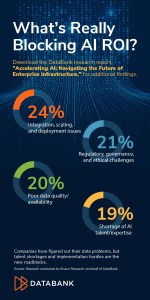
Here’s some encouraging news: Data quality is no longer the primary roadblock it once was. When we asked about major obstacles to AI adoption and ROI, only 20% of respondents cited poor data quality, availability, or labeling as a significant issue. This represents a dramatic shift from just a few years ago when data problems seemed to top virtually every list of AI challenges.
The survey results confirm this progress. One-third of respondents reported that their data and processes are “well-organized, governed, and ready for AI training and analysis.”
Another 34% said their data foundations were either “adequate or good but require some improvements in standardizing processes or data governance and structure.” Less than 10% described their processes and data as immature, fragmented, and siloed.
The New Roadblocks to AI Adoption
Now that companies have their data sorted out, different problems have moved to the front of the line.
Integration and Scalability Challenges
Integration, scaling, and deployment issues top the list at 24% of responses, showing that the biggest hurdles aren’t just technical anymore—they’re organizational and cultural too.
The challenge stems from what experts call “pilot purgatory” where organizations can successfully run AI proof-of-concepts, but struggle to move those solutions into production systems that work across the enterprise. Research shows that scaling AI requires integrating new technologies with complex, aging IT landscapes including legacy ERP, CRM, and manufacturing systems that weren’t designed for modern AI applications.
Regulatory and Compliance Hurdles
Regulatory, governance, and ethical challenges represent the second-largest barrier at 21%. Organizations must navigate complex compliance requirements, including sovereign data requirements across different territories and new legislation like the EU AI Act.
For companies operating globally, these challenges multiply significantly. As one research participant noted, operating across 200+ countries means dealing with vastly different payment regulations in each territory. However, AI itself may help organizations manage these complexities by training systems to quickly answer regulatory questions that previously required extensive manual research.
Talent Shortage and Skills Gaps
The talent shortage rounds out the top concerns, with 19% citing lack of AI expertise as a significant blocker. This scarcity has sparked what industry observers call “AI talent wars” between major technology companies, including Meta and OpenAI.
“When I think of the current greatest headwind when it comes to AI, it’s about having the right talent in place, as well as having the right training and the right upskilling,” notes Philips’ Chief Innovation Officer Shez Partovi, who participated in the research process and executive roundtable. His perspective emphasizes the importance of prioritizing “people, process, platform, in that order.”
Beyond the Basics: AI’s Emerging Applications
While data quality was once the primary concern for AI adoption, today’s landscape looks quite different. The barriers organizations face now center around people, processes, and organizational readiness rather than technical foundations. Integration challenges, talent shortages, and regulatory compliance have become the new focal points for companies working to scale their AI initiatives.
This shift suggests that AI technology itself has matured to a point where the human and organizational elements matter more than the underlying infrastructure. Companies investing in change management, building compliance frameworks, and developing internal AI expertise are positioning themselves to move beyond basic implementations toward more innovative applications.
Leadership plays a role, too. “Not unlike any other big change—whether it’s technology related or not—it comes down to leadership,” said Chris Bedi, Chief Customer Officer at ServiceNow, and another executive participant in the research survey. “It takes leadership courage to redefine a new mission, new roles, and new ways of working.”
In our next post, we’ll examine the shift from traditional AI and LLMs toward more innovative solutions that represent the next phase of enterprise AI adoption.