What is interconnection? Interconnection is an over-arching term that refers to many different physical and virtual connections companies can select to exchange data, provide business continuity and customer services, and address specific business objectives. Interconnection in colocation data centers are vital for fast data exchange, reduced latency, improved network performance, and other benefits.
Yet, the term interconnection is often used in different ways. As a result, it’s easy to understand why there is some confusion related to interconnection today. It may also explain why there are so many frequently asked questions (FAQs) on this topic.
To help, this article will take a closer look at interconnection in colocation data centers. It will also include a detailed look at five different but commonly used interconnection approaches today.
Why Do We Need Interconnection?
Why do companies need interconnection? The first answer is that interconnection plays a major role in helping businesses become more agile and responsive. Interconnection services from colocation providers enables unprecedented flexibility to distribute computing resources and move intelligence closer to the point at which decisions are made.
Interconnection also enables organizations to directly connect their networks to reduce the number of hops data must take to reach its destination. This leads to reduced latency, faster data transfer speeds, and improved application performance. The right interconnection technology and strategy can be a critical advantage for latency-sensitive workloads like streaming services, real-time data analytics, and financial transactions.
It may be helpful to think of interconnection as an umbrella term to refer to many technologies capable of connecting networks to networks. However, it’s important to know the difference between each type. This can help you select the right technology for the right job to establish connectivity in the data center.
Let’s take a closer look at five types of interconnection services available in most data centers today.
Cross Connects
Cross Connects represent the most basic type of interconnection. This term generally refers to the physical and dedicated connection between two networks directly within the same data center. Cross Connects provide dedicated, point-to-point connectivity as well as the most reliable, efficient, and secure way to connect networks and infrastructure. They also deliver excellent reliability and low latency.
Internet Exchanges
An internet exchange, or internet exchange point (IXP), is essentially a network switch. Organizations connect to an IXP via a physical cross-connect, enabling them to link up with other IXP members, without the need for dedicated cabling (or cross connect) to each IXP member.
Companies use internet exchanges to set up peering with other networks linked to the IXP. They use the BGP protocol for peering sessions through a single physical link, once again eliminating the need for extra cables. This peering capability is a key advantage for interconnected entities like internet service providers, content delivery networks, other service providers, and enterprises. It helps them cut transit costs, boost capacity, and enhance network performance.
Private peering, on the other hand, occurs within a colocation facility, where two parties use separate network routers but establish a direct cross connect rather than using the IXP. This setup is advantageous when large traffic volumes are exchanged between networks, exceeding the capacity of a shared exchange point connection.
Data Center Interconnects (DCI)
A data center interconnect (DCI) is similar in theory to a cross connect but uses electronics, typically DWDM, to establish a point-to-point connection between two data centers so they can share resources or improve other operations such as load balancing. For example, a company could choose to connect two different networks in the same metro or in two different metros.
DCI can connect any data center whether it’s in close proximity or located a great distance apart. This may depend on the technology used to deliver the connectivity (Optical Networking, or Ethernet).
Internet Connectivity
As the term suggests, internet connectivity enables data center clients to access and use the internet — and vice versa — for internet users to quickly reach the websites and applications of data center clients. However, this goes far beyond a simple connection. There are several methods to deliver internet connectivity, including:
Dedicated Internet Access (DIA) that offers basic connectivity. (Burstable Internet Access offers connectivity with a usage-based billing method.
IP Transit, which is more sophisticated, leveraging the BGP protocol. This approach enables organizations to advertise their own IP prefixes and manage how routing information is utilized.
Cloud Connectivity
Cloud connectivity refers to a company’s ability to link its systems to a virtual environment hosted by public cloud providers such as AWS, Microsoft Azure, or Google Cloud Platform, enabling access to their data and workloads.
While businesses often have resources like computing power, storage, and services housed in a data center, their applications may reside in the cloud. For optimal performance, they require a secure, private connection between these environments to address challenges related to bandwidth, reliability, and security.
There are several approaches to establishing cloud connections:
VPN: Businesses can link virtual private clouds to remote networks using various VPN options, such as site-to-site VPNs, cloud provider-specific VPN solutions, or third-party VPN software.
Cloud on-ramps: These connections utilize network infrastructure deployed by cloud providers. However, they may not be universally available across all data centers due to cost constraints, especially in regions with many data centers. Companies located in facilities with cloud on-ramps can access them easily through a cross-connect.
Network as a Service (NaaS): Organizations in data centers without cloud on-ramps can use NaaS platforms to achieve similar connectivity. NaaS operates much like an IXP, acting as a switch to connect companies to various cloud on-ramps.
All these options are designed to help companies in colocation data center environments access public cloud services efficiently, reliably, and securely.
Optimizing Connectivity for Modern Businesses
Interconnection in data centers is crucial for businesses seeking to optimize their network infrastructure and reduce operational complexity. The evolving landscape of interconnection technologies offers businesses the flexibility to tailor their connectivity solutions to meet their specific needs and improve the way they manage their business.
DataBank recently published a white paper examining the reality of cloud repatriation, exploring why enterprises are moving workloads back from public cloud, the hidden challenges of repatriation itself, and strategies for avoiding these pitfalls altogether. To learn more, download “The Reality of Cloud Repatriation” now.
Over the past two posts, we’ve followed a story that’s playing out across enterprise IT.
In the first article, we looked at why 86% of CIOs are rethinking their cloud strategies, driven by unpredictable costs, compliance complexity, and support gaps that materialized only after significant cloud commitments were made.
That brings us to the most important question of the series: How do you avoid ending up there in the first place?
The answer isn’t to avoid cloud. It’s to stop treating infrastructure decisions as permanent, and start designing for flexibility from the beginning.
The Real Cost of Not Planning Ahead
Most organizations don’t set out to create vendor lock-in. It accumulates gradually. A team adopts a managed database service because it’s convenient. Another builds on a proprietary container orchestration platform because the documentation is good. Over time, these choices compound, and what began as a series of reasonable shortcuts becomes an architecture that’s expensive and disruptive to undo.
The organizations that successfully avoid painful repatriation projects share a common trait: They made deliberate decisions about where and how to use vendor-specific features rather than defaulting to whatever was easiest in the moment. That discipline is harder to maintain than it sounds, because cloud providers are very good at making their proprietary services attractive. Convenience is a feature, and it’s designed to deepen dependency.
Build with Portability in Mind
Vendor agnosticism doesn’t mean rejecting cloud providers or their ecosystems. It means making conscious trade-offs about portability from the start.
In practice, this looks like choosing containerization with Kubernetes over proprietary orchestration, using open-source databases rather than managed database services with limited export options, and relying on infrastructure-as-code tools that work across environments rather than cloud-specific tooling that ties you to one provider. At the application level, it means avoiding tight coupling to proprietary APIs, using abstraction layers, and documenting dependencies so future teams understand what it would take to change course.
The upfront investment in portable architecture pays dividends when business needs shift or when a vendor’s pricing and policies move in unfavorable directions. Those situations are difficult to predict but nearly impossible to avoid over a long enough timeline.
Choose Partners for Flexibility, Not Just Features
Technical architecture is only half the equation. Partner selection matters just as much.
The right infrastructure partner offers a full spectrum of deployment options, including colocation, private cloud, bare metal, managed services, and seamless public cloud connectivity, so that as workload requirements evolve, organizations can adapt without changing partners or starting over. That kind of flexibility removes the infrastructure layer as a constraint on business decisions.
Pricing transparency deserves the same scrutiny as technical capabilities. Cloud providers’ pricing structures aren’t necessarily deceptive, but they’re often incomplete. The scenarios that generate the largest bills, such as high-volume data transfers, complex scaling patterns, and sustained high utilization, may not be front and center in initial conversations. Asking detailed questions upfront and expecting candid answers about worst-case cost scenarios is a reasonable expectation from any infrastructure partner worth working with.
For organizations in regulated industries, compliance certifications are equally important. A partner with existing FedRAMP, HIPAA, PCI DSS, and SOC 2 certifications dramatically reduces the burden of implementing controls independently in public cloud environments, which is one of the most commonly underestimated costs in cloud adoption.
Match Workloads to the Right Environment
Not every workload belongs in the same place, and the organizations that manage infrastructure costs most effectively are the ones that know the difference.
Public cloud is genuinely well-suited for applications with highly variable or unpredictable demand, development and testing environments that benefit from fast provisioning, and workloads that require global geographic distribution. These are the use cases where elastic scaling and pay-as-you-go economics deliver real value.
The calculus looks different for stable production workloads with predictable resource requirements, latency-sensitive applications, data-intensive workloads that generate significant egress fees, and systems subject to strict compliance mandates. For these, colocation and private cloud environments often deliver better performance at lower total cost, once the full picture is accounted for.
That last point is worth emphasizing. Total cost of ownership analyses need to go beyond monthly infrastructure bills to include data transfer costs, management overhead, compliance implementation, support quality, and the long-term cost of reduced flexibility. Organizations that run honest TCO comparisons across deployment models frequently discover that public cloud economics look very different at scale than they do during early pilots.
Plan for an Infrastructure Strategy That Can Evolve
Infrastructure decisions shouldn’t be treated as permanent. Business requirements change. Technology evolves. Vendor landscapes shift in ways that are impossible to anticipate years in advance.
Organizations that navigate this well build regular infrastructure assessments into their planning cadence, examining both technical performance and financial efficiency to identify workloads that have outgrown their current environments. They invest in maintaining in-house infrastructure expertise even when relying heavily on managed services. And they cultivate relationships with multiple infrastructure partners rather than concentrating dependency on a single vendor.
The goal isn’t to predict every future requirement. It’s to preserve the ability to adapt when requirements change, without facing the kind of costly, disruptive migrations that have sent so many organizations searching for alternatives to their initial cloud decisions.
Prevention as Strategy
The rise of cloud repatriation isn’t a story about cloud failing. It’s a story about infrastructure maturity, with organizations learning, sometimes at significant cost, that no single approach works for every workload at every stage of growth.
The good news is that the lessons are learnable before the pain sets in. By prioritizing portability in application design, choosing partners that offer genuine flexibility, making deliberate workload placement decisions, and building in regular reassessment, organizations can use cloud strategically while maintaining the freedom to evolve.
DataBank is built around this kind of flexibility, offering colocation, private cloud, bare metal, and managed services alongside direct cloud connectivity, so customers can optimize each workload for its specific requirements. Because the best infrastructure strategy is one that doesn’t box you in.
Sustainability has become considerably more complicated for the data center industry heading into 2026. Political shifts, policy changes, and other new market dynamics are creating an environment where progress may become harder to achieve.
Here are five predictions for how new trends and market forces will reshape data center sustainability in 2026.
Prediction #1: Greenhushing Will Replace Transparency
The trend toward greater sustainability and transparency will somewhat reverse in 2026. We’re already seeing cases where companies across many different industries are pulling back from public commitments and reducing visibility into their environmental programs—a trend now known as “greenhushing.”
This isn’t because sustainability efforts are stopping or even slowing down. It’s because the political and legal environment has made too much transparency risky. A large hyperscale cloud provider recently removed its net zero target from its website despite continuing to work toward this goal. In many other cases, terms like “ESG” are being rebranded to avoid too much political scrutiny.
This creates a dilemma for data center operators. Customers’ RFPs still require renewable energy commitments and sustainability certifications, and investors still evaluate ESG performance. Yet, the appetite for public messaging has diminished significantly.
The result is a disconnect where meaningful sustainability work continues behind the scenes while public communication will become more cautious or disappear completely. In response, data centers will need to balance legitimate customer and investor requirements against the risks of visible or perceived ESG-related advocacy in 2026.
Prediction #2: The Renewable Energy Cliff Draws Closer
Federal tax incentives are continuing to drive a surge in solar and wind deployments through mid-2026, but chances are good that the momentum will hit a wall soon after. Projects must either (1) begin construction by mid-2026 and be placed into service by 2030, or (2) be placed into service by the end of 2027 to receive clean energy tax credits.
This compressed timeline is forcing data center operators to accelerate procurement decisions and lock in renewable power agreements now or face a significantly different market landscape to address renewable and clean energy targets.
The consequences may extend beyond individual project timelines. When these incentives disappear, new solar and wind capacity will slow while older coal plants will remain operational longer than planned. Data center operators working toward net zero targets may find few options for new renewable power purchases.
Companies will likely turn to longer-term renewable energy procurement now, while those who don’t may face higher costs and limited supply in a constrained market. The window for taking advantage of current renewable energy economics is closing fast.
Prediction #3: Market Consolidation Follows the Power
The data center boom attracted a flood of new entrants over the past two years. Developers from other sectors recognized opportunity and rushed in, acquiring land and requesting power without always securing the infrastructure or capital needed to execute. This speculative activity is creating artificial scarcity and inflated competition for resources.
Yet not all these companies will survive 2026. The combination of limited available land, constrained power supply, and substantial capital requirements will force weaker players out. Chances are good that companies that purchased property without confirmed power access will struggle to deliver. Those without deep pockets or committed customers will find themselves unable to compete.
The resulting consolidation will benefit those established operators with proven execution capabilities. As speculative players exit, pressure on land and power resources should ease. The market correction will be painful for some, but it should ultimately push the industry toward more sustainable growth patterns built on real demand instead of speculative bets.
Prediction #4: Cooling Strategies Shift Toward Water Conservation
Data center operators are increasingly adopting waterless cooling technologies and closed-loop systems as part of water-conscious facility design strategies in areas of high water stress. Traditional evaporative cooling remains energy efficient in suitable climates and appropriate in many locations, but operators are recognizing that cooling choices should match local conditions rather than following a one-size-fits-all approach.
Closed-loop chilled water systems are becoming more popular because they recirculate coolant continuously with minimal or no water loss. Some facilities are exploring entirely waterless approaches using advanced air cooling or alternative fluids. However, local water availability is becoming an increasingly important factor in that cost equation. In water-stressed regions or communities particularly concerned about water usage, the economic and reputational costs of evaporative cooling may outweigh its energy efficiency advantages, making closed-loop and waterless systems more attractive.
The key change is strategic thinking about cooling decisions. Rather than defaulting to a single approach across all facilities, operators are evaluating local water availability and community concerns when designing cooling infrastructure. This geographic sensitivity to water resources represents smarter engineering practice as data centers balance energy efficiency against environmental stewardship and community relations.
Prediction #5: Nuclear, Geothermal, and Energy Storage Gain Momentum
While solar and wind incentives face expiration, nuclear power, geothermal energy, and energy storage systems retained their tax credits, creating a policy environment that favors these technologies through 2027 and beyond.
Data center operators are responding accordingly. Nuclear and geothermal power offer the constant baseload capacity that facilities require, without the intermittency challenges of renewables. Energy storage systems provide grid flexibility and backup power while supporting renewable integration. These technologies align with customers’ sustainability requirements while offering operational advantages.
The challenge is getting these technologies deployed quickly enough. Small modular reactors and advanced nuclear technologies show promise but face lengthy development and approval processes. Energy storage supply chains need domestic scaling to meet demand. Despite these hurdles, expect accelerated investment in both technologies as the renewable incentive cliff approaches and operators seek alternative paths to clean energy goals.
Preparing for What Comes Next
Data center operators face a different sustainability situation in 2026 than anyone expected two years ago, but the core business drivers haven’t changed.
The operators who succeed will be those who stay focused on these fundamentals and keep their heads down when necessary, building the right infrastructure for local conditions, and making decisions based on what customers request rather than whatever’s dominating the news cycle. When politics change again, the companies that spent their time executing will be better off than those who spent it talking.
Want to stay ahead of the sustainability trends reshaping the data center industry? Check out DataBank Digest for more insights on data center industry trends and infrastructure strategy.
When Anthony Hayes, DataBank’s Critical Facility Manager in Atlanta, received a call from Dexter Edmonds of Opportunity Runway asking if DataBank would host a career exploration event, he didn’t hesitate.
The mission was simple but powerful: Open DataBank’s doors to young people, pull back the curtain on what data centers are, and show them that lucrative, fulfilling careers exist beyond the traditional four-year college path.
The event served two purposes. It would counter misconceptions about the data center industry while opening doors for the next generation. It also gave Hayes a chance to give back in a meaningful way. “What good is it for me to have this knowledge and these skills if I don’t share them?” Hayes said. “I wanted to tell my story, share my journey, and give young people different paths to success.”
Beyond the Headlines
The event, held on a Saturday at one of DataBank’s Atlanta facilities, drew nearly 20 young people eager to learn about an industry many had never considered.
For Hayes, it was a chance to move past the headlines and misconceptions about data centers –especially those related to water consumption and environmental impact— and focus on what matters most: the opportunities these facilities create for communities.
“A lot of the rhetoric about data centers comes from people who don’t understand the technology,” Hayes explained. “We wanted to show them real examples: what closed-loop cooling systems actually mean, how modern data centers operate, and most importantly, the career paths available in this industry.”
A Team Effort
The day featured multiple components designed to give attendees a comprehensive view of data center careers.
A data center industry expert from Method Experts, a training organization dedicated to equipping operators and technicians in mission-critical environments with essential skills for safety and operational excellence, delivered an educational session on data center fundamentals, their diverse applications, and the wide range of career paths available. He covered everything from physical security and cybersecurity to MEP (mechanical, electrical, and plumbing), operations, and rack-and-stack positions.
Brian Wilkerson from PRT Staffing, a placement service that works with the industry, provided lunch for attendees and even brought his 15-year-old son to the event—a powerful statement about the real conversations families are having about alternative career paths.
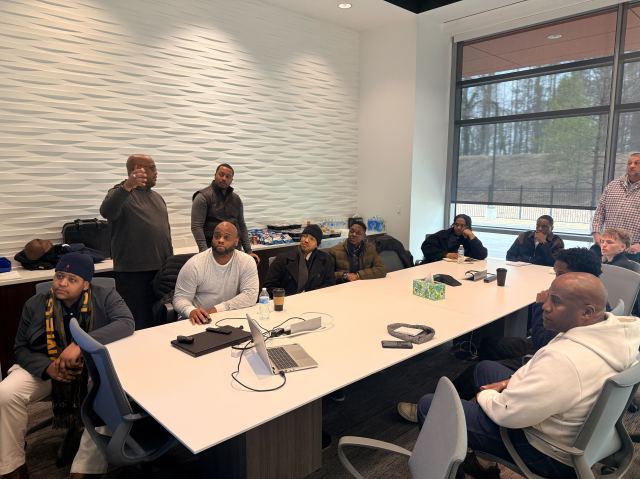
In this session, DataBank employees and data center experts presented career opportunities to students interested in learning more about the data center industry.
Hayes also invited members of his own team, Leon LaMar III and Clyde Ward, to share their personal journeys into the data center field. “Everybody in a data center has a unique story about how they got there,” Hayes said. “We’re in a field that didn’t exist 30 years ago, and now it’s exploding with opportunities young people may not even know exist.”
The Eye-Opening Reality
Hayes made a compelling case when he compared career paths side by side. The traditional college route often means four years of debt accumulation for a degree that might yield a $60,000 starting annual salary. Meanwhile, trade paths like becoming a journeyman or full electrician offer a dramatically different trajectory.
“You can join the IBEW, pay union dues, and get paid to learn,” Hayes told the group. “In the same four years someone else is in college, you can complete your training and come out making $45 to $55 an hour, which is close to six figures right from the gate.”
Hayes was also careful to note that choosing technical training doesn’t mean abandoning education entirely. Workers can return to school later to develop other skills like professional communication and presentation abilities. “The hard part is the technical knowledge,” he explained. “Once you have that, you can focus on perfecting your soft skills and positioning yourself for bigger roles over the years.”
The message clearly struck a chord. Many attendees connected with Hayes on LinkedIn after the event, staying behind to ask questions about what he looks for when hiring, whether he hires people without experience, and how they could break into the industry.
“The eye-opening realization that you don’t have to go to college but can still make real money,” Hayes said. “That was the biggest thing they took away.”
Creating Legacy
The event held special significance for Hayes. His own children are in high school, navigating similar decisions about their futures.
“It was an opportunity to show them that community is important, and that it’s important to have leaders who don’t gatekeep,” he said. “Your path might be different from mine, but it doesn’t hurt for you to understand my path and see there’s opportunities for you.”
Hayes also appreciates working for a company that actively supports community initiatives like this. “I really enjoy working for DataBank,” he said. “I’ve worked in toxic work environments before. This is so far from that. There’s a strong culture here that values giving back and investing in the communities where we operate, and that matters.”
Looking Ahead
The Atlanta event is just the beginning. Hayes continues to represent DataBank at career fairs and community events, partnering with organizations like Opportunity Runway to connect with young people exploring their career options.
“When we open our doors and share our story, we create pathways for others and strengthen the communities we call home,” Hayes said. “That’s what being a good neighbor really means.”
Want to see more stories about DataBank’s community involvement and industry leadership? Check out DataBank Digest for more insights on data center industry trends and infrastructure strategy.
It’s been a busy start to the year as evidenced that I’m writing this in February. After a record year of data center leasing and unprecedented investment announcements, some fundamental questions remain unanswered:
What is the actual pace of enterprise AI adoption?
How will companies like OpenAI and Anthropic meet their massive infrastructure commitments?
Can the power grid keep pace with amount of capacity coming online?
Which players have the capital and execution capability to survive tightening financial markets and increasing development costs?
These aren’t small questions, and while in some cases the answers are emerging, there is still a lot uncertainty.
I don’t expect 2026 will be the year of breakthroughs and think it will look and feel a lot like 2025. Yet the gap between ambitious announcements and financial reality will come into much sharper focus.
Here are my thoughts for what’s ahead for the data center industry for 2026.
Enterprise Colocation Demand Will Remain Strong
Despite economic headwinds including tariffs, slowing employment, interest rate questions, and widespread economic uncertainty, enterprise customers will continue investing heavily in technology infrastructure.
We signed a record number of multi-megawatt colocation deals in 2025, and we see that momentum continuing in 2026. Interestingly, this enterprise demand appears largely decoupled from the AI hype cycle. Yes, we are seeing some enterprise GPU deployments, but the bulk of what’s coming into our data centers are still CPUs and traditional compute/storage/network gear.
While AI infrastructure players grab headlines with gigawatt-scale deployments, established enterprise customers are quietly driving steady, sustainable growth in the colocation market. Enterprise customers prioritize reliability, flexibility of solutions, and proven operational expertise over gigawatt-scale campuses. Their needs may be less dramatic than AI training clusters, but they represent predictable, diversified, long-term revenue. For operators focused on this segment, 2026 looks healthy.
Financing Will Become Increasingly Difficult
The amount of capital being consumed by AI companies and data center developers has reached unprecedented levels.
There are more data center developments and companies in existence today than at any other time in our sector’s history. What do they all have in common? They all need cash to build.
This shift will hit newcomers the hardest. The high number of new real estate developers and newly minted data center operators who have entered the market over the past two years will find it increasing difficult to secure the capital needed to advance their developments.
The Power Story Will Escalate
According to industry reports, the data center industry leased over 15 gigawatts in 2025. The catch? Almost none of that capacity actually came online in 2025. It’s all scheduled to arrive in late 2026 and 2027, which means a massive surge in electricity consumption is about to hit the grid.
Meanwhile, supply remains constrained due to the current administration’s policies throttling near-term renewable energy projects and the long lead times required for natural gas and nuclear generation. The result is straightforward economics: constrained supply meeting sharply increased demand. Electricity prices will continue to rise into 2026 and beyond. This means that accessing power will become more difficult and expensive, and utilities will prioritize established players over new entrants.
Enterprise AI Adoption Will Continue to Be Gradual
Enterprise AI adoption will remain incremental in 2026. Expect two steps forward, one step back. There will be no watershed moment where AI suddenly transforms how businesses operate at scale, driving enterprise AI adoption to accelerate exponentially.
The reason is fundamental: AI is extremely powerful but difficult to control precisely. Businesses need predictable, foolproof outcomes from their systems. The current generation of LLMs delivers non-deterministic results. That tension makes enterprise integration genuinely challenging, not just a matter of overcoming adoption curves or change management.
Companies will continue experimenting, investing, and learning where AI can drive ROI in 2026. Some will find valuable applications and use cases; others will shutter projects and reduce spend. AI will be transformative, but the journey will take years.
Want more perspectives on where the data center industry is headed? Check out DataBank Digest for more insights on data center industry trends and infrastructure strategy.