By Vlad Friedman, DataBank Chief Technology Officer
In recent years, the adoption of cloud computing has surged, with organizations of all sizes embracing the potential of the cloud to enhance their IT infrastructure and streamline operations. The cloud propounds scalability, flexibility, and cost-efficiency, making it an attractive option for businesses. However, as operations reach scale, new challenges arise, and it is crucial to evaluate whether a cloud-only IT strategy continues to provide all of the benefits promised. We explore how organizations are increasingly embracing hybrid solutions for their workload placement.
The Rise of Cloud-Only Strategies
The cloud revolution brought forth a paradigm shift in IT strategy. Organizations migrated their applications and infrastructure to public cloud platforms, benefiting from the on-demand availability of resources, reduced capital expenditure, and simplified management. The cloud offered the promise of infinite scalability and resilience, enticing many to go all-in on the cloud, forsaking traditional on-premises infrastructure.
Limitations and Challenges
While a cloud-only approach certainly has its merits, it also presents limitations. While the cloud initially appears more cost-effective, scaled operators often see the inverse effect. As AI and analytics workloads continue to drive IOPS and computational intensity, cost increase accordingly. This fact is exacerbated through the consumption of vendor-specific APIs causing vendor lock-in. Organizations often rely on a single cloud provider and ecosystem, limiting their negotiating power, and network egress charges discourage the optimization of workloads across multiple providers.
The Emergency of Hybrid Solutions
Recognizing the drawbacks of a cloud-only strategy, many organizations are adopting a more nuanced approach by embracing hybrid solutions. Hybrid IT combines on-premises infrastructure in a highly resilient colocation facility with high-speed private connectivity to public clouds, allowing organizations to leverage the benefits of both. At DataBank, we are actively seeing our customers think more intelligently about their workload placement, driving the repatriation of computationally intense workloads and increasing the performance of their applications without losing the agility and scale of the public cloud.
Benefits of Hybrid IT
Hybrid IT enables organizations to optimize their workload placement based on their (not their vendors’) specific requirements. Critical, computationally intensive, and latency-sensitive workloads can be kept in colocation, providing performance at a lower cost. In contrast, variable workloads can be migrated to the public cloud for scalability and cost efficiency. Hybrid solutions also facilitate seamless integration between on-premises infrastructure and cloud services, enabling organizations to leverage existing investments while harnessing the power of the cloud. Further, Hybrid IT allows businesses to adapt and evolve their infrastructure strategy as technology advances, ensuring they remain agile and future-proof.
Overall, while the cloud has revolutionized IT strategy, it is becoming increasingly apparent that a cloud-only approach may have reached its limits. Organizations are recognizing the need for a more balanced and intelligent approach, thus achieving a flexible, secure, and optimized IT infrastructure that meets their unique needs – and so they can thrive in the digital age.
The Dallas Metropolitan Area is the fourth most populous in the U.S., bringing with it increased demand for tech services. This makes Dallas a key location for enterprise-class data centers. Prime examples are DataBank’s two carrier hotels: DFW1 and DFW5. Located just three miles apart in downtown Dallas, the data centers connect directly to each other, consolidating extra capacity for your compute resources while also delivering five key benefits of carrier hotels:
Fast Delivery: Quick installation intervals speed time-to-market for new services
Carrier Selection: A diverse range of many telecommunications service providers
Low-Latency Performance: Direct access to carrier backbones
Arbitrage Costs: Competition among the carriers drives down customer pricing
Scalability: Flexibility to select carriers without physically moving equipment to another data center
Whether you need to connect to an internet service provider, network service provider, or peering exchange, our two carrier hotel data centers have interconnection points where customers in the greater Dallas area need them most.
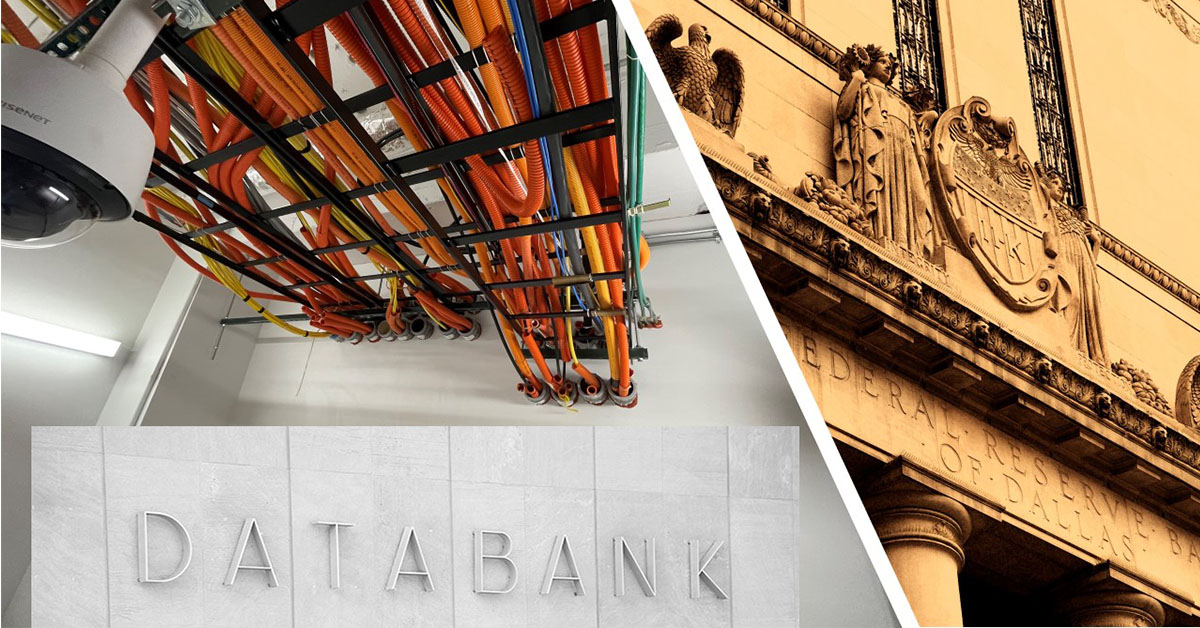
Since 2000, DataBank has made the DFW1 location a premier data center with established connectivity to many carrier networks. Located in the heart of the central business district in Dallas and adjacent to the AT&T Discovery District, DFW1 was formerly known as the Federal Reserve Building, built in 1921, and serves as the global headquarters for DataBank. Throughout its history, several expansions have added space for the mechanical infrastructure, including a five-story adjoining building. With 130,000 square feet of colocation floor space, the well-protected building is also well-connected, including direct tethering to two other DataBank data centers in the Dallas area—DFW2 and DFW3.
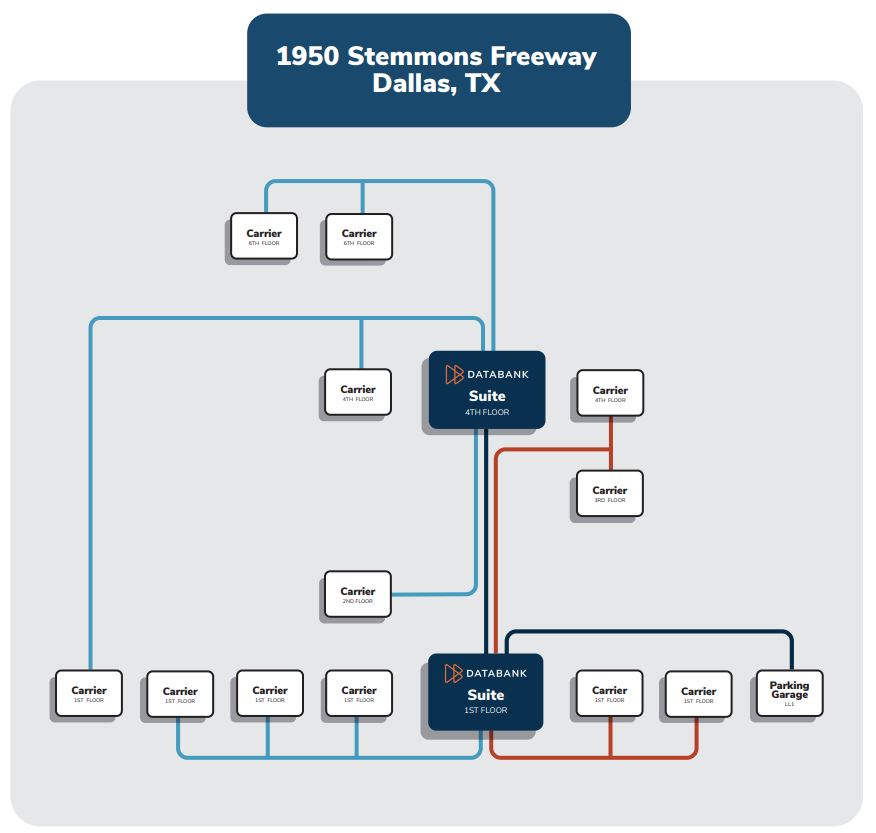
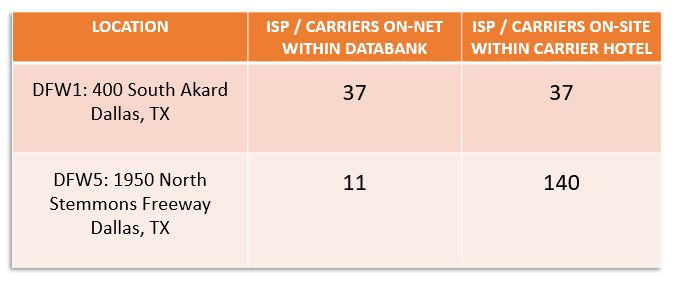
Located in a building formerly known as Infomart, DFW5 features 15,000 square feet of raised floor space within a seven-story building that spans more than 1.5 million square feet. The building was initially designed to host technical trade shows, and construction was completed in 1985. The facility now serves as the tenth most interconnected data center in the United States, providing a carrier-neutral environment housing over 140 network providers.
A Powerful Data Center Combination
Combined, DFW1 and DFW5 provide data center services to more than 230 customers spanning the communications, education, energy, entertainment, healthcare, high-tech, hospitality,manufacturing, retail, transportation, and utility sectors. The two data centers also offer 75 direct and extended carrier connections along with multiple innerducts and points of entry. In addition, customers can tap into five cloud on-ramps with direct, extended, and local-loop connections such as PacketFabric, Console Connect, and Megaport.
Other services that DFW1 and DFW5 customers can access include managed internet and colocation with an extensive quantity of risers and cross-connects between floors and suites to reach other data center operators, tenants, and carriers. DE-CIX also operates its Internet Peering Exchange directly within both data centers.
Key Players in a World-Class Network Provider Hub As a leading area of technology innovation, Dallas is the sixth-largest U.S. metro economy, generating nearly $1 trillion in combined Fortune 500 revenues. With the DFW1 and DFW5 hotel carrier data centers serving as key technology players in the market, DataBank is helping drive one of the uppermost accumulated network provider hubs in the world.
###
Featuring: Mark Houpt, DataBank’s Chief Information Security Officer
Listen to Mark Houpt as he discusses the need for distinct plans.
Here are a few things you’ll learn:
• Definitions
• What is unique between the plans
• A healthy habits approach
Run Time: 11 minutes
DataBank’s CISO Corner is for CISOs and security practitioners, where we discuss a variety of cybersecurity topics and current events from the CISO’s perspective. Our broadcast is designed for those who want to hear from security and compliance experts on the front lines.