By Eric Swartz, vice president of data center engineering
Does your data center give you the flexibility to deploy a standard server cluster and then scale to a higher-density solution when required?
That’s what you will need if you’re planning any digital transformation projects focused on improving experiences for customers, internal users, and partners to stay ahead of competitors. A key factor in driving innovative digital transformation is High-Performance Computing (HPC), which has revolutionized the speed at which enterprises process data.
At the same time, HPC applications significantly impact IT infrastructures. The compute resource firepower—which needs to scale quickly—requires racks of high-density compute resources. This adds to the demand for more power along with greater cooling to make sure the racks don’t overheat.
Solving the infrastructure challenge is key because HPC is vital for just about every industry—from finance to healthcare, manufacturing, and research. The ability to crunch massive datasets, perform complex simulations, and accelerate time-to-insight makes HPC indispensable for meeting the needs of end-users and gaining competitive advantages.
3 Major HPC Challenges Facing Data Center Providers
Power and Speed
The reliance on HPC by all these industries brings a host of challenges for data center providers in meeting the infrastructure requirements of their customers. As workloads grow more complex and datasets expand exponentially, data centers must deliver greater processing power with high-speed processors along with high-bandwidth networking technologies.
Scalability and Efficiency
Another factor driving the need for HPC is the exploding demand for artificial intelligence (AI). This includes machine learning applications that use algorithms requiring vast computational resources to train models on massive datasets. AI thus further drives the need for scalable and efficient infrastructure solutions.
Cloud and Hybrid Architectures
A third challenge reshaping the HPC landscape is the move toward cloud architectures and hybrid environments that blend on-premises and cloud infrastructures. While traditional on-premises HPC clusters remain popular for certain applications, many enterprises embrace the flexibility and scalability of the cloud. This means cloud providers must invest heavily in the HPC capabilities of their data centers by offering specialized instances, high-speed networking, and storage tailored to the unique requirements of HPC workloads.
TheUniversal Data Hall Design: The Flexibility to Fuel Innovation
At DataBank, we view the challenges HPC presents for data center providers as an opportunity to help our customers fuel their innovation initiatives. HPC requires us to tailor our offerings to support diverse deployment models for our customers and integrate our data centers seamlessly with cloud platforms. That’s exactly what we’vedone,. In doing so, we have opened avenues for greater collaboration.
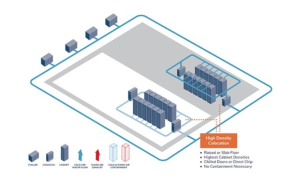
By deploying our vast resources, we deliver cutting-edgesolutions that give our customers the flexibility to move from a traditional environment to one that accommodates applications requiring greater density. One of the ways we do this is with our Universal Data Hall Design (UDHD), which allows us to accommodate any type of workloadour customers need today — and in the future — including innovative HPC applications requiring ultra high–density.
Our vision for UDHD developed as we saw the demand for delivering solutions with very different requirements within the same datacenter.One of which is power to the rack, evolving from 120/208 volts to 240/415 volts.
In the past, customers needed multiple power circuits to achieve 20+ kilowatts in a single rack. However, with 240/415 volts, they can achieve 30+ kilowatts with a single power circuit.This lowersinstallation costs and consumes less rack space for the same amount of power allowing the compute to be physically closer together maximizing cluster speeds.
The DataBank Universal Data Hall Design
Accommodating HPC environments with a water-cooled design is made possible with either liquid cooling underneath a raised floor or overhead on a slab.
In addition, UDHD provides greater cooling capabilities—a key feature because HPC workloads typically generate more heat than traditional air systems can cool to sufficient temperatures. We have the flexibility to approach this issue in different ways based on the application’s need. We can deploy rear-door heat exchangers for high–density air applications, direct liquid to the chip for those that go beyond the capabilities of air, or even immersion for the most demanding needs. We support all these methods using a closed-loop air-cooledsystem that doesn’t waste water and is more environmentally friendly compared to other evaporative systems.
HowDataBank Collaborates with HPC Customers
One example of a successful HPC deployment is the flagship computing cluster deployed by the research division at the University of Maryland (UMD).We helped the university deploy a cluster in one of our Northern Virginia DataBank data centers that makes compute resources available to any researcher on campus, spanning the fields of astronomy, physics, biology, social sciences, and artificial intelligence.
The solution required a custom 415V power distribution system and a mixture of traditional air cooling and high-density, direct liquid-to-the-chip cooling in the same environment. Our flexible design approach allowed UMD to deploy with no compromise to their design, enabling maximum performance.
Another example is DataBank’s collaboration with Georgia Tech in one of our Atlanta data centers. The university had unique requirements in that their HPC cluster runsupwards of 60 kW per rack using only air-cooled servers. We solved this by designing a portion of the data center to userear–door heat exchangers for primary cooling.
We also deployed a dedicated cooling loop for the doors, andby moving the heat absorption to the back of each cabinet,we can cool the high–density racks while keeping the roomtemperature neutral.By having the doors on a separate loop, we support the university’s other needs for more traditional density racks—using standard perimeter air cooling running at different temperatures.
Unlocking Opportunities for Growth and Innovation
With the rapid evolution of HPC reshaping the technology landscape and driving significant changes in infrastructure demands, enterprises must stay ahead of these trends and adapt their offerings to remain competitive. By embracing innovations in hardware, power, and cooling, and by leveraging hybrid and cloud-based architectures, DataBank helps customers navigate the complexities of the HPC landscape to unlock new opportunities for growth and innovation.
By Paul Myott, Vice President of Organizational Effectiveness & Internal Communications
Too many organizations make critical and expensive missteps when introducing a new digital tool. DataBank’s head of organizational effectiveness covers 10 steps to help you avoid critical mistakes and assure success when implementing a new digital solution.
So many companies today are looking for new or better ways to run their business, and as they do, many continue to turn to the latest digital solutions for help.
Yet, their attempt to layer on a new digital tool – or worse, blindly choosing the industry’s most recent “bright shiny object” – will not necessarily guarantee the return on investment (ROI) they are seeking. Implementing any new technology and getting employees to fully adopt it to the point where it delivers the desired results is a risky proposition.
Many companies have made critical mistakes in their attempts to introduce new digital tools or conduct widescale digital transformation efforts. One of the biggest and most common is not doing enough to educate and engage employees and make them part of the ongoing process. According to research findings from McKinsey & Company, 70% of digital transformation projects fail, primarily due to lack of a cohesive and compelling change strategy.
These failures add up to too many losses for the entire organization: loss of investment, loss of employee engagement and confidence, and loss of momentum in the marketplace. Organizations following structured digital implementation practices improve project success rates by 35%.
The Right Methodology for Change Management Success
Clearly, even the most successful companies can stumble when attempting to introduce a new digital tool to their employees. Despite having the best intentions, they accidentally overlook many of the most important steps when managing change. In doing so, they may inadvertently put the entire project at risk.
To help, here is a 10-step change management approach you can use to achieve success with implementing your next digital solution.
1. Assess Needs and Objectives
This is an important first step. It ensures alignment between the digital solutions’ capabilities, your own strategic goals, and the end-users’ needs. Many organizations start and end with simply defining the business objectives. However, to truly maximize adoption and ROI, we recommend defining both the business goals and end-user needs.
Whether you are buying or building the technology, evaluating and understanding your specific challenges, inefficiencies, and desired user outcomes will give you the highest chance of success at truly tailoring the implementation to address these areas effectively.
Don’t skip this step or simply select the most popular or trendy solution. Make sure you do enough research. Identify the right digital tool to address your unique requirements while providing the highest levels of functionality and compatibility with existing systems. Thorough research can minimize the risk of investing in tools that may not fully meet your needs.
We recommend choosing two to three best-in-class solutions and taking the time to have internal users demo them and complete a thorough side-by-side comparison. Best-in-class solutions typically have similar basic functionality, but some may have features you did not realize you needed or that may advance your capabilities.
3. Consider Employee Adoption as Early as Possible
It is surprising but still true: Too many companies overlook this part of the process, even if they follow Steps 1 and 2 above. They may assume their employees will accept the new tool or are knowledgeable enough to figure out how to use. This assumption can be disastrous and can even derail the whole project. Full-scale adoption is as critical as selecting the right tool and is dependent on buy-in from more than just the end-users.
It is critical to develop a comprehensive plan to identify and drive adoption with all impacted stakeholders, including leadership. Organizational change management is a comprehensive discipline designed to work in step with project management. This is why we suggest becoming familiar with a methodology and following it.
Related to the point above, once employees are bought in to the change, providing the right training and support ensures that they will understand the reason (and benefits) for the new digital tool and use it effectively. Deliver the right support resources at the point users need them and in the ways they prefer to use them.
Not only will this help reduce errors and maximize productivity, but it will foster increased confidence and proficiency among employees. These benefits will lead to smoother transitions and a better integration into existing processes and workflows.
Promoting adoption and engagement among employees fosters an ongoing culture of innovation and collaboration. This drives collective buy-in and ownership of the new digital tools. Actively involve employees in the onboarding process and encourage their participation. By using live demos, pilot groups, beta testing, and user acceptance testing, you can tap into their insights and feedback to refine strategies, enhance usability, and achieve faster uptake.
We also recommend identifying “change champions” early on. These champions can help evangelize the new tool within their teams ahead of the full-scale rollout.
Creating feedback loops is critical. They help you address potential missteps before they happen or quickly resolve issues that pop up unexpectedly. Creating product champions or functional owners to facilitate regular feedback and suggest enhancements from users during implementation is a great way to help tweak the tool to do what your users need it to do.
As the tool goes live in your environment, monitor ongoing usage and performance. This will not only measure adoption but can help you redirect resources, like technical support, where your users need them most.
By tracking metrics such as features accessed, issues reported, and system performance, you can ensure that the new solution continues to meet evolving needs and deliver the intended benefits over time. Sharing metrics with the user community is another way to promote transparency and drive iteration and continuous improvement.
Unfortunately, too many organizations don’t do enough to solicit any type of employee feedback. When they do, they don’t want to hear bad news. When negative feedback surfaces, it’s best to acknowledge it immediately, thank those who submitted it, and be clear about how you plan to address it.
If you don’t plan to address it, explain the business rationale in the most public forum possible to show transparency. This will go a long way toward fostering a culture of openness, trust, collaboration, and proactive problem-solving.
Plan now to celebrate the success you are sure to have. Recognizing early wins and achievements – no matter how small – will help reinforce positive behaviors. Also, highlight the efforts of key employees who have contributed along the way.
Build enthusiasm and momentum. Share user testimonials, publish case studies, and use simple rewards and recognition with early adopters. These are critical in encouraging further teamwork and adoption.
Don’t forget this last step. Focusing on driving continuous improvement with the new digital solution after implementation will give you the best chance for long-term success. By actively seeking ongoing feedback and soliciting suggestions for new functionality and capabilities from those who use the tool the most, you can make sure that the solution remains relevant, efficient, and capable of supporting evolving business objectives.
When it comes down to it, successfully implementing any new digital tool requires a comprehensive approach that focuses on people and process as well as the technology. By following the framework described above, you can develop an effective plan that addresses each of these areas – especially your employees – to maximize adoption and help you achieve your objectives.