Interconnection refers to the direct linking of networks, data centers, and cloud platforms to improve performance, reliability, and customer experience.
Interconnection encompasses the various physical and virtual connections that companies use to exchange data, ensure business continuity, and achieve specific operational objectives. In colocation data centers, these connections are vital for fast data exchange, reduced latency, and improved network performance. Yet the real value lies in how they’re delivered and supported.
While interconnection technologies themselves are well-established, the approach to implementing and managing them varies significantly across providers. The difference between adequate connectivity and exceptional connectivity often comes down to the customer experience. More specifically, how well a provider understands your specific requirements, eliminates operational friction, and delivers service excellence throughout your relationship.
Cross connects: Direct, dedicated connections within the same data center
Internet exchanges: Shared switching infrastructure for peering with multiple networks
Data center interconnects (DCI): Point-to-point connections between different data centers
Internet connectivity: Various methods for accessing public internet (DIA, IP Transit)
Cloud connectivity: Private connections to public cloud providers (VPNs, cloud on-ramps, NaaS)
The question isn’t which technologies you need. It’s how your colocation provider approaches delivering them. This article will examine three key pillars of effective interconnection strategy and provide specific examples of the measurable benefits each approach delivers to IT organizations.
Beyond SLAs: What True Partnership Looks Like
Most colocation providers approach interconnection with a checklist mentality: deliver the connection, meet the SLA, move on to the next ticket. But the most successful IT deployments happen when providers go deeper, establishing genuine partnerships that address the unique challenges each organization faces.
True engagement means understanding that every company’s interconnection needs are shaped by their specific industry, compliance requirements, and risk tolerance. A healthcare organization’s approach to data security differs fundamentally from a fintech company’s, even when both need the same basic cross-connect. The difference lies in how the provider addresses those site-specific requirements.
This partnership approach delivers measurable advantages:
Private Interconnections That Reduce Security Risk
Interconnection solutions create dedicated, isolated connections that minimize exposure to external threats. Unlike public internet connections vulnerable to interception and unauthorized access, these private channels enhance data security through multiple layers of protection. Organizations can implement robust security measures including encryption, firewalls, and intrusion detection systems to safeguard data as it travels between interconnected entities.
For regulated industries, this becomes even more critical. Finance, healthcare, and government sectors face stringent regulations governing sensitive data transmission. The right interconnection approach provides the infrastructure needed to establish secure connections that meet compliance standards, helping organizations demonstrate their commitment to data privacy while protecting against legal and reputational risks.
Customized Architecture that Grows with Your Business
This customer-focused approach translates into tangible operational benefits. Rather than treating interconnection as a commodity service, providers who prioritize engagement work closely with customers to understand their specific security posture, compliance obligations, and growth trajectory. The result is interconnection architecture designed not just for today’s requirements, but for tomorrow’s challenges.
Partnership-focused interconnection transforms connectivity from a commodity purchase into a strategic advantage that scales with your business. However, even the best partnerships fall short if operational inefficiencies create friction in day-to-day management.
Streamlining the Complex: Eliminating Operational Friction
The most expensive interconnection problems aren’t the obvious ones. They’re the hidden inefficiencies that compound over time: network bottlenecks that slow critical applications, capacity constraints that force reactive scaling decisions, and operational complexity that consumes IT resources better spent on strategic initiatives.
Smart colocation providers focus on minimizing these non-core activities that impact the customer experience. Instead of simply delivering connectivity, they work to eliminate the operational friction that makes interconnection management a burden rather than an enabler.
The following are specific examples of how these friction-elimination strategies work in practice:
Direct Connections to Reduce Latency
By utilizing direct connections that bypass the public internet, data transmits with minimal delay, delivering faster transfer speeds and reduced latency. This becomes particularly crucial for bandwidth-intensive applications and real-time data processing where milliseconds of delay impact user experience and operational efficiency.
Traditional internet connections remain susceptible to congestion and bottlenecks, creating potential downtime and data packet loss. Interconnection solutions provide dedicated, private links that ensure stable, reliable connections, reducing disruption risk and enhancing overall network resilience.
Real-Time Bandwidth Allocation Without Service Disruptions
As data volumes continue growing exponentially across applications, services, and devices, organizations face the ongoing challenge of managing and processing vast amounts of information. The right interconnection approach provides the bandwidth and capacity needed to accommodate these demands, allowing organizations to scale operations without compromising network performance.
This means businesses can conveniently add or remove network connections and allocate bandwidth in real-time, aligning with their changing demands. Rather than forcing IT teams into reactive mode when traffic spikes or new applications come online, proactive interconnection planning ensures the network remains capable of managing heightened data traffic without sacrificing performance.
Simplified Operations That Improve IT Management Bandwidth
The best interconnection strategies reduce complexity rather than add to it. When providers focus on eliminating operational friction, IT teams spend less time managing connectivity issues and more time driving business value. This operational efficiency becomes a competitive advantage, freeing resources for innovation rather than maintenance.
Friction-free operations transform interconnection from a technical headache into a strategic enabler. Yet even streamlined connectivity falls short without service delivery that evolves alongside your business needs.
Service Delivery for the Modern Enterprise
Modern IT organizations don’t just need interconnection services—they need interconnection partners who understand the pace of digital transformation. Traditional service delivery models, built around reactive support and manual processes, can’t keep up with the agility demands of today’s enterprises.
Service excellence in interconnection means anticipating needs, providing flexible solutions, and delivering support that matches the speed of modern business. It’s the difference between a provider who responds to tickets and one who helps architect your connectivity strategy.
This modern service delivery approach is capable of delivering positive, tangible results:
Seamless Integrations for Cloud, IoT, and Emerging Technologies
Scalability and flexibility define modern interconnection service delivery. Organizations need the ability to adapt quickly as they adopt cloud services, implement IoT devices, or incorporate new applications. Interconnection provides the framework for integrating these elements smoothly, allowing efficient data transfer and communication between different systems and networks so they work together seamlessly.
This adaptability becomes essential as businesses respond to market shifts and evolving customer expectations. Whether venturing into new markets, introducing fresh products and services, or scaling operations to meet growing demands, interconnection delivers the flexibility needed to accommodate dynamic business transformations without lengthy implementation cycles or service disruptions.
Edge-Computing Capabilities that Deliver the Fastest Response Times
The most forward-thinking interconnection approaches provide the foundation for building robust, distributed architectures like edge computing and hybrid cloud environments. By connecting edge locations with centralized data centers or cloud environments, organizations achieve low-latency data processing and real-time analysis at the edge.
This enables faster, more responsive services to end-users while offloading computational loads from core infrastructure. The seamless connectivity offered by modern interconnection solutions paves the way for innovative technologies and architectures that drive efficiency, performance, and competitive advantage.
Proactive Support to Prevent Issues Before They Impact Operations
Service excellence means more than meeting expectations. It means exceeding them consistently. This translates into proactive communication, streamlined processes, and support that anticipates challenges before they impact operations.
Modern service delivery transforms interconnection from reactive support into strategic partnership. When providers combine genuine engagement, operational excellence, and forward-thinking service delivery, interconnection becomes the foundation for competitive advantage rather than just another IT expense.
The Choice is Yours
The interconnection landscape will continue evolving, but the basic question remains the same: Will you choose a provider who treats connectivity as a commodity, or one who approaches it as a strategic partnership?
The technologies are largely the same across providers, but the customer experience varies dramatically. When evaluating colocation partners, look beyond the technical specifications and SLAs to understand how they’ll support your business objectives, eliminate operational friction, and deliver service excellence that scales with your growth.
Return on investment (ROI) measures the financial value gained from technology initiatives compared to their cost and operational impact.
While AI has been developing for decades, ChatGPT’s debut nearly three years ago suddenly made AI accessible to everyone and sparked the current enterprise adoption boom. It burst on the scene so quickly that many organizations found themselves scrambling to respond. Since then, organizations have been figuring out how to transform AI experiments into business-critical applications that generate real value. Now, that effort is paying off.
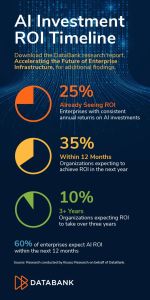
According to our recent survey of 304 senior IT professionals, 25% of enterprises are already achieving consistent annual returns on their AI investments, with another 35% expecting to hit profitability within the next 12 months. That means 60% of organizations surveyed are either seeing real money from AI or confident they will very soon.
The Quick Wins Are Working
These findings from DataBank’s new AI infrastructure report reflect real-world results from enterprise leaders who are making AI work today. Early AI adopters focused on what industry experts call the “low-hanging fruit”—straightforward automation and efficiency initiatives that deliver immediate, measurable value.
60% of participating enterprises reported they expect to achieve ROI for their AI projects in the next 12 months.
It’s clearly paying off. Consider the case of Visa, whose executives participated in our research roundtables and shared their AI journey. The company has been using AI for fraud detection for over 30 years but recently enhanced their models with deep learning and transformer technologies.
The result? $40 billion in prevented fraud last year alone. Visa has also deployed ChatGPT for employees, Microsoft Copilot for Office, and GitHub Copilot for developers to boost productivity across the organization.
ServiceNow, another executive participant in our study, offers an equally compelling example. Their AI transformation reduced response times in their finance department from four days to just 15 seconds while freeing up staff for higher-value work. The company reports over $350 million in enterprise value generated from AI implementations across their organization.
These early wins demonstrate that focused, practical AI implementations can deliver substantial returns, but industry leaders believe this is just the beginning of AI’s transformational potential.
Beyond Automation: The “Third Lift”
While these quick wins demonstrate clear value, industry leaders believe we’re still in the early stages of AI’s potential impact. Shez Partovi, Chief Innovation Officer at Philips and another executive participant in our research, describes AI adoption as happening in three distinct phases or “lifts”:
First lift: Automating administrative work. Tasks like data entry, basic customer service responses, scheduling, and routine report generation that free up human workers for more strategic activities.
Second lift: Augmenting employee skills to tackle higher-level tasks. In this phase, AI assists professionals in complex decision-making, advanced data analysis, creative problem-solving, and specialized technical work that they may not be able to do alone.
Third lift: Enabling entirely new capabilities. AI makes possible entirely new business models, products, or services that were previously impossible due to cost, complexity, or technological limitations.
“Most enterprises are still at a very early stage of AI adoption,” Partovi said, comparing the current state to 64K dial-up in the internet connectivity evolution. The greatest returns will come from that third lift when AI allows organizations to do things they simply couldn’t do before. This could include real-time personalization at massive scale, predictive maintenance that prevents problems before they occur, or AI-driven drug discovery that accelerates development timelines from years to months.
Obstacles and Opportunities in AI Adoption
While AI ROI is accelerating, our research reveals that enterprises still face significant hurdles, including integration challenges, high costs, lack of clear use cases, and other issues. (More on these topics in our next blog).
However, there’s encouraging news in one critical area: enterprises have largely solved their data quality challenges. Only 18.5% of respondents cite poor data quality as a major blocker, a significant improvement that reflects years of investment in data infrastructure and governance.
This post is part of a five-part series examining key trends in enterprise AI adoption based on our 2025 AI infrastructure survey.
By Branden Stanley, Senior Product Manager, Managed Services, DataBank
Computing infrastructure wasn’t always about the virtualization and cloud services we know today. In the early days of business computing, every server was what we now call “bare metal”—dedicated physical machines serving single organizations.
Through the 1980s and 1990s, if you wanted to run business applications, you bought or leased entire computers. As the internet expanded in the early 2000s, dedicated hosting providers recognized an opportunity. Many businesses needed server power but lacked the capital for hardware purchases and data center space.
The solution was simple: instead of the traditional model where businesses owned their own hardware, providers would own the physical infrastructure and rent dedicated servers to customers on a monthly basis. This shift from buying hardware outright to operational expense models made enterprise-grade computing accessible to smaller organizations, yet it also led to new challenges.
The Cloud Revolution: Trading Control for Convenience
However, the economics of dedicated hosting led to resource-sharing experiments. Shared hosting emerged as a cost-effective option where multiple websites or applications coexisted on single servers. While affordable, this approach introduced the “noisy neighbor” problem—when one tenant’s resource demands affected everyone else’s performance.
As businesses grew and their applications became more critical, they found themselves caught between two imperfect options: expensive dedicated servers with long provisioning times and complex management requirements, or shared hosting with unpredictable performance issues.
Enter cloud computing. Amazon Web Services and other public cloud providers revolutionized the industry by introducing virtualization technology that could provision servers in minutes rather than days or weeks. The cloud promised unprecedented automation, elastic scaling, and built-in redundancy that solved many reliability and uptime challenges that plagued traditional hosting. Suddenly, IT teams could spin up infrastructure with code, automate deployments, and scale resources dynamically based on demand.
However, this convenience came with trade-offs that became apparent as workloads matured. Virtualization introduced performance overhead, essentially a “tax” of roughly 10% on processing power due to the hypervisor layer managing multiple virtual machines. The very abstraction that enabled cloud flexibility also meant losing direct access to hardware-level controls, BIOS settings, and specialized configurations that some applications required.
Perhaps most ironically, the cloud reintroduced the noisy neighbor problems that shared hosting had created, as virtual machines competed for shared physical resources on the same underlying hardware.
The Bare Metal Renaissance
As these cloud limitations became clear, a new generation of offerings emerged—bare metal—that combined dedicated hardware performance with cloud-like convenience. Modern providers recognized that businesses didn’t want to choose between performance and ease of use. They wanted both.
Remote management technology became standard on new servers, and the capabilities it brought allowed complete server control without anyone physically touching the hardware. IT teams could now restart servers, change system settings, and even reinstall operating systems from their desks. Combined with automation tools, bare metal servers became as easy to manage as virtual machines, but without the performance trade-offs.
This evolution solved critical business problems beyond just performance. Instead of buying millions in hardware upfront, organizations could pay monthly like a subscription service. They could eliminate costly hardware replacement cycles while keeping dedicated resources. For many applications, a single optimized bare metal server could replace 10 or more virtual machines.
Most importantly, modern bare metal eliminated the performance penalty entirely. Applications get direct access to all hardware resources, everything from processing power to memory to specialized chips like GPUs. IT teams can fine-tune system settings and achieve the predictable performance that shared environments simply can’t deliver.
The control extends to networking capabilities as well. Companies can create and manage their own network segments within bare metal environments, then use managed internet connections to establish direct links to their existing colocation infrastructure. This approach allows businesses to seamlessly bridge their bare metal instances with traditional data center deployments, creating flexible architectures that span multiple infrastructure models.
Where Bare Metal Excels: Critical Use Cases
Modern bare metal servers have found their niche in applications where performance, control, and predictability are non-negotiable. Key use cases have emerged where the benefits clearly outweigh virtualized alternatives:
AI/ML training and inference: Training large language models or running inference at scale requires direct access to specialized accelerators, where even small performance losses translate to dramatically longer training times and higher costs.
High-Performance Computing (HPC): Scientific research, weather forecasting, and molecular modeling rely on intensive computational workloads that benefit from dedicated resources. These applications often require specific hardware configurations and can’t tolerate the unpredictable performance variations of shared environments.
Financial services: In high-frequency trading, microseconds mean the difference between profit and loss—literally millions annually. Ultra-low latency requirements demand bare metal’s predictable performance and direct hardware access, eliminating virtualization overhead that could introduce fatal delays.
Real-time analytics: Processing streaming data for fraud detection, recommendation engines, or IoT applications requires consistent, dedicated resources that can’t afford the performance variability of shared infrastructure.
Gaming and media: Multiplayer gaming servers and video processing need dedicated GPU resources and consistent network performance to deliver smooth experiences without lag or buffering.
Regulatory compliance: Industries with strict data sovereignty or security requirements often mandate the physical isolation that only single-tenant bare metal provides.
As these demanding use cases multiplied across industries, data center operators and cloud providers began recognizing a significant gap in their service portfolios that traditional virtualized offerings simply couldn’t fill.
Key Differences Between Virtualized Machines and Bare Metal
In summary, it comes down to these differences:
Virtualized Machines
Run on top of a hypervisor
Share physical server resources with other VMs
Resource allocation is logical, so actual performance can vary depending on workload and other tenants
Bare Metal
Dedicated physical servers with no hypervisor layer
All CPU, memory, and storage are exclusively yours, eliminating resource contention
Best for workloads needing predictable, consistent performance
These fundamental differences explain why organizations increasingly view bare metal as a strategic complement to, rather than replacement for, their existing cloud infrastructure.
The Market Response to Growing Demand
As these demanding use cases multiplied across industries, data center operators recognized a new opportunity in their service portfolios. They saw potential between their existing offerings: colocation services where customers housed their own hardware, and cloud services that layered virtualization on top of physical servers. There was room for a better way to deliver dedicated performance without operational complexity.
Rather than treating bare metal as a separate product category, data center operators are now positioning it as part of a comprehensive portfolio designed to help customers “shift left”—changing how they think about infrastructure ownership. Bare metal combines dedicated hardware performance with cloud-like operational simplicity, eliminating the burden of hardware selection, deployment, and maintenance. It also offers predictable monthly costs instead of large capital investments.
This evolution reflects market pressures toward performance, efficiency, and cost reduction. Bare metal fills the crucial middle ground between colocation and fully virtualized cloud, offering dedicated speed with managed convenience.
Bare Metal in Hybrid Architectures
Modern bare metal delivers significant value in hybrid infrastructures, where different models handle different workloads optimally. Organizations can run lightweight applications as virtual machines, deploy performance-critical databases on bare metal, and use public cloud for archival storage—each component optimized for its specific role.
One innovative approach involves using bare metal environments to process compute-intensive workloads, then moving results to public cloud for cost-effective long-term storage. This leverages bare metal’s processing efficiency while avoiding expensive cloud compute and egress fees. In this example, raw data ingestion and analysis happen on bare metal, while processed results archive to Amazon S3 at unbeatable storage rates.
This approach highlights bare metal’s core advantage: natural efficiency that other models can’t match, making it the ideal foundation for performance-critical components in modern hybrid architectures.
The Future of Infrastructure Choice
Think of bare metal’s evolution like choosing between owning a car and taking the bus. Public transit (cloud services) offers convenience and lower costs by sharing transportation resources among many passengers. Yet when you need to reach a specific destination on your exact timeline without delays from other stops, you need your own vehicle (bare metal). It gives you dedicated control over the route, speed, and schedule that gets you precisely where you need to go.
The infrastructure landscape has come full circle with important improvements. Today’s bare metal combines dedicated performance with cloud-like operational simplicity. As workloads become more demanding, bare metal represents not a step backward, but a maturation of infrastructure options, giving organizations dedicated resources without sacrificing the convenience that enables innovation.
Paul Myott, Vice President of Organizational Effectiveness and Internal Communication, DataBank
Kathy Skobe, Director of Customer Success, DataBank
Building and maintaining a strong organizational culture is one of the most challenging aspects of business leadership. At DataBank, we’ve learned that the “maintaining” part is often harder than the initial building effort.
While many companies focus on defining their values and hoping they stick, we’ve discovered that culture requires the same intentional, systematic approach as any other critical business function. The key insight that transformed our approach: culture isn’t something that happens to your organization, it’s something you actively hire for, measure, and nurture at every level.
Cultural engagement doesn’t require grand gestures. It’s about the daily choices that either strengthen or weaken the fabric of our organization and ultimately shape how customers experience working with us.
Building Culture by Design, Not by Default
The data center industry is heavy on mergers and acquisitions, where it’s common to see companies with a patchwork of different cultures existing under one roof.
We experienced this firsthand during our growth phase over the past few years when we completed four acquisitions in a short period, creating what we call a “Franken-culture.” Employees would reference doing things “the old way” versus “the DataBank way,” with different approaches competing instead of complementing each other.
While many companies struggle with teams scattered across locations defending their own approaches, we saw this as a competitive advantage waiting to be unlocked. Culture became a primary business objective, starting at the C-suite level.
Rather than following the typical “mission-vision-values” playbook, we approached culture building through three strategic phases:
First, we identified the culture we wanted. Instead of abstract values, we focused on our Purpose, Way, and Impact. This gave us concrete cultural cornerstones centered on being a “data center-people first” organization.
Second, we shared details about the culture to the whole organization. This meant integrating cultural expectations into job descriptions, performance reviews, and hiring processes so everyone knew that cultural engagement would be measured, not just talked about.
Third, we operationalized it for the long term. We built systems to maintain culture deliberately. Building culture requires intention but sustaining it requires a long-term commitment. Having a shared lexicon makes day-to-day interactions consistent with our intended culture.
This systematic approach created the framework that now drives every customer interaction at DataBank, and has resulted in an employee Net Promoter Score (eNPS) that has gone from the high 30s to above 60 in the last three years.
Three Cultural Cornerstones That Drive Customer Experience
At DataBank, we built our culture around a simple truth: healthy organizational culture requires strong alignment between your higher purpose and clear behavioral expectations. Our higher purpose is “to take away the worry of managing mission-critical IT infrastructure,” and we’ve developed three cultural cornerstones that support this purpose and guide every customer interaction.
Inspiring confidence means being present and responsive when clients need us most. Our teams take extreme ownership of issues and full accountability for their actions. For example, when a customer calls with a critical issue at 2:00 a.m., that customer will be able to reach someone who treats the emergency as his or her own.
Putting people first focuses on the relationships that make everything else work. We assume positive intent with each other and extend this naturally to clients. This becomes transparent communication and collaborative problem-solving that clients feel in every interaction.
Being data centered drives us to solve problems before selling services. We find answers in data and share that knowledge with clients to resolve challenges quickly. This pushes us toward technical excellence, but always in service of clients’ actual needs rather than what we think they should buy.
These three cornerstones provide the cultural framework, but we’ve learned that the most effective way to sustain them is by building teams with the right personality mix from the start.
The Archetype Mix That Delivers Exceptional Customer Experience
DataBank’s approach to culture goes beyond values and behaviors. We design our teams around specific personality and behavioral archetypes that naturally deliver better customer experiences. Through comprehensive assessment, we discovered that our most successful employees predominantly embody three key archetypes: Hero, Everyperson, and Sage.
This creates a powerful combination that customers experience directly:
Hero team members naturally take on the biggest, toughest challenges. When a customer faces a critical infrastructure crisis, they’re getting someone who thrives on solving problems others can’t.
Everyperson archetypes ensure our teams have each other’s backs and keep everyone grounded. Customers experience this as seamless collaboration across departments and consistent support from a team that works together rather than passing problems around.
Sage personalities drive our reliance on data and process. Customers get systematic problem-solving, evidence-based recommendations, and the confidence that comes from working with people who make decisions based on facts, not guesswork.
The result is a well-balanced culture with a clear outcome: We deliver exceptional customer experience by being a winning team that honors our word and has the collective capability to tackle any challenge.
From Culture to Customer Success: A Frontline Perspective
As DataBank’s Director of Customer Success, I (Kathy) see firsthand how our cultural framework translates into real customer outcomes. While our organizational development team has built an impressive cultural foundation, my role is ensuring that foundation becomes tangible value for every client we serve.
Culture isn’t just an internal initiative. Instead, it’s the invisible foundation that determines whether every customer interaction builds trust or erodes it. In the data center industry, where customers are entrusting us with their most mission-critical infrastructure, technical competence is table stakes. What differentiates exceptional service is whether customers feel genuinely supported, understood, and prioritized throughout their journey with us.
This culture translates into customer experience through quick responses to urgent requests and seamless team collaboration on complex problems. Most importantly, customers feel that we genuinely care about their success beyond just equipment maintenance.
When culture and customer experience align, customers don’t just get reliable infrastructure. They get a partnership that enables their business growth and gives them confidence to innovate without worry.
Living the Culture: Employee Recognition in Action
Our employees don’t just know our cultural cornerstones. They live them every single day in their interactions with customers. We see this dedication consistently, and our quarterly DataBank Way awards give us the opportunity to formally recognize employees who embody our culture in exceptional ways.
Recent nominations showcase exactly how our cultural framework translates into outstanding customer experiences:
One employee was nominated “for the way he continually took ownership in his data center, always making sure clients and account teams were aware and in-sync on issues in the facility.”
Another was recognized “for her efforts in several difficult projects migrations, coordinating between customer and network teams, resolving complex server issues by engaging customers directly, and ultimately leading to higher customer confidence and satisfaction.”
These aren’t isolated examples. They represent the daily reality of how DataBank employees approach customer relationships, guided by the cultural principles that define who we are as an organization.
What Our Customers Say: Where Culture Pays Off
All of this cultural work has one ultimate test: how customers actually experience working with DataBank. The proof isn’t in our mission statements or internal awards. It’s in what customers tell us directly through our Net Promoter Score (NPS) surveys and scores.
The results speak for themselves. Customers consistently highlight the personal connections and proactive support that set us apart: “Positive, friendly and proactive team minded environment. Reachable at any time during business hours and after,” and “The staff are some of the best in the business! Always helpful and always willing to go the extra mile for the customer.”
The specificity of their feedback shows how individual team members embody our cultural cornerstones. One customer praised their local team: “The professionalism, friendliness, and support from the local team. The team has been nothing short of fantastic to deal with and are a shining example of what your company represents.”
Perhaps, most telling are the comments that capture our “People First” approach in unexpected ways: “They keep grape soda in the fridge simply because I like it. Sold.” These moments of personal attention demonstrate that great customer experience often lives in the smallest gestures that show we genuinely care about the people behind the infrastructure.
We recently heard from even more customers who were willing to share their experiences. Some additional highlights:
From a customer success standpoint, culture isn’t just an internal initiative. It’s the invisible foundation that determines whether every customer interaction builds trust or erodes it. In the data center industry, where customers are entrusting us with their most mission-critical infrastructure, technical competence is table stakes. What differentiates exceptional service is whether customers feel genuinely supported, understood, and prioritized throughout their journey with us.
Great culture becomes the customer’s experience in countless moments: how quickly we respond to their urgent requests, whether our teams collaborate seamlessly to solve complex problems, and most importantly, whether customers sense that we truly care about their success beyond just maintaining their equipment. When culture and customer experience align, customers don’t just get reliable infrastructure. They get a partnership that enables their business growth and gives them confidence to innovate without worry.
The Bottom Line: Small Gestures Can Have the Biggest Impact
Our journey from a “Franken-culture” of competing approaches to a unified cultural framework demonstrates that intentional culture building directly drives customer satisfaction. While our three cultural cornerstones and leadership behaviors provide the structure, it’s often the smallest gestures that make the biggest difference.
The customer who mentioned grape soda in the break room wasn’t just commenting on a beverage. He was recognizing that someone cared enough to notice his preference and act on it. This attention to individual needs, multiplied across thousands of daily interactions, transforms routine business relationships into genuine partnerships. When culture becomes the foundation of every customer touchpoint, technical excellence evolves into trust, loyalty, and the confidence that enables customers to innovate without worry.