On May 15, 2019, the President issued an Executive Order (EO) directing that communications technology or services be more tightly controlled within the United States, both federal and commercial spaces. The specific order can be read here.
As part of an ongoing effort to keep our customers and partners appraised of significant security developments, we wanted to share our impressions of the EO and its likely impact on our, and possibly youroperations.
The intent of the EO is to prevent “sabotage”, “subversion”, or other “catastrophic effects” of infrastructure and technology or technology services such as code, designs, manufacturing, or general supply. The EO was in response to and vaguely directed at Huawei and accusations that they are an arm of the Chinese government,. However, the EO was broad enough to encompass any similarly accused providers including those of future, actual, or perceived adversaries. It should be noted that China, and Huawei deny these accusations.
While there is no immediate action to be taken, we do anticipate the following impacts and changes to operations in months ahead:
This EO will impact how DataBank acquires systems and our overall acquisition process.
Our CISO, Mark Houpt, will begin working with our internal acquisitions teams when more information is provided.Specifically, we’ll be looking to the U.S. Federal Governmentfor a list of defined “adversaries” or a program similar to the ITAR/EAR programs operated through the State Department and Department of Commerce. This list will likely include country, company, and individual person sources that we will have further evaluate. We will then need to develop policies and processes to ensure that we acquire technology and services in accordance with any new standardsand we will need to follow those strictly. It should be noted that we already acquire technology and services in accordance with U.S. Federal Standards as defined by Supply Chain controls for FedRAMP. We anticipate these new policies or standards to be more strict.
We should be prepared for more stringent regulation and testing – aka auditing – of our acquisition process and supply chain as it relates to SSAE18, HIPAA, FedRAMP and FISMA.
Our network, server and storage devices, and even our environmental systems such as UPS, generators and transfer switches, will have to be verified and certified in some way as not being impacted by “adversaries” as defined by the U.S. Federal Government. Our CISO expects that in the coming weeks and months additional guidance regarding this will be coming from the FedRAMP PMO or other applicable agencies and it will be provided as soon as it is available.
We’ll continue to closely monitor developments and appraise our customers and partners of operational changes as they become clear.
CVE-2019-0708 and Remote Desktop Services
On May 14, 2019, Microsoft released a patch for Windows 2003, Windows 2008, and Windows 2008 R2 servers. The specific patch mitigates the possibility that an attack could happen via Remote Desktop Protocol (RDP). It is important to note that RDP is not by itself vulnerable. This exploit is pre-authentication and does not require user interaction. If exploited, the vulnerability could spread to other vulnerable servers in a worm-like fashion. To exploit this vulnerability, an attacker would need to send a specially crafted request to the server via RDP. The exploit could then run code to take over control of a system, delete files, and/or install programs.
Is there an exploit available for this yet?
At the time of this writing, there is not a public exploit available. However, given the severity of the patch (Critical), it is likely only a matter of time before an exploit becomes available.
Which server versions are affected?
Windows 2003, Windows 2008, and Windows 2008 R2. While Windows 2003 is no longer supported by Microsoft, this is an out of band patch that is being released. Customers should consider migrating away from Windows 2003 to a supported OS.
Our servers are protected by VPN though. Does that help mitigate the risk?
While DataBank always recommends locking down ports on the firewall and using secure methods of connecting to a server, such as via VPN, this does not prevent an exploit from occurring. While a VPN does lower the surface area of an attack as the communication is encrypted and the RDP service is not opened externally, the risk still exists until the patch is deployed. The risk can also be partially mitigated with Network Level Authentication (NLA) in that the exploit would not spread to other vulnerable systems with NLA enabled. DataBank recommends deploying the patch as soon as possible.
Mission Critical IT Demands an Always Available Support Team
Today, technology no longer merely supports the business; technology is the business. Every enterprise out there, regardless of vertical, is heavily reliant upon technology, with mission critical apps carrying out the bulk of day-to-day business tasks whether in ecommerce, a hospital environment, or a financial organization. It’s not the support environment of yesteryear. When internal IT resources are limited, their daily tasks quickly become dominated by flashing lights and alarms, while the core mission falls to the wayside.
Meanwhile, digital transformation has made hybrid strategies commonplace, with businessesincreasingly choosing mixed infrastructures. Cloud usage is growing, as is complexity.
79% of enterprises say that lack of internal resources and expertise is their primary challenge with the cloud (RightScale).
84% of businesses who choose to outsource IT have initiated discussions, conducted pilots, or implemented solutions around transformation. When executed properly, disruptive outsourcing can actually bring competitive advantage (Deloitte).
If you choose to enlist the help of third-party support in conjunction with outsourced IT, your chosen partner should prioritize functioning as an extension on the IT staff and bringing proactivity to operations. At DataBank, for example, forklifting everyday distractions is a key objective. Complexity varies from one customer to another, but businesses rely on our support team for everything from managing mission critical applications and monitoring alarms to patching and upgrades. And we’re incredibly proactive in our approach. In fact, DataBank responds to over 19,000alarms per month, with technicians logging in to identify the source 98% of the time, and most being resolved within 15 minutes, often before customers are even aware there was an issue.Customers can easily reach out if they notice an application is running slowly to request an upgrade. Support can be as comprehensive as the customer requires.
“We’re an extension of their IT staff, and they don’t have to hire technical IT people because we’re managing their applications and we go all the way down to the application stack. Making sure their assets and sites are up and running and they can concentrate on their core business objectives”
-Michael Deamer, Vice President of Client Services, DataBank
Increasing the Positive Business Impacts of Managed Services
When you rely on managed services to streamline some of the operational tasks that weigh down your own IT team, experienced support engineers should be part of the package. In order to maximize efficiency impacts, support engineers need to have competency that spans infrastructure to operating systems.In evaluating support services with your chosen managed service provider, they should cover the following practice areas:
General tech support
Monitoring
Recovery
Patching
Backups
Security
How DataBank Makes Life Easier for Customers Through Comprehensive Support
The DataBank Support experience actually starts with implementation and provisioning. Depending on the project at hand, the implementation team will configure services and assist with the migration, ensuring apps are up and running. Once implementation is complete, Supportleverages a deep bench of analysts, development, and database administrators to keep systems up and running continuously.
95-96% of every ticket submitted by a customer is handled by the same person who answers the phone.
98% of alarms are fixed within 15 minutes.
DataBank opens 75% of tickets overall. Proactive monitoring ensures that potential issues are identified before they impact customers.
Quality, depth and breadth of support is critical when selecting an IT infrastructure and managed services partner. Having the right technical staff who know multiple operating systems and can contribute proven expertise across the spectrum of support activities is the key to success.
“We have the right staff. They’re technical, and whether there’s an alarm or an open ticket, they’re proactive and they identify issues before they ever become a problem for the customer. That’s what support is really about.”
-Michael Deamer, Vice President of Client Services, DataBank
This article first appeared in Data Economy, written by DataBank CEO, Raul K. Martynek.
It’s difficult to read any industry publication today and not see an article about “The Edge”. Most articles seem to assume that it is a foregone conclusion that there will be thousands or tens of thousands of edge data centers in the not so distant future. Most articles attribute the evolution of edge data centers with the introduction of 5G and concepts like Mobile Edge Computing. And, almost all articles mention latency as the primary driver of edge data centers and the need to reduce latency to support a range of applications from autonomous vehicles to artificial intelligence to robotic surgery.
In this article, I would like to examine each of these assumptions and provide some observations regarding latency, the evolution of 5G and what DataBank is seeing in the marketplace today. I will argue the The Edge is here already today, but happening in an overlooked space – inside “traditional” data centers in secondary markets. I will also argue that the incremental benefits of micro edge data centers, for example those proposed at the base of cell towers, would provide negligible incremental benefits to latency and in fact introduce significant operational and technical hurdles to deploying infrastructure over large geographies.
The Impact of 5G
Let’s begin with looking at 5G and how it will impact latency and the decision on where to deploy infrastructure. There is no doubt that the widespread adoption of mobile 5G will have important consequences for the evolution of the modern Internet. Broadly speaking, the two most important benefits of 5G are increased throughput and reduction in latency. Everyone understands increased throughput. VZN’s limited mobile 5G rollout in Chicago and Minneapolis has delivered download speeds of up to 600Mbps. More bandwidth is great and I’m sure we’ll see new higher definition video codecs and other technologies emerge to consume that bandwidth.
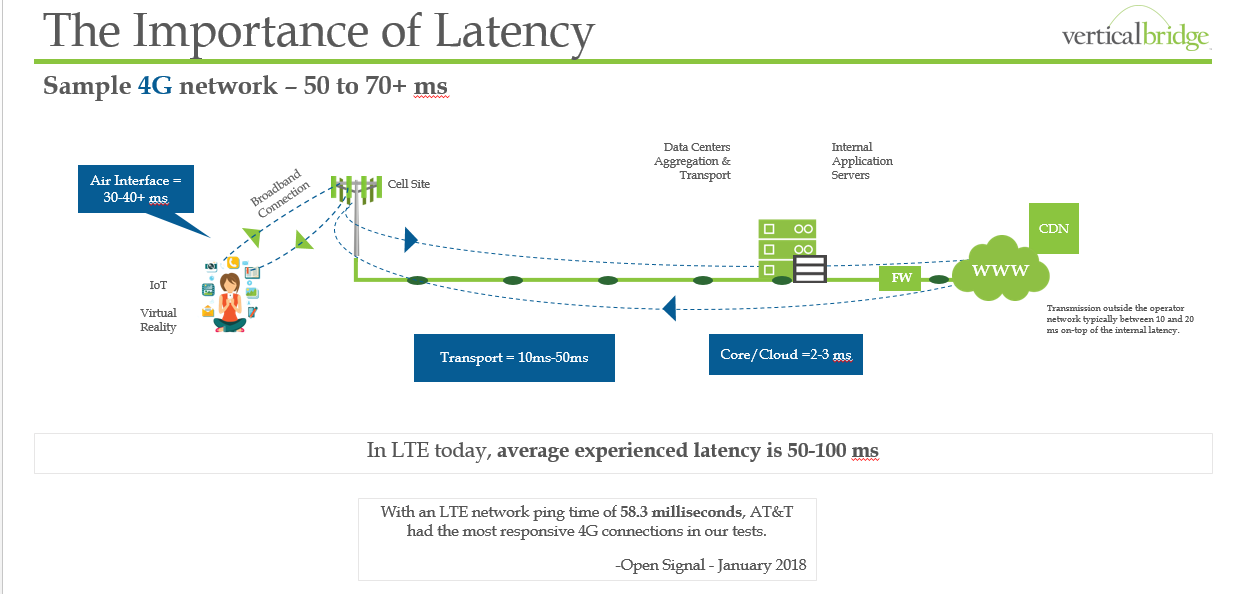
Improved latency is the other big benefit of 5G. What is less understood is exactly how 5G improves latency. Below is a chart (Figure 1) that illustrates how data is transferred by a smartphone and indicates the approximate latency introduced by the various segments of a mobile network. You should note that the majority of the latency in 4G networks is created by the “air interface”, that is, the communication between your smartphone/mobile device and the Radio Frequency antennas mounted on cellular towers. On average over 50% of the latency on 4G networks is caused by the air interface. The latency in the transport and core network is much less significant compared to the impact caused by the air interface.
Figure 1
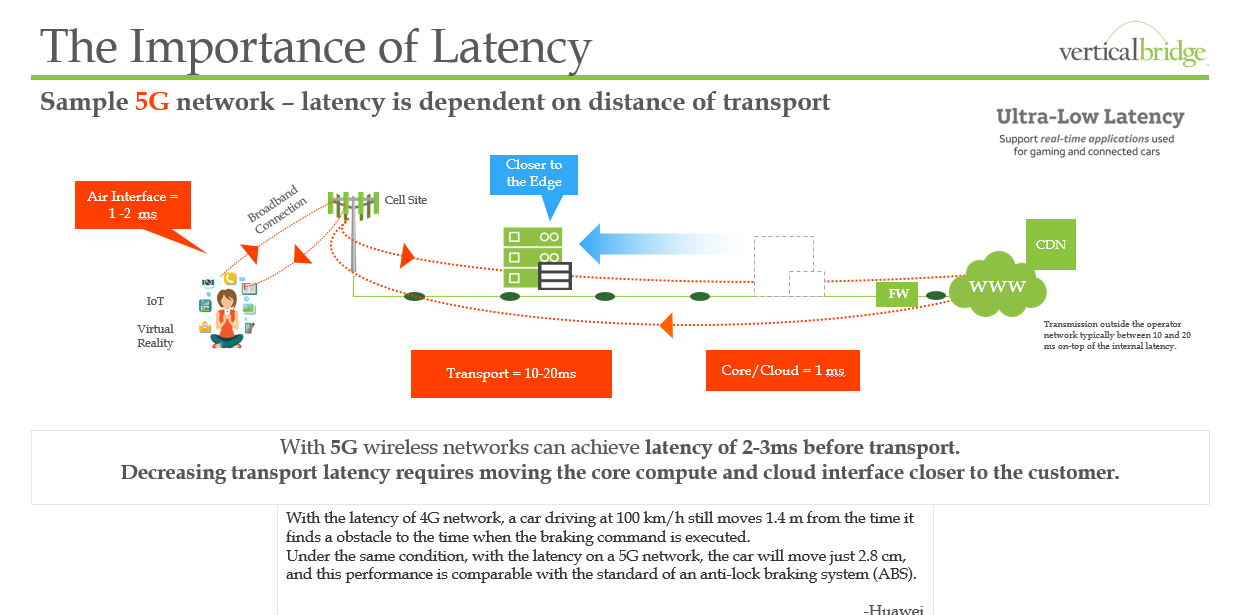
Below in Figure 2 is the same chart but for 5G. As you can see, 5G dramatically reduces the latency of the air interface, dropping round trip times from an average of 50-60ms (or greater) to sub 10 ms. The implications are clear: 5G – even without any change to where data centers are located, will dramatically accelerate application performance even from distant “cloud data centers”. Everyone will get an incremental latency benefit from 5G since the problem with the air interface will be largely addressed and terrestrial network will continue to move at the speed of light. By implication, applications that today (or tomorrow) could not function with the existing latency of 4G networks will perform adequately under 5G. Obviously, it is hard to predict what applications and in what instances, but it seems reasonable to assume that some group of applications will perform sufficiently well under 5G networks that no change in data center topology will be required to support them.
Now 5G does include Multi-access Edge Computing, also known as Mobile Edge Computing, which enables the incorporation of cloud computing capabilities within a cellular network and will be leveraged for applications like IoT. And for some set of applications, MEC will be useful. Our friends at Packet who are supporting the Sprint Curiosity IoT network with their bare-metal cloud is one such use-case. But the latency benefits of 5G will accrue to every mobile internet user regardless of where the application they are using is physically located.
The impact of 5G on future applications reminds me of the evolution of the early internet and development of VoIP. In the bubble era (for those that remember) many people tried to introduce VoIP as an alternative to TDM voice. Nothing worked in the 1995-2000 era as the internet was fundamentally not optimized for latency. As pipes got bigger and peering and caching evolved, VoIP over the open internet became possible. This is the opportunity that Vonage exploited and came to market with an OTT voice application in the early 2000s, something that could not have been commercially viable a few years earlier. I believe the same thing will happen with the introduction of 5G.
Figure 2
But let’s dig a little deeper into the latency argument for edge data centers and examine the incremental benefit of deploying compute and storage infrastructure closer to end users in a given metro market.
Before we do, it’s helpful to recall how most large-scale internet applications are configured today from a data center footprint perspective. Recently, we bid on a 2MW requirement for an ad-tech company who was looking to establish a footprint in Dallas. Ad-tech is one of the most latency sensitive internet use-cases. For their business model to function, they need to be able to identify the characteristics of an internet user on one of their web properties, determine their potential buying habits, conduct an auction to a group of ad buyers and insert the ad into the web page in under 100ms. Wow. The ad-tech firm had conducted significant network testing from various markets and determined that to be able to achieve national sub 100ms response, they would need to deploy in three US locations: Ashburn, Dallas and Santa Clara. This East, Central and West configuration is how most web scale applications are deployed. This is precisely why the largest wholesale data center markets are in Ashburn, Dallas and Santa Clara.
So this is what works (in broadly the same form) for most of the existing internet application use cases today. The argument for micro edge data centers is that new applications will require near real time latency and for that an East, Central and West configuration will not work. Instead, you will need to deploy at thousands of locations. Fair enough, so let’s examine the improvements in latency if we deploy infrastructure locally as opposed to solely in an East/Central/West configuration.
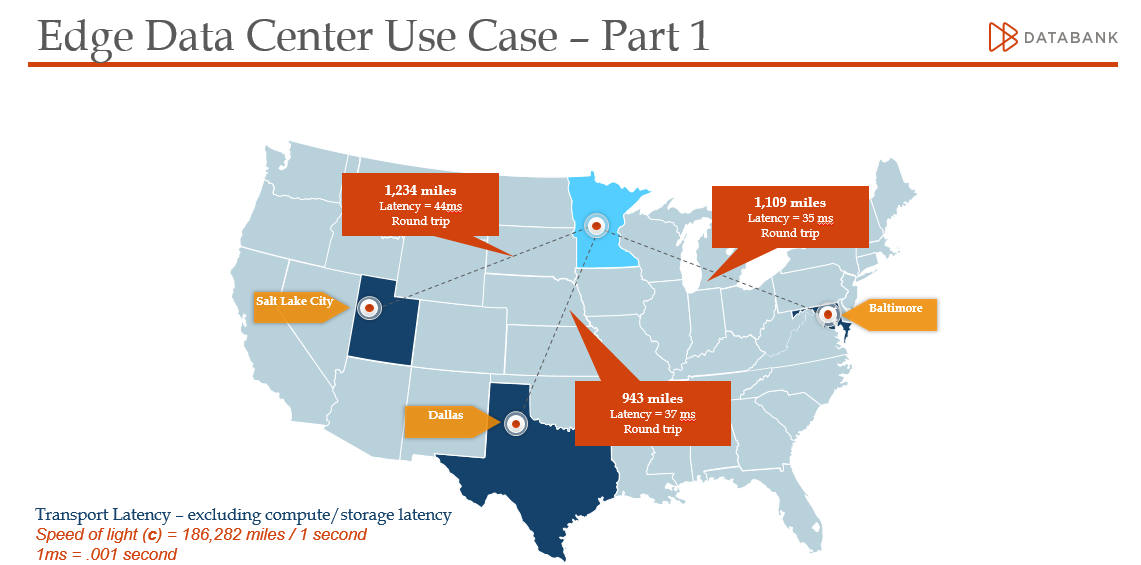
Figure 3 below shows a map of the US and expected latency from East/Central/West configuration to Minneapolis, MN. For the purpose of this exercise we used the actual DataBank locations in SLC, DFW and BLT. I would imagine the latency to Santa Clara and Ashburn would add another 5-10ms. I picked Minneapolis because it’s geographically most distant from the most common wholesale data center locations that web scale companies would likely deploy (exclude Chicago for the moment) so the benefit of reduced latency would be most pronounced. In addition, DataBank has two data centers in Minneapolis so we have firsthand knowledge of the available data center options and IP network dynamics in the market.
Figure 3
As you can see, the latency to Minneapolis introduced by terrestrial fiber transport is less than 45ms over the open internet from East, Central and West locations. Actual latency on a private MPLS/backbone network would be about 5ms-10ms lower. Recall that with 5G, the latency of IP packets will be greatly reduced even without the introduction of micro edge data centers since there will be significant improvement in the air-interface. This means that with 5G, most cloud data centers will be 25ms-50ms away from end-users, a significant improvement over 4G.
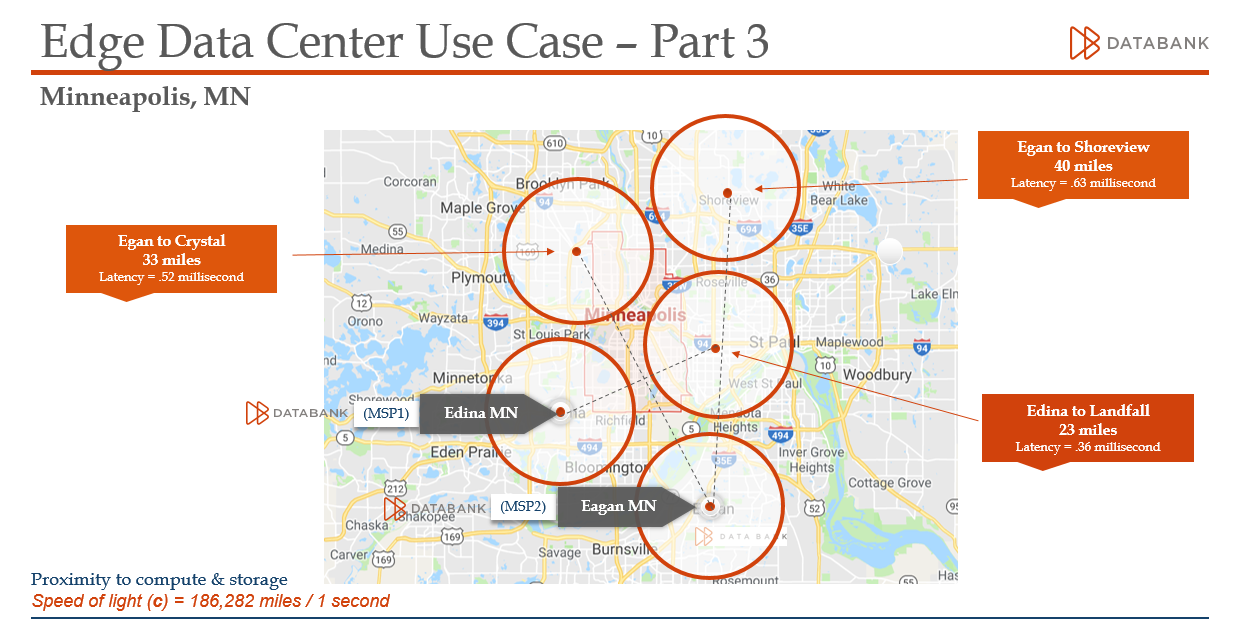
Nonetheless, let’s say you are a provider of an application that demands very low latency and looking to serve users in Minneapolis. What would you do? You would have two broad options: either deploy in a “traditional” data center within Minneapolis, for example, at either the DataBank MSP1 or MSP2 data center, or split your workload and deploy in a larger number of smaller micro data centers within Minneapolis. Let’s look at the incremental benefit of deploying in 5 micro edge data centers compared to deploying in a single traditional data center.
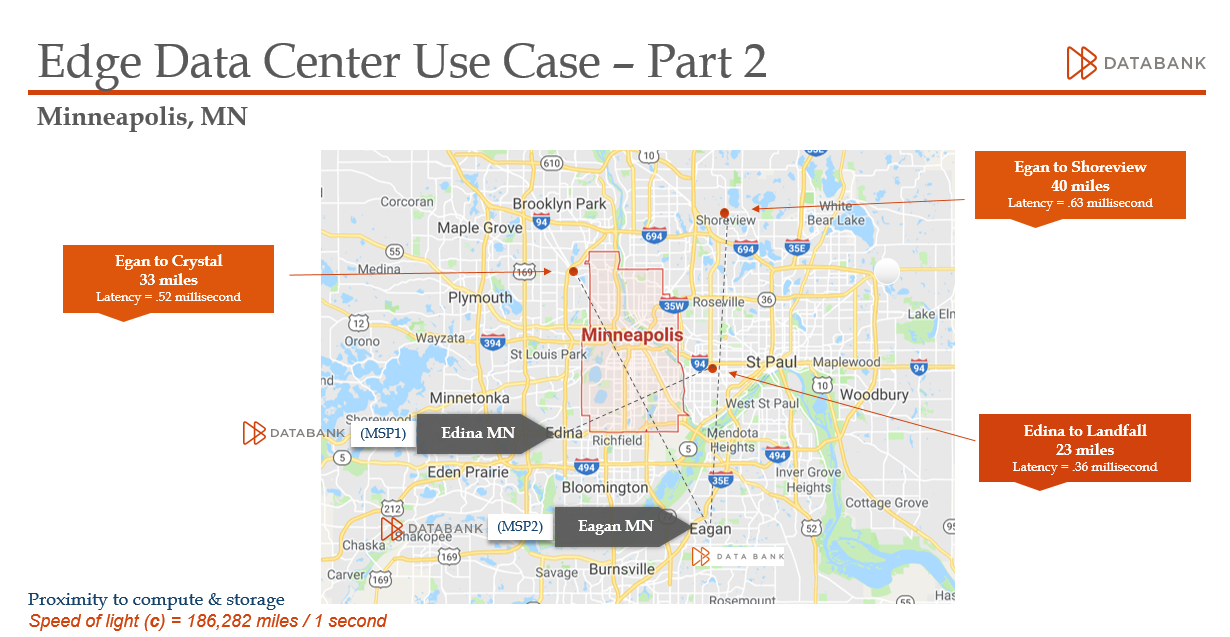
Figure 4 below estimates what your expected latency would be to various locations within the Minneapolis market if you deployed in a traditional data center like MSP1 or MSP2. If networks were perfectly optimized whereby an end user packets could go directly to the data center “as the crow flies” instead of having to hairpin through a peering point or carrier hotel, the latency would range from .16ms (for 10 miles) to .63ms. In reality, one would have to add the incremental latency to get to the carrier hotel or peering point in the market- but that will affect all users and all examples equally. Our ping tests indicate that from either MSP1 or MSP2, applications would be able to reach most destinations in the greater Minneapolis metro area within 3ms-5ms or less.
Figure 4
Figure 5 shows what would happen if you chose to deploy in 5 micro data centers, with MSP1 and MPS2 as two of the locations. In this scenario, your theoretical end user would be almost always within a 10 mile radius of a micro data center and be able to achieve ~.16ms round trip latency (Again, assuming networks are perfectly optimal…which they are not). But the incremental improvement from going from one data center location to 5 micro data center locations only improves your round trip latency by less than 1-2ms. Compared to an East/Central/West configuration, the vast majority of the latency benefit happens by simply choosing to deploy 1 node within a metro market. Deploying in tens-hundreds-thousands of micro-data centers would only improves latency by 1ms or less, and in some cases introduce latency depending on where the peering occurs.
Figure 5
When you consider the complexity, cost and operational support needs of deploying infrastructure in the field coupled with the benefits of scale that comes with aggregating infrastructure in a single location, the single data center deployment to serve a metropolitan market is superior. The conclusion is that once an application is deployed in a single location in a given market the actual latency to reach any eyeball in that market is dramatically reduced compared to the common East/Central/West configuration of web scale data centers and the incremental benefits of micro data centers evaporate.
We do business with many of the top 20 largest cloud and content players and we do see those customers leveraging our traditional data centers geographies in secondary markets to expand their capabilities. It seems logical to us that before the large cloud and content players deploy at 10,000 cell tower locations, they will first deploy a single cluster in a traditional data center in the top metro markets that they are looking to service and be able to reach any eyeball in those geographies with very low latency. In large geographic markets, for example LA metro, the provider can easily choose 2-3 traditional data centers already in the market.
Spend enough time in the telecom and technology industries and it becomes clear that the hype of many new technologies usually precedes the reality by 5-10 years. We believe that is the case with micro edge data centers. While it’s possible that at some point in the future new applications will emerge that we can only dream of today that will require an even more distributed data center geography, our view is the smart money will focus on this “medium edge” of second tier markets where cloud and content deployments are happening today.
You’ve made the decision to outsource some part of your IT operation. Your IT team narrows it down to three contenders, and goes as far as to complete the design phase to see who will be able to best fit your needs.You’ve got a clear picture of the technical fit, but what about the overall partnership fit? It’s during the pre-sales and sales process that you get a glimpse into more than just the quality of the technical solutions your prospective candidates offer; you also get a glimpse into the quality of their people, their values and how they’ll operate going forward.
Many providersstill foster a highly competitive, cutthroat sort of sales culture that doesn’t align well with the tenets of the modern customer experience. When technical sales reps are overly focused on meeting their numbers, or getting a signature by a certain date, it may be a sign of how provisioning, operations teams and the rest of the organization will operate. The pre-sales and sales customer experience sets the precedent for what can be expected throughout the rest of the company.
Here are some of the things businesses in search of a data centeroften struggle with in the sales process:
Lack of flexibility
Lack of responsiveness
Offering solutions that benefit the vendor, but not the client
What You Should Expect from an Honest, Customer-Centric Data Center Partner
Fortunately, the stereotypical sales representative doesn’t embody the experience you’ll have with every prospective partner, but you should know what to expect in order to have confidence in your data center’s integrity and process.
First, look for an engaged and service-oriented culture. Responsiveness throughout the entire process is key. If you’ve initiated outreach, you shouldn’t be waiting two or three weeks for someone to connect with you. Whether you make contact through an email, form or phone call, follow up should be immediate. It should be clear that solving your problems is the priority.
From there, your prospective data center should be honest about how you fit together, and manage expectations. The truth is, not every data center will be a fit for every prospect, depending on their areas of specialization, geography, and numerous other considerations. Your sales representative should be well-versed in data center solutions, clear on what they can and can’t deliver, andconversation should be transparent regarding whether they can help in a way that will fit your needs.
Next, a data center partner who’s legitimately interested in solving your problem won’t create undue pressure depending on how close you are to the end of the month. It’s not wrong to use quotas, but it’s wrong to make quotas the potential customer’s problem. Communication and courtesy should be consistent across the board.
Flexibility in pricing models and the general method for doing business is important, too. Every data center vendor has to have policy, but putting customers through needless hoops and rigidity when it’s not a big problem to make an adjustment out of courtesy is a red flag.
How DataBank Delights Customers with a Problem-Solving Sales Approach
Knowing the pitfalls of the marketplace, DataBank has gone to great lengths to develop a modern, customer-focused approach to sales that’s designed to help customers realize solutions quickly.
It all starts with unparalleled responsiveness and knowledge. For every inquiry we field, the representative who is most educated on the prospective customer’s problems will reach out immediately. It is of the utmost importance to begin customer engagements with responsiveness from the beginning and provide the right expertise upfront.
“To start from the very beginning with responsiveness and doing what we say we will, when we say we will…that plants the seed for a client who will be with us a decade. That’s how we look at it. Our biggest client started with a single cabinet. Now they exceed 7 figures in spend after they installed their last order.”
-Eric Morgan, Regional Sales Director SLC, DataBank
Flexibility is part of DataBank DNA. Our hybrid product offering and diverse footprint mean our sales teams don’t need to shoehorn any client into one particular product or location. We provide revenue portability that allows any client to switch their configuration among offerings and locations mid–contract, without penalty.
Also, while we have to run a “sales force,”we pride ourselves on serving rather than selling. We engage every prospect the same way: responding to their request, getting to the heart of what they’re trying to accomplish, and understanding their business. We approach every meeting as an opportunity to co-create the future: working shoulder-to-shoulder in front of a whiteboard, outlining technology goals,and offering the recommendations, resources and execution plan that will meet your needs. Customer relationships start with consultation and trust. At DataBank, there is no high-pressure sales approach. It’s all about understanding your challenges and the future-state you seek to achieve. Then, knowing that one size doesn’t fit all, we creatively combine colocation, cloud and managed services to engineer the solution that makes sense for you.
That’s the DataBank way: the Data Center Evolved.
“We had a meeting with a client who’s been with us for five years recently. He told us how much he appreciates thatwe’re not that organization who comes and says, ‘Can we get you to sign by the end of the month?’ He appreciates that we let him grow at his pace. The funny thing is, they were talking about expanding to 10 cabinets, but after having the discussion, he said they wanted to do 30 instead. It’s that kind of partnership, creating that relationship, that shows we want to collaborate rather than sell.”