You already realize the benefits of moving your IT environments to colocation data centers. They serve as the backbone of a modern IT environment, providing the required infrastructure to securely and efficiently store, process, and access vast amounts of data.
However, you can expand your colocation benefits by partnering with a provider that offers data center campus locations. While standalone data centers offer substantial benefits, a campus encompassing multiple facilities introduces additional advantages.
Here are eight compelling reasons why opting for a data center campus can be a game-changer for your business:
#1 – Anchor Tenant Access
Campus data centers typically host environments for hyperscalers. These include cloud on-ramps, telecommunications carriers, and Internet Exchange firms. Your company could benefit from close connections to any of these services. Setting up your infrastructure on a campus is, in many ways, just like operating in the same data center. Also, anchor tenants often attract similar businesses or those within the same ecosystem.
#2 – Enhanced Connectivity
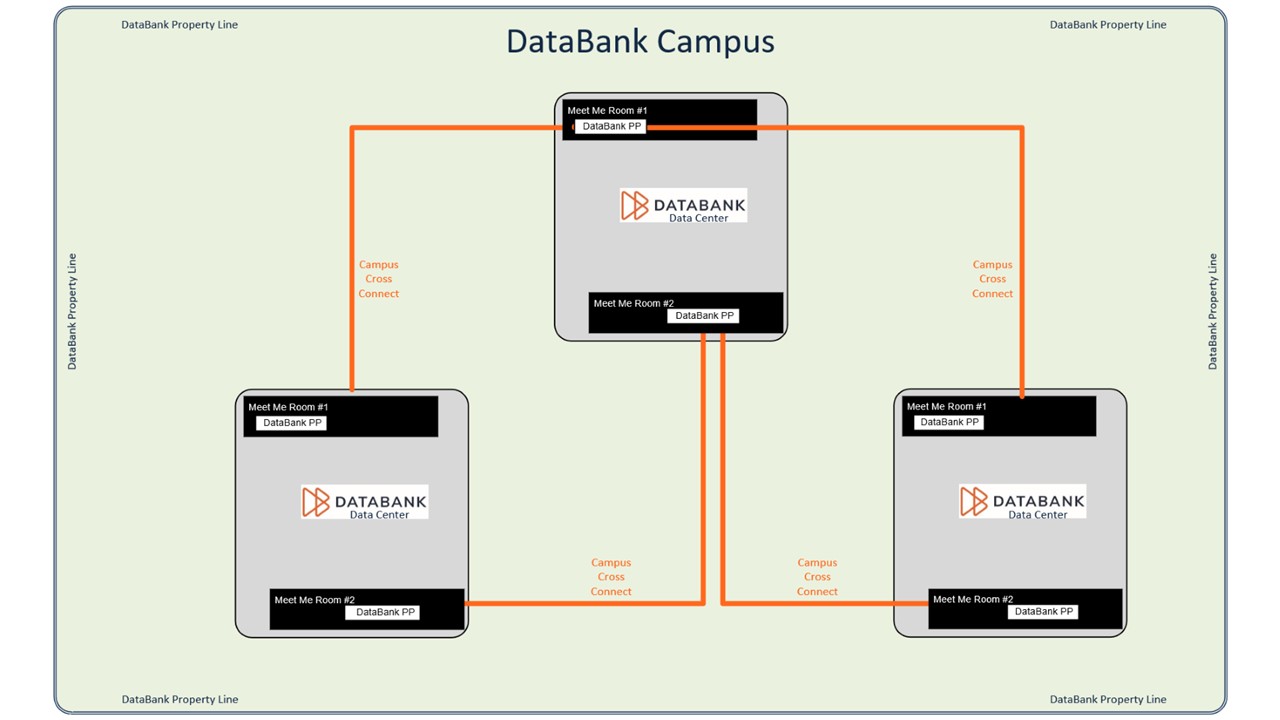
Multiple data center buildings nearby give you access to a diverse ecosystem of network carriers and service providers. Campus connectivity is more cost-effective than a carrier service because the cross-connects operate on one property. You get primary and secondary route options to connect with other tenants, avoiding the hassle of limited bandwidth. The abundance of connectivity options also minimizes latency and ensures uninterrupted access to critical services. Additionally, the presence of multiple carriers facilitates redundancy and mitigates the risk of downtime.
#3 – Flexible Scalability
With data centers in multiple buildings on the same property, your organization can seamlessly scale infrastructure up and down as demand fluctuates. This minimizes the risk of space constraints or capacity limitations. Whether expanding storage, increasing compute resources, or deploying new services, you can efficiently adapt your infrastructure for future growth.
#4 – Greater Power Resiliency
Many campuses have dedicated power substations. This gives you more resiliency. Exposure is only on the transmission lines, which rarely go down, and power distribution takes place right on the property. The data center provider also can control the substation in relation to maintenance and managing the power load. You don’t have to worry about a utility company taking power away for other segments of their grid.
#5 – Diverse Cooling Options
The cooling needs of IT infrastructure workloads vary. DataBank’s universal data hall design includes both raised and slab floors and offers a range of air and innovative liquid cooling technologies as well as advanced airflow management systems. Whether it’s liquid to the rack, liquid to the chip, or chip immersion, multiple cooling options ensure optimal operating conditions and energy efficiency.
#6 – Improved Business Continuity
Datacenter campuses provide built-in redundancy by distributing infrastructure across multiple buildings. You can implement robust disaster recovery strategies by replicating data across the campus with the option to also replicate to data centers in other regions. In the event of a localized outage, the redundant systems ensure uninterrupted access to critical resources, minimize downtime, and preserve user productivity.
#7 – Streamlined Operations
For both data center providers and customer IT teams, the campus set-up achieves economies of scale for operating large infrastructure footprints. Highly skilled teams can share office space across campus facilities to facilitate the management and maintenance of server and network gear, connections, power, and cooling. The campus model is also easier on hardware vendor support teams who can efficiently service multiple customer environments.
Data Center Campuses Across the U.S.
For enterprises looking to capitalize on the benefits of campus data centers, DataBank features 65+ colocation facilities across the U.S. These include 42 data centers located on 10 campuses in New York City, Northern Virginia, Pittsburgh, Atlanta, Minneapolis, Kansas City, Dallas, Houston, Denver, and Salt Lake City.
Image above shows the connectivity among three data centers on a DataBank campus.
The benefits of our campuses extend far beyond the traditional confines of a standalone facility. These include quick installation intervals that speed time-to-market for new services and direct access to carrier backbones that drive low-latency performance. With a diverse range of telecommunications service providers, you also benefit from lower connectivity pricing with the flexibility to select carriers without physically moving equipment to another data center.
By embracing the interconnectedness and scalability offered by multiple buildings within a centralized location, your business can unlock new levels of performance, resilience, and agility. From enhanced connectivity and scalability to diverse power options and collaborative ecosystems, our data center campuses empower you to thrive in the digital age and position your company for sustained success.
Minneapolis Area Technology is Driven by DataBank Carrier Hotel
Minneapolis is a bustling scientific research, healthcare, and financial center. It claims the largest economy in the Midwest region behind Chicago. Additionally, it is a key player in the technology ecosystem supporting these industries is the DataBank MSP2 East Twin Cities Data Center, located in the city of Eagan.
Along with three other DataBank data centers in greater Minneapolis, MSP2 meets the demand for colocation services—driven by Fortune 500 companies in the Twin Cities area that include United Health Group, Target, Best Buy, Supervalu, and 3M.
As a carrier hotel data center, MSP2 delivers five key benefits to DataBank customers:
Fast Delivery: Quick installation intervals that speed time-to-market for new services
Carrier Selection: A diverse range of telecommunications service providers
Low-Latency Performance: Direct access to carrier backbones
Arbitrage Costs: Competition among carriers drives down customer connectivity pricing
Scalability: Flexibility to select carriers without physically moving equipment to another data center
MSP2 is just 20 minutes southeast of Minneapolis in a carrier hotel known to enterprise customers as the “easy alternative” in contrast to another carrier hotel in downtown Minneapolis. Accordingly, as the second carrier hotel serving the Twin Cities region, the MSP2 data center leverages Eagan’s dense concentration of high-performance fiber. The facility is FedRAMP certified and offers 100% renewable power along with a dedicated DataBank cloud node.
A major reason why DataBank decided to open MSP2 in this strategic location is AccessEagan—the 17-mile open-access wholesale fiber network owned by the city of Eagan. The network offers connectivity and fully-scalable, high-speed bandwidth up to 10 Gbps throughout the central portions of Eagan. The network also provides a fiber infrastructure available to any telecommunications provider serving businesses in the area.
MSP2 delivers co-location services to more than 100 enterprise customers. In addition to AccessEagan, carriers include Zayo, AT&T, Cogent Communications, Comcast, Lumen, Megaport, Verizon, and Windstream.
Through MSP2, DataBank also provides interconnectivity to three DataBank data centers in Minneapolis via 1G MPLS and 10G WAVE. In addition, MSP2 features MPLS connectivity to 13 DataBank data centers in other U.S. metros, including Atlanta, Dallas, Kansas City, Salt Lake City, and Ashburn in northern Virginia. Peering occurs directly within MSP2 via the Midwest Internet Cooperative Exchange.
Free Cooling Most of the Year
With a notably high standard of living, Twin Cities is fueling entrepreneurial growth. To meet the area’s compute resource needs, MSP2 East Twin Cities utilizes high-efficiency, air-side and water-side economizers to bring free cooling to data center customers nine months out of the year. The area’s geography also promises reduced risk of natural disaster events. This makes Minneapolis one of the safer markets to colocate mission-critical workloads.
Look for MSP2 and other carrier hotels in DataBank’s portfolio of data centers on the interactive map on this website’s home page. You can also check below for related resources.
The synergy between Artificial Intelligence (AI) and data centers is transforming the technological landscape, ushering in an era of unprecedented efficiency and innovation. As AI continues to evolve, its integration into data center operations is not just beneficial but essential. AI-driven data centers enable real-time energy monitoring, reducing carbon footprints and operational costs. This blog explores how AI enriches data center capabilities and the remarkable impact of this integration on industries worldwide.
The Evolution of AI in Data Centers
Data centers, the backbone of the digital world, and the human-digital experience are seeing a paradigm shift thanks to AI. This collaboration is enhancing operational efficiencies, reducing energy consumption, and optimizing data management.
Smart Operations: AI algorithms predict and manage data center workload distribution, significantly improving operational efficiency.
Energy Efficiency: AI’s predictive analytics help in reducing energy consumption by optimizing cooling systems based on real-time data
The Numbers Speak: AI’s Impact on Data Centers
Statistics reveal the compelling advantages of integrating AI into data center operations:
AI can improve overall operational efficiency by up to 45% (source: IDC).
Predictive maintenance powered by AI can reduce downtime by 35% (source: Gartner).
AI-driven energy optimizations can lead to a 40% reduction in cooling costs (source: DOE).
Breaking Down the Integration
Enhancing Security with AI
Data centers house sensitive information, making security paramount. AI elevates security measures by:
Automated Threat Detection: Real-time monitoring to identify and neutralize threats before they escalate.
Access Control: Using biometrics and behavior analysis for secure, authorized access.
Predictive Maintenance
Downtime in data centers is costly. AI anticipates potential failures, allowing for:
Early Problem Identification: Detecting issues before they cause outages.
The volume of data managed by data centers is colossal. AI simplifies this task through:
Efficient Data Storage: Optimizing storage solutions based on usage patterns.
Advanced Data Analysis: Extracting valuable insights from large datasets in real-time.
Navigating the Challenges
Despite the benefits, integrating AI into data center operations comes with its hurdles:
Complex Implementation: Tailoring AI solutions to specific data center needs requires expertise.
Data Privacy: Balancing AI’s data analysis capabilities with stringent privacy regulations.
The Road Ahead
The fusion of AI and data centers is just beginning. AI‑optimized infrastructure enables dynamic resource orchestration: digital twins for load simulation, predictive cooling, and adaptive energy reuse. Data centers will transition into autonomous infrastructure platforms by 2027. As AI technologies advance, their integration into data center operations will become more sophisticated, driving innovations that we can only begin to imagine:
Autonomous Data Centers: A future where data centers self-manage, adapting to changing demands in real-time.
AI in Edge Computing: Bringing AI closer to the source of data for faster processing and analysis.
Embracing AI within data centers is not just a trend; it’s a strategic move towards building smarter, more efficient, and secure infrastructures. As we navigate this exciting confluence of technology, the potential for innovation is limitless.
Eager to explore how DataBank can transform your data center operations? Click here for more information.
Be sure to follow us on LinkedIn to stay informed.
The growth in hybrid IT infrastructure has increased the demand for data center infrastructure. For this demand to be met sustainably, data center operators need to make sustainable practices core to their operations. In particular, they need to focus on developing regenerative data centers that prioritize environmental conservation. Here is a quick guide to what you need to know.
The role of data centers in hybrid IT infrastructure
Data centers are the foundation of hybrid IT infrastructure. On-premises and/or colocation data centers provide a private environment over which clients have full control. Public cloud data centers provide dynamic scalability, customizability, and global reach. Edge data centers provide fast, localized processing. In short, without data centers, hybrid IT infrastructure literally could not function.
The environmental impact of traditional data centers
Traditional data centers are notoriously inefficient in their use of energy, water, and physical resources.
Energy: Traditional data centers use vast amounts of electricity to power their infrastructure, particularly their cooling systems. These were highly inefficient. Furthermore, most, if not all, of the energy used was derived from fossil fuels.
Water: Traditional cooling systems were not just energy-inefficient but also water-inefficient. This created serious environmental issues, especially in areas where water was already in short supply.
Physical resources: The manufacturing process of hardware components requires the extraction of raw materials. This extraction was not always performed in a sensitive and sustainable manner. Moreover, frequent hardware upgrades generated a significant amount of electronic waste.
The development of regenerative data centers
Regenerative data centers take their name from the fact that they aim to have a net positive impact on the environment. In other words, they aim to go beyond basic sustainability practices and address broader ecological concerns.
With that said the core of regenerative data centers is the integration of sustainability measures into the fabric of data center operations. This requires a holistic approach that incorporates advanced technologies, renewable energy sources, and circular economy principles.
Sustainable practices in regenerative data centers
Here is an overview of the five key sustainability practices implemented as standard in regenerative data centers.
Energy-efficient technologies
This includes the use of high-efficiency servers, advanced cooling systems, and intelligent workload management. Server virtualization, for example, enables the consolidation of multiple virtual servers onto a single physical machine. It therefore reduces the overall energy consumption of the data center.
Integration of renewable energy sources
Regenerative data centers prioritize the use of solar, wind, hydro, and other sustainable energy options to power their operations. This minimizes the data center’s overall carbon footprint.
Smart resource management
Dynamic power management adjusts the power consumption of servers based on workload demands. Intelligent cooling systems adapt to environmental conditions. These sustainable practices minimize regenerative data centers’ use of energy. They hence improve both sustainability and operating costs.
Monitoring and reporting systems
Real-time tracking of energy consumption, carbon emissions, and other environmental metrics allows data center operators to identify areas for improvement and fine-tune operations. This data-driven approach is essential for maintaining transparency and accountability in the pursuit of sustainable practices.
Circular economy practices
This involves designing infrastructure and hardware with a focus on durability, reparability, and recyclability. The lifecycle of components is carefully managed, emphasizing reuse and recycling to minimize electronic waste. This circular approach reduces the environmental impact associated with the production and disposal of data center hardware.
Challenges and solutions
Transitioning to regenerative data centers that focus on sustainable practices is essential for the long-term future of data centers. There are, however, some immediate challenges that need to be addressed for this to happen. Here is an overview of the four main ones.
High initial investment costs
To address this challenge, organizations can explore financial incentives and government subsidies for adopting green technologies. Additionally, phased implementation strategies, where sustainable practices are gradually integrated, allow for cost distribution over time, making the transition more financially feasible.
Legacy infrastructure compatibility
To overcome this challenge, a phased approach to modernization can be employed. This involves upgrading or replacing outdated components with energy-efficient alternatives while ensuring compatibility with existing systems. Virtualization technologies can play a crucial role in optimizing resource usage and extending the lifespan of legacy hardware.
Complexity of implementation
Addressing this challenge requires careful planning and collaboration between IT teams, sustainability experts, and data center operators. Implementing automation and orchestration tools can simplify the deployment and management of regenerative technologies, streamlining complex processes and ensuring a smoother transition.
Limitations of renewable energy sources
To mitigate this, regenerative data centers can implement energy storage solutions such as advanced battery systems. These batteries store excess energy generated during peak times and release it during low production periods, ensuring a consistent and reliable power supply regardless of intermittent renewable energy availability.
In the swiftly changing world of digital technology, cloud computing emerges not just as a trend but as a fundamental shift in how businesses operate, offering unparalleled opportunities for growth and innovation.
Yet, the path to cloud adoption is strewn with challenges, from ensuring robust security and privacy to navigating intricate compliance landscapes, managing costs effectively, and achieving seamless integration and migration.
This blog delves into these critical challenges and equips you with expert insights and actionable solutions to turn potential hurdles into stepping stones for success.
Security and Privacy
The cornerstone of a successful cloud strategy is the assurance of data security and privacy. In an era where cyber threats are evolving rapidly, adopting a proactive stance on security is imperative.
Key strategies include:
Implementing multi-factor authentication and encryption
Regular security assessments and adherence to best practices
Employing a cloud access security broker (CASB) for better visibility and control
Compliance and Regulations
With the global nature of cloud services, compliance becomes a complex web of regional and international regulations. The key to navigating this maze is understanding the specific requirements of your industry and the jurisdictions you operate in.
Actionable steps involve:
Conducting comprehensive compliance audits
Engaging with cloud service providers who demonstrate compliance with relevant standards
Staying updated on regulatory changes and adjusting your compliance strategy accordingly
Cost Management
One of the cloud’s most appealing features is its cost-efficiency. However, without careful management, cloud costs can spiral.
Effective cost management practices include:
Utilizing cloud cost management tools for visibility and monitoring
Opting for scalable cloud solutions to adjust resources according to demand
Implementing policies to prevent unnecessary spending
Integration and Migration
Migrating to the cloud should not disrupt your operations. A smooth transition and effective integration with existing systems are crucial for maintaining business continuity.
Tips for a seamless process:
Detailed planning and assessment before migration
Choosing the right cloud integration tools and platforms
Testing extensively in the cloud environment before going live
Performance and Scalability
Ensuring that your cloud infrastructure can grow with your business is essential. Scalability and performance go hand-in-hand, demanding a strategic approach to cloud resource allocation.
Strategies for success include:
Regular performance testing and capacity planning
Leveraging auto-scaling capabilities of cloud services
Optimizing applications for cloud efficiency and scalability
While the journey to cloud adoption is fraught with challenges, the opportunities it presents for operational efficiency, flexibility, and innovation are immense. By understanding and strategically navigating these challenges, organizations can unlock the full potential of cloud technology.
Ready to elevate your cloud strategy? Contact us for a consultation, and let’s transform your cloud challenges into opportunities for growth and innovation.
Navigating Challenges and Embracing Solutions
Remote work has become the new normal. Ensuring robust data security poses both a challenge and a priority for businesses worldwide. As organizations navigate this shift, the importance of implementing effective data security measures cannot be overstated.
In this blog, we’ll explore the evolving challenges of data security in a remote work environment, offer practical tips, highlight emerging trends, and demonstrate how our services can fortify your business against these challenges.
The Rising Tide of Remote Work
The transition to remote work, accelerated by the COVID-19 pandemic, has transformed how we work. According to a survey by Gartner, 74% of companies plan to permanently shift employees to remote work after the pandemic ends. This shift has expanded the cybersecurity perimeter, creating new vulnerabilities and amplifying the need for comprehensive data security strategies.
Unveiling the Challenges
Remote work environments often lack the robust security measures found in traditional office settings, making them more susceptible to cyber threats. Key challenges include:
Insecure Home Networks: Many home Wi-Fi networks lack strong encryption and password protection, making them easy targets for cyberattacks.
Use of Personal Devices: Employees using personal devices for work-related activities may not have adequate security software installed, increasing the risk of data breaches.
Phishing Attacks: Remote workers are more likely to fall victim to phishing scams, as cybercriminals exploit the uncertainty and disruptions caused by the pandemic.
Strategies for Securing Remote Work
To navigate these challenges, businesses must adopt a multi-layered approach to data security. Here are some essential strategies:
Strengthen Network Security
Use VPNs: Virtual Private Networks (VPNs) encrypt internet traffic, securing data as it travels between remote employees and company networks.
Secure Wi-Fi Networks: Employees should be encouraged to use WPA3 encryption for their home Wi-Fi networks and to change passwords regularly.
Enhance Device Security
Implement MDM Solutions: Mobile Device Management (MDM) solutions can help manage and secure employees’ devices, ensuring that they meet the company’s security standards.
Regular Software Updates: Encourage employees to keep their software and security applications up to date to protect against the latest threats.
Foster a Culture of Cybersecurity Awareness
Conduct Regular Training: Regular cybersecurity training can help employees recognize and avoid phishing attempts and other cyber threats.
Establish Clear Policies: Create comprehensive remote work policies that include guidelines for password management, use of personal devices, and data encryption.
Consider the Emerging Trends:
Continuous Monitoring: While most continuous monitoring solutions are controlled by corporate staff, there is a trend to implement these solutions because attacks have become so costly and prevalent.
Zero Trust Architecture: Adopting a zero-trust approach, where no entity is trusted by default from inside or outside the network, is becoming increasingly popular.
AI and Machine Learning: These technologies are being leveraged to detect and respond to threats more efficiently, often in real time.
How Our Services Can Help
At DataBank, we understand the unique challenges posed by the remote work model. Our suite of cybersecurity solutions is designed to provide comprehensive protection for your business, from endpoint security to advanced threat detection and response systems. Whether you’re looking to secure your data or enhance network security, we’re here to help.
Embrace the Future with Confidence
The shift to remote work is not just a temporary adjustment but a long-term transformation in the way businesses operate. By recognizing the challenges, implementing effective strategies, and staying abreast of emerging trends, companies can secure their data and thrive in the remote work era.
Has your business adapted to the remote work model? Let us know your biggest data security concerns in the comments below. For more insights, check out our other articles.
For more information on Managed Security, click here.
The proliferation of AI applications gives rise to questions about neural networks and the data centers that enable them.
Even when compared to past technology innovations and the resulting leaps they enabled, AI and ML are quickly disrupting and transforming so many business processes and disciplines. One of the most revolutionary innovations in AI today is the concept of neural networks.
Yet, like so many other quickly evolving technologies, neural networks can often be misunderstood. This is especially true when it comes to what they are and the benefits they can provide. To help, we’ll offer a closer look at neural networks and describe why data centers are uniquely positioned to power them – now and into the future.
What is a Neural Network?
Simply put, a neural network is a series of algorithms inspired by the structure of the human brain. Neural networks identify underlying relationships in data by mimicking certain brain functions. In the same way that we learn from past experiences, neural networks recognize patterns in data, adapt to training and new inputs, and continue to improve over time.
Traditional algorithms follow a deterministic approach – which means they will render the same output for the same input. Unlike traditional algorithms, neural networks work probabilistically. In this case, they integrate randomness, ambiguity, and imprecision into decision-making reasoning that combines probability theory with logic theory to manage uncertainty.
Neural networks can also handle increasingly complex patterns. This is further proof that their sophisticated learning capabilities are superior to other AI counterparts.
The Role Data Centers Play
Data centers can play a vital role in implementing and supporting neural networks with the following characteristics and capabilities:
Data storage and management: Neural networks require extremely high volumes of diversified, high-quality data. Data centers excel at storing and systematically managing colossal amounts of data, making them a perfect match.
Compute power: Neural networks also need extensive computing resources for their extremely sophisticated mathematical operations and continuous iterations. Data centers can provide top-tier servers, high speed processes, significant memory capacities, and other capabilities to provide the computing power neural networks need.
Parallel processing: Graphic processing units (GPUs) in data center servers make parallel processing possible and significantly streamlines neural networks’ training times and processes.
Data security: Above all else, data must be secure at all times. Data centers provide security and compliance with regulatory requirements, to make sure data is not compromised during any interaction with neural networks.
Scalability: As any AI or ML models expand, they need additional infrastructure resources. Data centers can offer more capacity and/or cloud computing resources to help any company scale neural networks – at will and on demand.
High-speed networking: Data centers excel at providing superior networking capabilities. This alone can be a major edge in inter-server training model coordination and data sharing across different locations or systems.
Proven uptime and reliability: Considering that neural networks need long, uninterrupted computing cycles to train and use neural, they need the proven reliability and consistent uptime hallmarks of the entire data center industry.
When specifically designed for neural networks, data center environments can provide scale and sophistication that exceed conventional on-premises IT environments. Additionally, other variables – high bandwidth networking, GPU-inclusive servers, specialized infrastructure, edge computing, and effective power and cooling options – are ideal in supporting neural networks in the future.
Data Centers: Supporting the Evolution of Neural Networks
Neural networks represent a fundamental shift away from traditional computing and have the potential to create a whole new paradigm of problem-solving. Bridging this gap and enabling such a transformative technology now requires the power, capacity, and versatility of modern data centers.
As AI and ML continue to evolve, so too will the role of data centers in enabling and then sustaining this evolution. It’s an exciting development, and we’re proud of the role our data centers can provide as we all venture further into the age of AI.
In an era where every digital interaction is meticulously logged, we find ourselves at the heart of a significant transformation.
Data analytics is not merely a notable aspect of modern technology; it’s actively reshaping industries and redefining our interaction with the digital world.
The Dawn of Data-Driven Decision Making
Imagine a future where predictive analytics doesn’t just forecast market trends but also intimately understands customer needs, crafting tailored experiences once thought to be purely imaginative.
This vision is becoming our reality in 2024, as the strategic analysis of vast data sets empowers organizations to make informed, innovative decisions.
Leveraging Smarter Decisions
The synergy of artificial intelligence and machine learning with data analytics marks a departure from traditional analysis methods.
The focus shifts from historical data review to the anticipation of future scenarios. This shift facilitates rapid strategic adjustments, risk mitigation, and the seizing of opportunities with unmatched agility.
Pioneering Innovative Solutions
The influence of data analytics permeates every sector of innovation:
Healthcare: Predictive models are refining patient care protocols.
Urban Planning: Enhanced public safety measures and improved city living conditions.
Entertainment: Content platforms predicting user preferences with remarkable accuracy.
Exploring Key Data Trends for 2024
Enhanced Cybersecurity: Prioritizing data security against emerging cyber threats is crucial.
Quantum Computing: Revolutionizing our processing capabilities for previously insurmountable data sets.
Sustainable Data Management: The push towards environmentally friendly data storage and efficient computing.
Edge Computing: Minimizing latency by processing data closer to its source.
Customized User Experiences: Tailoring experiences to individual preferences in shopping, learning, and beyond.
Embracing the Data Revolution
Looking ahead to 2024, the scope for data analytics is limitless. Success hinges on our collective ability to gather, interpret, and apply data judiciously. It’s about integrating data into our strategic thinking and valuing it as a key organizational asset.
With DataBank at the vanguard of this journey, we’re not just witnessing a new chapter of innovation; we’re actively crafting it. Stay engaged with our latest discoveries and thought leadership.
Follow our social media channels, you remain at the forefront of the data-driven age.
Embark with us on this captivating exploration of data analytics, and together, let’s chart the course of this transformative era.