The internet has evolved for nearly three decades, driving fundamental changes in IT infrastructure in every era. A closer look at the history of that evolution gives us a glimpse of how the current Web 3.0 era is reshaping IT infrastructure and helping IT leaders adapt their own strategies accordingly.
Web 1.0 was the first stage of the internet revolution during the 1990s. User bandwidth was generally slow (dial-up) and almost exclusively wired. Content and data were generated by a relatively small number of parties. There was little sensitivity to latency because applications were not real-time, consisting mostly of static web pages and emails. The dominant computing platform of the time was the PC, which was used in a client-server model. Much of the underlying infrastructure of the internet was centralized to a small number of backbone networks and exchange points (MAE-East, MAE-West, etc.).
In the early 2000s, we moved into the Web 2.0 era. The first widely available broadband access arrived in the form of DSL and cable connections and users could access the web via their mobile devices for the first time as well (albeit not at broadband speeds). Where relatively few parties created content in Web 1.0, the arrival of the first social media networks and blogging in Web 2.0 suddenly mean every person could be a publisher, significantly accelerating data creation.
The arrival of video and VoIP applications suddenly highlighted the importance of latency in networks. Enterprises began to move away from a pure client-server compute model and embrace internet-hosted applications as well as the first software-as-a-service models. Later in the decade, the virtualization of hardware spawned the first cloud-computing platforms.
These trends triggered an evolution in the IT infrastructure of the internet. Instead of a handful of network exchange and content-hosting points, we saw the arrival of the first third-party data centers and neutral interconnects. And the first CDNs arrived on the scene to help push content closer to end uses and reduce latency.
With Web 3.0, IT infrastructure will undergo an even bigger evolution. Ubiquitous 5G access will mean most of us have a faster broadband connection on our phones than we do in the office. The ever-expanding Internet of Things (IoT) trends means not only is every person creating content, but everything is now generating data and doing so everywhere imaginable. Applications like augmented/virtual reality and robotics are demanding ultra-fast network response with less than 10-millisecond latency. Where PCs and centralized clouds dominated the compute landscape in former eras, small, embedded edge computing devices are the primary compute platform of Web 3.0.
In response to this new era of the internet, IT infrastructure is evolving in two fundamental ways:
1. Infrastructure is becoming much more agile and software-driven. We’re moving away from traditional telecommunications-based models, where assets and connections were once physical entities, provisioned slowly, and managed by the provider. Now, thanks to digitally-driven models, these same assets are increasingly virtual, provisioned instantly and on-demand, and managed by the users themselves.
2. We are now seeing a shift to a geographic, localized edge model that provides faster, better services to customers, consumers, and end users. But it’s important to note that the edge is not simply a matter of geography or distance; instead, it’s a ubiquitous edge that can exist in different modes. Sometimes the edge will be geographic, extending from Tier 1 cities to more rural markets. It may also be application-specific, depending on a company’s core business and application latency sensitivity, which can vary depending on whether it provides content, networking, or computing.
Understanding these changes, and how to adapt to them, will be the key to capitalizing on all that Web 3.0 has to offer. One approach we’re developing here at DataBank is the concept of a “digital asset allocation” strategy, whereby IT leaders can dynamically adjust their infrastructure among platforms, interconnections, technologies, and edges to best meet their needs.
In parts two and three of this blog series, we will take a closer look at both these Web 3.0 infrastructure evolution trends and how they will fundamentally change the experience of consuming IT infrastructure. In the meantime, if you’d like to learn more about our “Digital Asset Allocation” strategy, check out our recent article in Data center Frontier: Digital Asset Allocation Strategy and Web 3.0
After much anticipation, PCI DSS 4.0 is finally expected to arrive in mid-2021. Do you know how the updates will affect your organization? If not, you’ve come to the right place. This quick guide will help you better navigate the PCI DSS waters and help keep your organization afloat. From Point-to-Point encryption to Software-based Pin entry, and everything in between, PCI DSS 4.0 has got it covered. Let’s Dive In.
Since PCI DSS version 3.2, the technology utilized by today’s organizations to accept and process credit card payments has seen substantial changes and evolved at a rapid pace. As expected, Cybercriminals have adjusted to meet those changes and upped the ante, introducing new threats to exploit vulnerabilities in the payment systems and processes. PCI DSS 4.0 seeks to ensure data security controls are effective through these changes. This starts with creating Strong Key Objectives that include:
• Continuing to provide the critical foundation for securing payment data
• Promoting security as an ongoing process
• Improving flexibility for organizations with a wide range of technologies
• Enhancing validation methods and procedures
In addition to updating the objectives, PCI DSS 4.0 takes on the risks associated with contactless payments, including those processed by merchants with commercial off-the-shelf mobile phones and tablets. Other trends PCI DSS covers include cloud adoption, new software development practices, and increased dependency of third parties in the payment process. It was necessary for PCI DSS to adapt to these trends to avoid being outdated.
Lastly, PCI DSS added several critical updates to which organizations should pay special attention. These additions provide better direction and more insight than the previous version on certain topics, such as authentication and cloud environments.
Critical Updates include:
• Sampling – Sampling guidance will be included for assessors to validate controls are in place consistently across the entire population.
• Cloud Environments – Requirements will be more accommodating for technologies, such as cloud hosting services.
• Authentication – This provides more flexibility for authentication techniques and changes to MFA requirements
• Risk Assessment – The requirement seeks to ensure this process isn’t used as a checkbox.
• Security Awareness Training – Training on threats, such as phishing and social engineering, will be required for end-users.
• Scoping – More testing and documentation will be required for confirmation of scope accuracy and completeness, and validation of processes.
With these impending changes, organizations should take the necessary steps to increase awareness and put a plan in motion for the new version of changes that will directly affect them. It is important to note that controls under the current version should be maintained, and organizations should steer clear of early drafts of PCI DSS 4.0 (Wait until the final version is released). Now that you have this information, go forth and conquer PCI DSS 4.0. Have any questions? Contact us!
Industry awards recognize leadership, innovation, and contributions that advance technology and business communities.
For its eighth annual Women in Technology Awards, the Dallas Business Journal will honor 25 of the top leaders in North Texas technology. We’d like to congratulate our very own, Wendy Stewart, Vice President of Sales Operations, for being honored with this prestigious award!
Wendy Stewart
About Wendy
Wendy is an advocate for women in IT. She loves sharing her candid journey to inspire not only her peers but the underserved. Wendy came from humble beginnings and used that as her foundation. Wendy’s model in life is based on servant leadership. She chose to be a part of the Salvation Army Advisory Board because of their desire to serve the underserved and less fortunate. Wendy is an advocate for education.
“Education was my way out and was the foundation I needed to be successful. I wake up each day looking for ways to help others and inspire them to be their best. It’s not easy being a wife, mother, business owner, but the reward of serving others brings me joy.”
Being a female in a Vice President role in a male-dominated industry has taught Wendy a lot. It’s taught her to have a voice, how to lead when the audience does not look like her. Wendy builds on this and uses her past to inspire others to excel and grow. Wendy always challenges peers to not just check a box but to be better than anyone in the room. Wendy had challenges in her role because people were not used to women leading IT companies, but she believes she has been fortunate to have leadership that trusts her passion, knowledge, skillset, and overall desire to help the organization succeed. In addition to her current roles and work with the Salvation Army, Wendy is the founder of the Dallas Women in Data Center Group and a board member for 7×24 Lone Star Chapter (Texas). In Wendy’s spare time, she enjoys cycling, running, serving in the media ministry, and teaching youth Bible study. Wendy also guest lectures and speaks on various podcasts.
About the Award
The 2021 Women in Technology honorees come from some of the largest companies in DFW to smaller industry disruptors. The honorees represent a variety of fields, including health care, legal, manufacturing, telecommunications, manufacturing, consumer goods and services, finance, nonprofits, and aviation. Read more and find out who are the women that are the cutting edge of technology in North Texas via the Dallas Business Journal here.
With severe winter weather affecting Texas, we want to provide you with the status and preparedness of our operations and communications. All eight of our Texas facilities in Dallas, Austin, and Waco are operating successfully on utility power with generator backup available. We have experienced no outages and no customers have been negatively affected.
During this fluid situation, we have ongoing communications with customers operating within our Texas facilities whenever there is a change to power systems and fuel levels.
Keep in mind that, while this is an uncommon and serious weather condition, DataBank is prepared.
“This is why we have data centers, and DataBank is performing its mission of keeping our customers’ IT infrastructure powered and cooled so that their data is protected,” said DataBank CEO Raul Martynek. “We topped off our fuel before the storm and have arranged for deliveries in advance.”
Although there are news reports of delayed fuel deliveries, DataBank has seen no interruption in fuel delivery; we are monitoring fuel use in real-time, diverting deliveries based on usage, and sourcing backup fuel from out-of-state providers.
Beyond Data Center operations, passable roadways remain a concern. Although roadway infrastructure is beyond DataBank’s control, our plan includes equipping all Texas facilities with sufficient food and water supply and providing nearby hotel accommodations for on-site staff, if next-shift personnel are unable to travel safely to the data centers.
The good news is that weather forecasts for Dallas, Austin, and Waco over the next several days call for warmer temperatures and decreasing precipitation. In the meantime, the people and infrastructure of DataBank are working around the clock to protect data and business operations for our customers.
Salt Lake City is one of DataBank’s biggest and most successful markets home to five of our 65 data centers globally and our largest campus overall. And there’s a reason why we’ve invested so heavily there: Utah is one of the fastest-growing and most attractive data center markets in the country.
Historically, this has been a function of the state’s business-friendly climate, highly educated workforce, low-cost and renewable energy sources, plentiful fiber, and ideal location as a safe disaster recovery location for west coast IT infrastructure. DataBank customers can now add another item to that list of attractive attributes: extremely attractive tax incentives.
In 2020, Utah made changes to its tax code to provide qualified data center owners, operators, and clients an exemption from sales tax on purchases of data center equipment with an economic life of at least one year as long as it is used in their operations at the data center.
The facility needs to be new or constructed after July 2016 which means that it applies to DataBank’s SLC3, SLC4, and SLC5 facilities in our Bluffdale campus. The tax savings for customers in those facilities would be 7.25%
If you are considering colocation in a Utah data center with DataBank or any provider, check with your tax advisor for full details. And reach out for a tour of SLC5, DataBank’s newest facility today.
By Phil Rosenthal, Vice President of Product and Engineering, DataBank
Fault Tolerance Requires Avoiding Single Points of Failure
A December public cloud outage was a rare but real occurrence of data disruption. It underscores how IT managers and directors must remind their teams about the need to get back to basics. When managing infrastructures, key tenets include avoiding single points of failure as well as building tolerance into the environment.
Outages that occur to data centers managed by the major public cloud providers are highly visible because many businesses use these platforms. Even for customers who don’t deploy applications in the cloud directly, they, likely, rely on third-party SaaS providers who use these large public clouds behind the scenes for VoIP, email, chat, help desk, call center, website hosting, and other enterprise application services.
If any of your third-party services happen to run in the cloud, you may not have sufficient redundancy. It is critically important you ask your third-party providers a) who their cloud provider is and b) what their back-up plan is if their cloud provider suffers an outage.
Many small business owners as well as IT pros at the enterprise level might be under the impression that they have distributed their workflows sufficiently because they are working with multiple IT infrastructure partners. However, if your partners are using the same underlying cloud provider, you still have a single point of failure.
Real Redundancy Requires More Than One Environment
Implementing a failover site that can host your infrastructure should a disaster strike may seem obvious, but this is sometimes forgotten when new infrastructures are deployed or when an existing infrastructure is migrated to a new environment. In fact, the major public cloud providers also emphasize the need for their customers to set up failover infrastructures at secondary data centers. It’s not enough to just deploy a backup site; you also need to test your failover capabilities regularly.
Before the cloud existed, when companies hosted their infrastructure on-premises, they focused on redundancy for all layers of their stack, ranging from the top—the application itself—down to lower levels, including power, cooling, servers, and network devices. As enterprises began to migrate to the public cloud, they stopped worrying about the parts that are outsourced to their cloud provider. They most likely assumed their cloud providers managed all of this. However, for real redundancy, you need more than a single environment.
Make Sure Tolerance Is Part of the Design Conversation
As you design your infrastructures, make sure fault tolerance is part of the conversation. Your system engineers should consider what will happen if, at random, services are shut off coming from a public cloud provider. Hypothetical outages could range from single VMs to entire datacenters, as well as any SaaS platform. Create a failover plan and then test it to see if the business can tolerate the shut-down.
Warning: If your system engineers are uncomfortable with this exercise, that’s a sign the current state of your fault-tolerance capabilities may not be up to your business requirements.
Testing what will happen if public cloud services suddenly become unavailable is critically important. As an alternative, you can build a private cloud or use a colocation data center to get more control over resiliency decisions.
For example, you can make sure your data center is not too close to the blast radius of a strategic city. It’s also a good idea to deploy ample levels of back-up generator capacity along with multiple IP transit providers, diverse fiber optic pathways, and a true A-B server and network infrastructure.
Failover Site Considerations
Before deploying a failover site for an existing IT infrastructure or one you’re about to deploy, evaluate the mission-criticality level of the applications supported by the infrastructure. How long can your business afford for that infrastructure and the applications it supports to be unavailable to end-users? They may be internal users managing operations or external users—such as customers and vendors—trying to transact orders.
From there, determine the IT resources and processes to meet the recovery time and recovery point objectives. Another key consideration is just how much control you want to maintain over the primary and failover infrastructures. Public cloud platforms give you the least control while on-premises data centers give you the most. In between those two extremes are private cloud and colocation data centers.
You may, for example, deploy your primary infrastructure in a colocation data center where you have more control. You can then set up the failover environment in the public cloud, where there’s less control—but where you can run the infrastructure for as long as it takes to restore the colocation data center should that infrastructure go down.
There’s also an added benefit to this approach. You can use the public cloud environment for extra capacity if a flash event occurs and the workload on your colocation data center spikes. In this case, you would address scalability and failover requirements with a single environment.
Portability Facilitates Fault Tolerance
Where you deploy the primary and failover infrastructures will vary according to your business requirements. Given all the variables, it’s best to consult with an IT partner who has data center and hybrid environment expertise. It’s also important to realize that as your applications mature, it may make sense to move your infrastructure to a different type of environment. This means you will need to evaluate your failover plan regularly, perhaps, as often as you test the plan.
The need to migrate infrastructures is where environment portability comes in handy. If you partner with data center providers that give you flexibility as to where you deploy your infrastructures, you have the freedom to migrate either your primary or failover infrastructures when the business or technical requirements warrant. Your choices can include colocation and on-premises data centers as well as public and private clouds.
The key is never to forget about the basics. Mission-critical applications always need a failover plan that’s tested and evaluated regularly. Your business can’t afford the revenue loss in the scenario that customers can’t place orders and if internal teams can’t fulfill those orders. You also risk tarnishing your brand reputation if customers stop trusting your ability to deliver products and services reliably.
For more information on how to set up failover environments and build resilience for your mission-critical applications, contact DataBank today.
This article was written by Phil Rosenthal, Vice President of Product and Engineering, DataBank.
Long ago, DataBank recognized that our Data Center Evolved™ model would ultimately be about our people and the experience our customers have interacting with each of us. We knew how important it would be to establish and maintain a cohesive culture, especially in a workforce that was dispersed across 20 locations and coming together after a series of acquisitions and integrations. It’s why we invested so intentionally over the past few years to make sure all our team members were united by a shared sense of purpose and cultural norms.
The onset of a global pandemic last year, with mandatory work from home requirements, created an especially acute challenge for us as it did for many companies: “How do you maintain the sense of camaraderie, purpose, and cultural cohesion when everyone is working is working remotely?” DataBank found the answer in three particular initiatives: a Cultural Ambassador Team, an online culture hub we call “The Vault”, and a companywide game show called “Keymaster.”
The Ambassador Team Sparks an Idea
Early in 2020, before COVID-19 had reached our shores, DataBank recruited a team of “cultural ambassadors” who would help us champion a new set of cultural cornerstones and bridge both the functional gaps between departments as well as the geographic gaps between locations. Meeting monthly, and serving as front-line observers to our culture, this team became one of our most valuable assets when the pandemic arrived.
About a month into the COVID-19 lockdown, we asked the ambassadors what they were seeing teams at DataBank do to successfully maintain cultural cohesion while working from home. One of the ambassadors shared an idea that had taken root with our implementation team in Utah: a weekly trivia game on Zoom. We discussed packaging the concept up for other teams to replicate, but the conversations soon sparked another, more ambitious idea: a companywide game show. And thus, was born Keymaster – a weekly 30-minute trivia contest, broadcast on Zoom for all employees to watch, with 5-6 contestants each week competing for cash prizes.
The DataBank Vault Provides a Forum
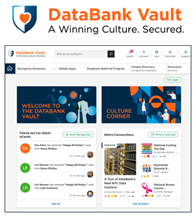
At the same time, these Ambassador meetings were taking place, DataBank was in the midst of developing an online culture hub called The Vault. Utilizing a platform from RewardGateway, the Vault would provide a virtual online “town hall” where employees could set up personal profiles, catch up on internal company news, send ecards to celebrate each other’s accomplishments, receive cash-based recognition rewards from managers, and leverage employee discounts from hundreds of retailers.
Throughout April and May of 2020, as sections of the Vault were being built out for launch, and the concept for the Keymaster was solidifying, it became clear to DataBank’s marketing and culture teams just how well the Vault and the Keymaster would complement each other. During the month of June, a campaign of teaser communications was developed to build excitement for the Vault, and upon launch after July 4th, it became the ideal forum upon which to promote the gameshow, recruit contestants, and even recap each week’s “episode” in the blog.
The Keymaster Brings it all Together
In August 2020, we kicked off Keymaster with a “pilot episode” featuring DataBank’s senior leadership as the initial contestants. For eight weeks after that, we conducted weekly episodes featuring 5-6 other employees competing for cash prizes, with two playoff games and a final championship.
Each 30-minute episode took place on Zoom with our host and the employee contestants on video, and everyone else in the company watching but on mute. Each episode opened with introductions that allowed the contestants to feature their role and department in the company, helping to build awareness across the organization. And at least one of the trivia segments in each episode involved “DataBank Trivia” helping to build awareness and drive home our important cultural messages.
In addition, we allowed employees who were viewing the show to post in the Zoom chat and this became one of the most interactive components of the experience. It opened the door for hilarious dialog that often rivaled the game itself for entertainment value and which our host often incorporated in real-time to the game commentary. We also recorded each episode and put the video and the chat transcript into a blog post the next day on the Vault for anyone who couldn’t attend live.
Measuring the Impact
The response to Keymaster and the Vault was tremendous. Employees eagerly anticipated each Thursday night episode of Keymaster, often saying it was the best 30-minutes of their workweek. It created a fun, shared, company-wide event that everyone could be a part of in real-time, or catch up on the next day. And the Vault has quickly become the center of our company culture vibrantly bringing to life the behaviors the are the hallmarks of The DataBank Way. In just the first three months of its operation, the Vault has seen an 11x increase in peer-to-peer recognition between employees and departments, and almost 95% participation across the employee base.
The combination of these three initiatives made a tremendous impact on the sense of cultural cohesion at DataBank in 2020, demonstrating that it is possible to build a real culture in a virtual setting, even in the most challenging of times.
In this episode of Data Movers, JSA’s, Jamie Scotto Cutaia, and B2B Social Media Influencer, Evan Kirstel, sit down with our CEO, Raul Martynek, and discuss thriving during uncertain times and the importance of company culture. Listen to the podcast here or watch it above!
About the latest series ‘Data Movers’ Podcast
Telecom PR pro, Jaymie Scotto Cutaia and top B2B social media influencer Evan Kirstel sit down with the most influential men and women of today’s leading telcos and data centers, supporting the network infrastructure requirements of our modern world. If you are interested in learning more about the people behind the industry’s top headlines, this podcast is for you! Follow Jaymie at @jscotto and Evan at @evankirstel
The health and well-being of our employees and customers are paramount at DataBank and has been a continuous objective throughout this pandemic.
Earlier this year, we enacted our Continuity of Operations Plan (CoOP) with a response for COVID-19. Part of that plan included containment levels applied to each site, detailing several levels of cleaning and handling situations when someone tests positive for COVID-19 that impacts the facility directly. It has been several months, so please go back and read our company blog post about that here.
We haven’t stopped there. As the pandemic has continued, DataBank has continued looking for new resources and methodologies to protect against the adverse impact of COVID-19 on operations and the possible spread of disease at our sites. Below is a picture of one example:
You will see thermal imaging pads installed at a few key facilities in the entrance, near the security office, or front desk.
These pads provide a quick, no-contact way to ensure people entering these facilities are wearing their masks and do not currently have an elevated temperature of 100.4°F or above.
The infrared sensors will measure the face’s surface temperature at multiple points in 1-2 seconds to provide a result within 0.6°F accuracy.
The IR scanner will not store images or data; it simply screens for elevated body temperature and the presence of a mask, providing an alarm sound and PC-based alert in the security office or front desk if an elevated temperature or no mask was detected.
We are employing this new technology to ensure the safety of our employees and our customers. It does not replace social distancing, enhanced cleaning, or other steps we’re currently taking.
This device does not provide a diagnosis, just a private warning to our security team. If an alarm is triggered, you will be privately asked to wear a mask or consult a medical professional if an elevated temperature.
Our investment in these thermal imaging devices is just another tool available to help keep you safe as we head into the winter season with a pandemic on our hands.
If you have any questions, contact us.
Building a new data center is an expensive and complex undertaking. The decisions that are made early on can have a huge impact on the performance, scalability, and cost of operating the facility, all of which impact the customer experience.
At DataBank, our construction effort is led by Danny Allen, VP of Mission Critical and Building Infrastructure, and Craig McGahey, VP Construction. Danny and his team set all the technical specifications for our new data centers and manage their construction accordingly. This includes power and cooling systems as well as collaborating on building management systems, fiber entrances, and security for the buildings with other internal departments.
Over many years of managing both add-ons, upgrade, and greenfield data center projects, his team has honed in on a design, planning, and construction methodology that is at the heart of our “Data Center Evolved” promise. In particular, their model focuses on two key objectives: 1) reducing the delivery time on any construction project and 2) keeping construction costs down while maintaining the highest possible quality.
Here is a closer look at a few of the ways they’ve been meeting both objectives.
Faster Delivery / Improved Operations
The construction standards developed by DataBank are used is all builds and reduce overall delivery time in three ways:
Ready-Made Design Packages – Rather than doing a new design for every build we have an electrical and mechanical (cooling) design that is ready to go at any time and can be used repeatedly in any market. This alone can save anywhere from three to six months in the planning process.
Continuous Improvement – Utilizing the same design allows us to address issues that arise in one building, and address them proactively in the next. This turns our design process into an ongoing improvement initiative, allowing us to get better with every build and encoding the lessons learned into our design packages to maintain organization knowledge.
Consistency of Operations & Knowledge – Leveraging a common design and construction process also drives consistency across the platform, allowing for faster and easier training of facility operations staff and a more rapid startup after construction completes. This also makes ongoing operations more efficient because if a facility technician in one market is needed to help cover in another, they will be familiar with the design and can hit the ground running.
Lower Build Costs
The DataBank team has also found a number of ways to reduce costs while maintaining superior quality. This has resulted from several modifications to our design, equipment, and construction methods.
Optimal Data Hall Sizing – Historically, we have built our data halls at 10k square feet. When looking at power densities and equipment sizing, we found that a better and more efficient fit for the electrical systems was to go to 15K square feet halls.
Right-Sizing Power and Cooling Equipment – In many recent facilities like SLC5 and DFW3, DataBank installed 1.5MW power blocks comprised of two 750KW UPS systems. While this configuration gave us the power density we needed, it also proved costlier than installing a single 1.5MW UPS, a change we have made in our designs for all future builds. This simple change cuts roughly in half many construction-related costs including, circuit breakers, maintenance contracts, installation manhours, and programming and hardware to monitor Building Management System (BMS) points. It’s important to note that we design this electrical topology in what’s called a “block redundant” scheme where a number of live “blocks” of power can switch to a reserve by means of a static switch. In most cases, we will install 4 blocks, with 3 live and one as reserve or backup. Mechanically, we are using a closed-loop air-cooled chiller plant with economization. This gives us the flexibility to meet high-density customer requirements while minimizing water use. This combination of electrical and mechanical systems results in an annualized PUE of less than 1.3.
Modified Construction Methods – Labor is one of the most expensive elements of a construction project. DataBank continuously measures and evaluates this element of each project and looks for ways to make the installation of equipment easier and faster. One example is the cable conduit. Historically, data centers have put all their electrical wires in conduit. While conduit offers the protection needed in critical infrastructure, it’s very labor-intensive, requires conduit benders and other specialized tools, and takes more time and effort to install. DataBank’s construction teams concluded that we could use armored MC Cable instead, providing the same basic level of protection we have with conduit while vastly simplifying construction. Unlike conduit, MC Cable can literally be rolled out on the floor, anchored down, and terminated 40% faster than installing conduit. That’s a 40% reduction in the amount of labor and no specialized tools are required thus saving time and costs that can be passed along to customers.
These are just a few of the ways DataBank’s construction teams work continuously working behind the scenes to improve the data center experience for our customers.