Now, in this second article in the series, we’ll examine what’s holding back the organizations that haven’t reached that point yet.
The Data Quality Turnaround
Most companies understand AI’s potential, but turning pilot projects into business-critical applications that generate real value involves overcoming several significant obstacles. Our survey of over 300 enterprise IT executives reveals exactly what those barriers look like today.
Research findings from DataBank’s new AI Adoption report reveal what is really holding organizations back from full AI adoption.
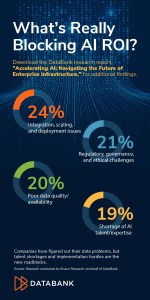
Here’s some encouraging news: Data quality is no longer the primary roadblock it once was. When we asked about major obstacles to AI adoption and ROI, only 20% of respondents cited poor data quality, availability, or labeling as a significant issue. This represents a dramatic shift from just a few years ago when data problems seemed to top virtually every list of AI challenges.
The survey results confirm this progress. One-third of respondents reported that their data and processes are “well-organized, governed, and ready for AI training and analysis.”
Another 34% said their data foundations were either “adequate or good but require some improvements in standardizing processes or data governance and structure.” Less than 10% described their processes and data as immature, fragmented, and siloed.
The New Roadblocks to AI Adoption
Now that companies have their data sorted out, different problems have moved to the front of the line.
Integration and Scalability Challenges
Integration, scaling, and deployment issues top the list at 24% of responses, showing that the biggest hurdles aren’t just technical anymore—they’re organizational and cultural too.
The challenge stems from what experts call “pilot purgatory” where organizations can successfully run AI proof-of-concepts, but struggle to move those solutions into production systems that work across the enterprise. Research shows that scaling AI requires integrating new technologies with complex, aging IT landscapes including legacy ERP, CRM, and manufacturing systems that weren’t designed for modern AI applications.
Regulatory and Compliance Hurdles
Regulatory, governance, and ethical challenges represent the second-largest barrier at 21%. Organizations must navigate complex compliance requirements, including sovereign data requirements across different territories and new legislation like the EU AI Act.
For companies operating globally, these challenges multiply significantly. As one research participant noted, operating across 200+ countries means dealing with vastly different payment regulations in each territory. However, AI itself may help organizations manage these complexities by training systems to quickly answer regulatory questions that previously required extensive manual research.
Talent Shortage and Skills Gaps
The talent shortage rounds out the top concerns, with 19% citing lack of AI expertise as a significant blocker. This scarcity has sparked what industry observers call “AI talent wars” between major technology companies, including Meta and OpenAI.
“When I think of the current greatest headwind when it comes to AI, it’s about having the right talent in place, as well as having the right training and the right upskilling,” notes Philips’ Chief Innovation Officer Shez Partovi, who participated in the research process and executive roundtable. His perspective emphasizes the importance of prioritizing “people, process, platform, in that order.”
Beyond the Basics: AI’s Emerging Applications
While data quality was once the primary concern for AI adoption, today’s landscape looks quite different. The barriers organizations face now center around people, processes, and organizational readiness rather than technical foundations. Integration challenges, talent shortages, and regulatory compliance have become the new focal points for companies working to scale their AI initiatives.
This shift suggests that AI technology itself has matured to a point where the human and organizational elements matter more than the underlying infrastructure. Companies investing in change management, building compliance frameworks, and developing internal AI expertise are positioning themselves to move beyond basic implementations toward more innovative applications.
Leadership plays a role, too. “Not unlike any other big change—whether it’s technology related or not—it comes down to leadership,” said Chris Bedi, Chief Customer Officer at ServiceNow, and another executive participant in the research survey. “It takes leadership courage to redefine a new mission, new roles, and new ways of working.”
In our next post, we’ll examine the shift from traditional AI and LLMs toward more innovative solutions that represent the next phase of enterprise AI adoption.
Interconnection refers to the direct linking of networks, data centers, and cloud platforms to improve performance, reliability, and customer experience.
Interconnection encompasses the various physical and virtual connections that companies use to exchange data, ensure business continuity, and achieve specific operational objectives. In colocation data centers, these connections are vital for fast data exchange, reduced latency, and improved network performance. Yet the real value lies in how they’re delivered and supported.
While interconnection technologies themselves are well-established, the approach to implementing and managing them varies significantly across providers. The difference between adequate connectivity and exceptional connectivity often comes down to the customer experience. More specifically, how well a provider understands your specific requirements, eliminates operational friction, and delivers service excellence throughout your relationship.
Cross connects: Direct, dedicated connections within the same data center
Internet exchanges: Shared switching infrastructure for peering with multiple networks
Data center interconnects (DCI): Point-to-point connections between different data centers
Internet connectivity: Various methods for accessing public internet (DIA, IP Transit)
Cloud connectivity: Private connections to public cloud providers (VPNs, cloud on-ramps, NaaS)
The question isn’t which technologies you need. It’s how your colocation provider approaches delivering them. This article will examine three key pillars of effective interconnection strategy and provide specific examples of the measurable benefits each approach delivers to IT organizations.
Beyond SLAs: What True Partnership Looks Like
Most colocation providers approach interconnection with a checklist mentality: deliver the connection, meet the SLA, move on to the next ticket. But the most successful IT deployments happen when providers go deeper, establishing genuine partnerships that address the unique challenges each organization faces.
True engagement means understanding that every company’s interconnection needs are shaped by their specific industry, compliance requirements, and risk tolerance. A healthcare organization’s approach to data security differs fundamentally from a fintech company’s, even when both need the same basic cross-connect. The difference lies in how the provider addresses those site-specific requirements.
This partnership approach delivers measurable advantages:
Private Interconnections That Reduce Security Risk
Interconnection solutions create dedicated, isolated connections that minimize exposure to external threats. Unlike public internet connections vulnerable to interception and unauthorized access, these private channels enhance data security through multiple layers of protection. Organizations can implement robust security measures including encryption, firewalls, and intrusion detection systems to safeguard data as it travels between interconnected entities.
For regulated industries, this becomes even more critical. Finance, healthcare, and government sectors face stringent regulations governing sensitive data transmission. The right interconnection approach provides the infrastructure needed to establish secure connections that meet compliance standards, helping organizations demonstrate their commitment to data privacy while protecting against legal and reputational risks.
Customized Architecture that Grows with Your Business
This customer-focused approach translates into tangible operational benefits. Rather than treating interconnection as a commodity service, providers who prioritize engagement work closely with customers to understand their specific security posture, compliance obligations, and growth trajectory. The result is interconnection architecture designed not just for today’s requirements, but for tomorrow’s challenges.
Partnership-focused interconnection transforms connectivity from a commodity purchase into a strategic advantage that scales with your business. However, even the best partnerships fall short if operational inefficiencies create friction in day-to-day management.
Streamlining the Complex: Eliminating Operational Friction
The most expensive interconnection problems aren’t the obvious ones. They’re the hidden inefficiencies that compound over time: network bottlenecks that slow critical applications, capacity constraints that force reactive scaling decisions, and operational complexity that consumes IT resources better spent on strategic initiatives.
Smart colocation providers focus on minimizing these non-core activities that impact the customer experience. Instead of simply delivering connectivity, they work to eliminate the operational friction that makes interconnection management a burden rather than an enabler.
The following are specific examples of how these friction-elimination strategies work in practice:
Direct Connections to Reduce Latency
By utilizing direct connections that bypass the public internet, data transmits with minimal delay, delivering faster transfer speeds and reduced latency. This becomes particularly crucial for bandwidth-intensive applications and real-time data processing where milliseconds of delay impact user experience and operational efficiency.
Traditional internet connections remain susceptible to congestion and bottlenecks, creating potential downtime and data packet loss. Interconnection solutions provide dedicated, private links that ensure stable, reliable connections, reducing disruption risk and enhancing overall network resilience.
Real-Time Bandwidth Allocation Without Service Disruptions
As data volumes continue growing exponentially across applications, services, and devices, organizations face the ongoing challenge of managing and processing vast amounts of information. The right interconnection approach provides the bandwidth and capacity needed to accommodate these demands, allowing organizations to scale operations without compromising network performance.
This means businesses can conveniently add or remove network connections and allocate bandwidth in real-time, aligning with their changing demands. Rather than forcing IT teams into reactive mode when traffic spikes or new applications come online, proactive interconnection planning ensures the network remains capable of managing heightened data traffic without sacrificing performance.
Simplified Operations That Improve IT Management Bandwidth
The best interconnection strategies reduce complexity rather than add to it. When providers focus on eliminating operational friction, IT teams spend less time managing connectivity issues and more time driving business value. This operational efficiency becomes a competitive advantage, freeing resources for innovation rather than maintenance.
Friction-free operations transform interconnection from a technical headache into a strategic enabler. Yet even streamlined connectivity falls short without service delivery that evolves alongside your business needs.
Service Delivery for the Modern Enterprise
Modern IT organizations don’t just need interconnection services—they need interconnection partners who understand the pace of digital transformation. Traditional service delivery models, built around reactive support and manual processes, can’t keep up with the agility demands of today’s enterprises.
Service excellence in interconnection means anticipating needs, providing flexible solutions, and delivering support that matches the speed of modern business. It’s the difference between a provider who responds to tickets and one who helps architect your connectivity strategy.
This modern service delivery approach is capable of delivering positive, tangible results:
Seamless Integrations for Cloud, IoT, and Emerging Technologies
Scalability and flexibility define modern interconnection service delivery. Organizations need the ability to adapt quickly as they adopt cloud services, implement IoT devices, or incorporate new applications. Interconnection provides the framework for integrating these elements smoothly, allowing efficient data transfer and communication between different systems and networks so they work together seamlessly.
This adaptability becomes essential as businesses respond to market shifts and evolving customer expectations. Whether venturing into new markets, introducing fresh products and services, or scaling operations to meet growing demands, interconnection delivers the flexibility needed to accommodate dynamic business transformations without lengthy implementation cycles or service disruptions.
Edge-Computing Capabilities that Deliver the Fastest Response Times
The most forward-thinking interconnection approaches provide the foundation for building robust, distributed architectures like edge computing and hybrid cloud environments. By connecting edge locations with centralized data centers or cloud environments, organizations achieve low-latency data processing and real-time analysis at the edge.
This enables faster, more responsive services to end-users while offloading computational loads from core infrastructure. The seamless connectivity offered by modern interconnection solutions paves the way for innovative technologies and architectures that drive efficiency, performance, and competitive advantage.
Proactive Support to Prevent Issues Before They Impact Operations
Service excellence means more than meeting expectations. It means exceeding them consistently. This translates into proactive communication, streamlined processes, and support that anticipates challenges before they impact operations.
Modern service delivery transforms interconnection from reactive support into strategic partnership. When providers combine genuine engagement, operational excellence, and forward-thinking service delivery, interconnection becomes the foundation for competitive advantage rather than just another IT expense.
The Choice is Yours
The interconnection landscape will continue evolving, but the basic question remains the same: Will you choose a provider who treats connectivity as a commodity, or one who approaches it as a strategic partnership?
The technologies are largely the same across providers, but the customer experience varies dramatically. When evaluating colocation partners, look beyond the technical specifications and SLAs to understand how they’ll support your business objectives, eliminate operational friction, and deliver service excellence that scales with your growth.
Return on investment (ROI) measures the financial value gained from technology initiatives compared to their cost and operational impact.
While AI has been developing for decades, ChatGPT’s debut nearly three years ago suddenly made AI accessible to everyone and sparked the current enterprise adoption boom. It burst on the scene so quickly that many organizations found themselves scrambling to respond. Since then, organizations have been figuring out how to transform AI experiments into business-critical applications that generate real value. Now, that effort is paying off.
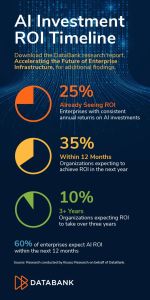
According to our recent survey of 304 senior IT professionals, 25% of enterprises are already achieving consistent annual returns on their AI investments, with another 35% expecting to hit profitability within the next 12 months. That means 60% of organizations surveyed are either seeing real money from AI or confident they will very soon.
The Quick Wins Are Working
These findings from DataBank’s new AI infrastructure report reflect real-world results from enterprise leaders who are making AI work today. Early AI adopters focused on what industry experts call the “low-hanging fruit”—straightforward automation and efficiency initiatives that deliver immediate, measurable value.
60% of participating enterprises reported they expect to achieve ROI for their AI projects in the next 12 months.
It’s clearly paying off. Consider the case of Visa, whose executives participated in our research roundtables and shared their AI journey. The company has been using AI for fraud detection for over 30 years but recently enhanced their models with deep learning and transformer technologies.
The result? $40 billion in prevented fraud last year alone. Visa has also deployed ChatGPT for employees, Microsoft Copilot for Office, and GitHub Copilot for developers to boost productivity across the organization.
ServiceNow, another executive participant in our study, offers an equally compelling example. Their AI transformation reduced response times in their finance department from four days to just 15 seconds while freeing up staff for higher-value work. The company reports over $350 million in enterprise value generated from AI implementations across their organization.
These early wins demonstrate that focused, practical AI implementations can deliver substantial returns, but industry leaders believe this is just the beginning of AI’s transformational potential.
Beyond Automation: The “Third Lift”
While these quick wins demonstrate clear value, industry leaders believe we’re still in the early stages of AI’s potential impact. Shez Partovi, Chief Innovation Officer at Philips and another executive participant in our research, describes AI adoption as happening in three distinct phases or “lifts”:
First lift: Automating administrative work. Tasks like data entry, basic customer service responses, scheduling, and routine report generation that free up human workers for more strategic activities.
Second lift: Augmenting employee skills to tackle higher-level tasks. In this phase, AI assists professionals in complex decision-making, advanced data analysis, creative problem-solving, and specialized technical work that they may not be able to do alone.
Third lift: Enabling entirely new capabilities. AI makes possible entirely new business models, products, or services that were previously impossible due to cost, complexity, or technological limitations.
“Most enterprises are still at a very early stage of AI adoption,” Partovi said, comparing the current state to 64K dial-up in the internet connectivity evolution. The greatest returns will come from that third lift when AI allows organizations to do things they simply couldn’t do before. This could include real-time personalization at massive scale, predictive maintenance that prevents problems before they occur, or AI-driven drug discovery that accelerates development timelines from years to months.
Obstacles and Opportunities in AI Adoption
While AI ROI is accelerating, our research reveals that enterprises still face significant hurdles, including integration challenges, high costs, lack of clear use cases, and other issues. (More on these topics in our next blog).
However, there’s encouraging news in one critical area: enterprises have largely solved their data quality challenges. Only 18.5% of respondents cite poor data quality as a major blocker, a significant improvement that reflects years of investment in data infrastructure and governance.
This post is part of a five-part series examining key trends in enterprise AI adoption based on our 2025 AI infrastructure survey.
By Branden Stanley, Senior Product Manager, Managed Services, DataBank
Computing infrastructure wasn’t always about the virtualization and cloud services we know today. In the early days of business computing, every server was what we now call “bare metal”—dedicated physical machines serving single organizations.
Through the 1980s and 1990s, if you wanted to run business applications, you bought or leased entire computers. As the internet expanded in the early 2000s, dedicated hosting providers recognized an opportunity. Many businesses needed server power but lacked the capital for hardware purchases and data center space.
The solution was simple: instead of the traditional model where businesses owned their own hardware, providers would own the physical infrastructure and rent dedicated servers to customers on a monthly basis. This shift from buying hardware outright to operational expense models made enterprise-grade computing accessible to smaller organizations, yet it also led to new challenges.
The Cloud Revolution: Trading Control for Convenience
However, the economics of dedicated hosting led to resource-sharing experiments. Shared hosting emerged as a cost-effective option where multiple websites or applications coexisted on single servers. While affordable, this approach introduced the “noisy neighbor” problem—when one tenant’s resource demands affected everyone else’s performance.
As businesses grew and their applications became more critical, they found themselves caught between two imperfect options: expensive dedicated servers with long provisioning times and complex management requirements, or shared hosting with unpredictable performance issues.
Enter cloud computing. Amazon Web Services and other public cloud providers revolutionized the industry by introducing virtualization technology that could provision servers in minutes rather than days or weeks. The cloud promised unprecedented automation, elastic scaling, and built-in redundancy that solved many reliability and uptime challenges that plagued traditional hosting. Suddenly, IT teams could spin up infrastructure with code, automate deployments, and scale resources dynamically based on demand.
However, this convenience came with trade-offs that became apparent as workloads matured. Virtualization introduced performance overhead, essentially a “tax” of roughly 10% on processing power due to the hypervisor layer managing multiple virtual machines. The very abstraction that enabled cloud flexibility also meant losing direct access to hardware-level controls, BIOS settings, and specialized configurations that some applications required.
Perhaps most ironically, the cloud reintroduced the noisy neighbor problems that shared hosting had created, as virtual machines competed for shared physical resources on the same underlying hardware.
The Bare Metal Renaissance
As these cloud limitations became clear, a new generation of offerings emerged—bare metal—that combined dedicated hardware performance with cloud-like convenience. Modern providers recognized that businesses didn’t want to choose between performance and ease of use. They wanted both.
Remote management technology became standard on new servers, and the capabilities it brought allowed complete server control without anyone physically touching the hardware. IT teams could now restart servers, change system settings, and even reinstall operating systems from their desks. Combined with automation tools, bare metal servers became as easy to manage as virtual machines, but without the performance trade-offs.
This evolution solved critical business problems beyond just performance. Instead of buying millions in hardware upfront, organizations could pay monthly like a subscription service. They could eliminate costly hardware replacement cycles while keeping dedicated resources. For many applications, a single optimized bare metal server could replace 10 or more virtual machines.
Most importantly, modern bare metal eliminated the performance penalty entirely. Applications get direct access to all hardware resources, everything from processing power to memory to specialized chips like GPUs. IT teams can fine-tune system settings and achieve the predictable performance that shared environments simply can’t deliver.
The control extends to networking capabilities as well. Companies can create and manage their own network segments within bare metal environments, then use managed internet connections to establish direct links to their existing colocation infrastructure. This approach allows businesses to seamlessly bridge their bare metal instances with traditional data center deployments, creating flexible architectures that span multiple infrastructure models.
Where Bare Metal Excels: Critical Use Cases
Modern bare metal servers have found their niche in applications where performance, control, and predictability are non-negotiable. Key use cases have emerged where the benefits clearly outweigh virtualized alternatives:
AI/ML training and inference: Training large language models or running inference at scale requires direct access to specialized accelerators, where even small performance losses translate to dramatically longer training times and higher costs.
High-Performance Computing (HPC): Scientific research, weather forecasting, and molecular modeling rely on intensive computational workloads that benefit from dedicated resources. These applications often require specific hardware configurations and can’t tolerate the unpredictable performance variations of shared environments.
Financial services: In high-frequency trading, microseconds mean the difference between profit and loss—literally millions annually. Ultra-low latency requirements demand bare metal’s predictable performance and direct hardware access, eliminating virtualization overhead that could introduce fatal delays.
Real-time analytics: Processing streaming data for fraud detection, recommendation engines, or IoT applications requires consistent, dedicated resources that can’t afford the performance variability of shared infrastructure.
Gaming and media: Multiplayer gaming servers and video processing need dedicated GPU resources and consistent network performance to deliver smooth experiences without lag or buffering.
Regulatory compliance: Industries with strict data sovereignty or security requirements often mandate the physical isolation that only single-tenant bare metal provides.
As these demanding use cases multiplied across industries, data center operators and cloud providers began recognizing a significant gap in their service portfolios that traditional virtualized offerings simply couldn’t fill.
Key Differences Between Virtualized Machines and Bare Metal
In summary, it comes down to these differences:
Virtualized Machines
Run on top of a hypervisor
Share physical server resources with other VMs
Resource allocation is logical, so actual performance can vary depending on workload and other tenants
Bare Metal
Dedicated physical servers with no hypervisor layer
All CPU, memory, and storage are exclusively yours, eliminating resource contention
Best for workloads needing predictable, consistent performance
These fundamental differences explain why organizations increasingly view bare metal as a strategic complement to, rather than replacement for, their existing cloud infrastructure.
The Market Response to Growing Demand
As these demanding use cases multiplied across industries, data center operators recognized a new opportunity in their service portfolios. They saw potential between their existing offerings: colocation services where customers housed their own hardware, and cloud services that layered virtualization on top of physical servers. There was room for a better way to deliver dedicated performance without operational complexity.
Rather than treating bare metal as a separate product category, data center operators are now positioning it as part of a comprehensive portfolio designed to help customers “shift left”—changing how they think about infrastructure ownership. Bare metal combines dedicated hardware performance with cloud-like operational simplicity, eliminating the burden of hardware selection, deployment, and maintenance. It also offers predictable monthly costs instead of large capital investments.
This evolution reflects market pressures toward performance, efficiency, and cost reduction. Bare metal fills the crucial middle ground between colocation and fully virtualized cloud, offering dedicated speed with managed convenience.
Bare Metal in Hybrid Architectures
Modern bare metal delivers significant value in hybrid infrastructures, where different models handle different workloads optimally. Organizations can run lightweight applications as virtual machines, deploy performance-critical databases on bare metal, and use public cloud for archival storage—each component optimized for its specific role.
One innovative approach involves using bare metal environments to process compute-intensive workloads, then moving results to public cloud for cost-effective long-term storage. This leverages bare metal’s processing efficiency while avoiding expensive cloud compute and egress fees. In this example, raw data ingestion and analysis happen on bare metal, while processed results archive to Amazon S3 at unbeatable storage rates.
This approach highlights bare metal’s core advantage: natural efficiency that other models can’t match, making it the ideal foundation for performance-critical components in modern hybrid architectures.
The Future of Infrastructure Choice
Think of bare metal’s evolution like choosing between owning a car and taking the bus. Public transit (cloud services) offers convenience and lower costs by sharing transportation resources among many passengers. Yet when you need to reach a specific destination on your exact timeline without delays from other stops, you need your own vehicle (bare metal). It gives you dedicated control over the route, speed, and schedule that gets you precisely where you need to go.
The infrastructure landscape has come full circle with important improvements. Today’s bare metal combines dedicated performance with cloud-like operational simplicity. As workloads become more demanding, bare metal represents not a step backward, but a maturation of infrastructure options, giving organizations dedicated resources without sacrificing the convenience that enables innovation.
Paul Myott, Vice President of Organizational Effectiveness and Internal Communication, DataBank
Kathy Skobe, Director of Customer Success, DataBank
Building and maintaining a strong organizational culture is one of the most challenging aspects of business leadership. At DataBank, we’ve learned that the “maintaining” part is often harder than the initial building effort.
While many companies focus on defining their values and hoping they stick, we’ve discovered that culture requires the same intentional, systematic approach as any other critical business function. The key insight that transformed our approach: culture isn’t something that happens to your organization, it’s something you actively hire for, measure, and nurture at every level.
Cultural engagement doesn’t require grand gestures. It’s about the daily choices that either strengthen or weaken the fabric of our organization and ultimately shape how customers experience working with us.
Building Culture by Design, Not by Default
The data center industry is heavy on mergers and acquisitions, where it’s common to see companies with a patchwork of different cultures existing under one roof.
We experienced this firsthand during our growth phase over the past few years when we completed four acquisitions in a short period, creating what we call a “Franken-culture.” Employees would reference doing things “the old way” versus “the DataBank way,” with different approaches competing instead of complementing each other.
While many companies struggle with teams scattered across locations defending their own approaches, we saw this as a competitive advantage waiting to be unlocked. Culture became a primary business objective, starting at the C-suite level.
Rather than following the typical “mission-vision-values” playbook, we approached culture building through three strategic phases:
First, we identified the culture we wanted. Instead of abstract values, we focused on our Purpose, Way, and Impact. This gave us concrete cultural cornerstones centered on being a “data center-people first” organization.
Second, we shared details about the culture to the whole organization. This meant integrating cultural expectations into job descriptions, performance reviews, and hiring processes so everyone knew that cultural engagement would be measured, not just talked about.
Third, we operationalized it for the long term. We built systems to maintain culture deliberately. Building culture requires intention but sustaining it requires a long-term commitment. Having a shared lexicon makes day-to-day interactions consistent with our intended culture.
This systematic approach created the framework that now drives every customer interaction at DataBank, and has resulted in an employee Net Promoter Score (eNPS) that has gone from the high 30s to above 60 in the last three years.
Three Cultural Cornerstones That Drive Customer Experience
At DataBank, we built our culture around a simple truth: healthy organizational culture requires strong alignment between your higher purpose and clear behavioral expectations. Our higher purpose is “to take away the worry of managing mission-critical IT infrastructure,” and we’ve developed three cultural cornerstones that support this purpose and guide every customer interaction.
Inspiring confidence means being present and responsive when clients need us most. Our teams take extreme ownership of issues and full accountability for their actions. For example, when a customer calls with a critical issue at 2:00 a.m., that customer will be able to reach someone who treats the emergency as his or her own.
Putting people first focuses on the relationships that make everything else work. We assume positive intent with each other and extend this naturally to clients. This becomes transparent communication and collaborative problem-solving that clients feel in every interaction.
Being data centered drives us to solve problems before selling services. We find answers in data and share that knowledge with clients to resolve challenges quickly. This pushes us toward technical excellence, but always in service of clients’ actual needs rather than what we think they should buy.
These three cornerstones provide the cultural framework, but we’ve learned that the most effective way to sustain them is by building teams with the right personality mix from the start.
The Archetype Mix That Delivers Exceptional Customer Experience
DataBank’s approach to culture goes beyond values and behaviors. We design our teams around specific personality and behavioral archetypes that naturally deliver better customer experiences. Through comprehensive assessment, we discovered that our most successful employees predominantly embody three key archetypes: Hero, Everyperson, and Sage.
This creates a powerful combination that customers experience directly:
Hero team members naturally take on the biggest, toughest challenges. When a customer faces a critical infrastructure crisis, they’re getting someone who thrives on solving problems others can’t.
Everyperson archetypes ensure our teams have each other’s backs and keep everyone grounded. Customers experience this as seamless collaboration across departments and consistent support from a team that works together rather than passing problems around.
Sage personalities drive our reliance on data and process. Customers get systematic problem-solving, evidence-based recommendations, and the confidence that comes from working with people who make decisions based on facts, not guesswork.
The result is a well-balanced culture with a clear outcome: We deliver exceptional customer experience by being a winning team that honors our word and has the collective capability to tackle any challenge.
From Culture to Customer Success: A Frontline Perspective
As DataBank’s Director of Customer Success, I (Kathy) see firsthand how our cultural framework translates into real customer outcomes. While our organizational development team has built an impressive cultural foundation, my role is ensuring that foundation becomes tangible value for every client we serve.
Culture isn’t just an internal initiative. Instead, it’s the invisible foundation that determines whether every customer interaction builds trust or erodes it. In the data center industry, where customers are entrusting us with their most mission-critical infrastructure, technical competence is table stakes. What differentiates exceptional service is whether customers feel genuinely supported, understood, and prioritized throughout their journey with us.
This culture translates into customer experience through quick responses to urgent requests and seamless team collaboration on complex problems. Most importantly, customers feel that we genuinely care about their success beyond just equipment maintenance.
When culture and customer experience align, customers don’t just get reliable infrastructure. They get a partnership that enables their business growth and gives them confidence to innovate without worry.
Living the Culture: Employee Recognition in Action
Our employees don’t just know our cultural cornerstones. They live them every single day in their interactions with customers. We see this dedication consistently, and our quarterly DataBank Way awards give us the opportunity to formally recognize employees who embody our culture in exceptional ways.
Recent nominations showcase exactly how our cultural framework translates into outstanding customer experiences:
One employee was nominated “for the way he continually took ownership in his data center, always making sure clients and account teams were aware and in-sync on issues in the facility.”
Another was recognized “for her efforts in several difficult projects migrations, coordinating between customer and network teams, resolving complex server issues by engaging customers directly, and ultimately leading to higher customer confidence and satisfaction.”
These aren’t isolated examples. They represent the daily reality of how DataBank employees approach customer relationships, guided by the cultural principles that define who we are as an organization.
What Our Customers Say: Where Culture Pays Off
All of this cultural work has one ultimate test: how customers actually experience working with DataBank. The proof isn’t in our mission statements or internal awards. It’s in what customers tell us directly through our Net Promoter Score (NPS) surveys and scores.
The results speak for themselves. Customers consistently highlight the personal connections and proactive support that set us apart: “Positive, friendly and proactive team minded environment. Reachable at any time during business hours and after,” and “The staff are some of the best in the business! Always helpful and always willing to go the extra mile for the customer.”
The specificity of their feedback shows how individual team members embody our cultural cornerstones. One customer praised their local team: “The professionalism, friendliness, and support from the local team. The team has been nothing short of fantastic to deal with and are a shining example of what your company represents.”
Perhaps, most telling are the comments that capture our “People First” approach in unexpected ways: “They keep grape soda in the fridge simply because I like it. Sold.” These moments of personal attention demonstrate that great customer experience often lives in the smallest gestures that show we genuinely care about the people behind the infrastructure.
We recently heard from even more customers who were willing to share their experiences. Some additional highlights:
From a customer success standpoint, culture isn’t just an internal initiative. It’s the invisible foundation that determines whether every customer interaction builds trust or erodes it. In the data center industry, where customers are entrusting us with their most mission-critical infrastructure, technical competence is table stakes. What differentiates exceptional service is whether customers feel genuinely supported, understood, and prioritized throughout their journey with us.
Great culture becomes the customer’s experience in countless moments: how quickly we respond to their urgent requests, whether our teams collaborate seamlessly to solve complex problems, and most importantly, whether customers sense that we truly care about their success beyond just maintaining their equipment. When culture and customer experience align, customers don’t just get reliable infrastructure. They get a partnership that enables their business growth and gives them confidence to innovate without worry.
The Bottom Line: Small Gestures Can Have the Biggest Impact
Our journey from a “Franken-culture” of competing approaches to a unified cultural framework demonstrates that intentional culture building directly drives customer satisfaction. While our three cultural cornerstones and leadership behaviors provide the structure, it’s often the smallest gestures that make the biggest difference.
The customer who mentioned grape soda in the break room wasn’t just commenting on a beverage. He was recognizing that someone cared enough to notice his preference and act on it. This attention to individual needs, multiplied across thousands of daily interactions, transforms routine business relationships into genuine partnerships. When culture becomes the foundation of every customer touchpoint, technical excellence evolves into trust, loyalty, and the confidence that enables customers to innovate without worry.
By Joe Minarik, Chief Operating Officer, DataBank
“Location, location, location.”
While this adage has applied to property values and their overall desirability in traditional, brick-and-mortar real estate markets for generations, this saying can also be used to define success for the next generation of data centers operating at the edge.
To put it another way, where home and commercial real estate markets tend to focus on geography, edge data centers must now carefully factor population proximity into their decisions where to locate, as this will affect latency times. Making the right choices gives data center operators the best chance to deliver fast, reliable, and always-available digital experiences their customers and their end users demand.
Edge Growth Demands New Strategies
This shift in thinking is a response to an edge computing industry that now finds itself at a critical inflection point that may require new variables in strategic decision-making.
Both of these findings point to a new dynamic: The fact that the edge computing industry now faces new considerations that outweigh latency metrics and other variables used in the past.
Why Hyperscalers’ Economics Create Population Proximity Gaps
While companies providing digital services have long obsessed over geographic coverage and millisecond improvements, forward-thinking enterprises are now recognizing that population density – not just proximity – represents the true determining factor in their edge infrastructure ROI and overall success.
Hyperscalers face a fundamental economic challenge when it comes to population-dense markets. Their business model depends on massive scale to achieve cost efficiencies, requiring enormous facilities with substantial land footprints and power capacities. In population-dense urban areas, land costs, power infrastructure expenses, and regulatory complexity make these large-scale deployments cost-prohibitive.
This economic reality drives hyperscalers to build their major infrastructure in lower-cost rural or suburban locations where they can achieve the scale economies their model requires. While AWS, Microsoft, and Google could theoretically build in downtown areas, the cost structure doesn’t align with their massive infrastructure requirements and margin expectations.
For edge services specifically, hyperscalers typically rely on virtualized solutions and distributed computing zones that leverage existing telecommunications infrastructure or partner facilities. These software-defined edges – like AWS Wavelength zones, Microsoft Azure Edge Zones, and Google Distributed Cloud Edge – offer broad geographic reach but with limited physical presence in the most population-dense areas where latency matters most.
The Colocation Advantage: Multi-tenant Economics Enable Population Proximity
Colocation data centers solve the population proximity challenge through a fundamentally different economic model. While hyperscalers require massive scale at individual locations to justify their infrastructure investments, colocation providers achieve the necessary scale through multi-tenancy. In doing so, they can successfully spread the cost of population-dense real estate across multiple customers sharing the same facility.
This multi-tenant approach makes the economics work in expensive urban markets where hyperscalers can’t justify dedicated facilities. By serving dozens of customers from a single strategically located data center, colocation providers can absorb the higher costs of prime real estate, power infrastructure, and regulatory compliance that come with being close to major population centers.
The colocation model can deliver better population reach through dedicated physical infrastructure that is positioned where customers need it most. For example, DataBank’s data centers are within a 50-mile radius of 50% of the population in the United States and 100 miles from 60%. This positioning is economically viable because the infrastructure costs are shared across multiple tenants, where each accesses dedicated resources within the same facility.
When a colocation facility positions itself within optimal distance of major population centers, it provides the dedicated processing power, storage, and connectivity that more population-dense applications demand. Unlike hyperscaler edge zones that share resources across larger geographic regions, colocation facilities can dedicate specific capacity to individual customers while maintaining multi-tenant economics that make the location strategy more sustainable.
Most importantly, colocation providers can respond to population growth opportunities through this scalable economic model. As demographics shift and new urban centers emerge, colocation companies can deploy facilities in these markets by leveraging multi-tenancy to justify the higher costs. This approach allows them to capture population proximity advantages through shared infrastructure economics.
Positioning for Edge Computing’s Explosive Growth
As the edge computing market grows from $16 billion to $155 billion by 2030, success will belong to those who understand that location truly is everything. Hyperscalers may offer broad geographic coverage, but colocation providers deliver what matters more: infrastructure strategically positioned within optimal reach of the population clusters that drive tomorrow’s digital economy.
At DataBank, we understand that being a good neighbor means going above and beyond to actively contribute to the communities where we operate. That’s why we’re always looking for meaningful ways to support local organizations and demonstrate our commitment to being a positive community partner.
Recently, a scheduled building demolition on our Culpeper, VA campus presented exactly that kind of opportunity.
An Unexpected Partnership: Turning Teardown into Training
When an old house on DataBank’s Culpeper County property was scheduled for demolition, what seemed like a routine teardown became an opportunity to address a critical community need.
The connection began when both Culpeper County government and the Culpeper County Volunteer Fire Department became aware that the building was due for demolition and reached out to DataBank. What started as a simple inquiry quickly evolved into something much more significant. The chance to provide firefighters with the kind of realistic training opportunity that’s exceptionally rare.
This was an attractive option because Culpeper County lacks a dedicated fire training facility. Their training facilities are located 30-90 minutes away in neighboring counties. This results in taking critical resources outside the county for the duration of the training. While the fire department is occasionally offered buildings for training, most of these structures don’t meet the necessary safety and structural standards required by the Virginia Department of Fire Programs for comprehensive firefighter drills.
“We do have access to training facilities about once a year, but firefighters can get too familiar with those spaces,” said Cody Fairfax, Firefighter and Instructor, Culpeper County Volunteer Fire Department. “The issue is that they tend to know where everything is, which reduces the realism of the training. Firefighters’ skills are perishable, so it’s important that we give them the best training environment possible to enhance their abilities.”
Data Center Community Partnership
DataBank’s building was different. It was in good structural condition and perfectly suited for the advanced training techniques that local firefighters needed to practice.
Rather than simply proceeding with demolition, DataBank worked closely with Culpeper County government representatives to ensure all legal and insurance requirements were met. This enabled the fire department to coordinate a three-day training program that would benefit the entire county.
“This partnership with the Culpeper County Volunteer Fire Department perfectly exemplifies our approach to community engagement,” said Antonia Passalacqua, Public Policy Lead at DataBank. “We’re always looking for creative ways to work with local organizations through meaningful opportunities that deliver real benefits to the communities where we operate.”
The Training Program
The training program followed a three-day “crawl-walk-run” methodology, with a total of 46 volunteers participating, including two other fire companies and career EMS personnel. Each day focused on different training techniques and created progressively more complex scenarios, allowing firefighters to build skills systematically while working in realistic conditions.
The residential building could be customized to change room layouts and possible scenarios each day. This led to a better training environment that couldn’t be replicated in a typical training facility.
The comprehensive nature of the training program allowed firefighters to practice a wide range of critical skills and scenarios:
Structural Operations:
Vertical ventilation techniques using chainsaws, ladders, and roof access
Wall breaching for emergency access and egress
Maneuvering through building studs during rescue operations
Search and Rescue:
Search and rescue operations using mannequins of different sizes
Basement exercises to simulate rescue operations in confined spaces
Hoarder environment simulations with realistic clutter and obstacles
Fire Suppression and Support:
Hose line advancement in various building configurations
Water supply operations, including portable water supply systems
Smoke machine exercises for reduced visibility training
Emergency Response Coordination:
Rapid Intervention Team (RIT) drills for firefighter rescue scenarios
Victim treatment and transport coordination with EMS teams positioned outside the building
This type of comprehensive, hands-on training is exactly what firefighters need to maintain their skills and readiness. Yet finding suitable buildings for these exercises tends to be an ongoing challenge for volunteer departments.
A Unique Perspective: From Data Center Manager to Fire Chief
Charles Perryman understands both sides of this collaboration, having spent 39 years as a data center manager while also dedicating time to the Culpeper County Volunteer Fire Department before becoming Fire Chief.
“I’ve rarely seen corporate partners step up like this for public safety training,” said Charles “Jr.” Perryman, Fire Chief, Culpeper County Volunteer Fire Department. “We rarely receive donated buildings from commercial providers, and certainly not from data center operators.
“What DataBank provided was truly exceptional. Not just a building, but a fully coordinated training opportunity that directly enhances our ability to protect our community.”
A compliance audit exception occurs when controls fail to meet regulatory or policy requirements during an audit review.
By Calli Schlientz, Director of Compliance, DataBank
What They Are, Why They Matter, and How to Respond
Compliance audits are a critical component of organizational governance, designed to ensure that companies adhere to established policies, procedures, and regulatory requirements. However, even the most well-intentioned organizations may encounter situations where actual practices don’t align perfectly with documented standards.
What Is an Audit Exception?
A compliance audit exception is a finding or deviation and occurs when an auditor, either internal or third-party (external), identifies a discrepancy or deviation from defined policies or procedures or required control parameters. Ultimately, this means something went wrong and what is required is not what is actually happening.
There are four key areas of an exception:
Nonconformance: The activity or evidence that did not meet the defined policy or compliance requirements (control).
Impact: The exception represents some sort of risk, inefficiency, or security vulnerability.
Documentation: The exception is formally documented by the auditor within the audit/assessment report.
Remediation: The organization receiving the exception is required to address the issue and implement corrective actions. Typically, this is done in the form of a management response, root cause analysis, and corrective action plan. These actions could be taken to correct the error, mitigate (or partially reduce the risk), or accept the risk posed by the deviation.
The following are real-life examples that might trigger these types of exceptions:
A terminated user account that wasn’t disabled within the documented service-level agreement (SLA) for that system.
An accounting process to change an ACH recipient was completed without validation and second-party verification as required by documented policies or procedures.
Configurations were not aligned with approved security baselines (e.g., firewall rules, system hardening, etc.).
Fire inspections that weren’t conducted within the annual timeline requirement.
Why Do Audit Exceptions Matter?
Audit exceptions, or non-conformities, matter because they highlight potential or actual weaknesses or failures in processes, policies, or controls. If they are left uncorrected, they can have a significant impact on the organization, and potentially, its customers. Additionally, an exception or non-conformity outlines what is not being done: where data is not protected, or where access points are weakened and easily exploited (physically or logically).
Depending on severity, these exceptions can:
Signal systemic process or training issues
Affect audit opinions, resulting in a qualified or adverse opinion:
Qualified: Everything is fairly presented except for a specific area where there is a limitation or deviation (“Mostly Compliant”).
Adverse: There are issues so serious that the report does not fairly present the organization’s controls (“Non-Compliant”).
Affect customer trust.
Impact customers’ or DataBank’s regulatory standing.
Lead to noncompliance penalties or overall audit failures.
Contribute to security breaches.
Result in financial loss due to incident cost, reputation damage, and customer turnover.
Cause business disruptions (which, if exploited can result in costly incidents).
How Should Organizations Handle Audit Exceptions?
Audit exceptions should be addressed in a timely manner with a well-documented and transparent response. One best-practice response is to follow a few steps that are well defined and repeatable (not that you want to have to repeat them).
Step 1: Validate and respond to the exception
Upon communication from the assessor, do not react immediately, but rather review it. Review internal data and documentation to validate the alleged exception.
Document for management all the data gathered during the internal investigation as part of the validation.
Draft a response for management’s review to respond to the alleged exception.
Step 2: Acknowledge the exception
Document the exception and management’s response to the exception by including what control(s) or processes were involved, a description of the issue, the date of discovery, and impact to the organization or system (risk level, all affected systems).
Step 3: Perform a root cause analysis (RCA)
Determine the reason why the control failed.
Consider if the failure was a process gap, human error, lack of resources or training, technical failure, system failure, vendor, or supply chain issue, etc.
Document the root cause and how it was determined.
Step 4: Create a corrective action plan (CAP)
Define specific steps to correct the issue, including:
Identifying the owner – who is responsible for each part of the correction.
Establishing the timeline for each step of the resolution.
Creating specific milestones – key points within the correction that should be targeted and any dependencies for each of these.
Documenting any changes to policy, procedure, or systems that are a result of this exception and action plan.
TIP: Your CAP should be auditor-ready and clearly assign responsibility and deadlines.
Step 5: Communicate transparently
Be honest with stakeholders. Customers and partners value remediation and accountability more than silence.
What to Look for in a Provider’s Audit Report
When reviewing a provider’s audit report, there will inevitably be several key red flags and confidence indicators within it. These should be brought up as part of each review, typically held annually, of all of your organization’s critical vendors. It is important to look for these, but if you have any questions, be sure to ask key vendors about exceptions and corrective action plans.
Where you’ll see exceptions documented:
SOC 1/SOC 2 reports
PCI-DSS ROC (Report on Compliance)
NOTE: Most providers will only give the Attestation of Compliance so ask for details related to areas of non-compliance
ISO 27001 certificates and reports
FedRAMP SAR (Security Assessment Report), RET (Risk Exposure Table), and POA&M (Plan of Action and Milestone) documents, which are accessible only through Connect.gov through the FedRAMP Access Request Process for those with a .mil or .gov email address.
Key evaluation factors:
Severity: Does the exception affect sensitive data or privileged access?
Frequency of numbers: Is it a one-time lapse, a single incident in a sample stack, or a recurring failure?
Cumulative numbers: Is the report littered with exceptions, or are there just one or two?
Remediation timeline: Is there a clear plan with ownership and due dates?
Management response: Is the organization proactive in resolving and documenting the issue?
Audit opinion: Is the audit opinion clean (unqualified) or qualified/adverse?
Ask this: “What actions has the provider taken since this exception was discovered?”
After collecting all of the data, your organization can make an informed decision on the level of risk that may impact your overall operations and whether or not a key vendor fits within your risk appetite.
Final Thoughts
Compliance audit exceptions are not just check-the-box findings as part of a larger compliance program. They are indicators of where systems, processes, or behaviors have deviated from expectations. Whether the result of human error, outdated procedures, or technical gaps, exceptions give organizations the opportunity to improve. When approached with transparency, accountability, and a structured response, exceptions can drive real progress toward a stronger security and compliance posture.
For both organizations and their partners, how exceptions are identified, managed, and resolved speaks volumes about operational maturity and risk awareness. Ultimately, a proactive approach to audit exceptions isn’t just about passing, it’s about building resilience, trust, and long-term success.
In today’s digital world, the ability to move data quickly, securely, and reliably between networks, cloud providers, and business partners has become a competitive necessity.
Data center interconnections play an important role in this need for connectivity. This specialized infrastructure enables direct, private connections between different networks and systems without relying on the public internet.
In this article, we’ll revisit what data center interconnections are and their key benefits for modern businesses. We’ll also look at DataBank’s new Interconnection Marketplace to show how this platform helps customers research, compare, and connect with hundreds of network cloud providers in one place. This solution turns what was once a complex, time-consuming process into a streamlined experience.
Understanding Data Center Interconnections
As a quick refresher, data center interconnection refers to the process of establishing direct connections between networks, systems, or devices to enable seamless communication and data exchange. (For even more information, read our detailed blog article, Understanding Interconnections.)
Unlike traditional internet-based connections that route traffic through multiple intermediaries, interconnections create dedicated pathways that dramatically improve performance, security, and reliability. Deploying interconnection solutions for data centers is the infrastructure foundation of business-critical connectivity.
These connections take several forms, each serving specific business needs. These include:
Cross-connects that provide direct physical links between different networks within the same data center facility, enabling instant data exchange without external routing.
Cloud on-ramps that offer dedicated pathways to major cloud service providers like Amazon Web Services, Microsoft Azure, and Google Cloud Platform, bypassing the unpredictable performance of public internet connections.
Internet exchange points that allow multiple networks to interconnect and exchange traffic directly, reducing latency and improving overall network performance.
Each of these interconnection types offers clear benefits for businesses.
Why Direct Connections Matter: The Business Case for Interconnections
Speed is the first advantage most businesses experience. Latency drops dramatically when data doesn’t need to traverse multiple network hops across the public internet. This can reduce response times from hundreds of milliseconds to single digits.
Security is better with private, dedicated channels instead of shared public infrastructure. This approach eliminates many potential attack vectors and compliance concerns. Reliability also increases since businesses aren’t dependent on the varying performance and potential outages of multiple internet service providers.
Cost savings are often the biggest benefit. Organizations can reduce their reliance on expensive bandwidth purchases from multiple carriers. Direct interconnections can eliminate costly data egress fees from cloud providers, reduce the need for redundant internet connections, and lower overall networking expenses. For businesses running bandwidth-intensive applications like video streaming, large-scale data analytics, or real-time collaboration platforms, these cost reductions can make a real difference.
The benefits extend beyond technical improvements. The specific benefits of interconnection solutions translate directly into measurable business outcomes. Data center interconnections, enabled by robust interconnection solutions, are a direct driver of business agility. Faster applications mean happier customers and fewer complaints. Reduced outages translate to less lost revenue, higher employee satisfaction, and improved business value.
The Challenge of Interconnection Complexity
Despite these advantages, implementing interconnection strategies has traditionally been a complex, time-consuming process. Businesses faced the daunting task of researching hundreds of potential network providers, cloud services, and connectivity options without clear visibility into what was available at their chosen data center locations.
The process typically involved too many phone calls, emails, and negotiations with different carriers and service providers. IT teams struggled to compare options, understand pricing models, and determine which connections would best serve their specific requirements. This complexity was particularly challenging for businesses operating across many geographic markets, where interconnection options could vary dramatically between locations.
Traditional data center environments created their own additional barriers. Restrictive policies, complex cross-connect procedures, and little information about available providers made it even harder for businesses to implement the best connectivity strategies. Many organizations found themselves making poor decisions simply because they lacked detailed information about their options.
DataBank’s Interconnection Marketplace: Simplifying the Complex
Recognizing these challenges, DataBank recently launched our Interconnection Marketplace, a dynamic platform that changes how businesses make connectivity decisions. This self-service tool gives clear visibility into DataBank’s network, cloud, and SaaS providers across 67 data center locations.
The marketplace solves the information problem that has made interconnection planning so difficult. Instead of making dozens of phone calls and emails, customers can now see all available options in one place. The platform lets users filter by region, provider type, and data center location to find the right partners faster.
DataBank created the Interconnection Marketplace to simplify the process of researching and building connections that drive business success. Whether a customer’s business is trying to reduce complexity, scale operations, or improve latency and redundancy, this tool empowers users to navigate our ecosystem and create a customized interconnection plan that meets their specific needs.
The marketplace’s value extends beyond simple provider discovery. By offering visibility into more than 200 network, cloud, and SaaS providers, businesses can make better decisions about their connectivity. Companies can find backup connection options, identify the fastest paths to important resources, and improve their overall network setup.
A Better Way Forward
DataBank’s Interconnection Marketplace represents more than just a convenience. It’s an important tool for businesses that need better connectivity solutions. In an era where application performance, data security, and network reliability directly impact business outcomes, having clear visibility into connectivity options gives companies a real advantage.
The platform eliminates guesswork from interconnection planning, reduces time needed for new connections, and ensures businesses can make informed decisions based on complete information rather than limited research. For organizations supporting AI workloads, hybrid cloud setups, or demanding real-time applications, this level of connectivity information is increasingly important.
As businesses continue to evolve their infrastructure needs, tools like DataBank’s Interconnection Marketplace become more valuable. By combining comprehensive provider visibility with easy self-service capabilities, it transforms interconnection from a complex technical challenge into a manageable decision that can improve performance, enhance security, and reduce costs.
By Kelley Edwards, Vice President of Data Center Operations and Danny Allen, Vice President of Critical Infrastructure, DataBank
In today’s hyperconnected business environment, data center downtime isn’t just an inconvenience. It’s a competitive threat that can cost enterprises millions in lost revenue, damaged reputation, regulatory penalties, and other negative consequences. When critical applications go offline, the ripple effects extend far beyond IT departments to impact customer experience, operational efficiency, and bottom-line results.
There’s a huge difference between good and exceptional uptime. For example, four nines of uptime (99.99%) may sound impressive and results in only 52 minutes of downtime per year. However, that’s not good enough. Five nines (99.999%)—DataBank’s target metric— reduces that amount down to just five minutes annually.
For enterprise organizations running critical workloads, one extra nine can mean the difference between meeting SLAs or facing costly penalties, or between maintaining positive customer relationships or losing business to competitors.
In this article, we’ll explore the essential strategies and best practices that leading data center operators use to achieve exceptional uptime and prevent costly outages.
The Three Pillars of Data Center Uptime Excellence
The old saying, “hope is not a strategy,” rings true. Achieving maximum uptime isn’t about luck or wishing for the best results. It requires a systematic approach, an extremely proactive mindset from all employees, and a passion to help customers win.
At DataBank, our approach to uptime is built on three foundational elements. Each one is critical to eliminating single points of failure and helping create highly reliable, highly resilient infrastructure for our clients.
Customer infrastructure decisions: The foundation of uptime begins with the choices customers make in setting up their IT assets. We believe the most effective data center design works in partnership with each customer’s infrastructure decisions. For example, we encourage them to use dual-corded power configurations that can provide automatic failover capabilities when issues arise as opposed to single-corded setups can lead to potential vulnerabilities.
Engineering design: Smart infrastructure design goes beyond industry minimums to build in multiple layers of protection. For example, DataBank uses N+2 cooling systems that essentially provide backup to backup systems. This helps us make sure each data center is always at the right temperature, even if something goes wrong. This commitment helped DataBank’s Universal Data Hall Design win a Golden Globee Award in 2024 for our ability to accommodate high-density computing demands while enabling fast deployments without facility retrofits.
Operational excellence and maintenance: The most sophisticated infrastructure means nothing without disciplined operational processes to maintain it. This includes rigorous maintenance procedures, comprehensive staff training, and a culture that treats complacency as the enemy of uptime. Consistent execution of proven processes, backed by continuous improvement and the application of lessons learned to all data centers, transforms good infrastructure into exceptional reliability.
These three pillars create the framework for exceptional uptime, but they’re really just the starting point. Leading data center operators build upon this foundation with additional best practices that turn theoretical reliability into actual results.
Operational Best Practices: From Reactive to Proactive Management
While solid infrastructure provides the backbone of uptime, operational excellence transforms that capability into measurable results. The most reliable data centers distinguish themselves through disciplined processes that anticipate problems, learn from every incident, and continuously improve performance across their entire portfolio.
Avoiding Complacency: The Roulette Wheel Mentality
Complacency in data center operations is like betting on red at a roulette wheel. The first time you do it, your odds seem reasonable. However, if you keep betting on consecutive reds, your chances of continued success get cut in half with each spin.
It’s an important mindset in data centers. The more times employees do something—even regular tasks—the more overconfident they become. While each individual procedure might have the same risk level every time, the reality is that repeated exposure to risk virtually guarantees eventual failure.
This is why data center operators need to maintain rigorous adherence to procedures regardless of how many times they’ve been successfully completed. It’s important to treat each task with the same level of caution and attention to detail as if it were the first time.
Comprehensive Training to Reduce Human Error
Human error remains one of the leading causes of data center outages, making comprehensive training programs essential for maintaining uptime. Effective training goes beyond basic procedures to include scenario-based learning and regular refresher sessions.
Consider a fictitious scenario where technicians were required to split their time across multiple facilities, making it difficult to stay current on equipment-specific procedures at each location. A simple misunderstanding about controls at an unfamiliar site could have led to an outage. This type of incident highlights the importance of increasing staffing levels so technicians can focus on fewer sites and ensuring every team member receives consistent, up-to-date training on all equipment they might encounter.
Rigorous Post-Mortem Review Processes
When incidents occur, thorough root-cause analyses (RCAs) and post-mortem review (PMR) processes turn any setbacks into learning opportunities. Effective post-mortem processes also include detailed timelines, technical analysis, and clear accountability for implementing corrective measures.
These sessions bring together subject matter experts from across the organization to conduct detailed root cause analysis and identify specific action items. It’s important to remember that the goal isn’t to point the finger but to understand exactly what happened and why. Instead, the goal is to create new institutional knowledge that prevents similar issues in the future.
Applying Lessons Learned Across All Facilities
One of the most important parts of operational excellence is ensuring that lessons learned at one facility immediately benefit all locations. When an outage occurs at any site, staff should conduct detailed audits across their entire portfolio to identify similar vulnerabilities. While unpredictable incidents may occur once, internal teams need to do all they can to proactively make sure it doesn’t happen again in any facility.
Effectively applying lessons learned and new best practices depends on the use of standardized implementation procedures and comprehensive communications plans that address all vulnerabilities and questions. It also demands a culture where sharing information about problems is encouraged rather than discouraged, creating an environment where every facility benefits from the collective experience of the entire organization.
Comprehensive Event Reporting and Historical Analysis
Maintaining detailed records of both critical events and advisories provides valuable insights for predicting and preventing future issues. Critical events impact customers directly, while advisories represent potential problems that were caught and resolved before causing service disruption. By tracking these events over months, even years, operators can identify patterns and trends that might not be obvious from individual incidents.
This historical analysis helps predict future maintenance needs, identify equipment that may be approaching end-of-life, and recognize environmental factors that could contribute to potential problems. Regular reporting on these metrics also demonstrates continuous improvement efforts and helps prioritize infrastructure investments based on actual performance data rather than assumptions.
Cross-Departmental Collaboration: Unified Focus on Customer Success
One of the most impactful best practices involves breaking down silos between departments to create seamless collaboration focused on customer uptime. When data center operations, critical infrastructure, engineering, construction, and vendor management teams all share the same goal — customer success — and the results extend far beyond what any single department could achieve independently.
Successful collaboration requires shared accountability for customer outcomes rather than department-specific metrics. When everyone understands that customer uptime is the ultimate measure of success, teams naturally align their priorities. Regular cross-departmental meetings, shared protocols, and unified dashboards maintain this customer-focused culture while accelerating problem-solving through diverse expertise.
Building Unshakeable Infrastructure Through Continuous Excellence
Maximizing data center uptime requires more than advanced technology and redundant systems. It demands a culture of continuous improvement where every incident becomes a learning opportunity, and every team member takes ownership of customer success.
Organizations that master this combination of robust infrastructure design, disciplined operational processes, and collaborative culture don’t just achieve exceptional uptime. They build the foundation for long-term competitive advantage in today’s digital world.