By Rob Lerner, Vice President of Sales and Cloud Strategies, DataBank
Rob Lerner, Vice President of Sales and Cloud Strategies at DataBank, stresses the concept of application portability and shows how it can help companies generate a win-win-win in terms of cost, performance, and geography.
As companies think about designing and hosting applications, workloads, and other assets, many already understand the benefits in options such as hybrid hosting models or environments designed to support agile development methods. Yet, we now think the industry should focus on a new paradigm above all else: design for portability.
As the name suggests, portable application design gives companies the ability to move applications and data from one type of compute environment—cloud, hybrid cloud, on-premises, or co-location—to another with minimal disruption. This architecture strategy delivers maximum flexibility and best positions companies to quickly shift services to meet changing business needs in the future.
Consider the case of a company developing a brand-new application, such as a SaaS solution. In the beginning, it makes sense for this company to host the application in the cloud, especially if the company doesn’t have resources or budget to support on-premises hosting and management. However, as the application becomes more popular, it begins to collect and store much more data, which can lead to surprisingly high egress and other transaction fees that often come as a shock. Worse, cloud-native products and code are not easy to port into another cloud provider’s technology, contributing to vendor lock-in and the loss of technology flexibility.
Fine Tune the Metrics that Matter Most
Portable design overcomes these issues and helps companies strike the balance between three critical measurement “dials”: cost, performance, and geography. For example, if companies are looking to reduce costs, they can migrate data-intensive workloads to a lower-cost provider or alternative hosting model. If they want to increase performance, they can move a performance-demanding workload to a best fit cloud provider in real time. If they want to host applications in a particular region—to improve network latency times or reach consumers at the edge—they could use cloud partners in the ideal location or locations.
Best of all, portable application design enables companies to optimize the results across the three dials. It doesn’t force IT leaders to rank priorities, but instead, provides the complete flexibility to help them achieve the balance that is right for their business on an ongoing basis.
It is important that companies start thinking about portable application design as early as possible, though. If they rely too much on tools that are native to one specific cloud provider, they are inadvertently painting themselves into a corner because it simply may be too expensive or difficult to re-design to a portable architecture later. (We’ll describe this in more detail below.)
Portable Applications at a Glance
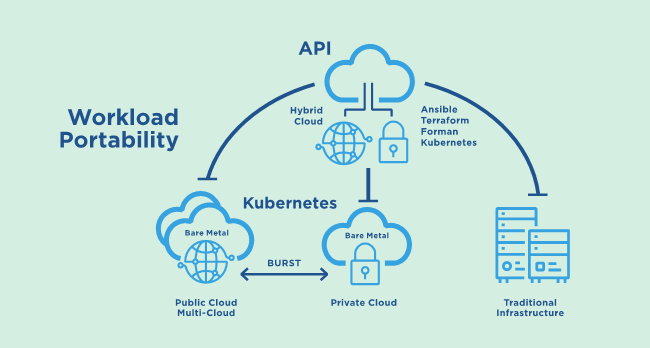
The image below depicts a portable workload infrastructure, which balances auto-scaling with the cost savings of better-utilized resources by sharing workloads across the infrastructure:
Within this architecture, if your business experiences periodic spikes in activity, bursting workloads to the public cloud during those times offers the best economics. When the workload is relatively consistent, a private cloud or a colocation data center will, most likely, reduce the long-term costs.
Native Cloud Technologies Reduce Portability
To demonstrate the importance of portability, consider the case of an IoT company that deploys thousands of thermostats, motion sensors, cameras, and microphones for customers who manage multi-building properties such as hotels, casinos, and college campuses. Knowing that services might need to scale quickly during busy periods for customers—such as a big event at a hotel or casino or the beginning of a college semester—the IoT company decided to develop its platform to manage and monitor the devices using technologies that were native to its hyperscale public cloud platform.
The platform-native approach seemed to make sense at first. After all, it was easy to quickly deploy applications in the cloud infrastructure, but one year later, the hyperscale environment was needed only 20% of the time. During the remaining 80%, the IoT company was essentially paying an elasticity tax on compute resources that were dormant during low workload time periods. Plus, the cost to host the environment increased rapidly as the infrastructure began to accumulate large data sets.
This is a case in which, once the initial workload stabilized, it would have made sense to move the base infrastructure into a virtual private cloud where the compute costs are lower. The IoT company could also set up on-ramp interconnects to a hyperscale cloud platform to expand compute capacity cost-efficiently when the workload spikes occur. However, this approach is predicated upon developing an initial environment utilizing application container management tools, such as Kubernetes, and provisioning tools, such as Ansible and Terraform, which are open source and can function in any cloud, on-premises, or colocation data center.
In this case, the IoT company relied on technologies that were native to the cloud platform provider. Porting such an environment to another cloud provider or a colocation or on-premises data center would be costly. If the company had avoided the native approach, they would have had the flexibility to easily port their applications to any cloud environment and leverage a hybrid approach that allows them to migrate workloads according to user demand.
Upfront Sacrifice Generates Long-Term Savings
The cloud is a great place to give birth to an application. It’s the fastest way to make the application available to end-users, and if the workload demand explodes, you can easily scale compute resources to ensure positive user experiences.
However, as the application workload begins to mature by stabilizing and accumulating large data sets and transactions, the costs of the cloud can quickly escalate. That’s when it often makes sense to move a portion of the infrastructure to a colocation data center or private cloud environment.
The key is to design for that portability now. As you evaluate IT infrastructure partners, assure they have these now or within their product roadmap:
Industry-standard APIs using open source technologies for mobility among environments in the cloud, on-premises, and in colocation data centers
Containerization so that your virtualized infrastructure shares the same operating system
Cloud on-ramps to facilitate your application’s portability
Security to protect your data as it moves to and from the cloud
By avoiding the temptation to develop applications with technologies that are native to a particular cloud platform you might sacrifice the ease of deployment upfront, but you can generate long-term cost savings for your company while giving your business the flexibility it needs—now and in the future.
About the Author: Rob Lerner is a 22-year industry veteran who has held leadership positions in solutions engineering and sales, always holding a customer-first mentality.
Aligning your workloads to the right infrastructure environments gives you the ability to balance application performance, scalability, control and costs. But oftentimes, CIOs and other IT leaders feel the pressure to move all workloads to the public cloud, thinking it will deliver these attributes. More often than not, the ideal approach is a hybrid infrastructure that spans not only the public cloud, but also private cloud, on-premises, and colocation data centers.
The key is to determine the right hybrid mix for each application workload, which starts with asking the right questions. It also helps to put your situation into context—by considering scenario use-cases encountered by other businesses that have taken on the same challenge.
Here’s a rundown of several situations that outline primary alignment issues and the approach to address those concerns:
Consistent Workloads—If your application workload requires roughly the same compute resource capacity every day, then the cost to run it in the public cloud vs. a data center will be significantly more expensive. You may also run into issues if you expect consistent performance from servers in the cloud. Conversely, dedicated servers in an on-premises or colocation data center that you control will deliver more predictable performance. A related scenario involves static workloads, such as databases and back-office systems, that run all day long. From a cost standpoint, they are best served in a colocation data center. Compared to the public cloud, it’s less expensive to buy and deploy gear in a colocation rack, let it run for three to five years, and then replace it with new technology.
Noisy Neighbors—When sharing servers in the public cloud, the performance of virtual machines can change drastically, depending on whether you have co-tenant “noisy neighbors” that use up extra network bandwidth and storage I/O, or memory and CPU resources on the same server. This means the resources you have access to will decrease. It’s also difficult to know in advance that such resources are not available until your users (or your customers) try to access the servers. Performance could suddenly decrease by 50% or more.
High Throughput Requirements—The big public cloud providers charge high fees to push bandwidth out to the Internet. In some cases, they charge you when transferring data from one of their data centers to another. So if your application requires high throughput at a consistent and predictable level, an on-premises or colocation data center is your least-expensive option. You might also consider a Content Delivery Network provider, which focuses on throughput delivery and costs much less than a public cloud platform.
Application Scalability vs. Resource Efficiency—If scalability is the primary driver for your workloads, you may head down a path of applications that run inefficiently. That’s because developers tend to write code for cloud applications as though there will always be unlimited compute resources. They sometimes build inefficient software that automatically scales the workload demand without considering the required resources. If the application is used heavily, the resources will continue to scale, and costs will spin out of control. As an alternative, if the application is built under the premise of eventually moving to a data center, the compute resources can scale…but only if IT makes the conscious decision to buy and deploy another server. This approach forces developers to build applications to run more efficiently so they consume only available compute resources.
Development Costs—When developing an application, a colocation data center can be expensive. The compute resources might cost $500K to stand up the infrastructure and then develop and test the application. It’s less expensive to rent the workload from a public cloud provider where development and testing environments can connect more easily, and there’s someone in the middle to orchestrate the development lifecycle.
Security and Compliance—Mission-critical systems and sensitive data are not always appropriate to run in the public cloud. At the same time, from a cost standpoint, a company may not want to build a data center where it needs to own the gear and provide resources to manage the data center. The best alternative is a private cloud managed by a partner with expertise across the entire technology stack—including the operating system, disaster recovery, security, and compliance. For developing the software that runs in a private cloud, be sure to connect to a public cloud that can seamlessly upload updates to the private cloud.
Misconfigured Environment—If one of your applications does not perform at expected levels, it’s critical to diagnose the cause before you migrate to a new environment and add compute resources, which will increase costs dramatically. You may discover you do not need a new environment but rather a reconfiguration of your environment. Sometimes, companies using a public cloud provider keep adding CPUs and memory because their application is not working. After the compute costs skyrocket, they take a step back and realize the infrastructure was not configured properly. If the issue is load balancing, for example, this can be remedied with properly managed services.
Cost Optimization vs. Peace-of-Mind—If your application is subject to unexpected and sudden spikes in activity, worrying whether your servers will crash can keep you up at night. This is especially true if the application is used by customers to purchase products and services. In cases like these, where cost is a secondary consideration, the public cloud or a private cloud are usually the best options. Access to additional compute resources is virtually unlimited, and infrastructures can be designed to scale and balance workloads automatically.
The Benefits of the Hybrid Approach
Using the public cloud as your only infrastructure environment may simplify your infrastructure operations. But it also decreases your control, and while it may generate cost savings, it could also actually increase costs.
As the use-cases above illustrate, a hybrid infrastructure approach is often best for creating the optimal environment for your application workloads. Hybrid environments that include private cloud and colocation infrastructures give you the convenience of auto-scaling and the cost savings of better-utilized resources by sharing different workloads on the same infrastructure.
Private clouds and colocation data centers also give you the ability to cost-optimize for consistent performance by avoiding “noisy neighbors” entirely. And if your workload is relatively consistent, you will reduce your long-term infrastructure costs.
If you run applications in the public cloud and find it too expensive, unreliable, or unable to scale the way you expect, you don’t necessarily need to move out of the cloud completely. By working with an infrastructure partner to analyze your application scenario and its implications, you may discover you need a mix of infrastructure options that can include a private cloud, a colocation data center, or an on-premises data center.
This approach, referred to as hybrid IT, is gaining in popularity. A survey of enterprises by the Everest Group found 72 percent of respondents described their cloud strategy as hybrid-first or private-first. That same survey revealed 58 percent of enterprise workloads are currently running in, or expected to soon be in, a hybrid or private environment.
Linked Environments Increase Your Agility
When determining the best way to align your IT workloads to infrastructures in a way that ensures application performance while controlling costs, the answer is almost always a hybrid environment. Rarely does it make sense to run all applications on one infrastructure.
Different applications and even application components are usually best served by splitting them across public clouds, private clouds, colocation data centers, and on-premises data centers. And to bring end-users as close to the edge of your network as possible, you may also need to deploy workloads across multiple data centers or even a modular data center pod.
Another key is linking all environments together. This gives you the agility to move workloads back and forth among environments as requirements change.
Key Infrastructure Partner Attributes
Your infrastructure partner should be able to advise you on the ideal hybrid infrastructure for your workloads. An infrastructure partner offering hybrid cloud options provides the flexibility to adapt as business requirements evolve. They should also offer a range of IT environments to complement any public cloud deployments you might already have deployed. Here’s a rundown of the key services to gain access to:
Colocation data centers covering the entire geographic area of your customer base
Multi-tenant and private cloud environments for the flexibility to adjust to security requirements
On-ramp interconnects to public cloud platforms to accelerate file and data exchanges
Edge modular data centers to reduce application latency for clustered and rural users
The range of services your infrastructure partner provides is also an important consideration. This includes helping you plan and migrate applications from one environment to another. Your partner should also ensure a strong security posture for your environment, compliance with any pertinent regulations and corporate policies, 24×7 monitoring, and server maintenance through regular updates and patches.
Consider the Logistics
While the technical components and expert services your infrastructure partner offers play an important role, relationship logistics are also key. You want to find a partner who is easy to work with. Try to avoid getting locked into any environments by insisting on portable infrastructure contracts that don’t charge you extra to move your workloads among private cloud and colocation data centers.
Another key logistic is visibility. Check to see if your partner provides a portal or dashboard access so you can see how your infrastructure is performing in all environments. This also helps you determine when your hybrid balance may need to be adjusted, or when it’s time to move a workload from one environment to another.
In the end, infrastructure agility is the key. What you need today could change drastically tomorrow as your business requirements change.
For more information on how to align your workloads to the appropriate IT infrastructures to ensure application performance and to control infrastructure costs, contact DataBank today.
DataBank, a leading provider of enterprise-class colocation, interconnection, and managed cloud services, broke ground on a 200,000 sq. ft. data center in Northern Virginia, the world’s largest data center market. The groundbreaking event on December 1, 2021 featured local dignitaries including Buddy Rizer, executive director of the Loudon County Department of Economic Development.
DataBank’s new facility, IAD3, will be built on the DataBank-owned land adjacent to its current site in Ashburn, VA. IAD3 will offer 4MW of power initially with the ability to deliver up to 40MW of power. The facility will be ready for service in Q1 2023.
An area rich in fiber connectivity and tech talent, Northern Virginia has a high concentration of enterprises, technology, cloud computing, hyperscale cloud providers, and content providers that require dense interconnection and proximity to best-in-class data center infrastructure.
“We are investing extensively across our portfolio nationwide, and IAD3 represents a tremendous opportunity for our clients to take advantage of Ashburn’s location and proximity to 70% of the world’s Internet traffic. This Ashburn data center more than doubles our colocation footprint in Louden County, providing a high-quality colocation solution for cloud, content, technology and Fortune 500 customers,” said Raul Martynek, CEO of DataBank.
DataBank’s facility will incorporate the latest modular design and energy-efficient technologies available today and demonstrates DataBank’s commitment to building environmentally sustainable data center solutions.
More than 70 percent of the world’s internet traffic routes through Northern Virginia’s “Data Center Alley.” As the velocity and volume of data are rapidly increasing, Web-Scale IT organizations must have access to low latency connectivity coupled with high capacity infrastructure designed to meet stringent compliance and security requirements. IAD3 will bolster DataBank’s significant presence in this region, including its two existing facilities in Ashburn and McClean with a total of 22.5 MW of power across 111,000 sq. ft. of raised floor data center space.
DataBank’s facilities are compliant with FedRAMP, HIPAA, PCI-DSS, FISMA, SSAE-18, ITAR, NIST 800-53, Flips 140-2. The company offers the full spectrum of cloud services, including Hybrid, Public, Private, Managed, IaaS, PaaS, Storage as a Service. Its 60+ data centers across 29 markets are all carrier-neutral and collectively support 30,000+ interconnections, along with robust connectivity options such as Metro Transport, Nationwide MPLS, Managed Internet, and Cloud Direct Connect.
For more information on DataBank’s interconnection and data center ecosystem, please visit https://www.databank.com or call 800-840-7533.
Anxieties Keep IT Up at Night
A great application is like a top quarterback in the NFL. The performance stats will be off the charts—but only if there’s a solid supporting infrastructure, i.e., talented blockers on the offensive line.
Just like head coaches with top quarterbacks, IT teams with great applications often worry about performance, availability, and costs. These anxieties are often created by a misalignment between applications and their supporting infrastructures. Finding the right balance to keep costs under control while making sure applications meet end-user needs often proves elusive.
The First Step to Align Applications and Infrastructures
If you’re feeling overwhelmed by the number of application issues you need to address, you’re not alone. The first step in aligning your workloads to the right infrastructure is to examine your application. The right data center partner can help you work through the key questions so you can find the answers you need:
What is the role of the application workload in your business?
Is the workload mission-critical to business operations?
How mature is the application within the development lifecycle?
What challenges are faced by your application—cost, performance, scalability, security, compliance?
What are the disaster recovery requirements?
Does the application integrate with other applications running in different infrastructures?
Is the application portable to another infrastructure environment
Who manages and maintains the application?
If you already considered these questions and are leaning toward a particular environment, be sure to examine and validate your reasons. The benefits that a particular environment delivers today may not hold up over the long term.
For example, if you already operate your infrastructure on a public cloud platform and use an auto-scaling service like Kubernetes, consider your peak requirements for CPU, RAM, and storage IOPS. You can then check with a private cloud provider to see what they charge to handle those requirements. If you use steady-configured resources, a colocation data center provider can advise which resources would function cost-effectively in a private cloud or on dedicated bare-metal servers.
Prioritizing Cost vs. Performance Factors
By answering the key application questions, you can assess the priority of cost control vs. the ability to quickly scale up and down as spikes in activity occur and then dissipate. You can also evaluate the balance of the cost against user-response times and the amount of downtime you can afford.
The maturity of your application is another factor. Early in the lifecycle, when first building an application, IT determines the infrastructure costs to support the minimum viable product of the application. If the application is built in the cloud, the cost will be low at first because there isn’t any demand for the application, and it requires a small amount of compute resources.
Then, when the application matures and the demand rises, you can model the costs over a longer time period. This gives you a better idea of which components belong in a data center and which components belong in the cloud.
Also Consider Your Infrastructure Management Capabilities
In addition to asking questions about your application, consider how you manage your infrastructure environments. Do you have internal resources to handle the task? Are you already working with a managed service partner, or are you looking for a new partner?
The infrastructures you select for your application may be influenced by who has access to manage the environments and if they can do so effectively. Sometimes you have the flexibility to manage an environment yourself; in other cases, you are limited to working with the hosting provider, whether it’s a public cloud, private cloud, or colocation data center. Finding a partner that gives you multiple options enables you to more easily create a hybrid IT environment, which is usually the best option.
For additional information on aligning applications to the right infrastructure, check out our white paper, How to Align Your Applications to the Optimal Infrastructure Environments. By adjusting your paradigm and asking the right questions, who knows? You just might give your quarterback…that is, your application…the supporting infrastructure it needs for off-the-charts performance.
To capitalize on 5G technologies and deliver low-latency experiences for customers, software-as-a-service and content providers need the ability to provision services from the edge as close as possible to their customers.
Raul Martynek, CEO at DataBank, continues to refine the definition of edge computing. This is the third of a three-part series looking at the edge from the multiple perspectives of enterprises that use and drive edge development: hyperscalers, network providers, SaaS firms, and content providers. In this article, we examine how SaaS and content providers can leverage the low-latency edge to fully capitalize on the capabilities of 5G networks.
Get Close to the Edge to Capitalize on 5G
As the World Economic Forum and PwC emphasized in a jointly-published white paper, 5G enables unprecedented levels of connectivity. This includes superfast broadband, ultra-reliable low-latency applications, massive machine-type communications, high reliability, high availability, and efficient energy usage. Together, these defining features will transform many sectors, such as manufacturing, transportation, public services, gaming, healthcare, and financial services.
With these capabilities, 5G also promises to greatly expand the data processing functionality and interactive capabilities that software-as-a-service (SaaS) and content providers can deliver to their customers. A key factor in enabling this transformation is the ability to provision services as close to the edge as possible when necessary.
Workload demands will spike as dense customer clusters try to access applications and content. Just think of how many Apple TV subscribers wanted to watch Ted Lasso every Friday as new episodes became available!
Edge Compute and Storage Resources Reduce Latency
With 5G bringing low latency and greater bandwidth to wireless customers, the technology is also paving the way for greater consumption of SaaS and content services in markets with sub-par internet service. Many people may actually move away from high-population areas, simply because 5G networks will support their bandwidth needs.
SaaS and content providers should thus prepare to serve the needs of customers moving to rural areas. But even where 5G is available, user experiences could degrade if services are not provisioned close enough to the edge. By adding customer-facing compute and storage resources to colocation and modular data centers operating at the edge, SaaS and content providers can improve customer experiences through improved application performance.
Rounding Out the Edge Perspectives
Our first article in this Voices of the Industry series covered the perspective of hyperscale cloud providers. We discussed how the definition of edge computing is expanding to include localized hyperscale data centers. This change comes as the IT industry once again turns toward decentralization to deliver applications as close as possible to end-users.
In our second article, the edge from the perspective of network providers, we discussed how network service providers want to move away from traditional, centralized compute infrastructures. Instead, they are embracing a more specialized, decentralized model.
As we now examine the edge from the perspective of SaaS and content providers—including those that deliver gaming, entertainment, and augmented reality services—we can see that they are looking for some of the same attributes as the hyperscale cloud providers. SaaS firms and content providers also want a wide footprint in Tier 1 and Tier 2 metros to get near where most of the US population lives. And like the carrier network provides, SaaS firms and content providers also value secondary colocation data centers in carrier hotels as well as private cloud options that offer on-ramp connections to public clouds.
Provisioning Services As Close As Possible to Customers
To fully capitalize on the benefits of 5G technologies that reduce latency and offer advanced caching capabilities, SaaS and content providers are mostly focused on the edge that puts their workloads even closer to their audiences. This requires highly geo-specific infrastructures such as modular data centers that can be placed anywhere—on the roof of high-rise buildings, at the base of cell towers, and within cable headend facilities.
Given the propensity of customer clusters to suddenly expand and contract, SaaS and content providers also need the flexibility to move workloads across secure and compliant hybrid environments that feature containerized infrastructures. No one knows exactly where future customer demand will come from, and the public cloud isn’t always going to be the answer.
A hybrid environment addresses this challenge by providing access to a mix of colocation, modular, and on-premises data centers as well as private and public cloud infrastructures. Such an infrastructure environment also facilitates managing and moving workloads to the ideal environment as they evolve across the application lifecycle—from development to testing, staging, and production.
Key Hybrid Infrastructure Attributes
For SaaS firms and content providers looking to deploy their applications within a hybrid infrastructure to get close to the edge and take advantage of 5G networks, it’s best to collaborate with an infrastructure partner offering a range of IT environments that complement public cloud deployments:
Colocation data centers covering the entire geographic area of the customer base
Multi-tenant and private cloud environments to adjust for security requirements
On-ramp public cloud interconnects to accelerate file and data exchanges
Modular data centers to reduce application latency for clustered and rural users
Portability across environments is another vital attribute. In some cases, public cloud vendors entice customers to code applications to sync with the provider’s proprietary platform. This means the application can’t be migrated to another environment without extensive recoding.
The maturity of an application is also a factor. When first building applications, IT allocates the infrastructure costs to support the minimum viable product. If the application is built in the cloud, the cost will be low at first because there isn’t any demand for the application. When the application matures and the demand rises, the company can then model the costs over a long time period to get a better idea of which components belong in a data center and which components belong in the cloud.
Bringing Applications and Content to Customer Doorsteps
5G along with edge infrastructures that provision applications close to customers will have a major impact on the services SaaS and content firms can deliver. This is critical because customers will demand faster and faster responses and expect more and more interactivity from their applications. The combination of 5G and edge solves this challenge by unlocking new capabilities for applications like augmented reality as well as faster data crunching and greater workflow-processing capacity.
Gone are the days when networks could send customers all the way to data centers on the other coast and then back again to their home office. 5G and low-latency edge networks virtually put applications and content right on customer doorsteps. And that opens the door to much greater customer experiences.
This article was written by Raul Martynek, CEO, DataBank. Mr. Martynek joined DataBank in June of 2017 as the CEO and is a 20+ year veteran in the telecom and Internet infrastructure sector, having held senior positions at several communications and networking companies, as well as asset management firms. Raul earned a BA in Political Science from Binghamton University and received a master’s degree in International Affairs from Columbia University.
The Scottish philosopher Thomas Reid once said, “A chain is only as strong as its weakest link.” So too is your ecosystem of vendors.
Every company faces many IT risks and challenges when sharing digital assets and integrating systems with third parties. If vendors let their guard down when exchanging data with your IT systems or providing software and hardware devices, cybercriminals could very well find their way into your IT infrastructure. The hackers can breach one of your vendor’s digital assets first, traverse their connection to your organization, and then hide in your network.
A good example of supply chain risk is SolarWinds, which provided an IT security tool called Orion used by 33,000 customers, including the U.S. Government. In December 2020, Russian hackers compromised the Orion infrastructure, which resulted in numerous IT organizations and security service providers suddenly questioning the toolsets on which they were relying. This highlights the importance of understanding supply chain IT security.
Multiple Levels to Secure
The make-up of your IT supply chain will vary depending on your industry and your business model. In essence, the chain includes any vendor that provides you with data, an IT asset, or online services. This includes data exchanges and application interfaces as well as the hardware components in your servers, desktops, tablets, smartphones, and other devices.
They all present opportunities for cybercriminals to breach a system, which, in turn, may allow those with ill intent to attack one of your systems. It is, thus, critical to ensure every entity in your downward supply chain meets your security requirements.
Validating each of their security postures and their compliance with pertinent regulations is crucial; not all vendors have sufficient budget and resources to secure every IT asset properly. Each vendor also has its own set of downstream suppliers, representing your fourth-party and fifth-party supply chain. They can all potentially have weak links that threaten your IT infrastructure.
For example, a SaaS company engages a managed services or colocation data center provider (third party) to host enterprise applications provisioned to customers. The data center provider also relies on a vendor (fourth party) from which they buy server hardware to run the applications. That server vendor depends on another vendor (fifth party) to provide antivirus software. If there’s a security weakness at any point in this supply chain, it can threaten the infrastructure of every other company across the supply chain.
Validate Vendors Though Independent Auditors
As you work with your vendors to verify their security posture, be sure to carefully construct your SLAs so vendors know what you require for a security posture, how security should be maintained, and that you need to verify the posture on a recurring basis. Also, check if your vendors follow a security framework such as NIST, ISO, or CSA STAR (See acronym glossary below). If not, that’s a red flag their security capabilities will require close examination. Therefore, ensure they can prove compliance to one of these standards via a third-party audit and that you can gain access to that report.
Following a framework like NIST tells you a vendor has good cyber hygiene. Another burgeoning, robust framework is CMMC, which is also based on NIST standards. It’s a third-party risk management framework with which the federal government requires all Department of Defense (DoD) contractors to comply. Like NIST, CMMC can also be leveraged by the private sector.
To validate a vendor’s security posture, determine if an independent auditor has attested to the correct design and deployment of the controls. Going one step further, some organizations provide an extra layer of assurance by validating auditors.
For example, SSAE auditors are monitored by AICPA while A2LA verifies FedRAMP and CMMC auditors, also known as 3PAOs (third-party assessment organizations). Reports generated by either of these groups give you additional peace of mind—you know the auditor is an experienced professional who is not just rubber-stamping what they heard from the vendor.
Maintaining a Strong Link Within Our Customer Supply Chains
At DataBank, we base our security methodology on NIST 800-53. Following this framework, we apply 325 security controls across all our colocation and managed services data centers. Many of those controls also roll down to our supply chain partners, depending on the type of service or hardware they provide. The controls can include any of the eighteen NIST categories such as access control, physical and environmental security, security awareness and training, and the application of other specified security controls.
We validate our vendors by examining their SSAE auditor reports. We also make our SSAE and CSA STAR audit reports available to our customers, as well as proof of compliance with PCI-DSS and HIPAA. These audit reports make it easy for customers to evaluate our security posture within their supply chains.
Getting Supply Chain Ecosystems to Work Together
Third-party risk can be tricky because many parties want to blame someone else when risk is exposed. Eventually, supply chain partners need to realize they are part of a complex ecosystem that needs to get on the same page to protect each other.
Such teamwork is vital because we all face a constant cat-and-mouse game with cybercriminals, defending against the many known and unknown vulnerabilities that keep emerging. The good guys will keep battling the bad guys, and to keep up, we need to rely on frameworks and multiple tactics to ensure our downstream and upstream digital assets stay secure.
Glossary of Acronyms
Security/Compliance Organizations, Regulations, and Government Agencies
By: Mark Houpt, Chief Information Security Officer, DataBank
“Compliance audit.” These two words alone are often enough to trigger immediate feelings of panic in even the most experienced business or technology leader. In fact, compliance audits may rank higher than root canals or even extended visits from our in-laws on a list of things we all dread the most.
In some ways, the compliance audit’s bad reputation seems to be well deserved. (Fortunately, we have an answer to compliance challenges below, so keep reading.) After all, compliance can be a major effort, one that could lead to future issues. Managing data, records, workflows, and specific processes in order to comply with many different industry regulations can be extremely time-consuming, require specialized skills or headcount, or take valuable time away from already busy employees.
How Did We Get Here?
While there are many different types of compliance audits today—workplace safety, quality management, environmental issues, and more—cybersecurity is often the most challenging. This is true because so many different regulations—such as HIPAA, PCI DSS, Sarbanes-Oxley, and GDPR—all have rigorous standards related to data privacy.
Additionally, so many companies today are embracing new technologies as part of an overall digital transformation effort. While “going digital” clearly positions them to reap new benefits, it also may introduce new cybersecurity vulnerabilities. All of this can make operations much more difficult, both in terms of actually safeguarding sensitive data but also when it comes to compliance efforts and preparing for an audit.
To understand the scope of work required and to see how you can improve your response to audits, let’s take a closer look at them and what they entail.
What is a Compliance Audit?
A compliance audit is an independent review to determine if your company is meeting the specific requirements of a compliance standard or regulation. Each compliance audit is conducted by external auditors—not internal teams or employees. These auditors generally follow a specific checklist based on the audit guidelines of the standard or regulation being assessed.
While no one has ever accused compliance audits of being fun, they can help in a few different ways. First, they may provide new insights that identify existing gaps that could subject your company to additional risk. They may also reveal new opportunities for improvement, such as the need for new processes or additional cybersecurity training. Most important: they can help your company avoid potential severe penalties and other negative consequences related to non-compliance.
Data Center Providers Can Make All the Difference
If all of this sounds ominous, we do have some good news. Selecting the right data center partner can actually give you a real advantage when it comes to compliance and compliance audits. For example, DataBank helps our customers improve cybersecurity and simplify compliance efforts in a number of important ways:
Secure, compliant infrastructure: All DataBank infrastructure is secure and fully compliant with the security requirements of industry regulations: FedRAMP / FISMA, HIPAA, PCI-DSS, SSAE-18, GDPR – Privacy Shield, ITAR, NIST, and StateRAMP. This compliance standing is passed to you as a DataBank customer. Not only do you gain a compliant hosting environment, but any systems, applications, and workloads located in our data centers are compliant, too.
Compliant services: In addition to infrastructure security, we also provide a wide range of compliance-related services such as ongoing monitoring, back-ups, and disaster recovery. DataBank also operates as a managed security service provider (MSSP) for a significant percentage of our customers. We use intrusion detection systems (IDS), intrusion prevention systems (IPS), and other specialized cybersecurity platforms. In this scenario, DataBank customers benefit from economies of scale—instead of having to purchase these expensive systems themselves, they can take advantage of our investment and let us use these tools on their behalf.
Compliance reporting: Too often, a looming audit requires employees to drop everything and attempt to find the right information they need as evidence of compliance. Unfortunately, this generally takes too much time, pulls employees away from other important work, and could even lead to damaging errors. To solve this challenge, DataBank provides a portal with access to many different types of compliance reports. Not only does this reduce the amount of time required for busy employees to attempt to produce these reports, such a wide variety also helps deliver the exact evidence auditors need to make the process go smoothly.
Compliance expertise: Finally, if an auditor has follow-up questions or seeks details that your team can’t answer, DataBank’s CISO, Mark Houpt, and dedicated security team can engage further to provide backup information, additional knowledge, and best practices to further streamline the entire process.
Cybersecurity Compliance Help from an Unexpected Source
If you’re wrestling with compliance—especially cybersecurity—while also considering new options for colocation, you may be pleasantly surprised to learn just how much data center providers can provide. In many cases, you can gain a security approach that exceeds your own capabilities and a critical advantage when it comes to potential cybersecurity audits.
Interested in learning more about DataBank’s commitment to cybersecurity and compliance? Contact us today for more information.
Salt Lake City is quickly becoming a go-to data center destination, especially for companies looking for an alternative to expensive data centers in Los Angeles, San Jose, and San Francisco. Utah offers a business-friendly climate, a highly educated workforce, low-cost and renewable energy sources, and plentiful fiber. Plus, Utah boasts some of the highest Internet speeds in the Intermountain West and among the highest in the nation.
Recently praised by Forbes as the “Best State for Business,” Utah is an ideal location for protecting valuable IT assets. Additionally, employment and construction/expansion in Utah’s technology sector has skyrocketed in the last decade and has more than doubled the national average during this time.
Why consider the Salt Lake City metro? Your first instinct—its world-class mountains and ski conditions—may not be too far off the mark since many “Silicon Slopes” innovators already flock to this area. Salt Lake City’s brand-new airport is an official Delta hub and also provides many options for easy flights from all over the country.
Tax advantages Recent changes to Utah’s tax code provide new tax exemptions—tax savings of 7.25%—for customers in the majority of DataBank’s facilities. These changes now give qualified data center owners, operators, and clients an exemption from sales tax on purchases of data center equipment (with an economic life of at least one year) as long as it is used in their operations within the data center.
The data center needs to be new or constructed after July 2016, which means that these tax exemptions already apply to DataBank’s SLC3, SLC4, and SLC5 facilities as well as our soon-to-be-completed SLC6 data center.
Geographic benefits
Its location provides easy accessibility to the growing Mountain community as well as the West Coast, which makes it an ideal location as a safe disaster recovery location for west coast IT infrastructure.
Salt Lake City could be ideal because it’s located on less earthquake prone ground and utilizes a different power grid from southern California. High elevation and dry desert geography allow the efficient cooling of these data centers, and the state’s extremely low occurrences of natural and man-made disasters make it one of the safest data center locations in the United States. All this makes Salt Lake City an ideal backup location for those cities in California that are more prone to earthquakes and wildfires.
Databank’s Salt Lake City data centers
DataBank currently offers five strategically located data centers in the area — including the DataBank downtown SLC1 Carrier Hotel and the Granite Point campus in Bluffdale – and has broken ground on the sixth.
In Bluffdale, UT, between Salt Lake City and Utah’s world-famous ski mountains, DataBank’s Granite Point Campus is an engine of digital growth. Our 23-acre campus includes a 66MW substation guaranteeing lower utility costs and scalability needed for the most ambitious enterprises and hyper-scale cloud ventures.
Offering a range of colocation, cloud, connectivity, and managed services, DataBank’s Salt Lake City data centers offer the ideal place to grow and control your destiny.
DataBank’s Salt Lake City Metro by the Numbers 6 Different Data Centers 67.5
Total Megawatts 23+
Total Carriers 230,000+
Total Square Feet (with more to come!)
DataBank’s Salt Lake City Metro Data Centers
SLC1: Downtown Salt Lake City
179 E Social Hall Ave, Salt Lake City
11,000 square feet, 1 MW of on-site power Explore this data center
SLC2: Granite Point Campus
14944 Pony Express Road, Bluffdale, UT
45,000 square feet, 10 MW of on-site power Explore this data center
SLC3: Granite Point Campus
14926 Pony Express Road, Bluffdale, UT
53,000 square feet, 10 MW of on-site power Explore this data center
SLC4: Granite Point Campus
14860 Pony Express Road, Bluffdale, UT
34,000 square feet, 9 MW of on-site power Explore this data center
SLC5: Granite Point Campus
14870 Pony Express Road, Bluffdale, UT
90,000 square feet, 20 MW of on-site power Explore this data center
Future site: SLC6: Granite Point Campus
Still in development, SLC 6 will bring even greater capacity to the robust Granite Point Campus.
Meet the Seattle DataBank team on September 16 at the SEA2 Open House, in Tukwila, WA, 11am – 2pm PST for networking, food and fun. As a major tech hub, the Seattle area is home to tech giants such as Microsoft, Amazon, and many other enterprise headquarters – making this also a major hot spot for growth. DataBank is excited to be a part of this vibrant tech ecosystem.
During the event, guests can meet DataBank’s team of specialists and tour the SEA2 data center while connecting with other Seattle IT professionals. Plus, you can enter to win awesome giveaways.
Features of the SEA2 Data Center:
– 2MW of on-site power
– 2N power design
– N+1 cooling for the ultimate in always-on availability
– 12,400 sq. ft.
– Tier III facility
– SSAE18, SOC1 & SOC2, SOC3, HIPAA, and PCI-DSS compliant
DataBank Data Centers in the Emerald City
DataBank clients have two data centers in the emerald city to choose from for their Pacific Northwest colocation needs.
DataBank’s downtown Seattle data center, SEA1, uses heat from the building’s cooling system to heat the Amazon headquarters building. The SeaTac data center, SEA2, in Tukwila provides a loading dock, package service, on-site parking, break room, conference rooms, and office space.
Come #SEA2 for yourself. RSVP to the Open House, 3311 South 120th Place, Tukwila, WA.