Initiatives in Minneapolis, Indianapolis, Atlanta, and Elsewhere Highlight DataBank’s Unique Approach to Environmental Responsibility
Data centers consume tremendous amounts of electricity to power their servers, storage equipment, back-ups, and power cooling infrastructure. Last year alone, U.S. based data centers used more than 90 billion kilowatt-hours of electricity, representing three percent of total U.S. electricity consumption. And that usage is growing. According to a recent AFCOM State of the Data Center survey, 70 percent of data center providers indicated that the power density per rack has increased significantly since 2013.
Within C-suites and among customers, there is a growing concern that the power demands of our digital infrastructure are having a major environmental impact, and it’s forcing data center managers and operators to find new ways to minimize that impact.
As an operator of 20 data centers across the U.S., DataBank is keenly aware of its environmental impact. Both our Data Center Evolved™ motto, and our corporate purpose – “To take the worry out of managing IT infrastructure” – have led us to continuously adapt our facilities and operations, finding ways to enhance our environmental responsibility while maintaining the highest levels of performance, reliability, and uptime.
Here are just a few examples of how DataBank has become a more responsible steward of our environmental impact.
Renewable Power Sources
DataBank’s Indianapolis data centers were the first to be 100% powered by renewable sources. Both IND1 and IND2 moved 100 percent of their combined electricity usage into a voluntary program that directs Indianapolis Power and Light to purchase renewable energy from wind farms and other midwestern facilities. Through that program, DataBank will offset the carbon dioxide emissions equivalent to 3,321 passenger cars driven for one year, or 84 railroad cars of coal burned. Participants in the Indianapolis program help support the development of additional renewable energy sources, thereby helping to reduce reliance on fossil-fueled power.
In addition, DataBank recently announced that its MSP2 data center in Minneapolis is now 100% powered by renewable wind sources as part of the Wellspring program offered by Dakota Electric. Through the program, DataBank will purchase enough wind-generated power to cover all of MSPs 6MW power requirements for the next 5 years.
Economizer Cooling Strategies
Thousands of servers in a data center can generate tremendous heat which needs to be removed in order to keep sensitive electronic systems running. Massive air conditioning systems are the primary mechanism but they consume significant power. In colder climates and cooler seasons, the use of naturally cold external air helps reduce reliance on air conditioning compressor units and reduces power consumption, a methodology called “economization”.
DataBank operates economizer systems at data centers in DFW, MSP, ATL and SLC. Precision sensors measure the outside air temperature and humidity, and if conditions are appropriate, they open air dampeners to allow outside air in to cool the facility. The system closes those air dampeners when the conditions require a return to mechanical cooling. Much like opening a window at your house on a nice day, but fully autonomous with a sophisticated sensing and control sequence that maintains strict temperature and humidity parameters.
Environmentally Friendly Refrigerants
Air conditioning systems require refrigerant chemicals that can have a negative impact on our atmosphere – both by depleting ozone and contributing to global warming. A refrigerant’s global warming potential is referred to by its Global Warming Potential or “GWP” which compares one unit of that chemical’s contribution to global warming relative to CO2. Historically, a refrigerant called R22 has been the most commonly used chemical in air conditioning systems and had both a high GWP as well as a destructive impact on Ozone.
At DataBank, we have switched the vast majority of mechanical cooling systems over to R410a refrigerant which is the most efficient and environmental-friendly coolant available and we are exploring the use of another chemical called R32. Both R32 and R410a have largely replaced R22 due to their lack of Ozone impact and lower GWP.
DataBank’s ATL1 hosts the Georgia Tech “liquid cooled” supercomputer, which offers high performance computing to the institution’s faculty, professors, research scientists, graduate students, and its academic and government affiliates. A water-cooled door chilling system in ATL1 affords DataBank the ability to scale up to 100kW per cabinet without having to take up additional space for cooling. And in a singular twist, the heat and waste energy from the supercomputer is transferred to the chilled water, which then reaches 90 degrees and is then supplied to the building’s boilers for use by the other tenants.
Greener Backup Systems
Backup power systems are a critical component of any data center operation, keeping mission-critical applications running when there is an interruption to utility-provided power. These backup systems need to be reliable, scalable, efficient and use as little space as possible. Advanced, three phase UPS battery systems provide the most popular option providing smart, dependable power in a compact format. However, their use of lead acid chemicals isn’t environmentally friendly and they need to be replaced periodically.
To minimize this impact, DataBank has turned to an innovative combination of UPS batteries with flywheels. A flywheel system stores energy mechanically in the form of kinetic energy by spinning a mass at high speed. When used in conjunction with a battery-based UPS system, the flywheel systems take the first “hit” during a power disturbance, preserving the battery for use in longer-term outages and minimizing discharge cycles to prolong overall battery life.
Onsite Power Generation
Relying exclusively on utility power means a data center’s power costs will rise as overall demand rises. Being able to offset that cost at peak times with onsite power generation is a way to reduce costs and improve efficiency. DataBank has done just that at its ATL1 data center in Atlanta.
In partnership with the local utility, Georgia Power, DataBank has deployed a 1.5MW “microgrid” to support Georgia Tech’s High Performance Computing Center (HPCC) which is housed in ATL1. The microgrid runs in parallel to Georgia Power’s grid as an additional power source for ATL1. It senses power consumption and can export power to the facility in an emergency or simply at peak times to save costs.
The installation includes fuel cells, battery storage, diesel generators, and a natural gas generator, but is adaptive to new and additional distributed energy resources. It will also be able to accommodate microturbines, solar panels, and electric vehicle chargers in the future.
These are just a few of the ways DataBank is adapting and evolving the data center experience to provide better service for our customers and a better result for our environment.
On July 14, 2020, Microsoft published a security update guide for a Windows vulnerability in Microsoft Domain Name System (DNS) Server. Domain Name Servers are the “yellow pages” of the Internet that translate IP addresses into plain language names and vice-versa. This vulnerability has been designated Common Vulnerabilities and Exposures (CVE) number CVE-2020-1350.
The CVE-2020-1350 describes this vulnerability as one where Windows DNS servers can fail to properly handle translation requests in such a way that could be exploited.
In summary, an attacker could send a malicious request to the vulnerable Windows DNS server and then execute commands or run scripts and programs on that server with security privileges similar to the local Administrator account.
How bad is this vulnerability?
Given what is publicly known about this vulnerability and what has been learned from analysis, this vulnerability has been given a Common Vulnerability Scoring System (CVSS) base score of 10.0, which indicates this vulnerability is critical (10.0 is the highest level of criticality a vulnerability can be scored as). Also, as of July 20, 2020, a proof of concept denial of service (DoS) exploit that takes advantage of this vulnerability has been released.
The US government Cybersecurity & Infrastructure Security Agency (CISA) has also issued Emergency Directive 20-03 regarding this vulnerability. CISA “strongly recommends state and local governments, the private sector, and others patch this critical vulnerability as soon as possible.”
Are my systems at risk?
This vulnerability affects all versions of Windows Server with the DNS role enabled (NOTE: this includes all Windows Domain Controllers (DCs) as the DNS role is required in order to be a DC). This vulnerability is now widely known, and Microsoft considers this vulnerability likely to be exploited.
If you have domain controllers or regular Windows servers that are running DNS, then you are likely at risk without the proper patching. Your risk may be mitigated by other controls such as firewall rules, IPS systems, or other security controls.
What action can I take? What is recommended?
According to Microsoft, there are two ways of mitigating this vulnerability:
1. Workaround: Make a small registry modification
2. Patch: Install the available Windows Update patch for your version of Windows Server
There is some amount of inherent risk in modifying the Windows registry, however, this workaround has the benefit of only requiring a restart of the DNS services on the server to take effect. The Windows Update patch is the simpler and less risky option but will require a server reboot for the patch to take effect.
If you are a DataBank Managed Services customer, DataBank has patched your systems on the weekend of July 17-20.
If you are not a DataBank Managed Services customer, we highly recommend that you evaluate this patch and your risk immediately.
Microsoft has released update patches to remediate this vulnerability for all Windows Server versions from Windows Server 2008 SP2 through Windows Server 2019 (as well as Windows Server, versions 1903, 1909, and 2004). Those patches should distribute to Windows Servers running Windows Update; however, it is strongly recommended to validate this and ensure your Windows Servers have the patch installed.
While it is recommended that Windows Servers with the DNS role enabled be the first Windows servers in your environment to get either the workaround or the patch, all Windows Servers should get patched because of the possibility that the DNS role could get enabled on other servers at some point in the future.
See here for details on the workaround and a listing of Windows Update patches available for each version of Windows Server.
Last year, the data center industry witnessed a significant uptick of attacks against service providers. On an average day, for example, DataBank detected and blocked more than 20 million attacks against customer infrastructure.
“This makes it imperative for customers to choose data centers that have the proper security controls in place, and certifications are the best to measure that,” said DataBank’s chief technology officer, Vlad Friedman, in a recently-published article in Data Center Frontier.
But not all certifications are created equal and some are more stringent than others. FedRAMP is the gold standard in security assessment, authorization, and monitoring data for service providers. Derived from close collaboration among various governmental agencies, including the General Services Administration (GSA), the Department of Homeland Security (DHS) and Department of Defense (DoD) and other commercial industry organizations, FedRAMP was initially intended to provide a prescriptive framework of best practices to help secure our nation’s critical digital infrastructure.
While the use of a FedRAMP certified provider is only required for various government agencies and those doing business with them, there are significant benefits for any organization using a FedRAMP-certified partner including:
Simplified auditing
Greater data security
Differentiated marketing messages
Faster time to market
In the article, DataBank’s CTO, Vlad Friedman, tackles the nuts and bolts of IT infrastructure certifications, from SSAE 18 to PCI DSS and finally to NIST 800-53 and FedRAMP. He documents the best practices and reporting required to meet the most stringent of these certifications. And he explains how the advance work done by service providers to meet these requirements makes those benefits possible for any customer.
DFW3, home of our flagship Dallas area data center, has opened Data Hall 2 and expedited the development of Data hall 3 to meet growing customer demand.
DFW3 is designed to accommodate a total of 6 Data Halls delivering 72,000 sq. ft of usable space and up to 40MW of total power from diverse utility feeds. Each data hall provides 12,000 sq. ft of secure raised floor and is capable of delivering 1.5MW of power. With generators and UPS already in place, DataBank will be able to expedite the opening of data hall 3 in Q4 2020, joining the capacity already in place with data halls 1 and 2.
DFW3: Compliant, Connected and Secure
Certified by the Uptime Institute as a Tier III Designed and Constructed facility, DFW3 offers a game-changing option for companies in Plano, the fastest growing area of the Dallas/Fort Worth metroplex. The facility provides options for colocation cabinets, cages, and suites with anywhere up 25kW in an air-cooled environment, and up100kW per cabinet using water-chilled rear doors.
Located in the Legacy Park section of Plano, TX, DFW3 offers tremendous network availability,. neutrality and performance. The facility provides access to ten on-site carrier POPs and to the two other major Dallas metroplex carrier hotels. It is also connected to DataBank’s DFW1 and DFW2 facilities via a data center interconnection (DCI) network which enables active-active DRaaS solutions.
DFW3 also houses DataBank’s FedRAMP-certified cloud platform which means the entire facility meets FedRAMP/FISMA auditing standards and delivers consistently better quality and repeatable outcomes at scale. This benefits even for those customers who are not doing business with the Federal government, but nevertheless seek higher data protection, simplified compliance reporting, and more effective go-to-market timing and messaging.
Security measures at DFW3 include full perimeter fencing, round-the-clock on-site security personnel, and dual-factor authentication (card and biometric) on exterior entry and all data center entrances. In addition to FedRAMP/FISMA, the facility meets a variety of key industry compliance standards, including HIPAA HITECH, SOC 1 Type II, SOC 2 Type II, SSAE 18, and PCI DSS compliance designations.
To learn more about DFW3 visit the facility’s web page here or take a virtual tour today!
Brandon explains the relationship between ATL1 anchor tenant Georgia Tech and DataBank, a unique partnership that allows the university to employ massive compute power, using substantial amounts of energy while remaining eco-friendly. ATL1 uses underground aquifers to draw water to liquid cool the Georgia Tech supercomputer. That heated water is then dispersed to buildings in the area to heat the building or offset boiler costs. Another ‘green’,’ eco-friendly initiative is a microgrid at ATL1 which can provide backup power during an outage or provide additional power during peak usage.
As an added benefit, the collaboration is keeping the best Georgia Tech-educated talent in Atlanta and the surrounding region – as opposed to losing the area’s best and brightest to other parts of the country.
Episode Topics: How COVID-19 is impacting security, recent security questionnaires, and the Importance of continuous monitoring and vulnerability scanning. Featuring: Mark Houpt, Stephen Maiorca, and Tyler Treat
Listen to Mark Houpt and his team as they discuss some of the challenges our clients are facing during the COVID crisis and recommendations on how to address those challenges. Mark and his team will not only cover the tactical side of the equation, but the human side of the equation as well.
Mark and his team will also discuss some of the security challenges that small and medium-sized businesses are faced with as they move to sell their services online. In many cases, these retailers are soft targets for hackers because they lack experience in security, which increases their “attack surface.” In other cases, hackers are reverting to older methods of “application attacks” to exploit the low hanging fruit.
DataBank’s CISO Corner is for CISO’s and security practitioners, where we discuss a variety of cybersecurity topics and current events from the CISO’s perspective. Our broadcast is designed to be a short intake for busy professionals, and for those of you who want to hear from security and compliance experts on the front lines who deal with these issues every day.
Determining the Best Primary and Secondary Homes for Your Most Important IT assets
Your worst fear – disaster strikes and you need to put your disaster recovery (DR) plan into place immediately. Fortunately, with a few clicks, you fall back to your secondary site, and your business continues on with little to no disruption to your internal operations or customers. Meanwhile, you are able to drive to your secondary site and oversee the operations and maintenance of your IT infrastructure until your primary is restored. Mission-critical IT operations can be impacted by disasters that are both naturally occurring, such as pandemics, hurricanes, earthquakes, tornados, floods, or wildfires – as well as those that are man-made, including cyber attacks, terrorism or the inadvertent failure of infrastructure systems like power grids.
With so many scenarios, it is not a matter of “if, but rather “when”, a man-made or natural disaster will affect your critical infrastructure. Having a strong DR plan is crucial for any business – both large and small – and the most important components of that plan are the strategic geographic locations of your primary and secondary sites to minimize overall risk and, ultimately, IT infrastructure downtime in the event of a disaster.
Balancing the Risk Factors with Your Primary Site Selection
There are several considerations when determining an optimal primary data center to house your IT assets, with geographic location topping off the list as the most important. Not only consider the proximity to your engineering team and access to power and connectivity but conduct a risk assessment of what disasters are most likely to occur in your current location. Keep in mind that even if a facility is fully-fortified, you also need to take into account the impact that any potential evacuation orders may have on your operations.
Regional climate should also be considered – facilities located in hot and humid areas require a significant amount of cooling, which is not only costly but also introduces a level of risk when chillers, air conditioner units, and air handlers are running at full capacity all day. On the other end of the spectrum, temperatures that get too cold can lead to thermal shutdowns and high levels of humidity that can lead to water condensation, which leads to short circuits and potential for rust and corrosion.
There is arguably no “perfect” location for a primary data center because a completely risk-averse location may be thousands of miles away but have latency issues, while a facility conveniently down the street from your office may be in an area prone to hurricanes. Ultimately, it is important to assess all the “what if’s” and balance the risk factors to find the best primary site to fit your organization’s requirements.
Determining a Secondary Site: Far Enough to Be Safe & Close Enough to Be Fast
Your recovery site should be far enough from your primary that it doesn’t face the same risks in the case of a disaster. The optimal distance will vary depending on a risk assessment of your primary site and the nature of your application/data – those at high risk of natural disasters may require a considerable distance, while those with a lower risk of a natural disaster may seek out a site nearby on a different power grid or simply connected to an alternate carrier hotel in the market to minimize localized risk.
While creating distance is key, the location of your secondary should also be close enough that it meets your latency requirements and is within an easy travel distance in the event your team needs to be onsite to operate and maintain your systems.
When evaluating a secondary facility, consider these factors:
Does the site meet the network performance requirements of your production site?
Is there a 24×7 support team onsite?
What is the drive time to the facility and is it accessible by major highways and/or an airport?
Are there nearby hotels and restaurants in case staff need to be in the area for an extended period of time?
Does the site offer amenities such as conference rooms, private offices, and break room facilities?
The Next Step to Integrating Geographic Diversity into Your DR Plan
Your business needs to safeguard data so no matter what disaster you face, your data will be protected, and your business can keep running as though nothing happened.
Click here to download DataBank’s newest white paper, “A Field Guide for Adding Geographic Diversity to Your Disaster Recovery Plan”, for a more in-depth look at factors to consider in your DR plan to protect your data against man-made and natural disasters.
The COVID-19 pandemic has shined a bright light on the importance of all sorts of jobs and made us all acutely aware of how important medical workers, teachers, store clerks, farmers, and truck drivers are to the continuity of our everyday lives. Well, the data center industry has its own set of unsung heroes – those who support the infrastructure needed to keep us connected as we shift almost exclusively to working, learning, and playing online.
DataBank has been designated by the Department of Homeland Security (DHS) – Cybersecurity and Infrastructure Security Agency (CISA) – as a “National Critical Function” (NCF). The NCF is a function of “government and the private sector so vital to the United States that their disruption, corruption, or dysfunction would have a debilitating effect on security, national economic security, national public health or safety, or any combination thereof.”
Our essential employees know this and have been briefed on our Continuity of Operations Plans (CoOP) from their first date of hire. Few could have imagined the current scenario, but all have responded as heroes, facing the obvious risks to come to work, keep our facilities open and clean, and keep our customer infrastructures up and running.
This is the first installment of a series of blog posts we’re making to highlight these amazing, hardworking members of the DataBank team who, while taking the utmost precautions, are working tirelessly and fearlessly to keep us all connected.
Nic Forcum, Lead Data Center Technician, Kansas City
Nic works closely with customers and vendors on the Operations side of our Kansas City facilities. He assists in providing access to equipment, turning up circuits, and performing remote hands services, including the rack and stack of equipment, Layer 1 troubleshooting, and internal networking.
You can imagine his days are already very busy, but amidst the COVID-19 crisis, his responsibilities and duties expanded and have included additional remote hands requests, turning up more circuits so customers can have increased bandwidth, along with other support tasks to assist clients who are staying home and working remotely.
As Nic so aptly puts it: “We are a 24x7x365 operation here, so have always had staff on-site around the clock. As of late, I have seen everyone going the extra mile to support each other and ensuring our clients are taken care of. We work as a team. I didn’t realize how often I shook hands with people until this happened and it can’t be done anymore. This crisis has shown us there will be a new way of doing business moving forward utilizing internet, cloud, and managed services such as IaaS. Client satisfaction during this time is very important to us. During this crisis, DataBank has been very supportive of its data center staff. I am proud to be a ‘DataBanker’.”
Thanks, Nic! We appreciate your dedication and customer-focused spirit. And we’re fortunate to have you on our team.
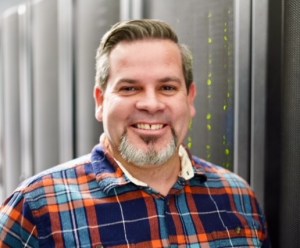
Brandon Heslop, Lead Data Center Supervisor, Salt Lake City
Brandon Heslop is another one of DataBank’s heroes of this pandemic. He is currently working to finalize the details for the SLC5 opening. That includes facilitating delivery of last-minute items like appliances and furniture. He is also a crucial point-person for access to facilities.
“We’ve seen an uptick in cross connect requests across our data centers. Our customers may want to connect to a carrier for added service, for example. Everyone is experiencing higher levels of bandwidth usage. We are running two to three new cross connects a week per site, with customers wanting them expedited as quickly as possible,” says Brandon.
When asked how he’s able to keep things up and running, Brandon immediately commends his team for being on the “front lines” day in and day out to keep operations running smoothly and ensuring business continuity for DataBank. Brandon says he misses the day-to-day small talk and face-to-face camaraderie at the data center. He says he feels communication will improve as an outcome of the current crisis. “Everyone is realizing how important those little, personal interactions are.”
Brandon, thank you for your commitment to the DataBank team and our customers! We couldn’t do it without you!
In the days, weeks and months ahead, we will be highlighting more of DataBank’s essential staff, so that you can put faces to those who are behind the scenes – indeed behind the SCREENS – of your devices and keeping you online, every day.
To our end-users, we want to remind you that the essential employees at DataBank’s data centers across the country are making sure you stay connected and your IT infrastructure is secure. And we thank them and recognize them for their work.
For our customers, we recognize that COVID-19 represents an unprecedented challenge, and we’re here to help. We know you have more to worry about now than ever before, and that’s why we’re providing the people and the expertise you need to reduce the burden of managing your IT infrastructure. Thank you for choosing DataBank.
Any company that grows through acquisition needs to be as thoughtful and thorough in its approach to integrating newly acquired people as it is in integrating systems, products and financials. It’s often the piece that makes an acquisition truly successful, particularly in our line of business, where we’re responsible for managing our customers’ mission-critical assets. During our recent growth, DataBank leadership has been keenly focused on the “people” aspect and purposefully set out to ensure that all team members across all of the acquired companies had an opportunity to help shape and embrace a culture we could all be proud of.
“Paying close attention to our culture and purpose is a big part of why we’re performing so well while so many other firms struggle to make M&A work,” says DataBank CEO Raul Martynek “A strong culture inspires and energizes people, creating a more cohesive team with a unified purpose: to continually serve our customers better.”
Martynek outlined the principles – call them “musts” – upon which the DataBank culture is built:
Be Authentic: Our culture must reflect who we really are and incorporate the best aspects of each organization we’ve brought into the DataBank family.
Be Articulated: Our culture must be expressed in simple, memorable messages that resonate with our team members.
Be Actionable: Our culture must be backed by behaviors that deliver a world-class experience for our customers.
Be Affirmed: Our culture must be measurable so we can make sure we were living it and staying true to it.
Uncovering Our Characteristic Behaviors
To ensure our culture is authentic to who we truly are, we designed a year-long process that touched every employee company-wide. This included group workshops and one-on-one interviews at every level of the organization and across our locations to gain an accurate picture of how team members really experienced – and felt about – the company’s day-to-day culture. As part of that process, we utilized a survey instrument called CultureTalk™ that was designed specifically to measure the “character” of the culture in each of our locations. Rooted in the famous psychologist Carl Jung’s notion of storytelling “archetypes” (e.g., the Hero, the Caregiver, the Sage, the Outlaw, etc.), the CultureTalk platform provided an amazing snapshot of our behavioral “inventory” that allowed us to find the common behaviors that can drive a shared sense of purpose.
Aiming for Brand and Culture Alignment
To take the next step of aligning our brand and culture, we compared the CultureTalk survey output with the findings from two earlier exercises: a half-day internal brand workshop and a series of subsequent customer interviews. This helped ensure that the language we used and the narratives we developed would be powerfully resonant with both employees and customers. The CultureTalk data was particularly helpful here, as each archetype has a unique narrative quality that allowed us to craft a story that knit the brand and culture closer together.
Articulating Our Purpose
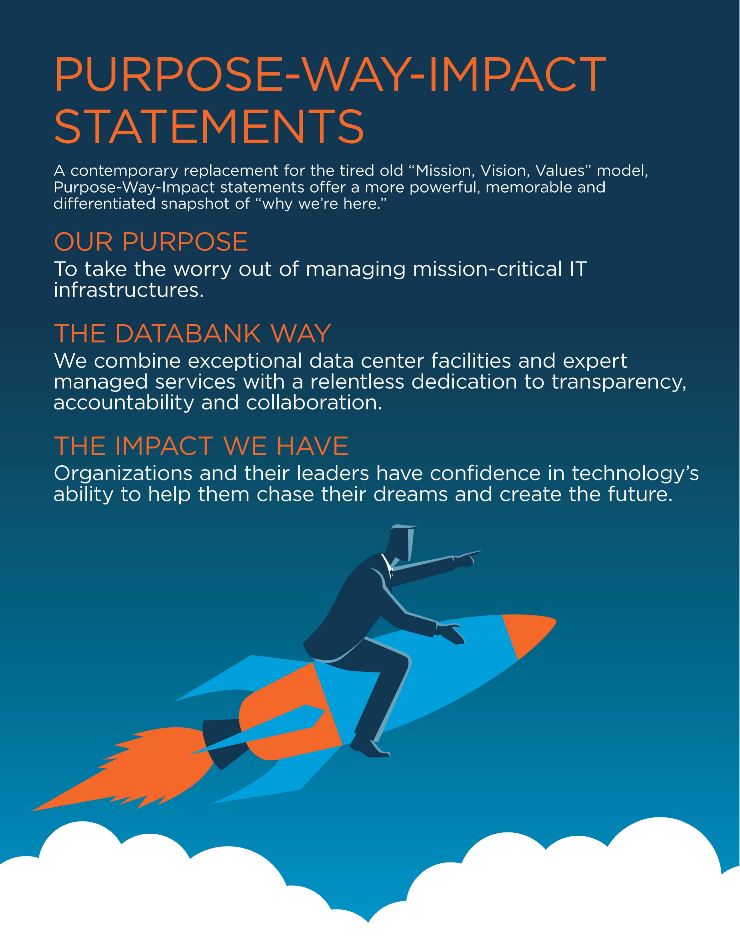
As we sought to clearly and simply articulate the tenets of our brand and culture, we turned to a new messaging framework called “Purpose-Way-Impact” or PWI – a contemporary alternative to the stale old “Mission, Vision and Values” framework that’s typically neither inspiring nor memorable. Based on the metaphor of a three-stage rocket, PWI cuts through the jargon to yield tight, memorable, and compelling statements of “why we’re here,” “how we operate,” and “what it means for the world.” The three statements were developed in a facilitated workshop where senior leadership team members joined together to express our highest ideals in a manner that rallies both internal and external audiences.
Defining the Actions Necessary for Delivering a World-Class Experience
To make sure all of the above principles and messages were actionable within the organization, we defined a set of four key behaviors that leaders can model… and employees can emulate. Developed in a workshop with the entire leadership team, these behaviors –
“Take Extreme Ownership”
and
“Collaborate Before We Escalate”
are two examples – were designed to maximize communication and interactions across all acquired teams and locations to bring all DataBank team members together as one cohesive operating unit.
Staying True to Ourselves
Finally, to ensure that all of this work is positively affirmed, we’ve developed a quarterly company-wide survey to measure the overall health of our culture and our adherence to the four key behaviors. This will allow us to determine whether we’re staying true to our ideals, where we’re getting better, and where we need improvement. Survey results will be unpacked in detail in quarterly leadership meetings and shared with the entire company so everyone can see how we’re doing.
The Keystone to Our Continued Success
At this point, it should be clear to all that we’ve invested heavily in truly understanding ourselves and defining the essential messages and behaviors that make DataBank an ideal partner for taking the worry out of managing mission-critical IT infrastructures. This is both our purpose on this planet and a goal against which we must continually make measurable progress.
According to Martynek, “If you ask me to identify the one single thing that is most critical to our success, my answer would be our corporate culture. It has the power to unify our team, drive our business, and set us apart in a sea of ‘vanilla’ data centers.” He adds, “It’s the cornerstone of our aspirations to truly be the ‘Data Center Evolved.’ And as we continue to grow through organic growth and M&A, our strong culture will be a key advantage in ensuring that we never lose sight of our purpose to support our customer’s mission critical data center requirements.”
A Method of Procedure (MOP) is a step-by-step document that governs how a task is performed safely inside a data center. This guide explains what a MOP is, why it matters for uptime and risk, and how DataBank manages it.
The Importance of MOPs in a Data Center Environment
MOPs were derived from the military, where the need for precision is critical, no matter who performs the task. When a MOP is used in a data center environment, the detailed list of steps ensures the technicians follow the exact same process every time.
Within a data center, there is an MOP for essentially everything in the facility to ensure standardization, consistency, and compliance. When followed, anyone running a MOP at any data center can run the same exact procedure and, thus, limit the chance of error.
Standardized MOPs reduce operational errors by up to 40% in data centers, improving reliability and compliance.
How DataBank is Digitizing MOPs to Maximize Quality Control
MOPs are typically paper-based, where steps are manually written and checked off on a list. To make sure DataBank is using the most advanced MOP system in the industry across all of our facilities, we have partnered with MOPstar, a state-of-the-art software solution that automates MOP creation and execution.
Procedural rigor is advancing via digital workflows with embedded validation, automated approval chains, and AI-assisted error checking. Digital MOPs will integrate directly with observability systems for zero‑touch operations.
The operations teams are leveraging MOPstar to automate processes and increase efficiency by using the software on mobile devices to conduct daily equipment checks and standard maintenance. Instead of having MOPs specific to each facility and piece of equipment per the industry standard, the platform allows us to have a database of MOPs that can be used across all the data centers in our portfolio, thus streamlining our operations, creating additional efficiencies, and ensuring quality control and scalability.
An added benefit of digitizing our MOPs is the ability to conduct real-time monitoring with photo verifications, allowing us greater visibility into how we operate and maintain DataBank facilities. The platform also records who did “what, when, and why” to any piece of equipment, thus providing a clear view for auditors, executives, and clients, and positively impacting compliance.
DataBank will roll out MOPstar starting in Indianapolis, Kansas City, and Salt Lake City, followed by 20 more data centers in nine U.S. markets by Q2 2020. To learn more, please click here to read the recent announcement about our partnership with MOPstar.

 Brandon Heslop, Lead Data Center Supervisor, Salt Lake City