DataBank is now a full forty-five (45) days into the enactment of our Continuity of Operations Plan (CoOP) and response to COVID-19. As the country and the world plods through this new “normal,” DataBank remains fully operational, moving forward, and continues to serve our customers with no degradation of services.
The overwhelming reason that DataBank remains in a fully operational state is that both our employees and customers have adhered to the enhanced controls established by DataBank in March and heeded the requests to shelter-in-place by local authorities. Many of you, our valued customers, have taken the proper precautions by only coming into the data centers when necessary and, more importantly, taken advantage of our remote hands functions to accomplish tasks. THANK YOU! We encourage you to continue to utilize our onsite, remote hands teams as this reduces foot traffic in the data centers and thus reduces risk to our staff and those customers that must come in.
DataBank is not enacting any new controls, requirements, or restrictions in our data centers at this time for employees or customers. We strongly believe, and evidence shows, that our existing plan is working. A key component of our plan is that the wellness and well-being of our staff are tracked daily, even on days when people are not working a shift. As a result, we have, at various times, isolated personnel from the facilities even when minor symptoms arise, just to be sure. This is how strongly we are committed to your wellness as well as our own. As a result of this, DataBank data centers have not experienced any known cases of COVID-19 in the facilities.
Our Containment Plan is Working
The DataBank facilities plan that is working well thus far is a three-phased approach we call “containment levels.” It is as follows (summation and highlights):
Containment Level 1 – Preventative Precautions:
Posted CDC COVID-19 Stop the Spread of Germs notifications.
Sanitizers available.
Limiting of large groups.
Cleaning after visitor/client visits.
Shared tools such as crash carts, ladders, handcarts are checked out (like a library) and cleaned after each use.
Containment Level 2 – Access curtailment and Site Screenings
All items noted in level 1.
All visitors must go through a screening consisting of questions provided by the CDC (have you had a fever, dry cough, shortness of breath etc.). A person may be denied entry based on a “yes” response to these questions.
Sites that are not staffed 24/7 will be accessible by appointment only when not staffed (request via a ticket).
Conference rooms, lounges, burn-in rooms and similar areas of our facilities will be inaccessible.
Containment Level 3 – Site Isolation and Sanitization
All aspects of Level 1 and Level 2 are in place.
Containment is for the purposes of data center isolation and to ensure the continued function of the data center.
Isolations may occur for the following reasons:
Lawful government order.
DataBank Management determines a risk to personnel, property, or continued operations is at severe risk.
A confirmed case of COVID-19 is found to have existed with the facility and sanitization is required.
What Happens if the site is Isolated?
If a site requires isolation, either by the government or DataBank management order or due to a known COVID case within the facility, DataBank will continue to monitor the facility, operations, and security, by either a minimal staff or remote facilities staff 24/7. Our continuous monitoring tools, processes, and alarm systems at all sites will continue to alert us to any developing issues. DataBank will continue to maintain our 100% uptime guarantee.
What happens if a Site is COVID-19 Positive?
In the event of a confirmed case of COVID-19 at the site, DataBank will institute a sanitization process with a certified cleaning contractor and initiate a contact trace process of confirmed and presumed contacted surfaces.
Individuals impacted by the results of the contact trace will be notified via their employer to ensure their health and well-being. Customers that have systems affected by any temporary isolation procedure will be notified of this emergency sanitization process via a ticket. DataBank will ensure all cleaning products meet OSHA standards and are acceptable for cleaning without impact on computing devices. Access to isolation areas will be limited or inaccessible for a period of time leading up to cleaning and for 24 hours after successful sanitization. Emergency remote hands and emergency customer access will be evaluated on a per request basis with requests submitted through the DataBank Portal or contact your Account Manager. Access that is approved will occur in full PPE gear to ensure the safety of our customers and staff. Upon successful sanitization process and subsequent 24-hour isolation period, the site will be re-opened based on Level 2 standards.
Staying Ahead of the Curve – Risk Analysis and Intelligence Monitoring
DataBank continues to closely monitor the situation not only in our data centers, but in their surrounding geographies, as well. There is a daily brief that is provided to key management team members. The management team also meets at least twice weekly to be briefed, address situations, and make decisions. This daily brief includes collection and analysis of DataBank specific information, medical information, government orders, civil unrest activities, and other general need to know items that may impact DataBank. The DataBank team uses this to conduct a risk analysis that results in a date center being assigned a containment phase.
Updates from Previous Communications
Can a Customer Come to the Data Center?
Yes – DataBank remains a National Critical Function and remains open for business. We encourage our customers to first consider using the DataBank remote hands availability to conduct changes to systems. If you must come into the data center, please adhere to local laws and the controls in place at the data center you are visiting. Please, if you are ill, do not come into our data center – we can help you. DataBank is not conducting group tours at this time.
What if I am Denied Entry?
If you are denied entry, please consider utilizing the DataBank Remote Hands functions or you may contact your account manager for further discussion.
How will DataBank Communicate Changes With Us?
DataBank will communicate changes to our Data Center access or other functions through email to your assigned point of contact (as defined by the Portal) via web (blog) announcements or through the DataBank Portal.
DataBank Employee Travel
DataBank has restricted its staff to management approved essential travel only until at least May 30, 2020.
BCP and Pandemic Compliance Questionnaires
DataBank will respond to BCP or Pandemic plan compliance questionnaires with only the data that is provided in this and previous blogs.
Questions
If you have additional questions or concerns regarding our preparation and plans, please direct any questions to CISO@DataBank.com.
Thank you,
DataBank Leadership
Continuity of operations ensures critical business functions remain available through continuous data protection and real-time monitoring of systems and security controls.
Episode Topics: Continuity of Operations, Continuous Data Protection, Continuous Monitoring Featuring: Mark Houpt, Calli Schlientz, and Tyler Treat
Listen to Mark Houpt and his team as they discuss the two things we need to pay attention to as security practitioners during these troubling times. First, we cannot lose focus on our continuous monitoring operations. Secondly, we need to be more vigilant than ever because we’ve seen a marked increase in attacks recently, hoping to catch us off-guard.
DataBank’s customers are asking about what we are doing from a security and compliance perspective and how we are responding to an exponential uptick in these attacks now that more of us are working from home, and our attention diverted. Listen to what we’re hearing and seeing as we all try to grasp this new reality together.
DataBank’s CISO Corner is for CISO’s and security practitioners, where we discuss a variety of cybersecurity topics and current events from the CISO’s perspective. Our broadcast is designed to be a short intake for busy professionals, and for those of you who want to hear from security and compliance experts on the front lines who deal with these issues every day.
Dear DataBank Customers,
The past week has seen unprecedented actions by federal, state, and local governments to control the COVID-19 outbreak. This situation has impacted each of us at all levels, families, communities, and our businesses.
Through all of this worldwide disruption, DataBank is fully operational and accessible. We are committed to ensuring that your business infrastructure hosted at DataBank is accessible, functional, and secure. Likewise, we are committed to the health and wellbeing of our employees, customers, and guests. We would like to share with you a few key items that ensure these commitments remain true.
DataBank – a National Critical Function Designation
DataBank has been designated by the Department of Homeland Security (DHS) – Cybersecurity and Infrastructure Security Agency (CISA) – as a “National Critical Function” (NCF). The NCF is a function of “government and the private sector so vital to the United States that their disruption, corruption, or dysfunction would have a debilitating effect on security, national economic security, national public health or safety, or any combination thereof.”
Put simply, this means that DataBank will remain open, operational, and we will remain staffed. DataBank has put in place the necessary plans and tools to ensure that this occurs and has enacted our Continuity of Operations Plans (CoOP).
Can a Customer Come to the Data Center?
At this time, DataBank remains open for customers to come to the data centers and work on their systems.
DataBank strongly recommends that customers traveling to the data centers review state and local travel restrictions and laws to ensure you comply with requirements. DataBank will not issue travel authorization letters or similar documents to customers employees that permit travel during restricted conditions.
Are there Restrictions or Screening Procedures for Data Center Access?
Effective immediately, all persons entering a DataBank facility are subject to possible additional screening.
We ask that you not enter DataBank facilities if you answer “yes” to any of the following questions:
1. Do you have any of the following symptoms:
Fever
Dry cough
Body Aches/Pains
Headaches
Sore Throat
Runny Nose
Tiredness
Shortness of Breath
2. Have you been in contact with a confirmed coronavirus (COVID-19) patient in the past 14 days?
3. Have you visited any of the following countries in the past 14 days?
Mainland China
South Korea
Italy
Iran
To ensure the safety of our staff, contractors, and customers, DataBank reserves the right to deny your entry to facilities if you have answered YES to any of the above questions. If you observe someone that appears to be ill, please inform our onsite staff or security team.
What if I am Denied Entry?
If you are denied entry, please consider utilizing the DataBank Remote Hands functions or you may contact your account manager for further discussion.
DataBank continues to monitor the situation and will make adjustments as necessary. We will communicate all adjustments or information through email and our blog on our website: https://www.databank.com/company/blog/
Thank you for your understanding. Your support of this process is appreciated. If you have additional questions regarding this policy, please contact DataBank at CISO@DataBank.com
Dear DataBank Customer,
On the morning of March 18, the Salt Lake area sustained a 5.7 magnitude earthquake and several aftershocks.
DataBank personnel and facilities are intact and operational at this time, with no degradation of services. We have built our structures within code and designed to withstand such events, which are a part of our continual risk assessment process and business continuity plans. We have conducted initial building assessments (visual walkthroughs and walkarounds) and have not identified any damage to the structures that would bring into question their integrity. Our Business Continuity Plan is currently active in an assessment and monitor mode. We do not anticipate any further actions within the BCP at this time. We intend to seek a professional assessment of these facilities to ensure safety is confirmed. As the aftershocks appear to be continuing, we will continue to monitor our facilities. Should the situation change, we will notify you.
If you should have any questions, please contact Brandon Swain (bswain@databank.com; 801-822-5376)
Dear DataBank Customer,
As a DataBank Dallas 1 (DFW1 – 400 S Akard St) or Dallas 2 (DFW2 – Richardson) customer, we need to make you aware of some changes that are occurring at these two facilities in response to COVID-19. Other DataBank facilities are operating without changes.
Effective immediately, all persons entering the DFW1 facility or entering the DFW2 property (but not facility – no facility changes are being made) are subject to possible additional screening by the property manager, as per the property management requirements.
The following applies:
1. At DFW1 you may only enter the facility from the main entrance which faces Wood St.
2. At DFW1 entrance or DFW2 facility drive-up gate, a Security Guard may question you upon entry. S/He will ask you the following questions:
A. Do you have any of the following symptoms:
i. Fever
ii. Dry cough
iii. Body Aches/Pains
iv. Headaches
v. Sore Throat
vi. Runny Nose
vii. Tiredness
viii. Shortness of Breath
B. Have you been in contact with a confirmed coronavirus (COVID-19) patient in the past 14 days? (yes / no)
C. Have you visited any of the following countries in the past 14 days?
i. Mainland China
ii. South Korea
iii. Italy
iv.Iran
To ensure the safety of our staff, contractors, and customers, the property manager has stated they reserve the right to deny your entry to this site if you have answered YES to any of the above questions. If you answer YES, they will ask you to voluntarily egress the facility and seek medical attention.
If you are denied entry, please consider utilizing the DataBank Remote Hands functions or you may contact your account manager for further discussion.
Please be aware that DataBank is not collecting or retaining any of the above data. DataBank is not aware that the property manager is collecting or retaining this data.
If you have additional questions regarding this policy, please contact DataBank at CISO@DataBank.com
We apologize for any inconvenience caused. Thank you for your understanding. Your support for this process is appreciated.
Dear DataBank Customer,
This past week has seen a significant rise in confirmed cases of the Coronavirus, or COVID-19, across our country. At DataBank, we take these situations very seriously and wanted to take a moment to address our stance and the actions being taken to protect your people, our people, facilities, and critical mission workloads.
Please be assured that your safety and health is always our primary concern. This communication is very important to read thoroughly and pay attention to so that you are informed and prepared to help DataBank protect you and our other customers.
In early January of 2020, DataBank began to prepare for this event and drafted a COVID-19 response plan. These are supplemental documents and plans to our standard BCP/DR plan. The plan is confidential to DataBank. DataBank will be sharing this document as an attestation of the plan and update this document with frequently asked questions (FAQ) as time progresses. This document is provided under the Compliance->Security Documents section of our Portal.
How is DataBank responding to this event?
The DataBank leadership team met in Dallas on Thursday, March 5th, to review and enact our plan based on a real-world situation. Our intention is to provide an appropriate, measured response. This email contains some very specific guidelines that we have enacted. We intend to adjust to the situation as new data becomes available. The leadership team will continue to meet at least on a weekly basis and more frequently if the situation warrants. We will update you as needed.
How will DataBank communicate changes with us?
DataBank will communicate changes to our Data Center access or other functions through email to your assigned point of contact (as defined by the Portal) or via web announcements.
Access to the Data Center:
Access to the Data Centers will remain “normal” for the time being. We have assessed the risks of each of our centers and determined that each are in low impact areas.
An alternative solution to your employees coming to our data centers is to utilize the DataBank Remote Hands functions. If you are not a current subscriber to this service, please let us know and we can accommodate temporary needs.
What happens if I feel sick or observe someone who is?
Please do not come to the Data Center if you are not feeling well. We would prefer to work with you through our Remote Hands functions. Please err on the side of caution.
If you observe another visitor appearing to be sick, politely suggest they go home or let Data Center Operations staff know, and they will take action.
Do not come to the Data Center if you have been in close contact (defined for our purposes as spending 15 minutes or more with the person in the last 14 days, or living in the same household) with someone who tested positive for COVID-19 or who has been asked to self-quarantine.
Cover your mouth when sneezing and coughing
If you run a fever, please stay home.
Wipe down your work area including desk, phone, cell phones, etc.
Wash your hands with soap and water for at least 20 seconds (the time it takes to sing the happy birthday song twice), regularly.
Employ “social distancing” measures. DON’T SHAKE HANDS. If someone extends their hand to you, just explain why you’re not shaking hands right now. A nod, foot tap or elbow tap is perfect etiquette in the current environment. In an in-person meeting, keep an empty chair between each participant if possible. Consider whether it is necessary to congregate in one office for conference calls as opposed to participating from your own office.
Travel:
DataBank has restricted its staff to essential travel only until at least the end of April 2020.
DataBank has stopped travel to or from high risk regions (Asia, Iran, Italy, Spain, San Francisco, Seattle, Los Angeles, New York City, Toronto) or high-risk functions (cruises, resorts, conferences). If you have been in these areas, please refrain from coming to the Data Center and utilize remote hands functions.
Staffing:
To prepare for an event that prevents DataBank employees from working at a DataBank facility, DataBank is conducting a Continuity of Operations test specific to this event. Each employee is being asked to work from home and verify previously tested functions.
DataBank has developed a minimum staffing plan for each Data Center in the event that an area is hard hit. This plan includes ensuring that facilities are manned and monitored appropriately by trained personnel.
Health Materials:
DataBank is stockpiling the appropriate disinfectant supplies, masks, hand sanitizer in each data center. Once deployed, if you see supplies running low or feel there should be other types of materials, please contact Data Center Operations.
DataBank will be sanitizing the biometric hand and finger readers on an hourly basis with at least 60% alcohol solutions as suggested by the CDC. If you do not want to use the biometric readers, you may request escorted access to your cage, with proper verification of identity and credentials.
Supply Chain Disruptions:
The leaders of the Managed Services team and Data Center Operations are aware of possible disruptions to the supply chain and are taking appropriate measures to ensure supplies are received in a timely manner. This includes all vendors.
Now is the time to be vigilant and be cautious, but also realistic. If you have any questions or concerns regarding our preparation, please direct any question to CISO@DataBank.com.
Every data center, hosting, and managed services provider offers a customer portal. Typically, they provide visibility into service performance and a modest degree of service parameter controls, but none were designed to fundamentally evolve the data center experience. DataBank took a different approach, custom-building a platform that empowers customers, taking features and functionality to a truly self-service level. Whether we’re hosting a colocation environment with managed internet, or a cloud environment with managed services, the DataBank Portal provides granular visibility and control unmatched by the typical customer reporting platform.
“It’s about transparency. You see what we see. Every alert and metric in your environment is available to you in real-time. The idea is to empower customers with the data they need to make informed decisions.”
-Vlad Friedman, CTO, DataBank
When we initially developed the Portal, the goal was to ensure total transparency through a central point of management for your environment; this is the objective that drives any changes and upgrades we make on an ongoing basis. Customers can see everything DataBank sees and can communicate with us at any time. You’re also able to specify how much access users can have to the environment through the Portal.
Key NEW Enhancements to the DataBank Customer Portal
Data Center Physical Access
Customers can now schedule visits at the data center facilities ahead of time, saving valuable time and easing the burden. It’s self-service when and where you need it.
Now, everything can be administered online. Customers can approve, activate, and deactivate user access with the click of a button. Online self-service also allows customers to provide cardholder and data center access lists to auditors quickly and easily. The self-service Portal also allows for supervisory roles for approvals, streamlining the entire process from top to bottom.
Colocation Space and Power Management
One of the major frustrations for IT administrators and managers when colocating equipment in the data center is knowing whether you are overloading your power circuits as you rack new equipment and as changes are made within cabinets and cages.
DataBank has eliminated that frustration by providing visibility into all power circuits provisioned and in-use, allowing IT staff real-time visualization of power utilization for any given circuit. A graphical representation of green, yellow, and red allows staff to see where there might be exposures.
Network and Internet Visualization, Performance, and Monitoring
One of the issues with other managed services and cloud providers is the unknown cost of bandwidth utilization. Quite often, you don’t realize the true total cost until you receive the invoice because you pay an unknown amount for egress as well as ingress.
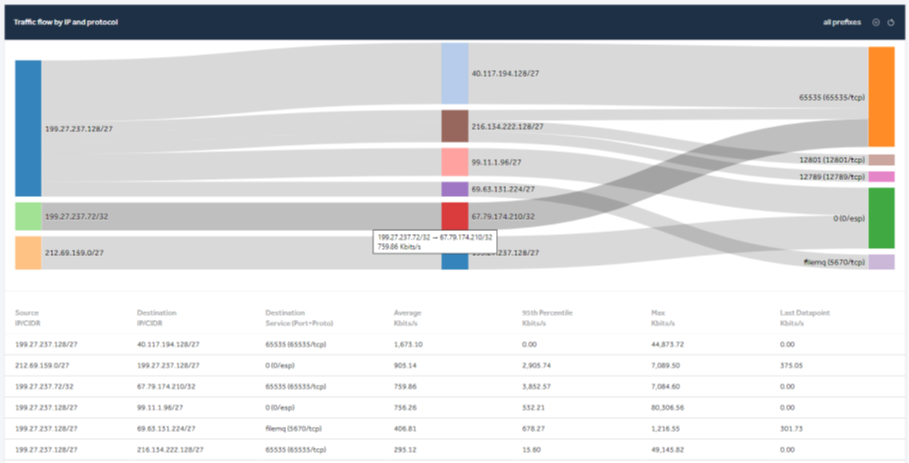
DataBank now gives customers access to not only 95th percentile reporting, but granular flow detail by IP, port, protocol, prefix, and protocol distribution – allowing customers to fine-tune infrastructure and applications where there may be overconsumption or other anomalies present in the environment.
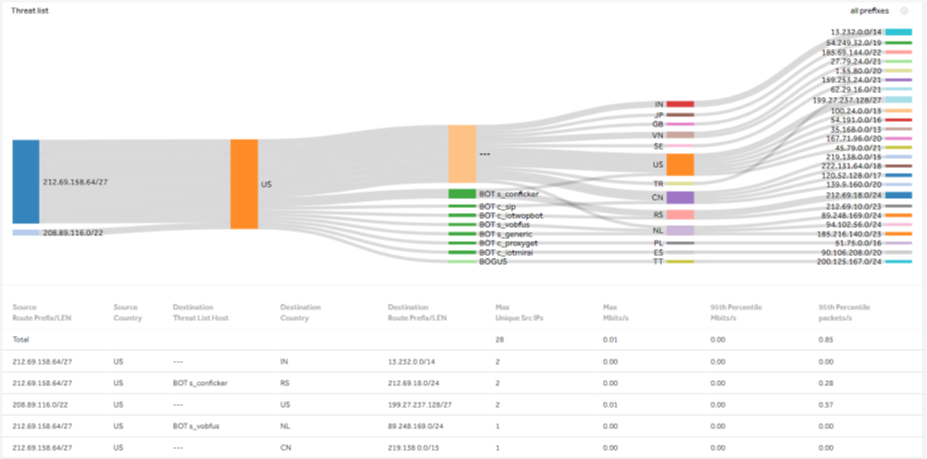
We also include a “Threat List Widget” so customers can correlate security threats within their environment, fulfilling our commitment to not only provide raw Internet, but Secure Managed Internet Services to customers who choose to have DataBank manage their Internet service.
A Breadth of Features for Managed Services Customers
Much of our vision for the Customer Portal is based on enabling the freedom to make changes independently, without contacting DataBank. Through the Portal, you’re able to view the status of any system, make changes, open tickets, review security services, and more. Here’s a snapshot of some of the specific features Portal users have access to:
Data Center Physical Access
Activate and deactivate access
Cardholder access list
Data center access report
Network and Internet Visualization, Performance and Monitoring
Visualization bandwidth utilization
Verify network performance
Colocation Space and Power Management
Visualize all circuits provisioned and in-use
Visualize usage by kilowatt, by circuit and circuit pairs
See actual kilowatt utilization, per circuit
Alarm when 80% threshold exceeded
Balance power circuits within cabinets and cages
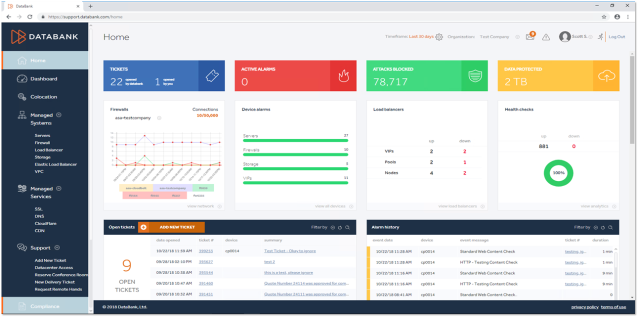
Executive Dashboards
Open Tickets
Active alarms and alarm history
Attacks Blocked
Data Protected
Managed Systems and Services
Servers, firewalls, load balancers, storage
Server details and performance
SSL, DNS, CDN
Backups, restores
Support tickets
Add a new ticket
Reserve a conference room
Open a new delivery ticket
Request remote hands
Compliance
View reports
Download Databank Security Certifications
Create Compliance Self-Assessment Questionnaires
Security
Query volume and type of attacks
Identify specific global location, destination server, and port
Billing
View invoices
Change billing contacts
Compare invoices
User management
Manage users
Manage roles
Edit user accounts
Reporting and analytics capabilities are particularly helpful for the IT team handling day-to-day support initiatives, compliance planning, or DR and business continuity. Executive leadership can also benefit from complete access to reporting analytics.
A Better Portal Experience Comes from the Ground Up—Not off the Shelf
The biggest difference between our Portal and other MSPs is the level of transparency and granularity. Typically, customer portals are based on off-the-shelf software tied into monitoring, so the data rendered shows only average. Conversely, the DataBank platform is custom-built from the ground up by our internal team of developers, hired exclusively for the care and feeding of the Portal. Capabilities extend to the application layer, offering greater visibility and detail, rather than just the OS layer. We consider ourselves your first responder, here to help manage your environment in the fashion that works best for you.
“My background and degree are in information technology. I was an IT director for two small firms before going into telecom as a consultant and account manager, so I’ve worked with many MSPs over the years. Most will give customers access to average stats on their environment but won’t let them drill down and investigate events and alarms on a server in real-time.”
Further, our specialization in compliant, high performing environments is unique. We’ve dedicated a full section of the Portal to compliance, which includes certifications and audits performed multiple times per year. DataBank covers around 80% of controls for compliance; customers address applications and code as well as user access to data.
The capabilities made possible by technology multiply when accessibility and self-service are built into a single point of management. For this reason, DataBank employs a full staff of developers dedicated exclusively to the Customer Portal to ensure we’re providing you with the information you’re looking for while continuously innovating. A customer portal might seem part and parcel to working with any MSP, but with DataBank, it’s a key component of evolving the data center experience.
If you’d like to schedule a demo of our Portal, contact us today at 800.840.7533.
DataBank’s Chief Information Security Officer, Mark Houpt, Senior Account Executive, Tonya Phillips, and Vice President of Sales, John Solensky, joined a panel discussion in Washington, DC recently. It marked an important step in helping inform policy decisions on protecting critical data, as well as making sure that public infrastructure is in place. The panel was hosted by Technology Councils of North America, a group that represents technology and trade organizations.
The panel, entitled “Creating a Secure and Resilient Public Infrastructure”, included discussion about the need for secure technology in both the public and private sectors. The proliferation of gathering, storing and using data at organizations makes security of that data paramount. Among the goals of the panel: to acknowledge the growing sophistication of bad actors. Unfortunately, right now that sophistication is outpacing what can be done to protect businesses and organizations. The effort to thwart those bad actors is part of a larger commitment by the federal government to prevent breaches and protect data.
With the European Union’s GDPR (General Data Protection Regulation) serving as a potential model, the United States is taking a deeper look into what data protection and privacy mean. With security breaches in the headlines more frequently, organizations ultimately want to prevent such attacks. Bipartisan legislation, introduced last year by U.S. Senator Jerry Moran (R-KS), and Senator Richard Blumenthal (D-CT) would help reform data privacy and protection nationally.
At the Data Center Crossroads: On-Premise, or Partner?
At some point, many businesses will confront the strategic decision of whether to operate an on-premises data center or collocate in an outsourced one. Operating your facility can be quite an undertaking – requiring expertise in power and environmental controls and responsibility for ongoing maintenance of information technology assets, from hardware to security. Deciding whether to build and operate an internal data center or turn to an outside partner, is a major strategic technology decision.
As the saying goes, most businesses aren’t in the data center business, which begs the question: should you be allocating time and resources to an internal data center? It makes sense for some organizations, while others would do well to consider alternative options.
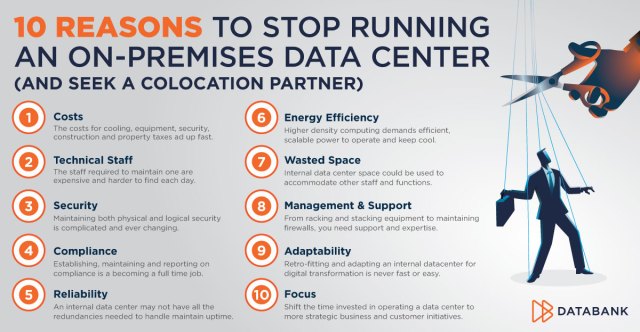
Whichever path you choose, evaluating some of the decision factors for opting out of the internal data center enterprise is a good place to start. Below, we’ve outlined ten reasons to stop running an on-site data center.
1. Costs
Cost analysis is often the first exercise your business must walkthrough in the quest to determine whether maintaining or building an internal data center makes good business sense. Investing in a private facility can seem like an attractive option for organizations who feel strongly about keeping their IT assets close to their physical location, have very specific security and compliance requirements or simply prefer to keep technology management in-house.
However, depending on your needs, the costs of running an internal data center can be impractical when you factor in heating, cooling, power, equipment, etc. If you’re set on running an internal data center, expect to foot the bill for the following:
Heating
Cooling
Power
Equipment
Physical security technology
Building permits
Taxes
Construction
Staffing
For many businesses, it’s simply not economically feasible to build or continue to run an internal data center. Opting for colocation, cloud or hybrid environment offsets these costs significantly. Paying for colocation monthly reduces capital expenses significantly, simplifies the challenge of future expansion, and eliminates the many economic pressures of dealing with your own data center.
2. Staffing and technical skillsets
While the skill set required to build a data center is significant, the technical acumen required to maintain and operate one can be just substantial, crossing multiple IT practice areas and requiring a great deal of expensive and difficult to find engineering talent.
And to make matters worse, the data center industry is facing a staffing crisis. Most organizations report experiencing significant difficulty in recruiting and retaining staff.
61% of businesses have trouble retaining or recruiting data center staff – a 6% increase from 2018 (Uptime Institute).
Opting to partner with a data center vendor who can offer a diverse range of options for your IT environment allows you to eliminate the stress of hiring and training staff. It can be easier to rely on specialized engineering and facilities staff to monitor your IT assets for you.
3. Security
Security is perhaps one of the greatest pressures of the internal data center, both physical and logical.
From a physical security perspective, there are countless tactics that can be utilized and combined to form a physical security strategy for your facility. This is often where security meets with compliance. Depending on your industry, customer base, and the nature of the data you deal with, the compliance requirements you’re subject to may stipulate physical security requirements for your data center. Here are just a handful of physical security measures many companies choose to employ:
Surveillance cameras
Biometric scanning
Multi-factor authentication
Entry and exit monitoring
Thick concrete walls
Then, of course, there’s logical security, which breaks down into numerous practice areas from network to information security. A common, and often overlooked, security risk found in on-premises data centers is technical debt. Older operating systems and legacy apps often have vulnerabilities that can introduce serious risks to data centers (Data Center Knowledge) and ineffective changelogs in older systems can make it significantly more difficult to detect attackers.
Leaning on a reliable partner, whether for colocation space, cloud or a mix, often reduces risk. Be aware that some data center vendors take more responsibility for more controls than others. If you choose to evaluate outside support, be certain your security personnel conducts an adequate evaluation to understand what sorts of controls, both physical and logical, are included or can be purchased as a service.
Also be aware that regardless of a provider’s security offerings, your business is responsible for your own data 100% of the time—this is a frequent misunderstanding among data center customers.
4. Compliance
Most organizations are subject to some sort of compliance regulations, be it HIPAA, PCI, or FedRAMP. Compliance isn’t known for being a simple practice area. The list of regulatory bodies and requirements is long and winding. Parsing out what you’re subject to, and how to establish and maintain compliance simply based on the data you deal with, is an undertaking on its own. That doesn’t include the many requirements which come along with an on-premises data center. It requires professional expertise, and not all businesses have the luxury of an on-staff CISO or compliance officer.
Plus, we all know by now, the consequences of noncompliance are steep. Take your pick in terms of major incidents: consider the Anthem breach that happened several years ago—the health insurance corporation was fined $16 million by the U.S. government for failure to comply with HIPAA (HealthLeaders Media).
The good news is this: compliance is part and parcel to several data center partner services. No one can assume responsibility for compliance on behalf of your business, but many data center providers can offer consulting services, share advice, or at the very least have on-staff compliance experts. They’re also required to maintain data center compliance with regulations such as SSAE 18. Keep in mind that hyper-scale public clouds are less likely to offer support for complex compliance requirements.
5. Reliability
Disruption and disaster events run the gambit, whether we’re talking about a technician stepping on a cable and mistakenly unplugging it or a massive hurricane that strikes your data center facility.
In 2019, 34% of businesses suffered some form of an outage of service disruption, many of which came with considerable financial ramifications. 50% have experienced an outage or disruption in the past three years.
10% of companies say their most recent significant outage exceeded $1 million.
Power loss accounted for one-third of outages while networking issues caused 31% (Uptime Institute).
Reliability brings different levels of concern for different companies. There are many factors to consider, from geographic location to infrastructure. Using a qualified data center partner reduces the need to worry about these issues. A Tier III data center will have been engineered from the ground up for inherent reliability, with redundant environmental systems, diverse power and network sources, and a location chosen for its reduced exposure to natural or man-made disasters.
6. Energy efficiency
The factor of power efficiency will vary from business to business. A data closet has very different needs from a full-on data center facility. Whether you’re buying fans to cool off your server room or your environment calls for overhead power and cooling systems, power efficiency and cost can become an issue.
Modern HVAC technologies and systems are highly complex and require skill sets to effectively manage. The more sophisticated your physical environment is, the more equipment and expertise you’ll need.
Today, most companies are aiming to consolidate their environments while maintaining tight SLAs and reasonable costs. Delivering on these objectives in terms of power is no easy feat when you’re building and operating your own data center.
High-quality data center facilities make the power and cooling part of the package in a fashion that will fit within your IT budget. Many providers are integrating innovative, high-efficiency technologies to offer customers further cost savings.
7. Wasted space
As your business grows, so does your data center. Depending on the nature and volume of your business, the physical space a data center can occupy can become extensive and burdensome. In some cases, your real estate is better used to accommodate new staff or maintain the most critical components of your infrastructure, while less vital assets can be offloaded to a colocation facility. Utilizing an off-site data center provides tremendous flexibility, allowing you to selective add space as needed, without overextending an expensive lease.
8. Access to managed services and remote hands
This relates closely to the staffing and skillsets challenges of internal data centers. With data centers, come IT assets, and with IT assets come many responsibilities; from racking and stacking equipment to maintaining firewalls. You need expertise to properly care and feed your data center, and the more it grows, the more staff you’ll require.
If you go the colocation, cloud or hybrid cloud route, a well-rounded service provider will usually offer managed services, taking care and feeding off the table for your business. Increasingly, OEMs and data center providers recognize the need to offer complete solution suites rather than single IT infrastructure components. Look for the following services if you’re thinking of cutting ties with your data center:
Technology moves fast. We’re all aware of the digital transformation discussion, regardless of your respective industry. It’s been said many times that every company is a technology company, and the concept is hard to argue with. Businesses of all sizes and backgrounds must be quick, agile, and ready to compete, and sound technology and digital transformation strategy are the foundation for these objectives.
It’s easier to be quick on your feet when you let experts handle your IT. Few things are more distracting from innovating and competing in the market than daily IT operations. If you don’t have an extensive internal IT department to maintain your data center, it could be argued that your ability to be agile is hampered.
10. Better for business
What is your business, exactly? We’re going to venture to guess that it’s not running a data center. And if it’s not, why are you investing the time and resources to run your own data center? What could you do with all the extra time you’d gain if you offloaded the obligations and refocused your efforts and capital on the functions that are core to your business and the happiness of your customers?
Like we mentioned in the beginning, there are some organizations for which building and/or running an on-premises data center makes good business sense. But for many, it doesn’t. We encourage you to take a closer look at your technology strategy and gain insights into what is most advantageous for your business, end-users, and customers.
Set up your equipment without a hitch
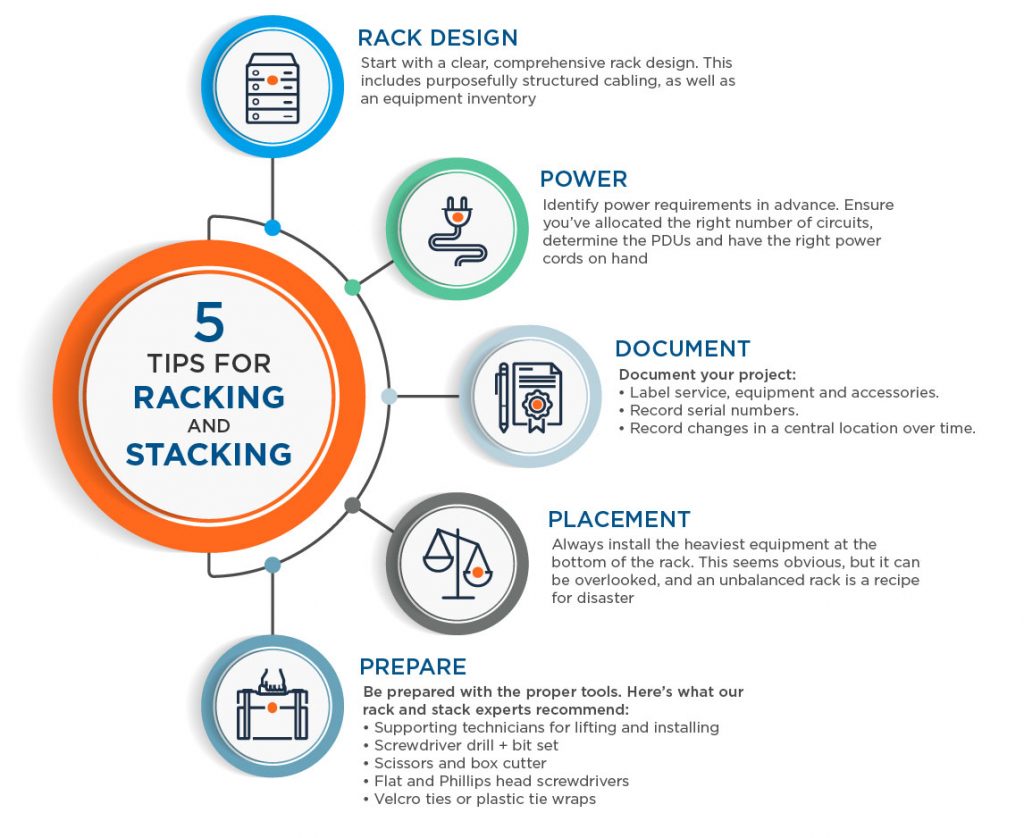
Dropping by the data center for a rack and stack project probably seems like a basic IT undertaking, but small mistakes at this stage can lead to bigger project delays later. It’s important to remember that doing some advance planning, and following some basic procedures and best practices, can make for a much easier and more successful experience in the data center.
Applying great care and planning to your rack and stack project will ensure efficient installation and prevent problems that can affect future performance. The recommendations and best practices above offer a range of technical benefits too, including better cabinet airflow and preparing the rack for future successful equipment additions or changes.
For more advice and support in planning and executing your “rack and stack” project, give DataBank a call at 800.840.7533!