By Eric Swartz, vice president of data center engineering
Does your data center give you the flexibility to deploy a standard server cluster and then scale to a higher-density solution when required?
That’s what you will need if you’re planning any digital transformation projects focused on improving experiences for customers, internal users, and partners to stay ahead of competitors. A key factor in driving innovative digital transformation is High-Performance Computing (HPC), which has revolutionized the speed at which enterprises process data.
At the same time, HPC applications significantly impact IT infrastructures. The compute resource firepower—which needs to scale quickly—requires racks of high-density compute resources. This adds to the demand for more power along with greater cooling to make sure the racks don’t overheat.
Solving the infrastructure challenge is key because HPC is vital for just about every industry—from finance to healthcare, manufacturing, and research. The ability to crunch massive datasets, perform complex simulations, and accelerate time-to-insight makes HPC indispensable for meeting the needs of end-users and gaining competitive advantages.
3 Major HPC Challenges Facing Data Center Providers
Power and Speed
The reliance on HPC by all these industries brings a host of challenges for data center providers in meeting the infrastructure requirements of their customers. As workloads grow more complex and datasets expand exponentially, data centers must deliver greater processing power with high-speed processors along with high-bandwidth networking technologies.
Scalability and Efficiency
Another factor driving the need for HPC is the exploding demand for artificial intelligence (AI). This includes machine learning applications that use algorithms requiring vast computational resources to train models on massive datasets. AI thus further drives the need for scalable and efficient infrastructure solutions.
Cloud and Hybrid Architectures
A third challenge reshaping the HPC landscape is the move toward cloud architectures and hybrid environments that blend on-premises and cloud infrastructures. While traditional on-premises HPC clusters remain popular for certain applications, many enterprises embrace the flexibility and scalability of the cloud. This means cloud providers must invest heavily in the HPC capabilities of their data centers by offering specialized instances, high-speed networking, and storage tailored to the unique requirements of HPC workloads.
TheUniversal Data Hall Design: The Flexibility to Fuel Innovation
At DataBank, we view the challenges HPC presents for data center providers as an opportunity to help our customers fuel their innovation initiatives. HPC requires us to tailor our offerings to support diverse deployment models for our customers and integrate our data centers seamlessly with cloud platforms. That’s exactly what we’vedone,. In doing so, we have opened avenues for greater collaboration.
By deploying our vast resources, we deliver cutting-edgesolutions that give our customers the flexibility to move from a traditional environment to one that accommodates applications requiring greater density. One of the ways we do this is with our Universal Data Hall Design (UDHD), which allows us to accommodate any type of workloadour customers need today — and in the future — including innovative HPC applications requiring ultra high–density.
Our vision for UDHD developed as we saw the demand for delivering solutions with very different requirements within the same datacenter.One of which is power to the rack, evolving from 120/208 volts to 240/415 volts.
In the past, customers needed multiple power circuits to achieve 20+ kilowatts in a single rack. However, with 240/415 volts, they can achieve 30+ kilowatts with a single power circuit.This lowersinstallation costs and consumes less rack space for the same amount of power allowing the compute to be physically closer together maximizing cluster speeds.
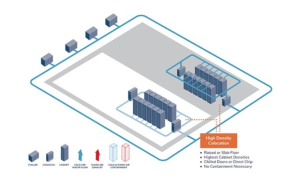
The DataBank Universal Data Hall Design
Accommodating HPC environments with a water-cooled design is made possible with either liquid cooling underneath a raised floor or overhead on a slab.
In addition, UDHD provides greater cooling capabilities—a key feature because HPC workloads typically generate more heat than traditional air systems can cool to sufficient temperatures. We have the flexibility to approach this issue in different ways based on the application’s need. We can deploy rear-door heat exchangers for high–density air applications, direct liquid to the chip for those that go beyond the capabilities of air, or even immersion for the most demanding needs. We support all these methods using a closed-loop air-cooledsystem that doesn’t waste water and is more environmentally friendly compared to other evaporative systems.
HowDataBank Collaborates with HPC Customers
One example of a successful HPC deployment is the flagship computing cluster deployed by the research division at the University of Maryland (UMD).We helped the university deploy a cluster in one of our Northern Virginia DataBank data centers that makes compute resources available to any researcher on campus, spanning the fields of astronomy, physics, biology, social sciences, and artificial intelligence.
The solution required a custom 415V power distribution system and a mixture of traditional air cooling and high-density, direct liquid-to-the-chip cooling in the same environment. Our flexible design approach allowed UMD to deploy with no compromise to their design, enabling maximum performance.
Another example is DataBank’s collaboration with Georgia Tech in one of our Atlanta data centers. The university had unique requirements in that their HPC cluster runsupwards of 60 kW per rack using only air-cooled servers. We solved this by designing a portion of the data center to userear–door heat exchangers for primary cooling.
We also deployed a dedicated cooling loop for the doors, andby moving the heat absorption to the back of each cabinet,we can cool the high–density racks while keeping the roomtemperature neutral.By having the doors on a separate loop, we support the university’s other needs for more traditional density racks—using standard perimeter air cooling running at different temperatures.
Unlocking Opportunities for Growth and Innovation
With the rapid evolution of HPC reshaping the technology landscape and driving significant changes in infrastructure demands, enterprises must stay ahead of these trends and adapt their offerings to remain competitive. By embracing innovations in hardware, power, and cooling, and by leveraging hybrid and cloud-based architectures, DataBank helps customers navigate the complexities of the HPC landscape to unlock new opportunities for growth and innovation.
By Paul Myott, Vice President of Organizational Effectiveness & Internal Communications
Too many organizations make critical and expensive missteps when introducing a new digital tool. DataBank’s head of organizational effectiveness covers 10 steps to help you avoid critical mistakes and assure success when implementing a new digital solution.
So many companies today are looking for new or better ways to run their business, and as they do, many continue to turn to the latest digital solutions for help.
Yet, their attempt to layer on a new digital tool – or worse, blindly choosing the industry’s most recent “bright shiny object” – will not necessarily guarantee the return on investment (ROI) they are seeking. Implementing any new technology and getting employees to fully adopt it to the point where it delivers the desired results is a risky proposition.
Many companies have made critical mistakes in their attempts to introduce new digital tools or conduct widescale digital transformation efforts. One of the biggest and most common is not doing enough to educate and engage employees and make them part of the ongoing process. According to research findings from McKinsey & Company, 70% of digital transformation projects fail, primarily due to lack of a cohesive and compelling change strategy.
These failures add up to too many losses for the entire organization: loss of investment, loss of employee engagement and confidence, and loss of momentum in the marketplace. Organizations following structured digital implementation practices improve project success rates by 35%.
The Right Methodology for Change Management Success
Clearly, even the most successful companies can stumble when attempting to introduce a new digital tool to their employees. Despite having the best intentions, they accidentally overlook many of the most important steps when managing change. In doing so, they may inadvertently put the entire project at risk.
To help, here is a 10-step change management approach you can use to achieve success with implementing your next digital solution.
1. Assess Needs and Objectives
This is an important first step. It ensures alignment between the digital solutions’ capabilities, your own strategic goals, and the end-users’ needs. Many organizations start and end with simply defining the business objectives. However, to truly maximize adoption and ROI, we recommend defining both the business goals and end-user needs.
Whether you are buying or building the technology, evaluating and understanding your specific challenges, inefficiencies, and desired user outcomes will give you the highest chance of success at truly tailoring the implementation to address these areas effectively.
Don’t skip this step or simply select the most popular or trendy solution. Make sure you do enough research. Identify the right digital tool to address your unique requirements while providing the highest levels of functionality and compatibility with existing systems. Thorough research can minimize the risk of investing in tools that may not fully meet your needs.
We recommend choosing two to three best-in-class solutions and taking the time to have internal users demo them and complete a thorough side-by-side comparison. Best-in-class solutions typically have similar basic functionality, but some may have features you did not realize you needed or that may advance your capabilities.
3. Consider Employee Adoption as Early as Possible
It is surprising but still true: Too many companies overlook this part of the process, even if they follow Steps 1 and 2 above. They may assume their employees will accept the new tool or are knowledgeable enough to figure out how to use. This assumption can be disastrous and can even derail the whole project. Full-scale adoption is as critical as selecting the right tool and is dependent on buy-in from more than just the end-users.
It is critical to develop a comprehensive plan to identify and drive adoption with all impacted stakeholders, including leadership. Organizational change management is a comprehensive discipline designed to work in step with project management. This is why we suggest becoming familiar with a methodology and following it.
Related to the point above, once employees are bought in to the change, providing the right training and support ensures that they will understand the reason (and benefits) for the new digital tool and use it effectively. Deliver the right support resources at the point users need them and in the ways they prefer to use them.
Not only will this help reduce errors and maximize productivity, but it will foster increased confidence and proficiency among employees. These benefits will lead to smoother transitions and a better integration into existing processes and workflows.
Promoting adoption and engagement among employees fosters an ongoing culture of innovation and collaboration. This drives collective buy-in and ownership of the new digital tools. Actively involve employees in the onboarding process and encourage their participation. By using live demos, pilot groups, beta testing, and user acceptance testing, you can tap into their insights and feedback to refine strategies, enhance usability, and achieve faster uptake.
We also recommend identifying “change champions” early on. These champions can help evangelize the new tool within their teams ahead of the full-scale rollout.
Creating feedback loops is critical. They help you address potential missteps before they happen or quickly resolve issues that pop up unexpectedly. Creating product champions or functional owners to facilitate regular feedback and suggest enhancements from users during implementation is a great way to help tweak the tool to do what your users need it to do.
As the tool goes live in your environment, monitor ongoing usage and performance. This will not only measure adoption but can help you redirect resources, like technical support, where your users need them most.
By tracking metrics such as features accessed, issues reported, and system performance, you can ensure that the new solution continues to meet evolving needs and deliver the intended benefits over time. Sharing metrics with the user community is another way to promote transparency and drive iteration and continuous improvement.
Unfortunately, too many organizations don’t do enough to solicit any type of employee feedback. When they do, they don’t want to hear bad news. When negative feedback surfaces, it’s best to acknowledge it immediately, thank those who submitted it, and be clear about how you plan to address it.
If you don’t plan to address it, explain the business rationale in the most public forum possible to show transparency. This will go a long way toward fostering a culture of openness, trust, collaboration, and proactive problem-solving.
Plan now to celebrate the success you are sure to have. Recognizing early wins and achievements – no matter how small – will help reinforce positive behaviors. Also, highlight the efforts of key employees who have contributed along the way.
Build enthusiasm and momentum. Share user testimonials, publish case studies, and use simple rewards and recognition with early adopters. These are critical in encouraging further teamwork and adoption.
Don’t forget this last step. Focusing on driving continuous improvement with the new digital solution after implementation will give you the best chance for long-term success. By actively seeking ongoing feedback and soliciting suggestions for new functionality and capabilities from those who use the tool the most, you can make sure that the solution remains relevant, efficient, and capable of supporting evolving business objectives.
When it comes down to it, successfully implementing any new digital tool requires a comprehensive approach that focuses on people and process as well as the technology. By following the framework described above, you can develop an effective plan that addresses each of these areas – especially your employees – to maximize adoption and help you achieve your objectives.
By Robert Clayton, DataBank Senior Product Manager
Enterprises can reduce their IT management costs by turning to their colocation provider for managed services.If you rely on a colocation provider to host your IT infrastructure, you realize the immediate benefits. You no longer worry about where to set up your server and networking gear. You also don’t lose sleep over having sufficient power supply because your colocation provider will assure that.
However, you may be missing out on another key benefit if you manage the infrastructure using internal resources. Those resources require specialized expertise and 24×7 bandwidth to do their jobs well — and that can add significantly to your IT infrastructure costs.
Fortify Your Colocation, Interconnection, and Cloud Platforms
The way to overcome this challenge is by also turning to your colocation provider for managed services that allow you to scale and fortify your colocation, interconnection, and cloud platforms. Instead of a do-it-yourself IT infrastructure, you get a suite of services and expertise to take care of challenging and time-consuming tasks that burden your internal IT resources.
These services can include distributed denial-of-service (DDoS) mitigation, intrusion detection and prevention (IDS/IPS), file integrity monitoring (FIM), vulnerability scanning, and storage as a service (STaaS). Managed IT services can also include business continuity—where your workloads automatically fail over to another data center in the event of a regional disaster. Your colocation provider can also monitor your storage and scale resources for you (on-demand) for data-intensive applications.
Tapping into all these services through your colocation provider reduces your IT management costs in these key areas, tools, expertise, and service protection:
Enterprise-grade security and performance management tools come at a fraction of the cost compared to deploying the same tools on your own. Colocation providers reduce software costs by spreading the expense across many customers and consolidating licenses, which allows them to negotiate better rates.
You no longer must spend money on hiring and training internal resources to manage and monitor your servers and network devices and keep them running at peak performance. Your colocation provider also never takes a vacation or has a sick day—they are always there 24×7.
Your colocation provider will have a Service Level Agreement (SLA) in place to protect your services and your budget.
In addition, the flat-rate pricing model for managed services provides you with predictable budgeting for your IT expenditures. You won’t have to worry about unexpected technology service incidents that often come with premium prices that can throw your budget out of whack.
The Benefits of Managed IT Services
On top of the cost savings, consider the many benefits of having your colocation partner provide managed IT services:
Cloud infrastructure management
Managed service teams in colocation data centers possess extensive experience in managing all aspects of your cloud infrastructure. They can provide guidance and support on migrating to the cloud, managing cloud storage solutions and interconnection options, and deploying cloud applications.
Security
Colocation providers deliver everything you need to make your IT environment safe and secure. This includes a multi-layered defense-in-depth approach with controls for physical security, network gear, the perimeter, user-access, and servers. Other key services span firewalls, intrusion detection and prevention systems, and regular vulnerability assessments.
Data backup and recovery
Colocation managed services ensure the continuous availability of your data and applications so your business can quickly resume operations in the event of a disruption. Managed services teams also perform regular backups of data and employ redundant storage systems.
Networking monitoring and management
Managed IT services within a colocation environment provide continuous monitoring and management of critical network infrastructure. Highly skilled network professionals use advanced monitoring tools to proactively detect and troubleshoot issues to ensure smooth network operations.
Software and hardware management
Turning to managed services teams in colocation data centers streamlines software and hardware management by handling software updates, ensuring license compliance, and performing regular maintenance of hardware devices.
Perhaps, even more importantly, managed service teams within data center colocation facilities serve as your trusted advisor. They provide valuable IT consulting and strategic planning services based on their deep understanding of technology trends and industry best practices. By aligning IT infrastructure with business goals and objectives, these teams help you make more informed decisions about technology adoption, system architecture, and digital transformation strategies.
Optimal Uptime and Agility with Reduced Risk
Three primary considerations are influencing the strategic shift toward managed services. The first is that every second of downtime translates into lost revenue, eroded customer trust, and diminished brand value. With around-the-clock monitoring, your managed service provider ensures optimal uptime and availability.
The second is greater agility. An agile IT infrastructure ensures you can swiftly pivot, scale, and transform, thus reducing the bottleneck of technology holding most customers back.
Third, partnering with a managed services provider who understands your business also minimizes transition challenges, miscommunications, and integration issues. This consolidation ensures smooth operations and significantly reduces your operational and cybersecurity risks.
About the author: Robert Clayton has enjoyed a successful career in product management, including security, network, systems, storage, BaaS, DRaaS, managed and professional services.
As we delve into the future, the convergence of AI and our digital experiences presents a myriad of revenue-generating opportunities for providers. In this blog, we’ll offer just a few realistic possibilities for new or enhanced digital experiences and underscore the pivotal role of data centers in supporting the infrastructure that powers AI.
The Evolution of AI Monetization
Personalized AI Services:
Imagine AI-driven personal assistants that serve users based on a deep understanding of their preferences and personal history.
AI Health Concierge
Users subscribe to an AI-powered health assistant that will analyze their health data – everything from medical history to exercise behavior, and dietary preferences – to provider personalized health recommendations, and even schedule virtual consultations with health care providers and/or personal trainers.
Personal Finance AI
A financial AI assistant that tracks expenses, income, and goals to offer personalized investment and budgeting advice, helping users optimize their financial portfolios and monthly cashflow.
Providers could monetize these experiences by offering premium subscription plans, unlocking advanced features and delivering previously unavailable convenience to users.
AI-Enhanced Virtual Events and Creative Collaboration:
In the post-pandemic era, virtual events have become the norm. AI can elevate these experiences in a least a couple of ways:
Multilingual Event Experience
AI can provide seamless real-time translation during virtual events, breaking language barriers and making content accessible to a global audience.
AI Networking Concierge
Intelligent matchmaking algorithms could connect attendees based on their professional profiles, preferences, and business interests, enhancing networking opportunities.
Providers could monetize these enhancements through tiered event packages and sponsored AI-powered features.
AI-Powered Creative Collaborations
Content creation is already undergoing a transformation with AI-driven tools. Providers can enhance and monetize these experiences in these ways:
AI-Enhance Design Collaboration
Creative professionals use AI tools that suggest design elements, predict visual trends, and facilitate real-time team collaboration. This could lead to more innovative outcomes and eliminate the location barriers of remote teams.
Interactive AI Storytelling
Writers and other content creators can leverage AI to generate interactive story elements, allowing real-time story curation that engage readers or viewers with personalized relevant content. Providers could offer subscription or tier pricing models for access to these advanced creative tools, providing a revenue stream while empowering creative professionals.
The Crucial Role of Data Centers in AI Monetization
Behind the scenes of these AI-powered experiences lies a robust infrastructure. Data centers play a mission-critical role ensuring the required performance, scalability, and reliability.
Processing Density for HPC
AI applications require complex neural network computations, computing owner that adds weight and heat to equipment. Some data centers provide the flexible infrastructure needed for this High-Performance Computing: slab flooring to accommodate equipment weight, and liquid cooling options that are more effective and efficient than traditional air-cooling, enabling AI providers to deliver on rapidly scaling demand.
Scalability
The success (current and future) of AI models is contingent on vast data sets. More intuitive and engaging experiences require more data. More data requires more compute power, bringing a growing demand to scale. Data center providers who own their facilities and the land beneath them are best suited to deliver scalability to AI providers.
Data Storage and Accessibility
As noted earlier, the success of AI models is contingent on vast data sets. Data centers offer secure and scalable storage solutions, ensuring that providers can access and manage the data they need for training and refining AI algorithms.
Network Connectivity for Real-Time Interactions
AI-powered experiences often require real-time interactions. Consider voice recognition or geospatial location. Data centers, with their high-speed network connectivity, enable seamless communication between users and AI applications.
Navigating the Future Landscape
As AI providers explore and deliver revenue-generating experiences, their symbiotic relationship with robust data center infrastructure becomes increasingly apparent. Providers in the AI space must focus on crafting compelling digital experiences and selecting the right data center providers to accommodate growing demand.
By Mark Houpt, DataBank Chief Information Security Officer
Earlier this year, I offered three predictions for cybersecurity in 2023, and Forbes asked for my thoughts on cyber attacks in 2022. For 2024, I have these five predictions:
#1 – Artificial Intelligence (AI) will drive the evolution of cybersecurity attacks and defensive mechanisms
Despite what many people believe, AI itself will not be the source attacks. Rather, it will be an amplifier of attacks. Because the technology can repeatedly run attacks and learn to alter itself based on the responses it receives, the addition of AI will make attackers much more effective, damaging, and robust. As the industry evolves next year, security professionals will focus on staying ahead of the game. They will defend their networks with AI tools that can auto-sense attacks and respond accordingly.
#2 – Tried-and-true methods will be the backbone of cybersecurity practices
Bad actors keep getting more sophisticated with their attacks. However, security teams must not surf the trend wave or look for shortcuts in their strategies in response. Everyone wants to adopt the shiny new solution, but as cybersecurity professionals navigate the landscape next year, we will see a greater push toward tried-and-true methods. Rather than adding the next big thing to their arsenal, teams will focus on assuring sound practices, doing what’s required by regulations in 2024.
#3 – More organizations will adopt identity verification
Expect more organizations to adopt identity verification to ensure the authenticity of individuals during account onboarding. The increasing adoption of identity verification across various organizations is a response to the evolving digital landscape, marked by advancements in AI and a growing need for robust authentication methods.
This trend is particularly relevant in the United States, where both government regulations and standards set by the National Institute of Standards and Technology (NIST) play a pivotal role. The trend toward broader adoption of identity verification is a necessary response to the challenges posed by an increasingly digital and interconnected world. The U.S. government and NIST requirements act as catalysts in this process, ensuring organizations adopt practices that are secure, reliable, and respectful of individual privacy.
First, the U.S. government has emphasized the importance of reliable identity verification in safeguarding national security and protecting individual privacy. Various regulations and standards—such as the Real ID Act and the guidelines provided by the Department of Homeland Security—underline the need for stringent verification processes. This focus is not only to combat identity theft and fraud, but also to ensure that government services are accessed securely and efficiently.
Second, NIST, a non-regulatory agency of the U.S. Department of Commerce, sets standards for identity verification. NIST guidelines, especially the NIST Special Publication 800-63, provide a framework for digital identity services. These guidelines emphasize the use of multiple factors for authentication, the importance of user consent, and the management of privacy risks. They advocate for a layered approach to security, incorporating both physical and digital methods of verification.
The wider adoption of identity verification is also driven by advancements in AI. AI algorithms can now analyze biometric data, detect anomalies in user behavior, and verify documents with higher precision. This not only improves the security of the verification process but also enhances the user experience by making it more seamless and efficient.
#4 – Third-party service providers will continue to place cyber security programs at risk
In 2024, third-party vulnerabilities are poised to significantly impact the cybersecurity landscape, a trend accelerated by the directives of Executive Order (EO) 14028. This order, aimed at improving the nation’s cybersecurity, underscores the critical nature of third-party risks. As organizations increasingly rely on external vendors and cloud-based services, the security of these third-party entities becomes a pivotal concern.
The interconnectedness of digital ecosystems means a single vulnerability can have cascading effects, leading to widespread security breaches. Compliance with EO 14028 will drive organizations to rigorously assess and monitor their third-party partners.
This shift will lead to a more resilient digital infrastructure but also requires significant investment in risk assessment tools and strategies to manage the expanding threat landscape. The overall impact will be a heightened focus on collective cybersecurity responsibility, moving beyond individual organizational boundaries to a more holistic, network-centric approach.
#5 – Hacktivists and nation-states will attempt to impact the U.S. presidential election
The 2024 U.S. Presidential election is likely to be a major target for hacktivists and nation-state actors aiming to influence or disrupt the democratic process. Hacktivists, motivated by political agendas, could deploy tactics like doxxing, website defacement, or spreading disinformation through social media.
Meanwhile, nation-state actors, seeking to destabilize the U.S. and undermine its global standing, might engage in more sophisticated cyber operations. These could include hacking into election infrastructure, stealing sensitive data, or launching influence campaigns to sow discord and mistrust among the electorate. Both groups view the high-stakes nature of the presidential election as an opportunity to amplify their impact, making cyber security a critical concern for maintaining the integrity of the election process.
###
By Raul Martynek, CEO DataBank
In 2023 we saw the explosion of AI and its immediate impact on the data center industry. This development alone has completely transformed traditional business models and once-accepted norms. It’s a transformation in the future of power, data center capacity, and even hyperscalers’ new requirements going forward.
What will 2024 bring? It’s hard to tell for sure. I predict the following developments related to AI and the way it will affect the entire data center industry.
AI: A Year of Closer Examination
Looking back, I think we will remember 2023 as the birth year of AI. It’s hard to believe it was just a little over a year ago when OpenAI unveiled ChatGPT. It was truly a jaw-dropping, game-changing innovation. It immediately captured the imagination and attention of the technology and business community. ChatGPT has spawned a surge of investment and experimentation in AI companies, tools, and capabilities.
At this time last year, very few people were talking about AI – or included it in their list of 2023 technology predictions. Now it seems to consume all the oxygen in the room. So, what will 2024 hold for new AI innovations? At the risk of sounding like a contrarian, I’m tempted to say, “not much.” Let me explain.
I firmly believe in the future impact of AI and that it is similar to the advent of the Internet in the mid-1990s. Fundamentally, it will change every human activity. Also, I believe in 2024 organizations will begin wrapping their heads around incorporating it into their businesses.
There are a number of reasons for this:
First, consider that Chat-GPT arrived very late in the year. By then, many companies already had baked their 2024 budget and priorities. Few, if any, had allocated significant funds and effort to Generative AI development. That’s because Gen-AI was not even on the radar screen.
Second, this technology is amazingly complex: from software development to data management to specialized GPU clusters for training and inference. This is completely new to almost all IT organizations.
Third, as we have seen this year, Gen-AI brings significant issues to the forefront. This includes security, privacy, copyright infringement, hallucinations, job displacement, etc. There is a lot to unpack related to these issues and the questions they raise.
I think while we will continue to read a lot about AI in 2024 (and forever more), we will not see any huge breakthroughs. Instead, most organizations will spend their time developing comprehensive plans for incorporating Gen-AI into their specific business models. This was true in the 1990s with the introduction of the Internet, and I think the same will hold true here.
It reminds me of one of my favorite sayings from renowned futurist Roy Amara: “We tend to overestimate the effect of a technology in the short run and underestimate the effect in the long run.”
Developments in the Data Center Industry
As we are coming to understand, the deployment of AI is inextricably linked with data center capacity. I think 2024 could be the “Year of Data Center Scarcity.” By all accounts, 2023 was a record year for data center leasing. Many companies, like DataBank, effectively leased two years of capacity in one year. The vast majority of the data center leasing for AI workloads still needs to be commissioned; much of the sector will be spending all of 2024 and beyond converting the huge backlog into production.
This has driven vacancy levels to all-time lows in all major markets. We expect continued investment in AI workloads. We expect continued public cloud growth and enterprise digital transformation in 2024. This means data center capacity will be even more constrained in 2024. Further, we expect pricing to continue to increase throughout the year as buyers compete to secure what little space is available.
Although the industry, including DataBank, is working to add new facilities, data center construction is now a 24-48 month endeavor. Therefore, the wave of demand from 2023 is not possible to be filled by next year.
Trends in the Public Cloud
As I mentioned above, I expect public cloud growth to accelerate in 2024. Of all the major public clouds, Microsoft clearly has the best-defined strategy for incorporating Gen-AI into its product offering and identifying a means to monetize that investment. The rollout of Co-pilot across the Azure stack, likely, will accelerate as enterprises understand the productivity benefits of the offering. Based on conversations I have with developers, Co-Pilot for GitHub radically improves productivity for software development. There is already early evidence of this. On its most recent quarterly earnings call, Microsoft attributed a 3% increase in Azure cloud revenue to AI alone.
Oracle is also very well positioned to benefit from Gen-AI given its partnership with Tik-Tok and Nvidia. Tik-Tok’s entire business is based on “internet AI.” Undoubtedly, they will continue investing to make the algorithm even more powerful, and Nvidia will continue to leverage Oracle’s relative semiconductor chip “neutrality” to deploy its CUDA GPU stack within Oracle data centers. Oracle reported a 50% increase in public cloud growth during its most recent earnings call. Also, they indicated it had billions of dollars of incremental cloud/Gen-AI demand.
AWS is beginning to make news about its investment in AI startup Anthropic and collaboration to develop and train more capable large language models (LLMs). Recall, AWS is an IaaS company – their platform is a technology stack for developers to build other products on top of it (think Slack). Their monetization strategy will require developing a compelling alternative to Nvidia CUDA and convince developers they should build their Gen-AI applications on their (proprietary stack) not Nvidia’s. Given AWS’s track record and scale, undoubtedly, they will make inroads. Ultimately, they are dependent on enterprises and technology companies to article to launch their Gen-AI roadmap (see above).
Google recently released its own AI model, Gemini, and claims it outperforms ChatGPT in widespread testing. Like AWS, Google Cloud depends on other developers to consume their services. I suspect Google’s energy direct Gen-AI toward protecting and expanding its lucrative search business first. With all these developments – many that seem too similar – we’ll have to see newly differentiated offerings to allow these vendors to stand apart from the competition.
It’s an exciting time for the entire tech sector.
About the Author: Mr. Martynek joined DataBank in June of 2017 as the CEO and is a 20+ year veteran in the telecom and Internet infrastructure sector.
By Jennifer Curry, Senior Vice President of Managed Services, DataBank
Managing IT is laden with choices, and one of the most significant is whether to manage IT internally or rely on the expertise of a Managed Service Provider (MSP).
Outsourcing IT functions isn’t about relinquishing control but strengthening your strategic focus. By leaving routine tasks to trusted partners, IT departments can free up time and resources to align technology with business goals rather than getting bogged down with day-to-day operational challenges.
Top 10 criteria you should consider
Strategic Advantages: Question: What are the strategic benefits to my business if I outsource my infrastructure and services? Insight: Beyond the routine IT management tasks, MSPs bring agility, security, and innovation to the table. With their comprehensive portfolio of services, businesses can rapidly adapt, mitigate risks, and stay ahead of technological curves.
Understanding Industry Issues: Question: What are the issues facing my industry? Insight: Each industry presents unique IT challenges. Understanding these nuances is essential, whether it’s regulatory hurdles in finance, data security in healthcare, or scalability in e-commerce. An experienced MSP typically has cross-industry knowledge, offering insights and solutions tailored to your sector’s challenges.
Empowering IT Managers: Question: What are the benefits to me as an IT Manager? Insight: Partnering with an MSP relieves IT managers from the routine of daily operations, freeing them to focus on aligning IT strategies with business objectives, ensuring innovation, and fostering growth.
Eye on the Competition: Question: How are my competitors solving their challenges with Managed Services? Insight: Observing competitors can offer valuable insights. If they’re leveraging MSPs for enhanced agility, reduced downtimes, or improved cybersecurity, it might be a cue for your business to explore similar advantages.
Staffing Concerns: Question: What about my current staffing? Insight:If reducing your staff is among your objectives, working with an MSP can help you achieve that. However, transitioning to an MSP doesn’t necessarily mean replacing your IT team. Instead, it’s about complementing internal expertise with external proficiency. Existing staff can collaborate with the MSP, ensuring optimal outcomes.
Control Considerations: Question: Will I lose control? Insight: A common misconception is that outsourcing equates to relinquishing control. MSPs work as partners, with businesses retaining decision-making authority while benefiting from expert guidance.
Trust Factor: Question: Who should I trust? Insight: Trust is paramount. Seek MSPs with a proven track record, robust client testimonials, and industry experience. Their transparency, communication, and success stories will build trust.
Setting the Stage: Question: What best practices should I consider before taking the plunge? Insight:Define clear objectives, establish open communication channels, and foster collaboration.Define clear objectives, establish open communication channels, and foster collaboration. Ensuring a shared vision with your MSP is a foundational best practice. Also, you shouldn’t be expected to go it alone. The right MSP should help you arrive at those objectives and have a recommended communications protocol.
Insource vs. Outsource: Question: Are we doing the right thing by insourcing and doing it ourselves? Insight: While insourcing provides direct control, it has challenges like staying up to date with tech advancements and managing scalability. Weigh the benefits of internal management against the advantages offered by MSPs.
The Right Choice: Question: How will I know when I have chosen the right MSP for my business? Insight: The right MSP will address IT challenges and proactively suggest innovations, ensuring alignment with business goals and providing measurable outcomes.
What Should I Expect? Agility, Reduced Risk, and Uptime
Information technology threads its way through every operation, every strategy, and every goal. Given this centrality, the decision on how to manage IT in-house or through an outsourced expert has far-reaching implications. Increasingly, forward-thinking organizations realize the advantages of entrusting their IT environment to a Managed Service Provider (MSP). Three primary considerations are influencing this strategic shift.
Agility: An agile IT infrastructure ensures businesses can swiftly pivot, scale, or transform without the bottleneck of technology hindering them. With their finger on the pulse of the latest tech trends and innovations, MSPs can guide businesses to remain agile and responsive, thus fostering agility. Leveraging a comprehensive portfolio of services from your MSP is crucial. Agility ensures that businesses can adapt swiftly to market demands, respond to disruptions without significant downtime, innovate faster and more effectively, and ensure operational continuity and profitability.
Reduced Risk: Partnering with a single provider who understands your business minimizes transition challenges, miscommunications, and integration issues. This consolidation ensures smooth operations and significantly reduces operational and cybersecurity risks.
Uptime: Every second of downtime can translate to lost revenue, eroded trust, and diminished brand value. With their innovative infrastructure and round-the-clock monitoring, MSPs ensure optimal uptime and availability. This reliability is the bedrock on which businesses can build robust operations and services. Partnering with an MSP that owns the data centers from which these services are offered is essential yet often overlooked.
While in-house IT management offers a direct control pathway, the multifaceted advantages of partnering with a seasoned Managed IT Service Provider are increasingly hard to resist. From agility to expertise, uptime assurance to compliance mastery, MSPs rise as essential allies for businesses aiming to harness technology as a strategic advantage.
In a world constantly reshaped by technology, aligning with the right IT partner can be the defining factor between mere survival and thriving success. And so outsourcing isn’t just about delegation; it’s about strategic alignment for a digital future.
Featuring: David Aviv, Radware’s CTO, and Mark Houpt, DataBank’s CISO.
New attacks are orders of magnitude more significant in terms of volume and capability. It’s a totally different ball game.
Attackers are using AI to learn the structure of your site and “smart craft” attacks.
CISO Corner Episode 26:
Listen to David Aviv, Radware’s Chief Technology Officer as he describes what is currently happening as a result of AI and what may very well happen in the future.
Run Time: 6 minutes
DataBank’s CISO Corner is for CISOs and security practitioners, where we discuss a variety of cybersecurity topics and current events from the CISO’s perspective. Our broadcast is designed for those who want to hear from security and compliance experts on the front lines.
Featuring: David Aviv, Radware’s CTO, and Mark Houpt, DataBank’s CISO.
New attacks are orders of magnitude more significant in terms of volume and capability. It’s a totally different ball game.
CISO Corner Episode 25:
Listen to David Aviv, Radware’s Chief Technology Officer as he describes the expanding attack surface for DDoS. For network DDoS, the most important parameter was false positives. For Web DDoS, it’s false negatives. This is a significant development.
Run Time: 6 minutes
DataBank’s CISO Corner is for CISOs and security practitioners, where we discuss a variety of cybersecurity topics and current events from the CISO’s perspective. Our broadcast is designed for those who want to hear from security and compliance experts on the front lines.
Expanded Compute Resources & Enhanced Connectivity to Drive Data Science Initiatives
Salt Lake City’s tech boom calls for greater compute capacity and enhanced connectivity to drive data science initiatives, and a key player in the technology ecosystem is the DataBank SLC1 data center. Located in the heart of downtown, SLC1 features easy access to the city’s business district.
The data center operates within the primary carrier hotel for the Salt Lake City area—populated with multiple Tier-1 and Tier-2 network providers entering the building through multiple access points. As a data center within a carrier hotel, SLC1 delivers five key benefits to DataBank customers:
Fast Delivery: Quick installation intervals that speed time-to-market for new services
Carrier Selection: A diverse range of telecommunications service providers
Low-Latency Performance: Direct access to carrier backbones
Arbitrage Costs: Competition among carriers drives down customer connectivity pricing
Scalability: Flexibility to select carriers without physically moving equipment to another data center
The carrier hotel was built in 1957 and is located one block from the Mountain States Telephone & Telegraph Building. The Salt Palace Convention Center is also nearby, and the Salt Lake City International Airport is just eight miles away.
SCL1 – 179 Social Hall Avenue, Salt Lake City
SLC1 serves multiple Internet Exchanges along with many peering participants, Internet service providers, and carriers. As with all carrier hotels, SLC1 connects to extensive fiber paths as well as multiple points of entryway and the numerous networks residing in these locations.
Twenty one carriers connect directly into the SLC1 network—including Zayo, AT&T, Comcast, and Lumen—while Packet Fabric (Unitas Global) provides SLC1 with a direct cloud on-ramp. Other accessible cloud on-ramps include Megaport, which is reachable via interconnect services, and Console Connect, an extended location in the carrier hotel that’s just a local loop away.
For interconnection services, peering occurs directly within SLC1 via the Salt Lake Internet Exchange and Mountain West Internet Exchange. With multiple points of entryway, carriers can also easily reach their outside plant fiber cables, ensuring fast delivery and performance.
To tether to other data centers, DataBank offers colocation services within Suite 200 at the carrier hotel, with extensive interconnectivity to the DataBank Granite Point Campus between Salt Lake City and Utah’s Silicon Slopes—where five DataBank data centers operate. Customers within SLC1 can link to each other through cross-connects, and SLC1 offers 1G MPLS and 10G WAVE connectivity to 10 DataBank data centers in Dallas, Kansas City, and Minneapolis as well as Ashburn, Virginia.
A Go-To Data Center Destination for Innovators
Praised by Forbes as the “Best State for Business” and “Least Debt Burdened,” Utah makes for easy accessibility to the West Coast and Rocky Mountain communities. Recognizing this trend many carriers and Internet Service Providers, which comprise the majority of the 81 customers within SLC1, have turned to DataBank’s data center resources. As these customers demonstrate, the Utah region is a go-to data center destination, not only for local Silicon Slopes innovators but also for those seeking an alternative to expensive data centers in California.
Look for SLC1 and other carrier hotels in DataBank’s portfolio of data centers on the interactive map on this website’s home page. You can also check below for related resources.