Featuring: Mark Houpt, DataBank’s Chief Information Security Officer
Listen to Mark Houpt as he discusses the need for distinct plans.
Here are a few things you’ll learn:
• Definitions
• What is unique between the plans
• A healthy habits approach
Run Time: 11 minutes
DataBank’s CISO Corner is for CISOs and security practitioners, where we discuss a variety of cybersecurity topics and current events from the CISO’s perspective. Our broadcast is designed for those who want to hear from security and compliance experts on the front lines.
Key Takeaways:
High-performance computing requires scalable and reliable infrastructure
Colocation supports high-density power and cooling needs
It improves performance for compute-intensive workloads
Enables efficient handling of large-scale data processing
By: Eric Swartz, vice president of operations engineering
According to recent research from Vantage Market Research, the global High Performance Computing (HPC) market size is expected to grow at a compound annual growth rate (CAGR) of 6.3% and reach $50.3 billion by the year 2028. This growth is driven by industries such as life science and financial services who are looking to model large volumes of data to solve complex problems. Yet, it’s not just these examples; many other companies are expanding their use of machine learning, artificial intelligence, and other simulations to solve advanced computational challenges.
If your company is moving to HPC, you clearly need to create the right infrastructure, purchase the right hardware and networking gear, and hire top talent. Don’t overlook the importance of the data center and how a colocation strategy can deliver real advantages when it comes to HPC.
The following are five important benefits of colocation for HPC environments:
1. High availability and reliability: One of the most important advantages of data center colocation is the enhanced reliability and availability it provides for HPC systems. Colocation providers have redundant power and cooling systems as well as backup generators and other systems in place to make sure their customers’ computing systems are up and running at all times.
Such an approach is in both parties’ interests because colocation vendors usually have service level agreements (SLAs) they must meet to ensure uptime and often to the “five nines” (99.999%) standard of availability, which translates to less than 5.15 minutes of downtime per year. Additionally, colocation facilities are often located in areas with low risk of natural disasters, especially hurricanes, floods, and earthquakes, further reducing the likelihood of downtime related to unexpected weather events.
2. Interconnections and high-speed connectivity: Colocation providers tend to have multiple network carriers available, enabling their customers to choose the carrier and interconnections that best meet their objectives. In addition, some data centers are located near major network hubs, which provides low-latency connectivity to a range of destinations, including edge-based applications and workloads. Such high-speed connectivity can be a must-have for HPC applications that require large amounts of data to be transferred between computing systems.
3. Improved security and compliance: Total security, including cybersecurity, is often a key concern depending on the sensitivity of data that HPC systems process. Colocation data centers have robust physical security measures in place, such as biometric access controls, video surveillance, 24/7 monitoring, and other controls.
4. Increased flexibility and scalability: Colocation can also deliver increased flexibility and scalability for HPC environments. For example, colocation provides a range of options, including various rack and server configurations, customizable power and cooling options, and on-demand scaling to meet ever-changing computing needs. This flexibility allows companies to quicky adapt HPC systems to meet changing business requirements without the need for costly and time-consuming infrastructure upgrades.
5. Reduced costs: Companies with HPC systems may also realize significant cost savings through colocation. Most notably, by outsourcing the management of their computing infrastructure to a colocation provider, companies can avoid the high capital costs associated with building and maintaining their own data centers.
One extra perk: colocation providers often offer economies of scale that can reduce the cost of power, cooling, and network connectivity. All of this helps HPC customers get the most out of their computing investments.
Colocation Solutions for HPC Environments
By partnering with a colocation provider, organizations can focus on their core business operations while leveraging the expertise and resources of a dedicated computing infrastructure provider. As the demand for HPC continues to grow, data center colocation is an increasingly attractive option for organizations looking to meet their computing needs in a reliable, scalable, and cost-effective way.
No matter where you are on your HPC journey, DataBank is ready to help. Our experience and expertise help you determine exactly what you need from your data center, so you don’t have to adjust after ordering servers and networking gear. Our colocation data centers take advantage of our Universal Data Hall Design framework built on flexibility to accommodate deployments of varying sizes, layouts, and technology.
Even if you don’t need an HPC solution today, we can provide a cost-effective solution for your current computing needs, and you will have the option to convert to HPC in the future—without moving to another data center.
For more information on Databank’s HPC solutions, visit our website. We have many years of experience accommodating and delivering high-density colocation HPC solutions in public supercomputing environments such as Georgia Tech and the University of Maryland. We also support publicly traded organizations in the financial services, cloud, software, and AI sectors. Our staff includes seasoned veterans in engineering, construction, and data center operations.
The terms “cloud” and “cloud computing” have become popular in recent years as individuals and businesses have become more familiar with the many benefits cloud services can provide. Yet, for many people, cloud computing is still a vague and confusing concept.
If you’re not completely sure what cloud computing is, how it works, and which model is right for your business, don’t worry, you’re not alone. This article will break down the basics of cloud computing by describing how it works and the many benefits various cloud computing models can provide. I’ve also described one or two surprises that still catch many businesses off guard and may indicate that some cloud computing models may not be a perfect fit for your business.
The Benefits of Cloud Computing
First things first: What is cloud computing exactly? At its core, cloud computing is the practice of using remote servers to store, manage, and process data and perform other computing functions instead of using on-premises servers. For many companies, cloud computing is an attractive option over traditional on-premises infrastructure since it can deliver many valuable advantages and business benefits.
1. Scalability: Businesses can easily scale their infrastructure up or down as needed, without worrying about investing in expensive hardware or maintaining a complex network of servers and related software.
2. Flexibility: Since cloud computing approaches give companies access to their data, applications, and other infrastructure assets from anywhere, using virtually any device, businesses can enjoy more flexibility when it comes to business processes and options.
3. Cost-effectiveness: At face value, cloud computing services can be more affordable than traditional on-premises infrastructure because companies pay for only what they use and don’t have to worry about the cost of purchasing and maintaining hardware.
However, companies should be very careful when evaluating and understanding certain policies and charges. For example, many public clouds have data ingress and egress fees that can add up quickly and become an unpleasant surprise.
4. Improved security and data backup: Cloud computing providers typically offer powerful security measures and automatic data backup, which can help protect data from cyber threats and disasters. In many cases, these security measures can be stronger than what a company could achieve on its own, helping avoid data breaches, ransomware, and other cyber-attacks as well as comply with stringent data privacy regulations.
Once companies have decided that cloud computing is right for them, they should then begin to plan and evaluate how to select and deploy the best model possible.
Cloud Computing Models
There are many different types of cloud computing models and approaches, each with its own benefits and challenges. Here is a closer look at three of the most common:
1. Public cloud: This generally refers to services such as Amazon Web Services, Microsoft Azure, and Google Cloud (hyperscale cloud providers), which provide shared, multi-tenant access to servers and other computing resources over the internet.
For many, the word “public” may seem counter-intuitive since public clouds keep each company’s data and applications hidden – seemingly “private” – from other customers. This may seem to be private clouds, but in this case, the term, public cloud simply refers to a cloud computing model that shares computing services with many different companies.
Still, public clouds can present some challenges. For example, it may not be as easy as it may seem to set up, deploy, and manage public cloud infrastructure, especially if the client company doesn’t have the experienced IT staff required. Additionally, while hyperscaler vendors promote public clouds as being less expensive than on-premises infrastructure, data ingress and egress fees can add up quickly and become an unpleasant surprise.
2. Private cloud: A private cloud is a dedicated cloud infrastructure that is designed and managed for a specific business, either as on-premises infrastructure or through a third-party provider. Since the company has more control over private clouds, it can offer more flexibility to meet the business’s specific demands and can also be more secure. Be aware that a private cloud infrastructure can also be more expensive and difficult to manage.
3. Hybrid cloud: As the name suggests, a hybrid cloud combines elements of public and private cloud computing models. This approach can give the company maximum flexibility over its IT infrastructure to meet its specific goals related to cost, scalability, performance, security, and control.
Each one of these models offers its own advantages as well as complicating factors. They should all be carefully considered as part of a larger IT strategy to make the best decisions possible.
The DataBank Difference
Interested in learning more about DataBank and our approach to cloud computing and infrastructure platforms? Please visit www.databank.com today.
If you need to catch an infrastructure connection in New York City or Newark, DataBank has just the right carrier hotel data center for you. Deploying your IT compute resources in a carrier hotel gives you several benefits:
• Fast Delivery: Quick installation intervals speed your time-to-market for new services
• Carrier Selection: A diverse range of many telecommunications service providers
• Low-Latency Performance: Direct access to carrier backbones
• Arbitrage Costs: Competition among the carriers drives down customer pricing
• Scalability: Flexibility to select carriers without physically moving equipment to another data center
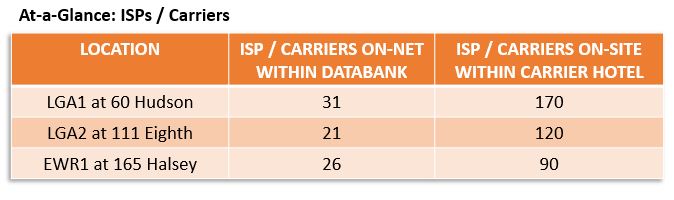
Whether you need to connect to an internet service provider, network service provider, or peering exchange, DataBank has interconnection points where you need them at our three carrier hotel data centers serving the greater NYC area:
LGA1 – 60 Hudson Street, New York City
More than 100 domestic and global telecommunications companies have established colocation interconnects inside DataBank’s secure LGA1 environment. This data center is located in one of North America’s premier carrier hotels in the Tribeca neighborhood of Manhattan. Previously, the building was the headquarters of Western Union and known worldwide for providing telegraph services.
With 700,000 square feet of floor space, the building is 24 stories tall and remains a well-recognized communications center with a nerve system of wires and cables reaching every corner of the nation and the world. Since the late 1990s, 60 Hudson Street has housed colocation operators and is recognized today as the main internet hub in the Northeast U.S. DataBank has unique responsibilities here since the 60 Hudson Meet Me Room is operated by DataBank. This means the 100+ domestic and global telecommunication companies that have a presence in the building can get interconnected via DataBank maintaining a carrier-neutral site.
LGA2 – 111 Eighth Avenue, New York City
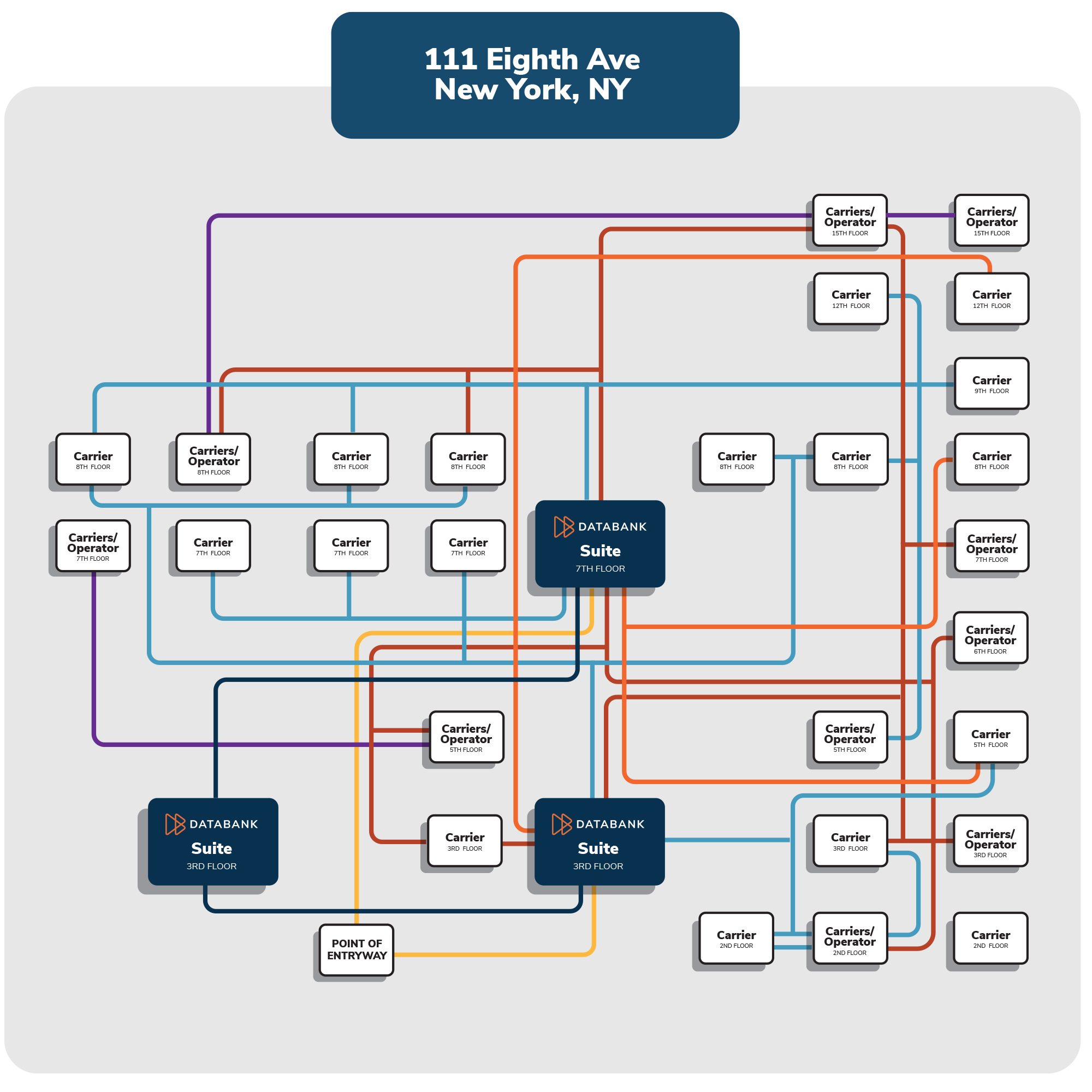
Also located in Manhattan, LGA2 is in a carrier hotel building that’s bigger than the Empire State Building and currently serves as the Google NYC headquarters. The building was originally the core piece of a plan created by the NYC Port Authority to reshape the region’s transportation network.
At 2.9 million square feet of floor space and 16 stories high, 111 Eighth Avenue has one of the largest footprints in Manhattan, taking up an entire city block. Some call it a skyscraper built on its side. In 1998, the building owners started bringing in the backbone infrastructure of the internet and internet tenants, and today the location is adjacent to trunk fiber optic lines—with access to 13 carrier hotels and 100 enterprise buildings in NYC and northern New Jersey.
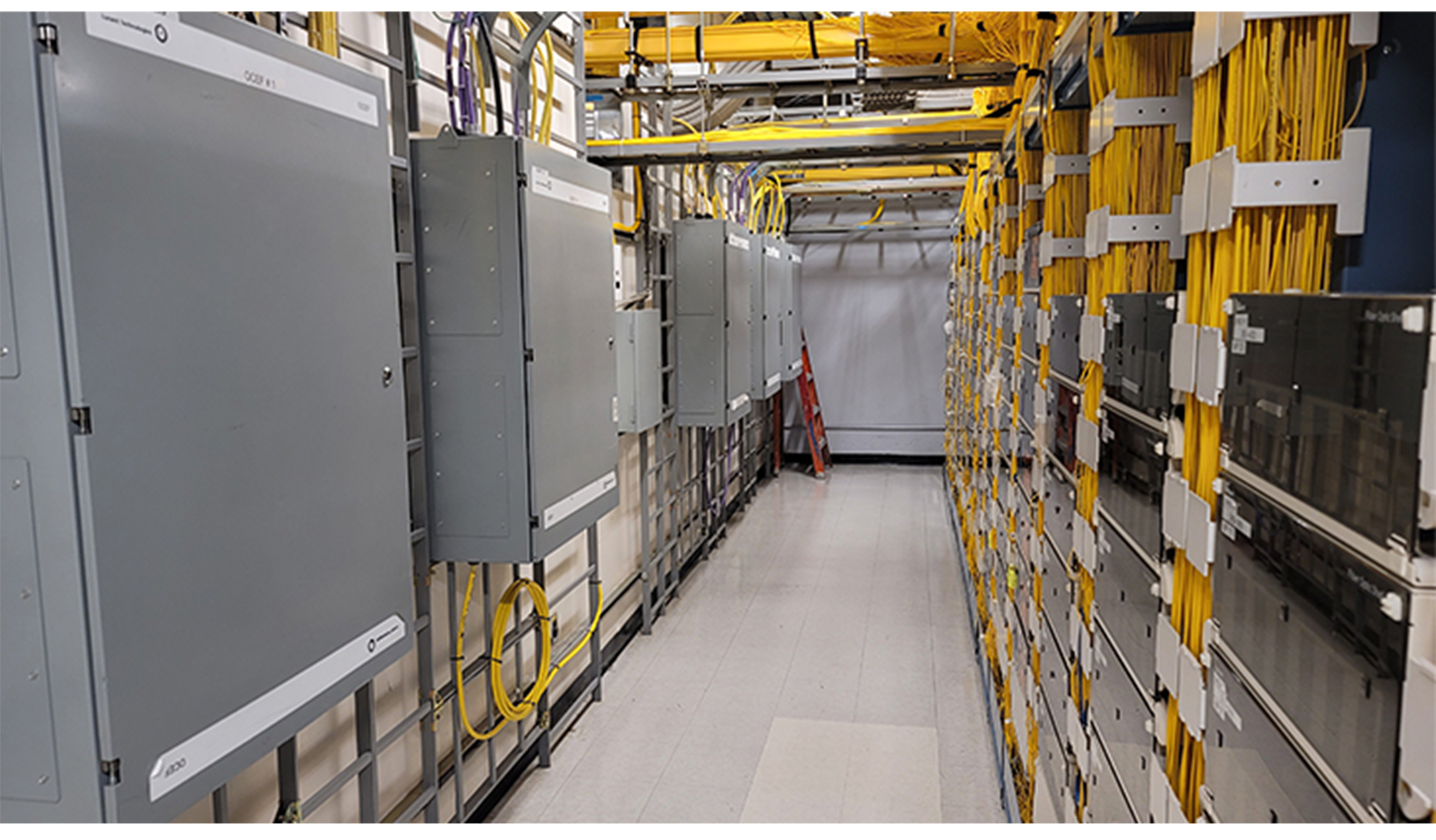
Connectivity at LGA2
EWR1 – 165 Halsey Street, Newark
This carrier hotel, EWR1, formerly known as the Bamberger Building, was initially designed as a department store. The 14 stories span 1.2 million square feet covering an entire block, and large open areas make it ideal for telecommunications equipment and data center operations.
As a major colocation center for the New York metropolitan area, the building is among the world’s largest carrier hotels and the principal access point of the Apollo optical submarine communications cable system crossing the Atlantic Ocean. Major financial exchanges have established a presence in the building, including the New York Stock Exchange and Nasdaq.
All three current data centers provide four internet exchange points, including a direct connection to DE-CIX Internet Peering Exchange, the fourth largest exchange in the U.S., and the largest neutral exchange on the Eastern seaboard. The data centers also leverage numerous submarine cable connections to accelerate communications and data exchanges across the Atlantic.
Interconnection Services
· Access to multiple entryway points, diverse riser paths, and numerous fiber networks.
· Console Connect and Megaport cloud on-ramps—using a combination of virtual cross-connects, intra-building risers, and local loop connectors.
· Extensive internal cross-connects and risers among DataBank data center rooms and with other data center operators in the carrier hotels.
Coming Soon: Expanded Capacity in New York
The three DataBank data centers at carrier hotels in NYC and Newark provide infrastructure services to more than 175 customers—spanning telecom, mobile carriers, entertainment, healthcare, media, IT, and other industry sectors.
For added compute capacity and data backups, DataBank is building LGA3 in Orangeburg, NY, and tethering it to LGA1 and EWR1 upon opening in early 2024. LGA3 will offer 40 MW in over 200,000 square feet as a greenfield build where the benefits of these highly connected carrier hotels will be available via DataBank’s managed interconnection services. With over 45 network providers combined within LGA1 and EWR1, LGA3 customers will have immediate access to these providers with many providers having diverse Points Of Presence within LGA1 and EWR1.
If we are to believe the latest headlines, it may seem like we’re just a few years away from autonomous cars, powerful AI tools rendering many jobs (and even entire careers) obsolete, and other examples of futuristic technology transforming our daily lives.
While the jury is still out on these use cases and their long-term implications, it is safe to assume we will continue to see the introduction of new technologies as well as the evolution of existing digital tools. In response to these developments, consumers will demand new – and better — products, services, and experiences. Businesses will also react, both to meet these new expectations but also to meet their own goals of becoming more efficient, more agile, and more competitive.
All of this will change current conventional approaches to developing, implementing, and using IT infrastructure. New developments will also force data center providers like DataBank to adapt new strategies and technologies to provide the power, performance, edge presence, and other criteria tomorrow’s businesses will require.
How will IT infrastructure evolve and what will it look like in the next ten years? To answer these questions, it may help to look at three emerging technological trends – AI, 5G, and edge computing – and see how they’re already influencing future generations of IT infrastructure.
AI Workloads: An Exponential Game Changer Requiring Exponentially More Power and Cooling
It’s hard to believe that it’s only been a few months since ChatGPT first became available for public testing in November 2022. Yet, it’s clear that this technology has the ability to transform, revolutionize, and even upend so many of our daily practices and processes. This includes everything from creating content to automating workflows to streamlining administrative tasks and more.
As the use of artificial intelligence continues to explode, AI-driven workloads will require much more processing power, data storage, and network bandwidth. Many companies will have to upgrade some facets of their architecture with high-performance computing, cloud-based data storage, and even new network hardware.
Data center providers supporting these companies will need to provide much more power to a smaller amount of space to support these AI workloads as well as new use cases we may not even be thinking about yet. Consider the fact that ChatGPT currently has nearly 25 million daily visitors, whose search activity translates to approximately 600,000 kilowatt hours per day of consumption – 2,000 times more than what the average U.S. household consumes each day.
DataBank is already seeing high-performance computing cases where our customers now need 30-100 kilowatts for each cabinet in the data center. This is not an incremental increase. These power density requirements are an exponential leap over previous scenarios where data center customers only needed three to 10 kilowatts.
With more power will come the need for more cooling. This means that future data centers will have to rely on new cooling methods – such as rear chilled doors, water to the chip or immersion technologies – as well as other strategies such as more intelligent data center design to provide the right mix of power and cooling.
The Continued Rollout of 5G and the Push to the Mobile Edge
5G has the potential to increase connectivity between people, digital products, and services while delivering higher data speeds, lower latency, increased availability, and other benefits. For businesses and service providers to take full advantage, they need to move beyond hardware-centric, previously centralized infrastructure and implement a more scalable, cloud-native architecture.
Driven by the promise and potential of 5G networks, more and more companies will push their infrastructure and hosted data centers even further to edge markets. This will be true as more companies continue to adopt 5G (and even look to the release of 6G in 2030). This new approach is critical to reach customers at the edge of their network and deliver the enhanced experiences associated with 5G.
As I covered in the sidebar of this article, four critical infrastructure components are needed to manifest the potential of 5G. You can find this at the very end of this article.
In the past, the entire industry leaned toward a centralized model where servers, fiber optic cables, and data storage were consolidated in a relatively small number of “core” data centers locations. With the emergence of 5G and the new era of mobile edge computing, far more data will be created at the edge — near users of the data — and will need to be processed and stored there to support IoT, robotics, gaming, autonomous machinery, and latency-sensitive applications and workloads.
In these mobile edge environments, network providers will increasingly be drawn to Tier 2 and Tier 3 markets, expanded geography within Tier 1 markets and the multi-tenant data centers located in them. They are also expected to take advantage of modular data center platforms that can be deployed anywhere with closer proximity to fiber and cellular tower infrastructure. They will also be able to perform localized internet exchanges in facilities that are more open and neutral than past options.
The Future is Not So Far Away
These trends are already happening now and affecting the way companies are designing their IT architecture. They also raise new questions when it comes to evaluating future data center providers and what options will be right for their business. It’s clear that their infrastructure will have to change to keep pace with industry and technology developments, so getting a proactive head start on strategic planning now – and identifying the right hosting model – can go a long way to ensuring future success.
To learn more about DataBank, and how our we’re designing our data centers to meet tomorrow’s infrastructure needs, please visit www.databank.com today.
###
The 4 Critical Components of Deploying a True Stand-Alone 5G Network:
Incorporating the full-frequency, three-spectrum-band “layer cake” all the way from cell towers, small cells, or rooftop RF distributions to devices. This weaves together low, mid, and high band frequencies that will provide the Ultra-Wide Broadband (UWB) and Ultra-Low Latency (ULL) of 5G; the carriers are about 25% of the way to completing this component.
Re-architecting network cores from 4G to 5G virtualized. This will transform the cores from a centralized design to an architecture where a relatively smaller number of control points are disaggregated into dozens of user-plane locations where applications can access the network at a more local level.
Virtualizing Radio Access Networks (cRAN or vRAN) so cell towers in a region can pool their resources to handle peak user activity and improve handoff between cell zones. This eliminates the need to size each individual macro site for peak activity, which is the case with 4G.
Leveraging open networks components where the key network functions are ‘virtualized” as software that runs on commodity hardware and allows applications to plug directly into networks. This approach enables a more proximate location for mobile users to access edge computing at cRAN cell tower locations and performing like the internet in terms of aggregation points.
National Security’s Cautionary Tale for Business Security Leaders
By Mark Houpt, Chief Information Security Officer, DataBank
In late 2021, I was interviewed by Forbes as part of an article on 8 Crystal Ball Predictions About Cyberattacks in 2022. At the time, I predicted that we’d all have to be much more vigilant in defending against cyberattacks from state-sponsored groups around the world.
Fortunately, not all of these predictions came true, although I still think the industry was wise to consider them at the time. For example, we just didn’t see any attacks against major COVID-19 vaccine makers or against high-profile events such as the World Cup. This was most likely due to the combination of increased diligence and cybercriminals looking for more profitable opportunities elsewhere, and frankly — as in the case of the World Cup — the expenditure of lots of money on tools and software to prevent the attacks.
So…why publish an article about 2023 predictions in March? It’s simple. We should never treat data security introspection and systems evaluation as we do New Year’s resolutions: made with the best of intentions but quickly abandoned.
Back to the Forbes article, one of the quoted experts predicted that cyber-threats would continue to evolve and increase in number, especially ransomware. I believe this will always be the case because cybercriminals continue to be motivated by potential financial gains and the acquisition of intellectual property. In the case of ransomware, the volume of these attacks has increased because many of them have been successful in getting the affected company to pay the ransom as well as the fact that they believe insurance companies will pay the ransom on the company’s behalf. Another reason for their success is that ransomware effectively obfuscates the theft of intellectual property.
While many of the 2022 predictions in that article represented valid concerns, the good news is that we simply did not experience all of them in the way we envisioned. Yet, one stood out: the fact that cybercriminals will continue to adopt more sophisticated strategies to do harm as they try to stay a step ahead. With this in mind, I have three additional cybersecurity predictions for 2023.
Although you’ll notice a theme of national security in my predictions, as CISO of a for-profit business, I am ever mindful that security breaches of any kind can – and do – bring negative implications for businesses and their customers.
Prediction #1: New Conflicts Will Begin as Cyber Events
We’ve officially reached the point where modern warfare will most likely start as a cyber event rather than a physical (kinetic) demonstration of force. While not widely reported, this happened in Eastern Europe in February 2022: Cybercriminals sponsored by the aggressor hit the attacked country’s infrastructure and other systems with crippling DDoS and other cyberattacks more than a week before the land invasion commenced.
I believe this will now become the norm. If there is a major conflict or an advance in an existing conflict, the first waves will be cyber—cyberattacks against critical infrastructure, service providers, and essential government entities and the businesses that support them. This can be an extremely effective way to disrupt communications and take important operations and services offline as well as prove a capability.
Prediction #2: The Increased Weaponization of Social Media
I also believe that we’ll see social media platforms start to be used as an actual weapon. This will evolve past the standard ways that social media platforms are used to distribute and disrupt information flow, share videos, and solicit support and assistance. Now virtually anyone can use social media and other technology to track and target the opposition and its followers. We’ve already seen examples in the current war in Eastern Europe where both sides have used open-source intelligence from social media sites as well as IP address tracking to develop very effective targeted bombing campaigns.
Fortunately, the United States is not in such a conflict, but the takeaway is still important. Companies need to be very careful about what information they or their employees share and protect other technical details as much as possible to bolster their cybersecurity defenses.
Prediction #3: Banning of Foreign Equipment and Technology
I think we’ll start to see more scrutiny related to sanctions and even banning foreign-made equipment and technology in the United States and possibly within NATO countries. For example, recreational drones are becoming more popular in the U.S. and now offer the latest advances, such as high-resolution cameras that are so accurate they can use geolocation data to identify and track images within just a few feet.
However, there’s a real concern about the data these products collect, and more specifically, if it could be sent back to the countries that manufacture them without the knowledge of the user. If so, what is the purpose, and what is this data being used for?
Again, this prediction has real cybersecurity implications not just for government organizations, but also for the industrial sector and private companies. Imagine if a foreign power used data collected from products and technology that were strategically placed in the United States as part of a powerful cyberattack or even a covert intelligence collection tool. It’s possible a rogue nation-state or other group could target vital infrastructure such as power and energy, gas pipelines, telecommunications, water, or even roadways—which could be devastating.
Stay Vigilant
In many ways, 2022 was a turbulent year, and unfortunately, one where global geopolitical developments could potentially put U.S. companies at more risk. For data center providers and their customers, this means now is the time to thoroughly assess their existing cybersecurity defenses. There’s a saying in the cybersecurity industry today: “It’s not if you’ll come under attack, but when.” Knowing this, while also considering where new cyberattacks could come from, may help give you the upper hand against new adversaries in 2023.
By Mark Houpt, Chief Information Security Officer, DataBank
According to market research firm Statista, the total amount of data created, captured, copied, and consumed globally is projected to grow to more than 180 zettabytes by 2025. One zettabyte is equal to one trillion gigabytes—a number far beyond our imagination.
With all this data out there, and expanding ways to access the data, more and more enterprises and research institutions are finding they need High Performance Computing (HPC) capabilities to solve advanced computational problems. They’re hiring data scientists to develop the required algorithms and investing capital to purchase enough compute and networking firepower to crunch the numbers as fast as possible.
Perhaps, you’re not yet quite ready for HPC but may be in the future. You may be ready to begin or you’re well into your journey to create the infrastructure and hire the expertise to enable HPC. Either way, consider the data center you will need to provide a home for all the servers, switches, routers, other gear, and the right facility for your environment.
Here’s a quick rundown of what to evaluate on your HPC Journey:
Density is the first and most important factor—the kilowatts per cabinet your data center can deliver. HPC systems can run from 10 kW per cabinet to as high as 100 kW and above. Your server manufacturer will advise you on the kilowatts your servers require, and using as few cabinets as possible is key. That’s because you want to minimize the length of cables connecting your networking gear. Costs and latency escalate quickly as the distance increases, and your servers may not be able to deliver the performance you require. As an example, if your servers require 100 kW, your networking costs will be a lot lower if you stack all the servers in one 100-kW cabinet rather than using five cabinets that deliver 20 kW each.
Cooling is another key factor as servers that overheat won’t last long. The higher the kilowatt density of a cabinet, the more heat it generates, so your data center had better have systems to lower the temperature. Depending on your density requirements and your application workload, you may require air cooling, chilled cabinet doors, direct-to-chip cooling, or even chip immersion in a dialectic fluid. Even the physical cabinet layout plays a role with cabinet width and spacing, hot and cold aisle sizing, and air containment all contributing to cooling capabilities.
Resiliency varies by application according to the mission-critical status. Some applications have geographically diverse nodes that can fail over to each other, reducing the resiliency need. Others are highly dependent on local uptime and require high levels of resiliency. For these applications the data center needs to have sufficient power, backed by Uninterrupted Power Supply systems and Generators, all configured in a redundant topology.
Cybersecurity is another concern, especially for those organizations subject to regulation. Government data may require FedRAMP compliance while healthcare data will need HIPAA compliance. Other requirements could include SSAE 18, PCI-DSS, and GDPR compliance.
Location is influenced by whether your personnel need to physically visit the HPC infrastructure. You may also want the infrastructure to be within a certain distance of another node or another provider to reduce latency.
Equipment Weight increases significantly with High Performance Computing, meaning the flooring of your environment is another concern. While raised floors help diffuse heat, they are limited in how much weight they can support. You may need a data center that offers slab flooring.
Give Yourself Plenty of Time and Look for a Data Center with Flexible Options
One of the biggest pitfalls for enterprises and institutions planning to deploy an HPC environment is underestimating the timeline. Hardware supply chain issues and the time it takes to establish a relationship with a data center provider—plus the time to configure and deploy the gear—usually take several months for an HPC solution. It’s sometimes possible to accelerate the timeline, but we recommend you pick up the phone and call for help at least one year in advance of your target deployment.
No matter where you are on your HPC journey, DataBank is ready to help. Our expertise helps you determine exactly what you need from your data center so that you don’t have to adjust after ordering your servers and networking gear. Our colocation data centers feature a flexible Universal Data Hall Design framework that provides slab floors and allows us to easily add raised flooring to accommodate varying cabinet sizes, layouts, and other options.
Even if you don’t need an HPC solution today, we can provide a cost-effective solution for your current computing needs, and you will have the option to convert to HPC in the future—without moving to another data center.
Interested in learning more about Databank, and how we help our customers with the best high-performance computing options and services to drive their business? Visit www.databank.com today.
For more information on Databank’s HPC solutions, visit our website. We have many years of experience accommodating and delivering high-density colocation HPC solutions in public supercomputing environments such as Georgia Tech and the University of Maryland. We also support publicly traded organizations in the financial services, cloud, software, and AI sectors. Our staff includes seasoned veterans in engineering, construction, and data center operations.
Key Takeaways:
Rising infrastructure costs and scalability challenges signal the need for colocation
Businesses outgrowing on-prem setups benefit from shared facilities
Improved reliability and performance drive migration decisions
Colocation supports long-term IT strategy modernization
By Mike Alvaro, Senior Solutions Architect, DataBank
Your IT infrastructure plays a critical role in the success of your business, and it is essential to keep it updated and modernized. Yet, beyond managing IT assets, it’s also important to pick a strategy that is right for your business.
Many companies start by managing on-premises servers, networks, databases, applications, and workloads, but soon realize they would be better served by migrating to a multi-tenant data center, also known as colocation.
There are usually many different reasons behind this decision: complexities of managing your own data centers, rising costs, overwhelmed IT resources, a demand for more computing power, geographic diversity for disaster recovery, evolving edge-computing strategies, and more. For many companies, it can be hard to tell when it is the right time to make the move.
To help, let’s take a closer look at some of the most common key indicators. Are you asking any of these questions?
Security concerns: Have your worries about security – both physical and digital – grown? You’re not alone. One of the primary benefits of a multi-tenant data center is increased security. As businesses continue to collect and store more sensitive data, it’s crucial to have a secure infrastructure in place. Colocation data centers are equipped with state-of-the-art security measures, such as biometric access controls, multi-factor authentication, and 24/7 monitoring, that can provide a higher level of security than most in-house IT infrastructures.
Also, managed security and specialized cybersecurity solutions at colocation data centers will protect your most critical digital assets.
Compliance requirements: Do you know whether your systems and processes are compliant? How would you respond if you were to be audited? For businesses that are subject to regulatory compliance requirements, such as FISMA, SOC 2, HIPAA, or PCI-DSS, moving to a colocation data center can provide peace of mind. Colocation data centers are designed to meet a wide array of compliance requirements that provide a secure environment for storing and processing sensitive data.
Scalability: Is your current model hampering your ability to grow? Another significant advantage of a colocation data center is scalability. As businesses grow and change, their IT infrastructure must keep up. Multi-tenant data centers offer scalability options that allow businesses to quickly increase their IT resources as needed, without the need to manage expanded facility space and operations.
This scalability can be a valuable asset to businesses that are looking to grow rapidly, or those that have unpredictable workloads.
Cost savings and control: Is the cost of managing your own data center spinning out of your control? Moving to a colocation data center can also result in significant cost savings. By sharing resources with other tenants, businesses can benefit from economies of scale, which can reduce the costs of maintaining their IT infrastructure, such as energy-efficient equipment and cooling systems, which can significantly reduce energy costs.
Additionally, moving to a colocation data center also moves your management costs from a CapEx to an OpEx model for greater control.
Outdated technology: Are you simply making do with your current technology stack? The best colocation data center providers continually invest in the latest technology, which ensures that businesses have access, without the need to invest in new equipment or infrastructure. The equipment you use and the facilities where is all resides must stay ahead of your needs.
Disaster recovery: If a disaster where to strike, how long would it be before you can recover precious data? A colocation data center can also provide improved disaster recovery options. With multiple redundancies in place, including multiple power sources, backup generators, and backup storage, multi-tenant data centers are designed to provide uninterrupted service, even in the event of a disaster.
Additionally, colocation data center have a wide geographic footprint. (DataBank currently has 65+). This gives you options when it comes to selecting two or more data centers to a create a geographic diversity strategy to best support disaster recovery objectives.
Moving to a multi-tenant / colocation data center can provide numerous benefits to businesses, including increased security, scalability, cost savings, and access to the latest technology. If your business is facing security concerns, needs to scale quickly, is using outdated equipment, is subject to regulatory compliance requirements, or is looking to improve its disaster recovery capabilities, chances are good that it’s time to consider a move to a multi-tenant data center.
###
Interested in learning more about Databank, and how we’re helping our customers with the best colocation options and services to drive their business? Visit www.databank.com today.
Our 24,000 sq. ft. expansion of SNA2 in Irvine, CA will offer an additional 24,000 square feet of raised flooring and 4 megawatts of critical IT power. The total build-out will be 57,700 sq. ft. and 8 megawatts of critical IT power. To learn more about our Irvine facility, visit our website at https://www.databank.com/data-centers/irvine/
Featuring: Mark Houpt, DataBank’s Chief Information Security Officer
Listen to Mark Houpt as he discusses Trust but Verify: The Normalization of Security Operations.
Here are a few things you’ll learn:
Is two-factor authorization here to stay?
The value of various verification methods
Multi-factor authentication fatigue
Run Time: 9 minutes
DataBank’s CISO Corner is for CISOs and security practitioners, where we discuss a variety of cybersecurity topics and current events from the CISO’s perspective. Our broadcast is designed for those who want to hear from security and compliance experts on the front lines.