From Pearl River Day to the Little League fields, DataBank’s local involvement reflects a commitment to putting people first.
Being part of a community means more than operating a facility there. It means getting to know the people who live nearby, understanding what matters to them, and finding meaningful ways to contribute.
For DataBank, a recent opportunity to put that commitment into practice was Pearl River Day, where employees from our nearby LGA3 data center joined residents and local businesses for a day of conversation and community celebration.
Showing Up at Pearl River Day
Each fall, Pearl River Day brings approximately 25,000 people to Central Avenue to celebrate the businesses, organizations, and traditions that make the area special. With more than 200 businesses and vendors, food trucks, and live music, the festival gives neighbors a chance to connect — and businesses like DataBank a chance to introduce the people behind their local operations.
DataBank employees staffed a Pearl River Day booth to meet community members, answer questions, and build connections with local neighbors.
DataBank has been a premier sponsor of the festival for several years. This year, employees from our data center operations, construction, and sales teams also staffed a booth, spending the day meeting residents and introducing the people behind our local operations.
Despite cold, blustery weather, the team welcomed hundreds of visitors, answered questions, and handed out DataBank blankets, stadium cushions, and warm jackets that were particularly appreciated as temperatures dropped.
Alongside those giveaways, our employees distributed more than 150 copies of The Truth About Data Centers, providing a resource to help residents better understand these facilities, their role in everyday life, and important context needed in the public dialogue. Just as importantly, the booth created space for face-to-face conversations. Visitors could ask questions about DataBank and our local presence, while our employees had an opportunity to listen, learn, and get to know the people who live and work around LGA3.
That personal interaction matters, especially when development brings questions or concerns. A community festival offers something a website or project announcement cannot: an informal conversation with the people who work at a facility. Building trust takes time, and showing up is an important part of that work.
A Partnership Built Next Door
DataBank’s community connections also extend to the baseball fields neighboring our Orangeburg property. When work on the facility initially prompted concerns among local residents, conversations with Pearl River Little League representatives helped establish a relationship with an organization that has long been important to area families. Meeting league representatives during construction gave our team an opportunity to understand their needs and identify practical ways to help.
DataBank invested nearly $20,000 to help improve the dugout sheds and provide field lighting, contributing to facilities used by young athletes throughout the season. Our involvement has continued through approximately $5,000 in annual support for general sponsorship and student-athlete scholarships, helping sustain the partnership beyond that initial investment.
The relationship also includes a creative connection between the data center and the diamond: the “DataBank Dinger.” A poster on the facility gives players a home-run target, with qualifying home runs generating DataBank contributions toward scholarships. It adds excitement to the game while supporting opportunities for young people—a way to make the partnership both meaningful and memorable.
A Personal Connection to the Fields
For Ryan Buchan, a Junior Critical Infrastructure Engineer at LGA3, supporting Pearl River Little League is more than a workplace initiative. Ryan grew up in Orangeburg and played on these same fields. His father was also a dedicated league supporter and a member of its board, making the organization an important part of his family’s life. Today, Ryan works for a company helping care for the place where he once played.
Discover how DataBank supports Pearl River Little League through field improvements, sponsorships, and scholarships, and hear employee Ryan Buchan share his personal connection to the league.
“One of DataBank’s core values is ‘putting people first,’” Ryan says. “We want to be a positive influence on the community.”
For Ryan, that means supporting the people who live near the facility and contributing to the organizations that matter to them. Seeing DataBank help improve the fields where he played carries personal significance and connects his work today with his own childhood experiences. His story is also a reminder that the people working inside a data center can have deep roots in the surrounding area, with family histories and personal ties to the programs DataBank supports.
Continuing to Build Community Relationships
Pearl River Day and the Little League partnership put the same commitment into practice in different ways. One creates opportunities to meet residents, answer questions, and make our team accessible. The other supports an organization that brings families together and helps young athletes build confidence, learn teamwork, and make lasting memories. Both reflect the importance of listening and following through.
As DataBank continues its work in Orangeburg, we’ll keep looking for meaningful ways to support the people and programs that help the local community thrive.
Our recent food drive continued that commitment, bringing DataBankers together to support hunger relief in the communities we call home. Through hands-on volunteering, local food donations, and an Amazon wish list that let employees contribute from wherever they work, DataBankers supported a shared goal: helping our neighbors put food on the table.
Denver Volunteers Make a Hands-On Impact
Our Denver Metro team took a hands-on approach to hunger relief by volunteering at the Food Bank of the Rockies.
Employees volunteered their time sorting and packing food boxes for distribution to the community. During their shift, the team helped move 508 boxes containing 12,620 pounds of food — the equivalent of 10,516 meals.
Sorting and packing are essential steps in getting donated food to the people who need it. By taking on that work together, our Denver team helped the Food Bank of the Rockies get thousands of meals ready for local families.
Doubling Down on Giving in Dallas
Our Dallas Metro team built on last year’s food drive in a big way, collecting more than twice as much food.
The team delivered 440 pounds of food, representing 337 meals, to the North Texas Food Bank. The increase highlights how individual donations can add up to meaningful support our neighbors.
Participation also reached beyond the Dallas team. Through an Amazon wish list, employees across DataBank could purchase food and have it shipped directly to our Dallas headquarters. This gave DataBankers in other locations a straightforward way to join the effort and support hunger relief in the Dallas community.
Part of an Ongoing Commitment
The food drive is one of many ways DataBank Cares puts our commitment to our communities into action. Throughout the year, employees have opportunities to contribute their time and resources to causes that matter in the places where we live and work.
This year’s effort showed how different forms of participation can support a common goal. From packing food boxes in Denver to collecting donations in Dallas and contributing through the Amazon wish list, DataBankers helped provide food for neighbors facing hunger.
Thank you to everyone who volunteered, donated, or helped organize the drive. Your generosity made this effort possible and continues to shape a culture of giving back at DataBank.
This article continues our series on the facts shaping the debate around data centers and the grid. If you would like to follow the full discussion, you can read parts one, two, three, and four, or download The Truth About Data Centers for a more complete view of the topics covered so far.
Data centers have become an easy symbol for a power system under strain. They are large, visible, and many are tied to AI, which makes them a natural target in a public debate about electricity demand. Yet, the pressure showing up across the grid did not begin with data centers, and it will not be resolved by treating them as the main cause of the problem.
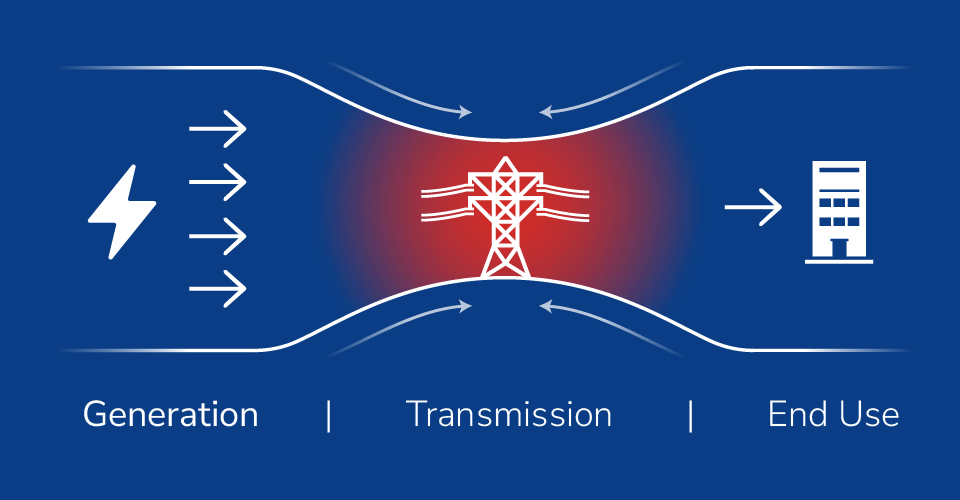
The bigger issue is structural. Much of the grid was planned for an era of slower load growth, more centralized generation, and fewer competing demands on the system. That planning model is now colliding with a very different economy, one shaped by online interactions, electric vehicles, building electrification, growth in domestic manufacturing, and a shift from traditional power plants toward a larger share of wind, solar, and battery storage. In that environment, the limiting factor is increasingly the network itself, especially transmission.
This is why the current conversation needs more context. The question is no longer simply how much electricity the economy will need. The harder question is whether the system can move power to the places where demand is rising, connect new loads and new generation fast enough, and do so with infrastructure that in many regions is already aging or congested.
A data center announcement is easy to see. A decade of underbuilt transmission is not.
Transmission Is Where Grid Stress Becomes Visible
That challenge is showing up across the country. Utilities are extending timelines for large new power connections. Developers are waiting years for transmission upgrades, new substations, and other system work needed before a project can be served reliably. Grid operators are also dealing with long backlogs of proposed power plants and battery projects that are waiting for approval to connect to the system.
The real grid challenge is not only adding power, but expanding transmission so electricity can reach where growth is happening.
According to Lawrence Berkeley National Laboratory, interconnection queues in the United States now contain more than 2 terawatts of generation and storage capacity. That number reflects how much planned supply is waiting on grid readiness rather than market interest alone. The issue is often less about whether new projects exist than whether the system can accommodate them.
Transmission sits at the center of this problem. High-voltage lines move electricity from where it is produced to where it is needed, whether that means carrying wind power from remote areas to population centers or serving fast-growing regions with rising commercial and residential demand. When transmission capacity falls behind, the effects show up quickly. Congestion increases, project timelines stretch, reliability margins tighten, and costs rise as utilities are forced into more expensive fixes.
Part of the challenge is geography, but that is only one piece of it. The transmission system was largely built around older patterns of generation and demand. Many of today’s fastest-growing sources of electricity, especially wind and solar, are being added in places far from major load centers. At the same time, demand is rising in regions shaped by population growth, manufacturing investment, digital infrastructure expansion, and transportation electrification.
The infrastructure itself also takes a long time to expand. New transmission lines can take years to permit and build. Substations and transformers are expensive, specialized, and often in short supply. Local opposition can slow projects. So can the difficulty of coordinating approvals across utilities, regulators, landowners, and in some cases multiple states. Even when everyone agrees new capacity is needed, adding it is rarely quick.
That is why transmission has become such a critical pressure point. The grid needs more than enough generation on paper. It needs the physical network required to deliver that power where growth is happening.
Electrification Is Expanding Demand from Every Direction
The economic shift now underway is making existing grid constraints harder to ignore. Electric vehicle adoption is beginning to reshape both total electricity consumption and local demand patterns. Residential charging, fleet depots, and highway fast-charging all place new demands on local distribution systems.
Those changes also add up at the regional level. As EV adoption grows, utilities have to plan for more electricity demand, different daily load patterns, and new infrastructure in places that were not built for it. With gasoline and diesel prices remaining elevated in 2026, that shift may accelerate as more drivers and fleet operators look for alternatives.
Building electrification adds another layer of pressure as heat pumps, water heaters, and other electric appliances shift energy use away from fossil fuels and onto the grid. Manufacturing is doing the same in some regions, as companies expand domestic production and pursue lower-emissions operations. In many cases, that new demand is showing up in areas where transmission capacity was already tight.
Data centers belong in that mix, but they are one category of large load seeking access to a system with limited spare capacity in many places. Their growth is significant, particularly in concentrated markets such as Northern Virginia, Texas, and parts of the West. Goldman Sachs has projected that global power demand from data centers could increase by 50 percent by 2027 and by as much as 165 percent by the end of the decade. Those numbers deserve serious attention, especially for utilities and regional planners.
They also point to a larger reality: Data center growth is happening alongside a much wider expansion in electric demand across transportation, buildings, and industry.
Years of Deferred Grid Investment Is Catching Up
Another important part of this story is deferred investment. Transmission projects take years to permit, approve, and build. So do substation expansions, transformer replacements, and many other core upgrades. In periods of relatively modest demand growth, it was possible to delay some of that work.
Today, the cost of that delay is becoming visible. The American Society of Civil Engineers has repeatedly warned that much of the nation’s energy infrastructure is aging and in need of modernization, and utilities across multiple regions have reported that lead times for major electrical equipment have stretched sharply in recent years. A grid that was once managed through incremental upgrades is now facing simultaneous pressure from new loads, changing generation patterns, and equipment constraints.
This is one reason the public discussion can become misleading. A data center announcement is easy to see. A decade of underbuilt transmission is not. A new large customer can be tied to a location and a megawatt figure. The planning assumptions that failed to anticipate overlapping growth from EVs, electrified buildings, domestic manufacturing, and digital infrastructure are harder to see, even though they sit much closer to the heart of the problem.
What the Grid Debate Should Focus on Now
A more useful way to frame the issue is to ask what kind of grid a more electric economy requires. The answer begins with transmission, but it does not end there. It includes faster processes for connecting new generation and large loads, better regional planning, modernization of substations and local delivery networks, and a regulatory framework that supports investment before constraints become urgent.
The pressure on the grid is real, and so is the growth in data center demand. Focusing too narrowly on data centers reduces a much larger infrastructure challenge to a single category of customer. The more important question is whether the grid can keep pace with an economy that is becoming more electric, more digital, and more dependent on reliable power delivery across every sector.
Transmission is at the center of that challenge, but the larger issue is grid readiness. That is the work in front of utilities, regulators, developers, and large power users alike.
Looking for clearer perspective on the issues driving the data center debate? DataBank Digest brings you analysis, insights, and the latest developments across digital infrastructure, energy, and growth.
Leadership development looks different depending on where you sit at DataBank. In construction, a mistake shows up in steel and concrete or on a deadline that will not move. In security, a mistake shows up in trust, in the confidential information customers hand over the moment they sign a contract. Different stakes, different daily pressures, and we feel both every day.
A few convictions show up again and again, whichever side of the business you’re on. In this article, we bring together perspectives from both sides to share the strategies and best practices that hold up across DataBank.
Prove It Before You Get the Title
The instinct in most organizations is to hand someone authority first and see what they do with it. We tend to run it the other way.
When a new team function grows from one person to four, and two candidates have equal standing, the answer is not a coin flip and it is not a title. It is six months of informal, shared leadership, with both people told plainly that one of them will end up running the group and the process itself will make it obvious who. Leading without authority is harder than leading with it, and asking someone to prove they can do the harder version first tends to produce a leader people actually want to follow, rather than one they are told to.
The same instinct shows up as patience elsewhere in the business. High potential is not something we spot in a single strong quarter. It takes time, and it takes more than one person’s opinion. A leader who is only impressing the person one level up, while treating peers poorly, is not showing high potential.
That’s something else entirely, and multiple perspectives are what surface the difference. Once a handful of people independently point to the same specific instances of strong judgment or capability, we consider that worth investing in. A gut feeling from one manager is not.
There is No One-Size-Fits-All Development Path
Most career ladders are built in fixed steps: analyst to manager to senior manager, in that order, whether or not the person climbing it actually wants what is waiting at the top. We start from a different question: what does this specific person want, and why?
That means pushing back gently when someone asks for the “logical next step.” Wanting authority is not, by itself, a reason to grant it. The better question is why someone wants the promotion in the first place. A strong individual contributor and a strong manager are frequently not the same skill set, and pushing someone into people-leadership because he or she excelled technically can be a set-up for failure.
It also means learning how each person actually receives feedback before delivering it. The same words, the same tone, land completely differently depending on who is hearing them. Two children raised in the same house, given the exact same sentence, can walk away with two different reactions.
A lot of that comes from raising many children (a total of seven from both executives), and a fair amount from Ted Lasso. Both taught us that you can’t lead everyone the same way and expect the same result. Knowing someone well enough to choose the right words is not a soft skill. It is what makes the rest of coaching possible.
Feedback Is a Question, not a Verdict
We don’t describe our harder conversations as confrontations. We describe them as questions and opportunities to learn and grow together.
Instead of opening with, “You did this wrong,” the more useful opening is, “Do you think we got the result we wanted?” That single question does two things at once: It tells us whether the gap was a skills problem or a communication problem, and it gives the other person room to arrive at the answer rather than defend against it.
One discovery we’ve made through exactly this kind of question is that a missed expectation isn’t always a performance issue. Sometimes it’s a failure to define what success looked like in the first place, which means the fix is a clearer conversation, not a disciplinary one.
Bad news doesn’t improve with time. If a piece of feedback is landing for the first time in a formal performance review, that review has already failed, which is a sign of poor leadership. The fix is small, frequent course correction, delivered as soon as the gap appears, framed around what support is needed rather than what went wrong.
Conflict itself isn’t the problem. Different perspectives are how we learn from each other. It only becomes a problem when it turns personal or chaotic, and that’s when a good leader steps in — not before.
Why the Stakes Shape the Approach
The two sides of our business feel this differently, and that difference is worth naming rather than smoothing over.
On the construction side, the pressure is external and immediate: a labor market stretched thin across general contractors and subcontractors, where people are routinely poached on compensation alone. Our counter to that isn’t matching every offer. It’s building loyalty that survives a competing offer, the kind where people choose to follow a leader they trust rather than stay for a transaction. Autonomy, real investment in someone’s goals, and a workplace people want to recommend to a friend all compound in a way a signing bonus doesn’t.
On the security side, the pressure is about trust. We hold information most people never see, and data centers themselves are increasingly viewed with suspicion by the communities around them. That makes integrity part of the leadership pipeline itself. Identifying high potential isn’t just about capability. It’s about whether someone will handle what they’re trusted with the way they say they will, in public and in private.
While the risks are different, the stakes are still the same: Will this person do right by what he has been given, whether that’s a team, a timeline, or a customer’s trust?
Different Hats, Same Habits
Strip away the hard hats and the security clearances, and the same three habits carry both sides of our business: earn the role before you’re handed it, build a development path around the individual instead of the ladder, and give feedback the moment it’s needed instead of saving it for a form. None of that is unique to data centers. What’s unique is how much is riding on getting it right, and it’s something we take seriously across the board.
Want to learn more about how DataBank’s leaders build and grow strong teams across the business? Visit our Leadership page or explore DataBank Digest for more insights on talent development and management strategies.
This is the fourth article in a series exploring the facts behind the data center debate. You can read parts one, two, and three, or download our full eBook, The Truth About Data Centers, for a closer look at the issues covered in this series.
Water consumption is one of the most emotionally charged concerns raised about data centers today, and it’s one of the most misunderstood. A single statistic can circulate for months before anyone checks where it came from, and by then it may have already shaped local debates and headlines.
The picture looks very different once you look at how these figures actually get built.
Cooling Isn’t One Thing
Lumping every data center into the same water conversation is where most confusion starts. There are three completely different approaches to cooling, and each comes with its own tradeoffs.
Air-based cooling uses no water at all, relying entirely on traditional air conditioning. It’s common in older and smaller facilities, although it becomes less practical as computing density rises.
Evaporative cooling trades water for efficiency. It’s a continuous process: Water goes in and doesn’t come back, and many large legacy facilities run this way because the energy savings are real.
Closed-loop cooling sidesteps that tradeoff entirely. Water (or in some systems, a glycol-based fluid) circulates inside a sealed system rather than getting released, so once the system is charged, ongoing consumption approaches zero.
That distinction is measured through Water Usage Effectiveness, or WUE, the industry’s standard for tracking how much water a facility uses relative to its size and output. DataBank’s standard facility design runs on closed-loop cooling, so new builds start service with a near-zero water footprint from day one, not something the facility works toward over time.
The inflated version counted water lost to evaporation at hydroelectric reservoirs as part of a data center’s footprint, water that evaporates off dammed rivers regardless of who’s drawing power from the dam. It’s a bit like arguing that a retail store uses water every time its cash register rings up a sale, since generating the electricity behind that transaction required water somewhere upstream.
Strip that out and the numbers change dramatically: Masley’s corrected estimate for onsite water use lands around 2.2 milliliters per prompt across the U.S. grid, or about 1/227th of a standard bottle. It’s the same underlying data, but just with a different definition of what actually counts as data center water use.
Real Numbers, Real Context
Compare data center water use against everyday consumption and even the larger figures shrink fast.
A less-discussed piece of this story is the power behind the water. Fossil fuel generation is water-intensive; yet, wind and solar are not. As the grid shifts toward renewables, a data center’s indirect water footprint shrinks along with its carbon footprint, even before accounting for cooling design. That’s a benefit that rarely makes it into the figures critics cite, even though it compounds every year renewable capacity grows.
Drought-prone communities are right to ask hard questions here, and those concerns reasonably extend beyond onsite cooling to the water used generating the electricity in the first place. The honest answer is that the industry isn’t moving at a uniform pace, which is exactly why specifics matter more than pledges.
The Bottom Line
Water figures that sound alarming often turn out to be measuring the wrong thing, not the wrong facility. Once the boundaries get examined, a modern, closed-loop data center tends to look a lot more like an office building than an industrial plant.
Data centers are essential infrastructure, and concerns about their footprint deserve real answers, not headlines that never checked their own math.
Want to stay ahead of the trends shaping digital infrastructure? DataBank Digest delivers analysis, insights, and the latest news from the world of colocation and digital infrastructure.
Network latency has quietly shifted from an operational metric to a strategic risk. For years, IT teams measured performance almost entirely in uptime, watching for outages, tracking service level agreements, and treating five nines on a dashboard as proof the network was doing its job. That measure is no longer sufficient. A network can be fully available and still be costing the business money every day, one slow response at a time.
That cost has a name: latency. It is the delay between a request and a response, and it rarely announces itself as a failure. Instead, it shows up as a checkout page that loads a second too slowly, a trading algorithm that reacts a few milliseconds too late, or a fraud detection system that flags a transaction after the damage is done.
These delays are easy to overlook because nothing technically breaks. They are also easy to underestimate, because the cost accumulates across thousands of small moments rather than one visible incident, which is exactly what makes it dangerous for leaders who are only watching uptime.
Where Latency Actually Comes From
Latency rarely comes from a single failure point. It accumulates anywhere data travels farther or through more steps than necessary, and most networks have several of these points built in without anyone noticing.
Public internet routing is the most common source. Traffic moving across the open internet takes an indirect path by design, hopping between networks before reaching its destination. Each hop adds delay, and each additional network in the path becomes a place where congestion or packet loss can slow things down further. The internet was built for resilience, not speed, and that tradeoff shows up as latency.
Physical distance compounds the problem. A request traveling from a data center on one coast to a cloud region on the other carries transmission time that no amount of software optimization can fully remove. Layer in the number of applications, APIs, and third-party services most businesses now depend on, and it becomes clear why latency compounds quickly across a modern technology stack, often in ways that are difficult to trace back to a single cause.
Why This Matters More Than It Used To
A decade ago, a little extra latency was a tolerable inconvenience, something IT teams optimized around when time allowed. That tolerance has disappeared. Across nearly every industry, latency has become a measurable competitive disadvantage, and the businesses that treat it as a minor technical detail are absorbing costs their competitors have already engineered away.
Financial services. Firms build entire infrastructure strategies around shaving microseconds off trade execution, because in that industry, microsecond translate directly into dollars.
Retail. A slower checkout experience leads to more abandoned carts and lower conversion rates.
Healthcare. Fast, reliable data exchange matters for systems where delay is not just inconvenient but potentially harmful.
AI workloads. Training large models and running real time inference both depend on moving enormous volumes of data quickly and predictably. When the network cannot keep pace, businesses either accept degraded performance or delay the AI initiatives they were counting on to drive growth.
None of this is hypothetical. Across these industries, the cost of latency shows up in lost revenue, lower conversion rates, and missed opportunities, and it rarely arrives with a clear root cause attached. That is what makes it dangerous. The businesses that get ahead of it are the ones actively looking for it, rather than waiting for it to show up on a balance sheet.
Interconnections Change the Equation
Interconnections solve the latency problem by giving data a more direct route instead of relying on the public internet to move information between applications, clouds, and partners. A few core approaches make this possible.
Cross connects. A direct, dedicated link inside a data center connects two networks directly, often reducing what would be a multi-hop journey to a single, predictable connection.
Direct cloud on-ramps. Rather than sending traffic out to the public internet to reach a cloud provider, a private connection carries that traffic straight to the cloud environment. The result is lower latency, more consistent performance, and fewer variables that can introduce delay.
Internet exchanges. Networks peer directly with each other, cutting out the transit providers that would otherwise sit in the middle of every exchange.
Together, these approaches replace an unpredictable, multi-hop path with a shorter, more direct one.
What This Looks Like in Practice
Consider a mid-size fintech firm running algorithmic trading systems. Every millisecond of delay between its systems and the exchanges it trades on represents a measurable financial risk, one that shows up directly in execution quality rather than as an abstract performance metric.
By colocating its infrastructure in a facility with direct, low latency connections to major exchanges, the firm removes the unpredictable variable of public internet routing entirely. Trades execute faster, risk models run closer to real time, and infrastructure costs become more predictable, since the firm is no longer paying for the inefficiencies of a longer network path or absorbing the cost of unplanned volatility in its connection quality.
That advantage compounds when the firm’s own infrastructure sits inside the same facility as its network provider. The connection is not just faster, it is also physically protected by the same power redundancy, cooling systems, and access controls that safeguard the network equipment itself. A firm relying on a remote connection back to its infrastructure is exposed to a failure at either end. A firm colocated alongside its provider closes that gap.
The underlying principle extends well past financial services. Any organization moving data between clouds, partners, or physical locations at meaningful volume is running the same risk calculation, even if the consequences are less immediately visible than a missed trade. A retailer’s fraud check, a healthcare system’s record exchange, and a manufacturer’s supply chain data feed all depend on the same fundamentals: shorter paths, fewer hops, and fewer variables outside the organization’s control.
The businesses that recognize this early are the ones designing their infrastructure around it, rather than discovering the cost after the fact.
The Real Return on Interconnections
Latency is often invisible until someone quantifies it, and by then the cost has usually already accumulated. The businesses that get ahead of the problem are the ones that treat connectivity as a strategic decision rather than an afterthought. Interconnections offer a proven way to shorten the distance between systems that need to talk to each other quickly, reliably, and without the unpredictability of the open internet.
The hidden cost of latency is real, but it does not have to be permanent. With the right interconnection strategy in place, it becomes a cost businesses simply stop paying.
Want to learn more about how DataBank’s interconnection ecosystem can help reduce latency across your network? Visit our Interconnections page or explore DataBank Digest for more insights on network performance and infrastructure strategy.
In another example of DataBank employees giving back to the community, employees from across the country recently came together for a backpack drive to help local students start the school year off right. This time, the effort centered on something every kid needs on day one: a backpack stocked with supplies.
The effort came together in two rounds of generosity. First, DataBank employees, along with vendors and customers, donated funds to purchase backpacks and the supplies to fill them. Then, many of the same volunteers gathered at our Salt Lake City data center to stuff the backpacks before delivering them to a local elementary school. In total, contributors gave over $1,250 toward the project in addition to their time.
DataBank employees participated in a backpack drive to donate 60 backpacks of school supplies to students and teachers at a local school.
Twenty-Seven Volunteers, One Classroom-Ready Delivery
Twenty-seven DataBank employees pitched in to pack the backpacks, some of which were branded with the DataBank logo. Each one was filled with a water bottle, notebook, ruler, crayons, pocket folder, pencil pouch with pencils, eraser, pencil sharpener, glue stick, and kid scissors. The team also set aside extra water bottles, notebooks, erasers, pocket folders, pencils, and crayons for teachers, recognizing that classroom needs do not stop with students.
The finished backpacks were delivered directly to Bluffdale Elementary, giving local kids and their teachers a boost heading into the school year. It is a small gesture with an outsized impact for families who could use the help.
A Culture of Giving Back
Backpacks are one more example of a commitment that shows up across DataBank markets throughout the year. A few recent examples:
Kindness Kits: Employees across Houston, Dallas, Salt Lake City, and Denver assembled and donated 852 care packages this spring for organizations serving women, children, and individuals in need.
DFW Metro Blood Drive: DataBankers, customers, and vendor partners came together at our DFW3 facility, with 21 donors giving blood and two giving double donations.
Letters to the Troops: Teams across eight data centers wrote and sent more than 500 letters of gratitude and encouragement to U.S. service members.
DataBank employees consistently look for ways to support the neighborhoods surrounding our data centers, and Salt Lake City’s backpack drive is a good example of that spirit in action.
We are proud of every DataBank employee, vendor, and customer who contributed to this effort. We are especially proud of our Salt Lake City team, who stepped up a second time to pack and deliver the backpacks, making sure Bluffdale Elementary students and teachers started the year with what they needed.
Want to learn more about how DataBank is investing in the communities where we operate? Visit our Community Relations page or explore DataBank Digest for more stories about our people, our partners, and the neighborhoods we’re proud to call home.
Your choice of hosting provider will determine the quality of your hosting experience. This means it’s vital to go through a robust evaluation process before choosing a vendor. With that in mind, here is a straightforward guide to finding an enterprise Proxmox hosting provider. It covers the shortlist criteria most teams skip.
Why most enterprise Proxmox shortlists look right on paper but fail in production
Selecting an enterprise Proxmox hosting provider often begins with a familiar pattern. It goes: compare pricing, check feature lists, review SLA percentages, and confirm that “managed support” is included.
The problem is that these surface-level criteria rarely predict real-world operational success.
Proxmox is a flexible and powerful virtualization platform, but at enterprise scale it depends heavily on how it is engineered, operated, and supported day-to-day. Providers that look identical during procurement can behave very differently once workloads are live, incidents occur, or scaling is required.
For enterprise IT decision-makers, the real risk is not choosing Proxmox itself. It is choosing a provider whose operational maturity is not visible during the initial evaluation phase.
Depth of in-house expertise is the first real differentiator
Many Proxmox hosting providers advertise “expert support,” but enterprise environments require more than general familiarity with virtualization.
What matters is whether expertise exists in-house and is directly responsible for operations.
What enterprise-grade expertise looks like
A credible enterprise Proxmox provider should have:
Dedicated virtualization engineers (not generalized support staff)
Hands-on experience with clustered Proxmox environments at scale
Deep knowledge of storage backends (e.g., Ceph or ZFS-based architectures)
Familiarity with HA configurations and failure scenarios
Real-world troubleshooting experience under production conditions
Why this matters
In production environments, issues rarely fit neatly into one category. A single incident may involve:
Storage latency across nodes
VM scheduling conflicts
Network misconfiguration
Kernel or hypervisor-level behavior
Without deep in-house expertise, providers often rely on escalation chains that extend resolution time and increase downtime risk.
Architecture review capability separates operators from resellers
One of the most overlooked evaluation criteria is whether the provider actively participates in architecture design or simply deploys pre-built infrastructure.
What strong providers offer during evaluation
Enterprise Proxmox providers should be able to:
Review workload profiles before deployment
Recommend cluster sizing based on CPU, memory, and I/O demand
Design storage layouts aligned with performance needs
Define HA and failover strategies based on application criticality
Why this matters
Proxmox is not a one-size-fits-all platform. Poor initial design decisions can lead to:
Overloaded nodes and performance bottlenecks
Inefficient storage utilization
Unbalanced cluster scaling
Increased operational overhead over time
Architecture review is where long-term stability is either designed in or missed entirely.
Reference checks reveal operational reality
Reference customers are one of the most reliable ways to validate provider capability, but many procurement processes treat them as a formality.
What to ask during reference calls
Instead of general satisfaction questions, enterprise teams should focus on operational detail:
How quickly are incidents typically resolved?
How does the provider handle upgrade cycles?
Have there been any major outages and how were they handled?
How transparent is capacity planning?
How responsive is escalation support during critical events?
Why this matters
Marketing materials describe intended service quality. References reveal actual operational behavior under pressure.
Providers with strong enterprise Proxmox capabilities should be able to provide customers who can speak confidently about stability, responsiveness, and engineering depth.
Support model structure is more important than SLA percentages
SLAs often dominate provider comparisons, but they rarely reflect how support actually functions during an incident.
Key areas to evaluate
Enterprise buyers should understand:
Whether support is in-house or outsourced
Whether Tier 3 engineers are directly accessible
How escalation is triggered and handled
Whether 24×7 engineering coverage is truly available
What tools support teams use for full-stack visibility
Why this matters in Proxmox environments
Proxmox environments are tightly integrated systems involving:
Virtualization layers
Storage clusters
Networking configuration
Host-level dependencies
Without deep engineering access, even small incidents can take significantly longer to resolve due to multiple hand-offs.
Lifecycle management discipline is critical but often invisible
Another frequently overlooked criterion is how providers handle lifecycle operations such as updates and upgrades.
What enterprise lifecycle management should include
A mature Proxmox hosting provider should have:
Planned upgrade schedules across clusters
Pre-production testing of updates
Version consistency across nodes
Controlled rollback procedures
Clear communication of maintenance windows
Why this matters
Uncoordinated updates can introduce:
Cluster instability
Storage replication issues
VM performance inconsistencies
Unexpected downtime during maintenance windows
Lifecycle discipline is one of the strongest indicators of operational maturity.
Architecture consistency across environments
Enterprise Proxmox deployments often scale across multiple clusters or sites. Consistency becomes critical at this stage.
What to look for
Providers should maintain:
Standardized node configurations
Consistent storage architectures
Unified networking design patterns
Predictable scaling models
Documented deployment standards
Why this matters
Without consistency:
Troubleshooting becomes more complex
Performance benchmarking becomes unreliable
Scaling introduces configuration drift
Operational overhead increases significantly
Enterprise environments depend on predictability, not variation.
Monitoring and visibility are non-negotiable
A strong enterprise Proxmox provider should deliver full-stack observability, not just basic uptime alerts.
Expected monitoring capabilities
Node-level health metrics
VM performance tracking
Storage latency and throughput visibility
Cluster quorum and HA status monitoring
Network performance analysis
Historical performance reporting
Why this matters
Without visibility:
Capacity issues are detected too late
Performance degradation becomes user-reported
Incident root cause analysis takes longer
Planning becomes reactive instead of proactive
Monitoring maturity is often a direct reflection of operational maturity.
Disaster recovery capability should be proven, not theoretical
Enterprise environments depend heavily on recoverability, not just uptime.
What to validate
Defined RPO and RTO targets
Multi-site replication capability
Regular DR testing procedures
Documented failover workflows
Evidence of successful recovery tests
Why this matters
Many environments fail during recovery events not because DR was absent but because it was never tested under real conditions.
A strong provider treats DR as an operational process, not a documentation exercise.
Security integration must be built into the platform
If any of these areas are unclear or underdeveloped, the risk typically surfaces after production deployment.
Why provider selection matters more than the platform
Proxmox is a capable and widely adopted virtualization platform, but enterprise outcomes depend far more on the provider operating it than the software itself.
The provider determines:
How reliably systems are maintained
How quickly incidents are resolved
How predictable performance remains
How effectively scaling is managed
How secure and compliant the environment is over time
In enterprise environments, operational execution outweighs platform capability.
Conclusion: the shortlist should reflect operational reality, not marketing claims
Finding the right enterprise Proxmox hosting provider is less about comparing feature lists and more about evaluating operational depth.
The most reliable providers demonstrate expertise through architecture design capability, disciplined lifecycle management, strong escalation paths, consistent monitoring, and proven disaster recovery execution.
Teams that skip these deeper evaluation criteria often discover gaps only after the environment is live. By this point, however, changes are harder, incidents are more disruptive, and operational expectations are already set.
Ready to evaluate an enterprise-grade Proxmox hosting provider?
DataBank delivers managed Proxmox infrastructure with enterprise-grade architecture design, in-house engineering expertise, disciplined lifecycle management, and 24×7 operational support designed for mission-critical environments. Contact DataBank to evaluate your current virtualization strategy and build a more resilient, scalable private cloud foundation.
This is the third article in a series of articles exploring the facts behind the data center debate. Read part one here or part two here, and download our full eBook, The Truth About Data Centers, for a closer look at the issues covered in this series.
If your electricity bill has crept up over the past year, there’s a clear reason for it, though data centers are only part of the story. Rates have risen across most of the country, and data centers are often named as the reason. The truth is shaped by fuel costs, aging infrastructure, market design, and how efficiently power moves across the grid, not by any single industry alone.
Data Centers Don’t Set the Price of Power
It’s a common misconception that data centers set electricity prices. They don’t. In states with regulated utilities, they pay standard commercial or industrial rates approved by state regulators. In deregulated markets, they negotiate rates the same way any other large business does. Either way, the price is set by the same system that determines what every household and business pays.
That distinction matters because it changes where the real questions belong. A data center’s electricity bill is not a private negotiation happening behind closed doors. It runs through the same regulatory approval process, the same rate structures, and the same oversight that governs every other commercial customer on the grid. If rates are climbing, the answer lies in the larger system, not in any single customer’s contract.
So What Is Actually Driving Rates Up?
Electricity bills reflect a long list of pressures, and most have nothing to do with data centers. For example, natural gas prices rose 56% in 2025 compared to the year before, driven largely by overseas demand for U.S. liquefied natural gas exports. Utilities have also poured money into aging infrastructure replacement, wildfire mitigation, and grid hardening after years of extreme weather events. These costs are recovered through rate increases regulators approve.
Rising demand from electric vehicles, home electrification, and industrial reshoring adds further pressure, along with policy costs like clean energy fees passed directly to ratepayers. Add it all up, and the story behind your bill has very little to do with any single industry.
Growth and Higher Bills Don’t Always Move Together
Many people assume that rising demand automatically means rising prices, but the data often tells a different story. A Lawrence Berkeley National Laboratory report found that states with the fastest-growing electricity demand often saw smaller rate increases, and in some cases prices actually fell. PG&E has projected that data center growth in its territory could lower average household bills by up to 2%.
Texas, home to one of the country’s largest AI data center buildouts, operates under ERCOT, the grid operator for most of the state. ERCOT runs on real-time pricing, where electricity costs shift throughout the day based on actual supply and demand rather than being locked in through long-term capacity contracts. Rates there rose about 3.8% in 2025, close to the 2.9% inflation rate.
Some PJM states, part of a separate grid operator spanning much of the mid-Atlantic and parts of the Midwest, use a capacity auction model instead, where utilities pay in advance to guarantee power availability years ahead of when it’s needed. While data centers are often blamed for the strain on PJM’s capacity market, several other factors play a role too, including a slow interconnection process that has left new generation, some of it lower cost, stuck in a lengthy approval backlog instead of coming online.
California tells a similar story: Rates rose just 2.1% in a year when national electricity prices jumped 6.9%, even as the state added significant data center capacity. Growth and moderate rate increases can coexist. The market rules governing how power is priced matter more than the presence of data centers themselves.
The Bottleneck Isn’t Generation. It’s Delivery.
Most of the public debate over data center energy use focuses on how much power they consume. That framing misses the real cost driver: getting power from where it’s generated to where it’s needed. The country can generate enough electricity to meet demand. The constraint, and the source of most delays and costs, is an aging transmission grid built for a different era.
Dominion Energy in Virginia has faced multiyear delays connecting new facilities because transmission infrastructure isn’t ready. PG&E has said substation upgrades for large interconnections can take five years or more. Every major regional grid operator outside of Texas has reported it will miss federal deadlines for transmission upgrades. This is a systemic problem decades in the making. It existed long before the current data center buildout, and it will require the same investment and planning regardless of how fast that buildout continues.
If demand and delivery are two pieces of the puzzle, efficiency is the third, and it’s an area where the industry has spent decades improving on its own initiative.
Long before regulation required it, data center operators created Power Usage Effectiveness, a metric comparing total facility power draw to the power actually delivered to computing equipment. A score of 1.0 would mean zero energy lost to cooling or overhead, a theoretical ideal no facility reaches. The industry average today stands at 1.56, and leading facilities operate between 1.2 and 1.3.
DataBank has made the same commitment. Our own PUE improved from 1.81 in 2020 to 1.5 by the end of 2025, a 17% improvement driven by ongoing investment in cooling technology and facility design. That progress reflects an operating discipline the industry built for itself, long before anyone required it.
The Full Picture
Rising electricity bills are real, and the frustration behind them is fair. The full picture shows a national grid under pressure from many directions at once, with data centers representing one piece of a much larger story utilities and regulators have been managing for years.
Fuel costs, aging infrastructure, market design, and transmission constraints all played a role long before this current wave of data center growth. The industry’s own track record on efficiency shows a sector already working to shrink its footprint rather than expand it unchecked. Getting your bill under control means addressing the grid as a whole, not singling out any one piece of it.
Want to stay ahead of the trends shaping digital infrastructure? DataBank Digestdelivers analysis, insights, and the latest news from the world of colocation and digital infrastructure.
There’s a lot of talk these days about AI, cloud growth, and the future of digital infrastructure. The reality beneath all of it is something much more physical: data centers. Keeping those data centers running requires a workforce of skilled tradespeople and technicians who rarely make the headlines.
That’s why I believe we’re in the middle of a blue-collar gold rush.
As the data center industry grows, so does the demand for electricians, HVAC technicians, mechanics, facilities engineers, controls specialists, and other critical operations talent. In many of our high-growth markets, that demand is outpacing supply — and it’s changing the way we think about recruiting.
The reality is, this talent is in high demand everywhere. We’re not just competing with other data center companies. We’re competing with manufacturing, energy, semiconductor fabrication, telecom, and other industries attempting to hire from the same skilled labor pool.
The reality is, this talent is in high demand everywhere. According to a 2025 Deloitte survey, 63% of data center executives cite a shortage of skilled labor as their single biggest obstacle to securing talent. We’re not just competing with other data center companies. We’re competing with manufacturing, energy, semiconductor fabrication, telecom, and other industries attempting to hire from the same skilled labor pool.
So how are we responding?
First, we’ve had to widen the lens on where talent comes from. Great data center talent doesn’t always come from data centers. Some of the best candidates have transferable experience from adjacent industries — including military service — and bring the technical skills, discipline, and problem-solving ability needed to succeed in mission-critical environments.
Second, we’re spending more time building relationships before roles open. In fast-growth markets, reactive hiring isn’t enough. We’re investing in talent pipelines, workforce partnerships, and stronger connections with trade schools, technical programs, and local communities.
Our Critical Facility Manager there made a direct case for the economics: A student who joins the International Brotherhood of Electrical Workers (IBEW), completes trade training, and enters the workforce in four years can come out earning close to six figures, often with better long-term stability than a peer who spent the same four years accumulating college debt.
In Culpeper, Virginia, we partnered with the local career and technical education school, which happens to sit directly across the street from our data centers currently under construction. Over two days, 40 electrical students experienced the full arc of a data center career — from their own lab model of a data hall, to a live construction site, to a fully operational facility in Ashburn — hearing directly from construction managers and technicians about how their training maps to real careers. That kind of experience doesn’t come from a job posting.
Ultimately, these programs are a long-term investment in the workforce this industry will require.
The Stakes Are Real
The scale of what’s coming makes this more than a long-term investment. It’s an immediate operational priority. DataBank’s construction leadership has noted that peak crew sizes on major data center builds have grown from roughly 750 workers to 4,000 or more on a single campus. The second half of 2026 into 2027 will see massive capacity activation across the country, and the industry simply doesn’t have enough qualified workers to meet that demand.
The operators who secure skilled labor now, through early contractor commitments, trade school partnerships, and creative workforce strategies, will have significant advantages over those waiting until projects break ground.
Telling a Better Story
Just as importantly, we’re focused on telling a better story about these careers.
For too long, skilled trades have been overlooked in conversations about the future of work. These are high-impact, well-paying, highly technical roles with real long-term opportunity. In many ways, they are some of the most future-proof careers out there.
What’s happening in data centers is bigger than a hiring challenge. It’s a shift in how we value skilled labor and infrastructure talent. The companies that recognize that — and act on it — will be in the best position to grow.
Because at the end of the day, the future of digital infrastructure depends on the people who build it, power it, and keep it running.