Disaster Recovery as a Service (DRaaS) is a cloud-based approach to business continuity that replicates your critical IT systems and data to a provider’s infrastructure, enabling rapid failover and restoration when a primary system goes down, whether due to ransomware, hardware failure, natural disaster, or human error. Unlike traditional disaster recovery, which required organizations to maintain duplicate physical hardware at a secondary site (expensive, complex, and rarely tested), DRaaS delivers recovery capability on a subscription basis with dramatically lower upfront cost and far more flexibility. The core business case for DRaaS among US organizations comes down to three factors: Recovery Time Objective (RTO: how fast systems are restored), Recovery Point Objective (RPO: how much data is lost), and total cost of ownership compared to traditional DR infrastructure. Leading DRaaS providers deliver sub-hour RTOs and near-zero RPOs for mission-critical workloads at a fraction of the cost of maintaining a warm standby data center. DRaaS is particularly well-suited for organizations that lack dedicated DR expertise, operate in geographies prone to natural disasters, or face compliance requirements mandating documented, tested recovery plans. For any US business whose revenue depends on IT availability, DRaaS transforms disaster recovery from a rarely-tested insurance policy into a continuously verified, operationally mature capability.
Companies face so much risk today from a wide and growing number of threats: cyberattacks, power outages, natural disasters, or other types of situations that can lead to downtime and require rapid recovery.
In turn, each of these threatens business continuity, which can lead to real consequences, including:
Lost revenues
Loss of customer trust
Reputational damage
Missed business opportunities
Surprisingly high costs related to recovery
Potential fines, penalties, and lawsuits
At this point, cybersecurity attacks and outages are happening at such an alarming rate that most organizations would be wise to consider any disruption to their operations to be an inevitable, “when” event, not an “if.”
Unfortunately, a high number of companies may not be prepared. According to recent research from IDC Research, 93% of all organizations have suffered a data-related business disruption in the last 12 months. Yet only 29% of the surveyed IT and business leaders in those companies expressed complete confidence in their current disaster recovery technology to recover their data.
The Challenges Posed by Traditional Recovery Tools
Why is this? Again, there’s a gap between what companies think they have for their disaster recovery solution and what they have in terms of ownership, daily use, and overall efficacy. In short, many organizations face one or more of these limitations:
High cost of ownership
The need for specialized IT or cybersecurity skills
Lack of scalability
Lengthy recovery point objectives (RPO) and recovery time objectives (RTO)
Missing or limited communication plans
Compliance risks
These challenges and limitations signal that the time is right for companies to move beyond old ways of thinking about disaster recovery and begin to consider next-generation innovations and managed services approaches that are already proving to be more effective at protecting them from any adverse event.
The Benefits of Disaster Recovery
It is important to emphasize that even the most redundant systems can’t offer 100% protection. Each system represents a single point of failure in the overall architecture. If an entire system goes down, it could trigger a chain of events that threaten business continuity and can’t be overcome, even with multiple redundancies.
For example, a redundant storage system with highly available controllers and other elements could still completely fail due to a software bug. This makes it critical to have a disaster recovery solution, even for the most highly available applications and systems.
Disaster recovery solutions help companies restore data and resume operations in the shortest time possible after disaster strikes. Disaster recovery solutions encompass comprehensive backup strategies, redundant systems, and failover mechanisms that allow for a seamless transition to backup systems in the event of system failures, cyberattacks, or natural disasters.
By minimizing downtime and data loss, disaster recovery solutions enable businesses to continue serving customers, managing operations, and maintaining productivity even during challenging circumstances. This continuity helps prevent revenue loss, preserves customer trust, and upholds the company’s reputation as a reliable partner committed to data security and customer trust, even in the face of adversity.
Why You Should Consider Disaster Recovery as a Service
As the acronym implies, DRaaS is a service, not a product. While your solution will surely involve industry-leading hardware and software platforms, the keys to successful outcomes center around the experience, expertise, and service components of your provider.
To help you achieve your RTO and RPO objectives now, and for years to come, it is advisable to seek partners and service-based solutions, so you don’t have to worry about internal staffing or re-evaluating the underlying hardware and software platforms as your needs change.
For example, with DataBank’s disaster recovery service, part of our larger Managed Services offering, there’s no need for overburdened technical resources to set up and manage a duplicate production system in a secondary data center or attempt to rely on backups at an offsite location. DataBank owns all of the components of the disaster recovery platform and employs the engineering expertise, so implementation, migration, and support are all performed in-house.
We offer one other important differentiator: our consultative process for helping you navigate from where you are to where you need to be. A wide range of organizations – of all types and sizes – already leverage DataBank’s experience, expertise, migration assistance, and personalized services to achieve the outcomes they need to protect their business.
Next-generation disaster recovery solutions – such as a modern DRaaS offering delivered by a capable managed service provider – is a proven way to overcome common limitations and subsequent business failures. Implementing such an approach can give any organization a better way to improve cybersecurity resilience, prevent downtime, and keep their business up and running at all times.
For specific guidance on how you can develop a disaster recovery strategy that’s right for your organization, download our Disaster Recovery Planning Checklist today.
If you would like to discuss your business initiatives or have technical questions about how our service works, please Contact Us,
Liquid cooling removes heat directly from computing equipment using fluids, improving efficiency and supporting higher power densities in data centers.
By Eric Swartz, vice president of engineering, and Jenny Gerson, senior director of sustainability – DataBank
With great power comes great responsibility. The growing demand for compute power brings greater demand for associated cooling – and the ability to do so sustainably. This blog addresses current and potential cooling options, and we’d like to know your thoughts, too. In fact, we’re planning an event on the topic and will use your feedback to build one that’s relevant to your business. Please share your thoughts at feedback@databank.com.
Demand is escalating rapidly for data centers to provide cooling solutions that keep pace with the dramatic adoption of artificial intelligence, High-Performance Computing, and graphics-intensive applications. At the same time, low-latency needs are driving the stacking of compute resources in the smallest footprint possible to maximize compute output and reduce the cost of expensive cabling.
These workloads require High-Density server racks that go beyond the capacity of air cooling. As a result, enterprises and colocation data center providers are looking toward liquid cooling options. In the past, the lack of an absolute need (paired with a generally negative perception within a multi-tenant environment) for liquid cooling limited development and resulted in few options and high set-up costs.
However, systems have become so power-dense that there is just no other option, thus driving the need for liquid cooling. Liquid cooling is evolving from niche to norm due to AI workloads and sustainability pressure. Immersion, direct‑to‑chip, and closed‑loop systems reduce energy use, water demand, and enable heat reuse. Adoption projected to grow at ~20–23% CAGR through 2030. Fortunately, today’s technologies make it possible to efficiently deploy piping and fittings that encase liquids and deliver cooling closer to CPUs, GPUs, and memory chips.
3 Ways to Leverage Liquid Cooling
One common cooling approach is liquid-to-the-rack, which uses cooling coils inserted into the rear doors of rack cabinets connected to the data center’s chilled water loop. This advances the technique of running chilled water through a Computer Room Air Handler (CRAH) on the perimeter and blowing cold air into a data hall. The chilled liquid goes directly to the back of the cabinet doors. The hot air is cooled as it comes out the back of the cabinet—instead of having to travel all the way to a CRAH to get cooled.
For additional cooling capacity, some enterprises are turning to servers with direct-to-chip cooling. Inside the servers, tubes filled with liquid connect to cold plates sitting on top of the chips.
Instead of a fan blowing air over a heat sink to disperse heat, liquid runs through micro-channels within the cold plates — without touching the server — to extract heat from the chips. Servers with these designs attach the cold plates to high heat loads like CPUs, GPUs, and memory chips. Components generating low heat, such as capacitors, are still cooled by air.
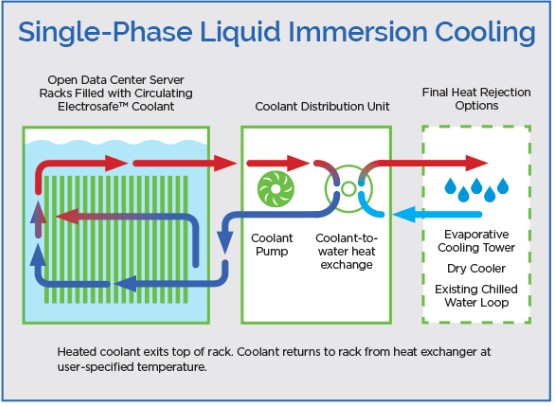
The most advanced technique is immersion cooling—the servers sit in a tub of thermally conductive dielectric liquid, typically a mineral oil substance:
All the heat created by the server components is captured by direct contact with the dielectric liquid, which is capable of absorbing significantly more heat than air, for the same volume. Through convection, the warm liquid rises in the tub and flows over the top into a vat, where it is cooled by pumping through a heat exchanger and back into the bottom of the tub.
All three cooling approaches can use a closed-loop heat rejection system to reduce water consumption and operational costs. Once a loop has been filled, the liquid would need to be replaced only if there’s a leak or during maintenance. During maintenance, the systems might lose just a few gallons of liquid, but the rest can be continuously recycled.
A Comparison of Kilowatt Capacities
In today’s colocation facilities, when creating an environment for an application workload in a High-Density rack that requires liquid cooling, the chosen technique is usually based on what the data center provider can bring online quickest. Looking ahead, colocation providers will pre-design data hall cooling systems based on the density levels they want to offer to their customers.
As an example of the densities that the various cooling techniques can handle, a standard air-cooled rack would max out at around 40 kilowatts. Racks with chilled-liquid doors can push to 60 kilowatts or even more, depending on the conditions. Chip and immersion cooling take racks even further to 100 kilowatts and beyond.
A Positive Impact on the Environment
A key sustainability benefit for purpose-built data centers offering immersion cooling is the reduced environmental impact. Because the dielectric liquid is in direct contact with every component of the server and captures heat better than air, the liquid can run at significantly higher temperatures than air-cooled systems.
Consider how chips within High-Density environment servers can run upwards of 150° Fahrenheit. Because the liquid in which the servers are immersed is so much more efficient than air at absorbing heat, it can comfortably run at temperatures of over 110° compared to the 70°-80° at which air conditioners must run to cool servers. The high operating temperature allows outside air to be used for heat rejection using nothing more than pumps and fans to reject heat outside.
This enables some immersion systems to be deployed in a way that eliminates the need for refrigerant-based mechanical cooling.
Pioneer Breakthroughs Rely on Combination of Air and Liquid
Some data centers are considering innovative uses of the heat that their water and liquid cooling systems absorb from server racks. It’s possible, for example, for a data center to pump heat to nearby buildings to keep them warm during the winter, as we have put in place at neighboring office space at our ATL1 facility.
Air Is Still Here to Stay
Air cooling is not expected to go away completely. Given the highly specialized requirements for deployments like direct to chip and immersion cooling, not everybody will be able to make the switch to these cooling techniques. Also, most data centers will always have low-density servers and secondary server components of High-Density racks that can be cooled with air.
To provide sufficient cooling for all densities of server racks (while also conserving energy), data centers will ultimately need to deploy a combination of liquid and air-based systems. As rack density increases, the key will be to move the cooling mechanism closer to the server or the chips in order to sufficiently remove the heat.
To learn more, watch for an upcoming DataBank event on data center cooling techniques. In the meantime, we would like to hear from you about your experiences with air, water, and liquid cooling: Is one technique working better for you? Do you rely on a combination of cooling techniques? What have you done to control costs?
Remember to share your thoughts and questions about cooling your own IT environments by emailing us today at feedback@databank.com.
DataBank’s Los Angeles carrier hotel, LAX1, is located at One Wilshire Boulevard—often referred to as “the most connected carrier hotel on the West Coast.” At the nexus of a rich telecommunications network in the western United States, One Wilshire serves as an essential communications point to the Pacific Rim—with submarine cables transmitting 33% of Internet traffic from the U.S. to Asia.
As a data center within a carrier hotel, LAX1 delivers five key benefits to DataBank customers:
Fast Delivery: Quick installation intervals that speed time-to-market for new services
Carrier Selection: A diverse range of telecommunications service providers
Low-Latency Performance: Direct access to carrier backbones
Arbitrage Costs: Competition among carriers drives down customer connectivity pricing
Scalability: Flexibility to select carriers without physically moving equipment to another data center
Originally built in 1966, most of the 664,000-square-foot structure at One Wilshire is now used as data center space and carrier points of presence. The thirty-story high-rise was originally built for offices but transformed into a home for telecommunications companies in the 1990s after a heavy concentration of underground cable was installed in that section of Los Angeles. The current building owner is GI Partners, while past owners include the Carlyle and Hines corporations.
LAX1 – 624 South Grand Avenue, Los Angeles
LAX1 provides colocation services from data centers on the 29th floor and the 18th floor at One Wilshire with extensive connectivity among content delivery customers and carriers. DataBank also has established direct connections with four carriers, including Zayo Group. Via Crown Castle, customers also can access 24 other carriers within One Wilshire through riser connections. These include AT&T, Burbank Fiber Network, Century Link, Cogent, Comcast, Cox Telecom, Hurricane Electric, LADWP, Level 3, Netfortris, New Edge (Earthlink), NNI, Santa Monica City Fiber, Sprint, Southern California Edison, TATA, Telepacific, Telstra, Time Warner Cable (Business Class), Time Warner Telecom, Verizon, Windstream, XO, and Zayo.
DataBank customers relying on LAX1 for compute resources and connectivity include streaming service providers and content delivery networks. Other customers include hyperscale cloud providers, a major publisher, and auto manufacturers. As is the case with all data centers located in carrier hotels, the fiber paths and networks connected to LAX1 are extensive and numerous, featuring multiple points of entryway and diverse riser paths. For cloud on-ramps, LAX1 connects directly to Megaport and via local loops to Console Connect and Packet Fabric (Unitas Global).
Changing the Connectivity Dynamic
DataBank is changing the connectivity dynamic within One Wilshire by enabling our LAX1 customers to reach their end-users through carriers of their choice. Customers also can link to each other through cross-connects and to other companies in One Wilshire through intra-building risers. Whether you need to connect to a network service provider, cloud provider, content delivery network, or content provider, our LAX1 carrier hotel data center has interconnection points to connect to where you need them most.
Look for LAX1 and other carrier hotels in DataBank’s portfolio of data centers on the interactive map at this website’s home page. You can also check below for related resources.
Our Pittsburgh carrier hotel, PIT1, provides colocation data center services to dozens of customers. This data center is a key infrastructure provider to innovators in an area featuring an abundance of technology expertise. Located at Nova Place in the Allegheny Technology Center Mall, PIT1 is just minutes from Acrisure Stadium (formerly Heinz Field) and PNC Park—the homes of the Pittsburgh Steelers and the Pittsburgh Pirates.
As a carrier hotel, PIT1 delivers five key benefits:
Fast Delivery: Quick installation intervals speed time-to-market for new services
Carrier Selection: A diverse range of many telecommunications service providers
Low-Latency Performance: Direct access to carrier backbones
Arbitrage Costs: Competition among the carriers drives down customer pricing
Scalability: Flexibility to select carriers without physically moving equipment to another data center
As one of the most connected data center locations in the Pittsburgh metro, PIT1 is the premier facility for the region’s fast-growing university and research-driven High-Performance Computing clusters. Also, PIT1 is situated close to the key U.S. connectivity triangle which runs from New York City to Ashburn and New Hope in Virginia; these are all major public-cloud nodes.
Multiple Carriers and Fiber Points of Entry
The PIT1 colocation data center is located at 100 S. Commons #126 in Pittsburgh. It features direct connections with 28 carriers. These include but are not limited to AT&T, Comcast, Verizon, and Zayo. Customers also benefit from multiple fiber points of entryway diversely fed from both streets surrounding the plaza. This extends from the West Commons side and the East Commons side into the PIT1 data center. The facility also features interconnection conduit and innerduct infrastructure utilized by the many network providers serving PIT1. For cloud on-ramps. PIT1 offers local loop connections to Megaport, Console Connect, PacketFabric, Unitas Global, and hyperscale cloud providers.
Managed Internet and Cross Connects
Within the data center, DataBank provides managed Internet services and extensive cross-connects among customers. We do this with TeraSwitch, which operates the Pittsburgh Internet Peering Exchange (PIT-IX). PIT1 also connects with the DataBank’s PIT2 data center (in Summit Park, less than 15 miles away). This connection is made via multi-protocol label switching (MPLS) and dense wavelength-division multiplexing (DWDM). PIT2 recently added 10 megawatts of power for critical IT loads that customers have leveraged for its connectivity back to PIT1.
Connectivity for Innovators in the Pittsburgh Area
Near Carnegie Mellon and Duquesne University as well as the University of Pittsburgh and its renowned medical center (UPMC), the Pittsburgh area has access to some of the top innovative talent in the country. With PIT1, DataBank continues to play a vital role in facilitating this innovation by providing data center space, connectivity, power, and cooling to enterprises and organizations that require high-performance computing.
You can look for the carrier hotels in DataBank’s portfolio of data centers on the interactive map on this website’s home page. Also, check below for these related resources:
By Autumn Salama, Vice President, Cloud Operations, DataBank
Companies of all sizes rely on their IT infrastructure to drive productivity, efficiency, and innovation and to help their businesses achieve their most critical goals.
However, behind the scenes, it can be exceedingly difficult for some companies to manage all aspects of their IT environment and operations in house because the overall effort is usually extremely resource-intensive, expensive, and challenging for many other reasons.
One challenge many companies face is struggling to have the right employees in place, particularly those with specialized skills, experience, and required certifications. Attracting, hiring, and retaining these key employees can be tricky, especially for budget-constrained companies or those that don’t have a large IT staff in place.
The brightest technical talent might be attracted to larger technology companies where they can continue to work with bleeding edge technology not often found in everyday business. Even when a company has hired great technical talent, retaining this talent often means allowing them to work on new and exciting projects that bring value to the business.
For companies facing these challenges, it may make sense to partner with a managed service provider (MSP) to offload important IT services such as upgrades, ongoing maintenance, help desk and troubleshooting, and general support. In general, these tasks might be considered mundane and boring by their in-house IT staff but are essential to the security and availability of a company’s IT infrastructure.
Yet, there may be a better model related to outsourcing managed services: partnering with a colocation data center provider who is capable of delivering a comprehensive suite of managed services.
Managed services offerings in a colocation environment can be an extremely effective win-win: Not only are you able to reduce costs by offloading manual, time-consuming tasks, but you also gain access to a wide range of service offerings and expertise to overcome daily challenges and position your company for long-term success – all where you maintain your IT infrastructure.
Let’s take a closer look at many of the specific services and powerful benefits delivered by colocation providers, such as DataBank.
1. Enhanced networking monitoring and management: Reliable managed services within a colocation environment can provide continuous monitoring and management of critical network infrastructure. These service teams use highly skilled staff and the most advanced monitoring tools to proactively detect and troubleshoot issues to ensure smooth network operations.
Such a proactive approach prevents network outages, minimizes downtime, and optimizes network performance—all vital in supporting the company’s daily processes and business goals.
2. Comprehensive security services: All you have to do is look to the latest high-profile cybersecurity story in the news to realize that cyber threats pose a real—and significant—risk to any company today.
Colocation providers are now better equipped to deliver everything you need to make your IT environment safe and secure. Many, such as DataBank, offer a multi-layered defense-in-depth approach including controls for physical security, the network/perimeter, user access, and servers and internal systems, as well as continuous monitoring.
These managed service teams implement and manage innovative security measures such as firewalls and intrusion detection systems and intrusion prevention systems (IDS/IPS). They also conduct regular vulnerability assessments. All of this helps fortify your IT infrastructure to help ensure the availability of your critical data and systems.
3. Powerful data backup and recovery: Let’s face it: Data loss can be catastrophic for your business. The good news is that with colocation managed services, ensuring the continuous availability of your data and applications doesn’t have to be a time-consuming, expensive process.
For example, powerful disaster recovery-as-a-service offerings can protect your IT environment and enable your business to quickly resume operations in the event of a disruption.
Additionally, colocation managed services teams can perform regular backups of critical data to safeguard against potential loss and implement well-designed backup strategies. They also employ redundant storage systems to ensure data resilience.
4. Cloud services: Today, the cloud has become an integral part of modern business operations, offering on-demand scalability, flexibility, and cost-efficiency. Managed service teams in the data center possess extensive experience in managing all aspects of cloud infrastructure.
For example, managed services teams can provide guidance and support when it comes to migrating to the cloud, managing cloud-based storage solutions and interconnection options, and deploying cloud-based software applications. By tapping into their expertise and related services, you can reap the full potential of the cloud, scale your IT infrastructure, and further optimize resource allocation.
5. Efficient software and hardware management: Managing software installations, updates, licensing, and hardware devices can be time-consuming and resource-draining.
Turning to managed services teams in colocation data center facilities will streamline software and hardware management processes. These teams handle software updates, ensure license compliance, and perform regular maintenance of hardware devices. This approach reduces the burden on internal IT teams, freeing up valuable resources to focus on core business activities and more strategic initiatives.
6. Improved IT consulting and strategic planning: Finally, managed service teams within data center colocation facilities serve as trusted advisors and provide valuable IT consulting and strategic planning services.
They possess a deep understanding of technology trends and industry best practices. By aligning IT infrastructure with business goals and objectives, these managed service teams can help you make more-informed decisions about technology adoption, system architecture, and digital transformation strategies.
Such a strategic partnership—and one backed by these comprehensive services—helps maximize your IT investments, increase productivity and innovation, reduce costs, and stay a step ahead of the competition.
Interested in learning more about DataBank and our comprehensive suite of managed services? Visit our managed services site or www.databank.com today.
About the author: Autumn Salama is a proven tech operations leader with nearly 20 years of experience in product management, sales enablement, customer support, engineering, critical infrastructure, and service delivery. She is dedicated to success in every aspect of life and
thrives on creating operational efficiency through collaboration, tools, processes, and, most importantly, people.
Milliseconds No Longer Suffice in Today’s Accelerated Digital Environment
By Gregory Ryman, DataBank Solutions Engineer
Application and database latency are critical factors for enterprises across many industries. A delay of mere milliseconds can break a business when it comes to financial transactions, real-time data analytics, and online gaming. As a result, the demand to reduce latency is on the rise. Whereas milliseconds were once acceptable, microsecond responses are now required.
The first step in solving the latency challenge is understanding the drivers behind the demand for faster response times. In this blog, we delve into five use-cases that illustrate the factors fueling the need for microseconds over milliseconds. We also examine how data center colocation companies play a pivotal role in meeting these evolving requirements.
Microsecond latency refers to data transmission delays measured in millionths of a second. This is a performance threshold that might sound like engineering overkill until you understand which industries live and die by it. In high-frequency trading (HFT), for example, the difference between executing a trade in 10 microseconds versus 100 microseconds can be the difference between profit and loss. Trading firms co-locate their servers inside data centers physically adjacent to exchange matching engines for exactly this reason. Online gaming and real-time multiplayer platforms also demand sub-millisecond response times to keep gameplay fair and immersive. A 50ms lag spike is noticeable to players, and consistent microsecond latency is what separates a great gaming experience from a frustrating one. In healthcare, real-time diagnostic imaging, robotic surgery systems, and intensive care monitoring all require near-instant data processing where delays could have serious patient safety consequences. Achieving microsecond-level performance requires a combination of geographic proximity (servers close to end users), optimized networking hardware (FPGA-based processing, fiber interconnects), and purpose-built data center infrastructure designed to minimize every possible delay. As AI inference workloads, autonomous systems, and real-time analytics become mainstream across US industries, the demand for microsecond latency infrastructure will only intensify in the coming years.
Use-Case #1—High-Volume Trading: Every Nanosecond and Microsecond Counts
In the realm of high-volume trading, microseconds are the new currency. (A microsecond equals one one-millionth of a second) Financial institutions rely heavily on lower-latency connections to gain a competitive edge in executing trades.
This has driven the need for closer proximity to major exchanges and trading platforms and has led to the rise of specialized data center colocation facilities—strategically located near financial hubs. These facilities provide low latency connectivity, enabling traders to capitalize on market opportunities faster, mitigate risks, and improve overall trading performance.
Financial services, high‑frequency trading, and edge AI inference demand true microsecond latency. Providers leverage direct interconnection, on‑site accelerators, and edge pods to meet sub‑microsecond requirements by 2026.
Use-Case #2—Cloud and Edge Computing: Revenues Rely on Superior User Experiences
The proliferation of cloud computing and the emergence of edge computing contribute significantly to the demand for reduced latency. In industries such as e-commerce, online gaming, and streaming media, even a few milliseconds delay can result in a subpar user experience—leading to lost revenue and diminished customer satisfaction.
To solve this challenge, data center colocation providers strategically position their facilities near major network interconnection points, reducing the distance and necessary network hops between end-users and cloud resources, resulting in faster response times and higher throughputs. Many cloud service providers host applications and store data in these large-scale data centers to reduce latency for users accessing compute resources, providing an improved customer experience with higher customer satisfaction..
Use-Case #3—Internet of Things and Analytics: Real-Time Decision-Making Required
The rapid growth of Internet of Things (IoT) devices and the need for real-time analytics further intensify the demand for reduced latency. Industries such as manufacturing, healthcare, and logistics rely on IoT sensors and devices to collect and transmit data in real-time. This data is often processed and analyzed to make immediate decisions, monitor equipment performance, and optimize supply chain operations.
With the increasing volume and velocity of data generated by IoT devices, minimizing latency is crucial to ensure timely insights and actions. Data center colocation companies, equipped with robust network connectivity and edge computing capabilities, answer the challenge by offering the infrastructure to process and analyze data closer to the source. This will enable real-time decision-making of the future, such as managing smart cities and edge-based infrastructures for oil and water pipelines.
Use-Case #4—Interactive Applications: Streamlining Productivity and Collaboration
End-users are accustomed to instantaneous responses from the applications they use daily. Whether it’s a messaging app, video conferencing, or online collaboration, users expect seamless and lag-free experiences. Any delay or latency can hinder productivity, collaboration, and user satisfaction.
To meet these heightened expectations, companies developing interactive applications seek data centers with high-performance networks and fast interconnections. By locating their infrastructure in these colocation facilities, software development firms can deliver superior experiences and retain users to gain a competitive advantage.
As technology continues to advance, new applications and technologies will demand even faster response times. Innovations such as augmented reality, virtual reality, autonomous vehicles, and 5G networks will rely heavily on low latency to function seamlessly.
Colocation providers with advanced infrastructure and connectivity options are positioned to support these emerging technologies. By deploying infrastructures in these data centers, enterprises can future-proof their business and ensure they are well-equipped to embrace user demands.
Colocation Data Centers Play Key Role
In today’s digital landscape, microseconds matter. That’s why enterprises across almost every industry are increasingly prioritizing reduced latency to gain a competitive advantage, enhance user experiences, and drive business growth.
Data center companies play a vital role in meeting these evolving demands. By strategically locating their facilities, investing in high-performance networks, and embracing edge computing, colocation providers offer the infrastructure to minimize delays and enable real-time data processing and transmission. As the demand for microseconds over milliseconds continues to grow, enterprises can rely on colocation data centers to provide the required low-latency connectivity to thrive in today’s fast-paced, interconnected world.
To learn how DataBank can help your business leverage the benefits of reduced latency and enhanced operations to stay ahead of your competition, contact us today.
About the Author: Gregory Ryman has had the pleasure of working in the hosting and data center industry for over 20 years in support roles and director level engineering positions. His passion for technology is rooted in a lifelong pursuit of continuous learning and building meaningful solutions that solve real world problems.
Denver’s fast-growing economy—driven by the Denver Tech Center and notable technology companies like XO Communications, Zoom, AT&T, and HP—has attracted technical talent and accelerated innovation. This critical regional hub for local, national, and international businesses is also driving demand for colocation options.
A key player in this ecosystem is DataBank’s DEN3 downtown Denver data center, near the 16th Street Mall. Located at the intersection of major fiber pathways servicing Denver and the Rocky Mountain region, the premier carrier hotel delivers five key benefits:
• Fast Delivery: Quick installation intervals that speed time-to-market for new services
• Carrier Selection: A diverse range of many telecommunications service providers
• Low-Latency Performance: Direct access to carrier backbones
• Arbitrage Costs: Competition among the carriers drives down customer pricing
• Scalability: Flexibility to select carriers without physically moving equipment to another data center
Whether customers need to connect to an internet service provider, network service provider, or peering exchange, DEN3 has interconnection points where needed in the greater Denver area.
DEN3 – 1500 Champa Street, Denver
DEN3 is located in the central business district in Denver at the corner of Champa Street and 15th Street. Built in 1985, the 138,000+ square-foot building includes large plots and substantial load capacities across three floors along—with extensive and numerous fiber-paths and diverse riser paths.
DataBank provisions colocation services within the building from nearly 10,000 square feet of raised floor space that supports critical IT loads with two megawatts of power. The data center features riser connectivity to the building’s Meet Me Room. DataBank also offers managed Internet, cross connects, intra-building risers, innerducts, and point of entryways.
Hundreds of Connectivity Options
To facilitate customer connectivity, DataBank has established direct connections with 11 network carriers that operate within DEN3. These include Apple, AT&T, Coeo Solutions, Cogent Communications, Comcast, Disney Streaming, Google, Inteliquent, Telnyx, Windstream, and Zayo Group. For cloud on-ramps that connect via local loops, customers can choose from Console Connect, Megaport, and PacketFabric (Unitas Global).
The DEN 3 data center is also in the heart of the Denver telecommunications community, making it an ideal carrier hotel location. Other important nearby players include the Denver Gas & Electric carrier hotel (910Telecom Building), which is only 250 feet away. A fiber vault sits between the two facilities, providing DataBank customers with access to hundreds of ISPs and carriers. Another key telecommunications player, AT&T, is less than a tenth of a mile away while the Mountain State Telephone building is just two-tenths of a mile from DEN3, and the Qwest central switching office is less than a mile away.
A Key U.S. Hub
The Denver tech ecosystem is one of the nation’s most educated populations and one of the highest concentrations of advanced technology workers. With the DEN3 carrier hotel data center serving as a vital technology player in the Midwest region, DataBank is helping drive one of the most important network provider hubs in the U.S.
Featuring: Mark Houpt, DataBank’s Chief Information Security Officer
Listen to Mark Houpt, DataBank’s CISO, as he discusses some key concepts and misconceptions about public vs. private cloud security.
Here are a few things you’ll learn:
• Defining public vs. private models via OSI and NIST
• Nuances and grey areas
• Shared Responsibility Model
• Repatriation
Run Time: 19 minutes
DataBank’s CISO Corner is for CISOs and security practitioners, where we discuss a variety of cybersecurity topics and current events from the CISO’s perspective. Our broadcast is designed for those who want to hear from security and compliance experts on the front lines.
By Vlad Friedman, DataBank Chief Technology Officer
In recent years, the adoption of cloud computing has surged, with organizations of all sizes embracing the potential of the cloud to enhance their IT infrastructure and streamline operations. The cloud propounds scalability, flexibility, and cost-efficiency, making it an attractive option for businesses. However, as operations reach scale, new challenges arise, and it is crucial to evaluate whether a cloud-only IT strategy continues to provide all of the benefits promised. We explore how organizations are increasingly embracing hybrid solutions for their workload placement.
The Rise of Cloud-Only Strategies
The cloud revolution brought forth a paradigm shift in IT strategy. Organizations migrated their applications and infrastructure to public cloud platforms, benefiting from the on-demand availability of resources, reduced capital expenditure, and simplified management. The cloud offered the promise of infinite scalability and resilience, enticing many to go all-in on the cloud, forsaking traditional on-premises infrastructure.
Limitations and Challenges
While a cloud-only approach certainly has its merits, it also presents limitations. While the cloud initially appears more cost-effective, scaled operators often see the inverse effect. As AI and analytics workloads continue to drive IOPS and computational intensity, cost increase accordingly. This fact is exacerbated through the consumption of vendor-specific APIs causing vendor lock-in. Organizations often rely on a single cloud provider and ecosystem, limiting their negotiating power, and network egress charges discourage the optimization of workloads across multiple providers.
The Emergency of Hybrid Solutions
Recognizing the drawbacks of a cloud-only strategy, many organizations are adopting a more nuanced approach by embracing hybrid solutions. Hybrid IT combines on-premises infrastructure in a highly resilient colocation facility with high-speed private connectivity to public clouds, allowing organizations to leverage the benefits of both. At DataBank, we are actively seeing our customers think more intelligently about their workload placement, driving the repatriation of computationally intense workloads and increasing the performance of their applications without losing the agility and scale of the public cloud.
Benefits of Hybrid IT
Hybrid IT enables organizations to optimize their workload placement based on their (not their vendors’) specific requirements. Critical, computationally intensive, and latency-sensitive workloads can be kept in colocation, providing performance at a lower cost. In contrast, variable workloads can be migrated to the public cloud for scalability and cost efficiency. Hybrid solutions also facilitate seamless integration between on-premises infrastructure and cloud services, enabling organizations to leverage existing investments while harnessing the power of the cloud. Further, Hybrid IT allows businesses to adapt and evolve their infrastructure strategy as technology advances, ensuring they remain agile and future-proof.
Overall, while the cloud has revolutionized IT strategy, it is becoming increasingly apparent that a cloud-only approach may have reached its limits. Organizations are recognizing the need for a more balanced and intelligent approach, thus achieving a flexible, secure, and optimized IT infrastructure that meets their unique needs – and so they can thrive in the digital age.
The Dallas Metropolitan Area is the fourth most populous in the U.S., bringing with it increased demand for tech services. This makes Dallas a key location for enterprise-class data centers. Prime examples are DataBank’s two carrier hotels: DFW1 and DFW5. Located just three miles apart in downtown Dallas, the data centers connect directly to each other, consolidating extra capacity for your compute resources while also delivering five key benefits of carrier hotels:
Fast Delivery: Quick installation intervals speed time-to-market for new services
Carrier Selection: A diverse range of many telecommunications service providers
Low-Latency Performance: Direct access to carrier backbones
Arbitrage Costs: Competition among the carriers drives down customer pricing
Scalability: Flexibility to select carriers without physically moving equipment to another data center
Whether you need to connect to an internet service provider, network service provider, or peering exchange, our two carrier hotel data centers have interconnection points where customers in the greater Dallas area need them most.
Since 2000, DataBank has made the DFW1 location a premier data center with established connectivity to many carrier networks. Located in the heart of the central business district in Dallas and adjacent to the AT&T Discovery District, DFW1 was formerly known as the Federal Reserve Building, built in 1921, and serves as the global headquarters for DataBank. Throughout its history, several expansions have added space for the mechanical infrastructure, including a five-story adjoining building. With 130,000 square feet of colocation floor space, the well-protected building is also well-connected, including direct tethering to two other DataBank data centers in the Dallas area—DFW2 and DFW3.
Located in a building formerly known as Infomart, DFW5 features 15,000 square feet of raised floor space within a seven-story building that spans more than 1.5 million square feet. The building was initially designed to host technical trade shows, and construction was completed in 1985. The facility now serves as the tenth most interconnected data center in the United States, providing a carrier-neutral environment housing over 140 network providers.
A Powerful Data Center Combination
Combined, DFW1 and DFW5 provide data center services to more than 230 customers spanning the communications, education, energy, entertainment, healthcare, high-tech, hospitality,manufacturing, retail, transportation, and utility sectors. The two data centers also offer 75 direct and extended carrier connections along with multiple innerducts and points of entry. In addition, customers can tap into five cloud on-ramps with direct, extended, and local-loop connections such as PacketFabric, Console Connect, and Megaport.
Other services that DFW1 and DFW5 customers can access include managed internet and colocation with an extensive quantity of risers and cross-connects between floors and suites to reach other data center operators, tenants, and carriers. DE-CIX also operates its Internet Peering Exchange directly within both data centers.
Key Players in a World-Class Network Provider Hub As a leading area of technology innovation, Dallas is the sixth-largest U.S. metro economy, generating nearly $1 trillion in combined Fortune 500 revenues. With the DFW1 and DFW5 hotel carrier data centers serving as key technology players in the market, DataBank is helping drive one of the uppermost accumulated network provider hubs in the world.