It’s no secret that the IT market has evolved in step with changing customer needs during the past decade.
In terms of infrastructure, a growing number of enterprises must grapple with increasingly hybrid workloads (think colocation, public cloud, and private cloud environments). Managing the support of multiple vendors in this disconnected landscape is a nightmarish prospect, making the job of an IT admin considerably more difficult and time-consuming.
The folks at DataBank know this and have spent the past 15 years providing proactive infrastructure management services in step with a rapidly changing industry.
“In terms of the hybrid cloud journey, there’s no one-size-fits-all solution for every customer,” said Vlad Friedman, CTO at DataBank. “It’s the amalgamation of all these different platforms — and as you start to put them together, they become incredibly powerful but complex.”
Behind the scenes, DataBank’s team of professionals combine such networks into cohesive solutions while ensuring they are secure, monitored, backed up, and available. This allows the customer to focus on essential business objectives rather than infrastructure concerns.
DataBank leverages top-notch facilities, a robust national network, scalable cloud infrastructure, and a multihomed secure internet access hub to deliver its datacenter, cloud, and connectivity services to enterprises. Between its infrastructure, frameworks, and internal talent, the company strives to provide flexible, customer-centric solutions united seamlessly via the company’s advanced support portal.
As for the future, DataBank is working to reach additional markets while enhancing the managed cloud, internet, and compliance solutions that alleviate infrastructure burdens for customers across the nation.
Leveraging 15 Years of Experience in Mission-Critical Infrastructure
DataBank, founded in 2005 to address market demand for personalized colocation solutions, is headquartered in the former Federal Reserve Bank in Dallas, which was converted into a datacenter six years prior.
From 2014 through 2018, the company experienced rapid growth due in part to an acquisition strategy that kicked off with the purchase of Arsalon Technologies. The move brought two additional datacenters, an extensive technical team, and a broad set of robust cloud and managed services into the fold.
In 2016, the company acquired Edge Hosting, a managed services provider founded in 1998 by Vlad himself.
“Edge Hosting was launched to focus on mission-critical managed services and application workloads that needed to be highly compliant, could never go down, and remain secure,” Vlad told us. “Today, Edge has enhanced the managed services arm of DataBank with a similar focus but on a much larger scale.”
An overview of Configuration scanning: The DataBank vulnerability scanning tool of choice.
Configuration scanning is a process for scanning operating system vulnerabilities to identify and mitigate vulnerabilities that threaten compliance, including software flaws, missing patches, malware, and misconfigurations across operating systems, devices, and applications. Our service allows security professionals to connect to a multitude of servers, run vulnerability scans, and generate an executive or detailed report based on vulnerability types, vulnerabilities by host/plugin, and by team/client in a variety of formats (HTML, CSV, and Configuration scanning XML).
External vulnerability scans only give visibility to part of the picture, while configuration scanning allows for internal credentialed scans to gain a more comprehensive picture. Internal vulnerability scanning is a requirement for FedRAMP and PCI-DSS environments.
Key features of Configuration scanning
We’ve selected only the best configuration scanning tools for vulnerability scanning because of the key features available within the tools that greatly benefit customers; specifically, those subject to FedRAMP and other high security compliance requirements.
Breadth and depth of coverage
These providers continually work with the information security community to identify new vulnerabilities while offering insights to assist businesses in advancing vulnerability assessment practices. Threat intelligence is built into configuration scanning using plugins.
Automatic plugin update
Our process is powered by the top-rated configuration scanning tools leveraging over 130,000 plugins that update automatically, in real-time. This ensures timely information on new vulnerabilities while reducing time to assess and remediate issues.
Vulnerability scanning with DataBank
As part of the base configuration management service offering, DataBank performs scans up to the operating system, but not the database and web application. However, database and web application scans can be ordered for an additional fee. It’s important to note that FedRAMP stipulates that cloud service providers must perform internal authenticated scans.
FedRAMP vulnerability scanning requirements
Authenticated and credentialed scans
Vulnerability scans must be performed using system credentials that allow full access to systems. Scanners must have the ability to perform in-depth vulnerability scanning of all systems where applicable. Systems scanned without credentials provide limited or no results of the risks. All unauthenticated scans are rejected unless an exception has been previously granted due to applicability or technical considerations.
Enable all non-destructive plug-ins
To ensure all vulnerabilities are discovered, the scanner must be configured to scan for all non-destructive findings. Any vulnerability scans with limited or excluded plug-ins are rejected. Exceptions may occur based on specific requests from the government for re-scans or targeted scans. These scans must comply with the directions provided by the government.
Full system boundary scanning
Each scan must include all components within the system boundary. Reduced number of components or missing categories will result in rejected scans. In some cases, sampling is acceptable; however, it must be approved as a part of the initial security assessment plan and approved as a part of the continuous monitoring plan.
Scanner signatures up to date
CSP must ensure the vulnerability scanner used is up to date and includes the latest versions of vulnerability signatures. Before scanning, each scanner must be updated to reflect the latest version of the scan engine, as well as signature files.
Provide a summary of scanning
Each scan submission must be accompanied by a summary of the scan performed. The summary must include a listing of all the scan files submitted, which scanning tools were used, and a summary of the purpose of the scan (e.g., monthly scans, re-scans, verification scans, etc.).
In addition, the summary should discuss the configuration settings of the scanner, including if signatures were limited for targeted, verification scans, or if the scope of the scans excluded certain components or IP addresses. IP address ranges and/or a description of the targets are required.
POA&M all findings
Findings within scans must all be addressed in a plan of action and milestones or other risk acceptance requests and maintained until vulnerabilities have been remediated and validated.
Types of scans DataBank runs for customers
1. Credentialed patch audit scan
-Vulnerability scans run monthly
-Check to determine what’s out of date on the server
-DataBank is responsible for OS patches only.
2. Host discovery scan
-Network discovery scans offered to FedRAMP environments only
-Scan runs daily
-Reviewed monthly
-Checks for new hosts in the environment
CIS Hardening scan
Configuration scanning is used with the Center for Internet Security (CIS) benchmarks and baselines to assess and harden all servers during the provisioning process to ensure all servers are in the optimal state at delivery. In production, scans are also scheduled on a recurring basis for continuous monitoring purposes.
Vulnerability scans are a critical component of an overall security program. They’re a non-invasive method of testing which allows your security team to gain feedback on the health of your network quickly. When entrusting DataBank with vulnerability scanning as part of your security program, your internal team will be better equipped to act on protecting your network and data.
By Raul K. Martynek | Chief Executive Officer
How DataBank and Zayo Networks are Teaming-Up to Deliver on the Promise of Edge Computing
In a previous post, I argued that despite all the buzz about micro-data centers at the base of cell towers, the first place “The Edge” will most likely materialize is inside traditional data centers located within secondary “NFL cities”. The incremental improvements in latency that come from deploying content and workloads locally in these large population centers (as opposed to distant cloud data centers), coupled with the ability of full-sized data centers to better scale and maintain infrastructure, actually make this approach far superior to alternatives like micro-data centers.
But while this thesis addresses the latency considerations and benefits of data center location, we all know that the effective delivery of bits depends on another critical element in the infrastructure chain: the network behind the data center. The connectivity available in a building, and the paths from which it enters and exits the property, are just as important as the redundancy and configuration of the mechanical, electrical and plumbing (MEP) systems in the facility. A weak link in this part of the chain can negate all the benefits of the data center’s proximity and redundancy to users in that metropolitan region.
Let me propose an analogy. Everyone knows that best practices dictate that a properly designed data center must have a minimum of two Points of Entry (POEs) for fiber, and a minimum of two Meet Me Room (MMRs) to terminate the fiber and distribute it to IT workloads. This ensures the proper degree of physical diversity both within and outside the data center.
And what is true for a data center needs to be true for a geographic market. If we imagine that interconnection data centers are effectively the “meet me rooms” of a metro area, and the long-haul fiber paths into and out of those data centers are the “Points of Entry” for that market, it stands to reason that on this macro scale we need the same level of diversity. Within a given metropolitan market, redundant interconnection locations and diverse long-haul fiber access must be available in order to provide the market level diversity our industry is accustomed to at the micro-level. As we will see, that’s not always the case, and it has the potential to slow the development of the edge for all providers and users.
In this article, we will explore the current problem with network interconnection and fiber redundancy in secondary markets. I will argue that multiple interconnection points and physically diverse long-haul fiber connectivity options must emerge for mission-critical deployments to flourish at the Edge.
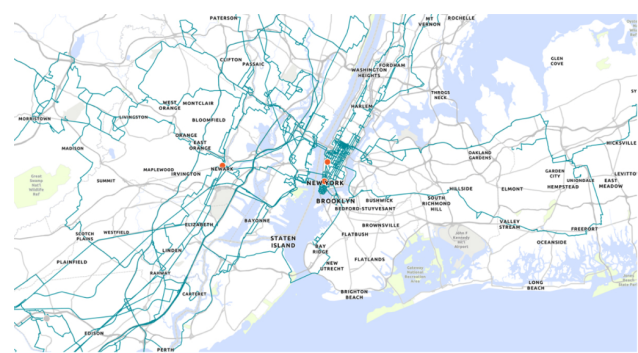
Let’s start by looking at how most large Tier 1 markets are configured for data center interconnection and long-haul fiber. Figure 1 below depicts the Zayo fiber map in metro NYC. While New York is unique in many ways (and one that I have known for years) the broad configuration I will describe is the same in all Tier 1 markets. The three orange dots are the three main “carrier hotels” in the New York area – 60 Hudson St., 111 8th Ave., and 165 Halsey St. in Newark, NJ. In a market such as NYC, there are other significant interconnection points (32 Ave of Americas, 325 Hudson, 75 Broad, etc.) but most people would agree that these three locations form the “core” of peering and interconnection for the New York Metro market. The reason there are multiple locations is obvious: redundancy. With three locations, users have the ability to deploy in multiple locations to ensure uptime. A failure in one facility or portion of a facility will not impact traffic in another location. Similarly, each of these locations benefits from dozens of metro and long-haul fiber options that exit the New York area heading north, west, east, northwest and southwest from Manhattan. With multiple interconnection points and multiple routes coming into/out of the area, a provider can carefully construct a resilient architecture for connectivity and availability.
(Figure 1) NYC Metro Fiber Map
When you survey the landscape, all major Tier 1 markets also have 2-3 major interconnection points and diverse metro and long-haul fiber connectivity. Dallas (my new home) has three main locations – 1950 Stemmons, 2323 Bryan and 400 South Akard (DataBank’s DFW1 location). Long-haul fiber enters the market from multiple, physically separate routes. Chicago has 350 E. Cermak and 600 S. Federal. From each of these facilities or by tethering to a sub-tending datacenter in the same market, users can avail themselves of diverse data center locations and redundant metro fiber and long-haul fiber options to ensure that no one location can become a “single point of failure”.
Large cloud, content and technology providers understand this. DE-CIX is one of the world’s leading interconnection platforms. Until this year, their only location in Dallas was at the Infomart Building at 1950 Stemmons. As their traffic grew, they decided to create a secondary location that offers its customers an alternative peering point for diversity. In August, DE-CIX, deployed their fully redundant Apollon platform at our 400 South Akard location. In talking to the DE-CIX folks, the two main criteria for their selection were: (a) a robust data center location physically diverse from Stemmons with good fiber connectivity; (b) available long-haul fiber routes fully independent from Stemmons. South Akard checked both boxes. In addition to offering a diverse local data center facility, the 400 South Akard location provides access to fully diverse long-haul fiber routes to exit the Dallas region.
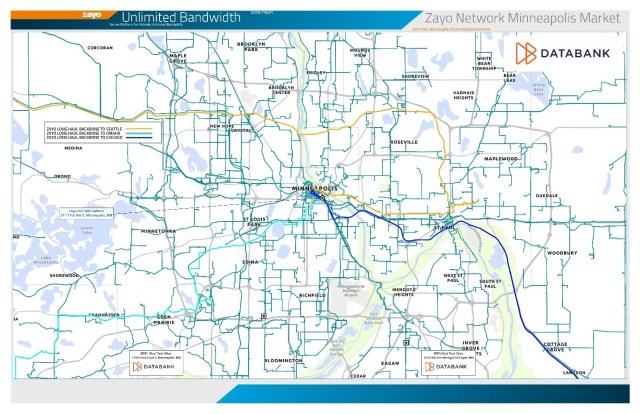
The situation is not the same in most secondary markets. In many of the markets that DataBank operates, multiple, diverse interconnection locations and physically diverse long-haul fiber routes have not yet developed. Figure 2 below shows the situation in Minneapolis. In that market, the Cologix facility located at 511 Main Street is the predominant carrier interconnection point. To exit the market, the main long-haul fiber routes go either south to Chicago or west to Seattle (we show the Zayo routes in this figure). A third route heads due south towards Omaha. Most of the peering in the Minneapolis market happens within the 511 building. Today, there does not exist another interconnection point within the market that has both direct access to all the diverse long-haul fiber routes and enough critical mass of local metro fiber providers to be a viable alternative location. For Minneapolis, the 511 building is the proverbial single point of failure and a bottleneck that must be addressed for the region to support fully diverse edge workloads.
(Figure 2) Current MSP Metro Fiber Map
Recently, DataBank’s lead investor, Digital Bridge Holdings, announced the acquisition of Zayo Networks in conjunction with EQT Equity Partners. Zayo owns and operates the largest fiber network in the United States with dense metro and long-haul fiber routes. At Digital Bridge, we believe that having complementary internet infrastructure assets in the same portfolio will foster the development of innovative solutions. DataBank and Zayo are doing just that. We have joined forces to bring alternative interconnection and long-haul fiber diversity to secondary edge markets, and we have picked Minneapolis as our initial market.
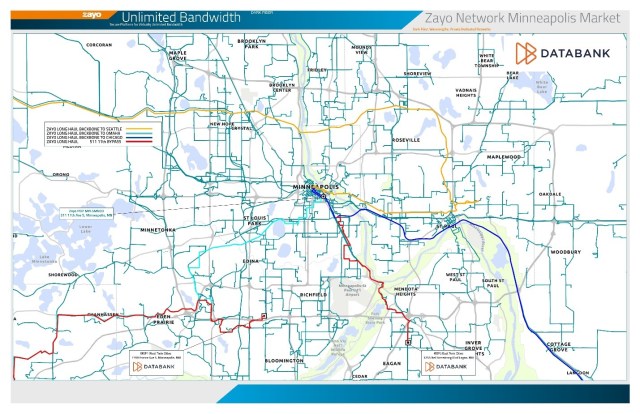
Figure 3 depicts the proposed new routes for long-haul dark fiber connectivity out of the Minneapolis market using Zayo fiber. Zayo will extend its Omaha long-haul route to terminate at DataBank’s MSP1 facility and its Chicago route to terminate at DataBank’s MSP2 location. Zayo metro dark fiber already connects MSP1 and MSP2. The key element of this route is that it bypasses the 511 Main location heading West, while also providing long-haul access to Chicago and Omaha via metro fiber splices. As an interconnection point, the DataBank MSP2 facility is the designated termination point. DataBank’s MSP2 facility is a certified Tier III data center location with over 15 onsite metro fiber providers. Recently, the Midwest Internet Cooperative Exchange (MICE) deployed an extension switch in MSP2. MSP2 is also located in Egan, a suburb in Minneapolis about 10 miles south of the downtown 511 Main Street location. MSP2 provides an alternative interconnection facility with diverse long-haul dark fiber options, giving Minneapolis the resilient internet infrastructure required to support the mission-critical workloads and make it a viable edge market. DataBank and Zayo intend to partner in other markets where there is a significant overlap in assets such as Kansas City, Indianapolis, and Salt Lake City. We will share those plans as we develop the solutions.
(Figure 3) New Zayo Long Haul Fiber Routes
At DataBank, we believe that for Edge markets like Minneapolis to fully develop, redundant interconnection and long-haul fiber options must emerge, so that providers of scaled, mission-critical applications can build the redundant architectures they have come to rely on in Tier 1 markets. In our conversations with large cloud, content and technology companies, this topic is a reality. With the exponential growth in internet traffic, large content providers and ISPs are increasingly looking to “regionalize” their traffic flows and drain traffic from Tier 1 markets into adjacent metropolitan areas. However, in our conversations with such users, they are reticent to expand their footprint without the availability of diverse options for colocation, peering and dark fiber transit. For edge workloads to fully evolve and deliver the 100% uptime that will be expected from these new technologies, a robust physical internet infrastructure topology will be required.
Diversity of options also provides another non-technical benefit: competition. As the importance of internet infrastructure grows, so does the importance of truly neutral interconnection locations. Yet we continue to hear stories of aggressive incumbent behavior, incessant price increases and anti-competitive terms of supposedly “neutral” operators of interconnection facilities. We believe that owning/controlling the dominant interconnection point in a market is not an excuse to abuse your customers, but an opportunity to foster and build a better internet, which will ultimately benefit all users and consumers of internet infrastructure.
All service providers who maintain compliance certifications for SSAE-18 and HIPAA-Hitec are required to undergo an annual audit of their compliance controls to ensure they meet the standards.
DataBank recently completed its annual audit and received an “Exception Free” rating, a fairly rare occurrence, but in our case, it was the 6th year in a row. (dating back to our acquisition of Edge Hosting).
We caught up with DataBank’s CISO, Mark Houpt, to better understand the audit process and what it means for us and our customers.
Mark, what does it mean to be “recertified” for HIPAA and SSAE-18 Compliance?
Audits are conducted on an annual basis. During these procedures, the auditors evaluate the effectiveness of service provider’s compliance controls, how suitable the design of the those controls are, and how fairly they are represented or presented to customers. Our recertification means that for the period of the examination (in this case, 10/1/18-9/30/19), DataBank had properly designed security controls, we fairly told our customers what we do with those security controls, and – by the auditors actually testing the controls – that we were operating those controls effectively.
What authority conducts these audits and re-certifications?
The audits we most recently completed were in accordance with the American Institute of Certified Public Accountants (AICPA) standards and completed by 360 Advanced.
What DataBank services or facilities does it apply to?
The recent audit and recertifications apply to all of DataBank’s colocation and managed services in all of our data centers. The PCI attestations, apply just to our colocation services in all data centers.
What process was required to achieve this re-certification?
Each year DataBank undergoes an extensive, 4-month audit process where auditors review approximately 300 artifacts and sources of evidence, interview our personnel, and visit our data centers for visual examination.
What does “exception free” mean and how common is that?
Exception free means that for each security control listed, the auditors could not find deviations or faults in how we design and operate our controls. This is rare in the industry, although this is DataBank’s second year in row and “legacy Edge Hosting’s” 6th year in a row of exception free examinations.
How does this benefit our customers?
An exception free audit and recertification provides assurances to our customers that the design of our security environment is in line with industry best practices. You can think of it as a measure of technical excellence. But it’s also a measure of operational excellence. The auditor’s test results demonstrate that our security design doesn’t just work on paper, it works in practice. Achieving this standard six years in a row demonstrates consistency in that practice. It’s part of our operational DNA. And that’s critical to any customer looking for a reliable partner for mission-critical colocation, security and compliance.
If you are looking into learning about how we can help you in your FedRAMP, HIPAA/HITECH, PCI-DSS, and GDPR needs give DataBank a call at 800.840.7533.
Privacy is one of the most difficult challenges for global enterprises to address. Cultures and human mindset vary across the globe and standards are evolving rapidly making it hard for IT organizations to keep up. The bottom line impacts of a privacy breach are growing, both from potential financial and punitive penalties as well as the loss of brand reputation.
DataBank’s comprehensive compliance approach simplifies the task across a variety of designations, including privacy. We are thrilled to announce that DataBank has successfully completed the recertification of its U.S. Privacy Shield and expanded that certification to include the assets of its recent Lightbound acquisition!
What does this mean to you?
Privacy Shield is a collaboration by the U.S. Department of Commerce and the European Commission (and Swiss Administration) to bridge the cultural and regulatory differences that exist on either side of the Atlantic. Privacy Shield provides companies on both sides of the Atlantic with a mechanism to comply with data protection requirements (GDPR) when transferring personal data from the European Union to the United States. This certification is an annual process.
“By having this recertification, we’re ensuring that both our customer and data subject information is protected and acted upon within legal bounds of multiple jurisdictions.” -Mark Houpt, CISO
What can you do to additionally protect yourself?
As a holder of an Authority to Operate (ATO) from multiple U.S. Federal agencies and a supplier of FedRAMP, FISMA, HIPAA/HITECH, PCI-DSS, and GDPR compliant data centers, cloud and colocation solutions, DataBank can help you ease the complexity of security and compliance, no matter the designation. Below are some additional resources from our security team to help your organization navigate through the overall compliance challenge:
1. Free Guide to Data Center Compliance
A concise overview of the definitions, methodologies, and responsibilities that compliance demands of you and your solution provider.
2. Lessons Learned from Recent Ransomware Attacks
Ransomware isn’t going anywhere anytime soon. In fact, it will only continue to increase in frequency and sophistication. The best you can do for your business is to maintain a strong position of defense and know what to do in the event of an attack
3. FedRAMP Compliant Hosting Checklist
This guide will help you understand what we are responsible for and what you are responsible for as a customer. It’s compliance without complexity.
If you are looking into learning about how we can help you in your FedRAMP, HIPAA/HITECH, PCI-DSS, and GDPR needs give DataBank a call at 800.840.7533.
Leveraging infrastructure at the edge
Before we dive into the age of the edge, let’s talk about infrastructure in the early 2000s: IT personnel traveled to a physical data center where on-site technicians would help set up. Maybe they loaned a switch and cables and asked about connectivity needs. In two or three weeks, your chosen data center provider would likely have helped you secure additional elements like IP space, and you’d have a few servers and a switch connected to the internet.
This worked well at the time—when IT infrastructure only needed to be in one place. But that’s not the case anymore. Today, the internet dominates daily life, the cloud is ubiquitous, platforms service global audiences, and the buyer of IT services has changed dramatically. The idea of going to a data center to rack a server is not desirable and depending on who you’re talking to, laughable. At the same time, infrastructure is deployed on a global basis, making it physically impossible to get “there.”
“We have 24 data centers worldwide and I’ve only been to three. There’s an invisible part of the internet where the ecosystem and infrastructure are in many places, managed programmatically so that you simply don’t need to go to the data center most of the time.”
-Zachary Smith, CEO & Cofounder, Packet
The reality is, the concept of IT specialists visiting a physical data center to “rack and stack” is an antiquated model for provisioning infrastructure. Today, modern enterprises leverage trusted partners who can deploy and manage far-flung IT resources. Customers don’t want a data center; they want access to infrastructure in diverse markets. Everything else is the muck of getting things up and running.
This is why DataBank is focused on providing services across diverse second-tier data center markets, making consumption easy. The experience we offer service providers and enterprises today is perfectly aligned with the push towards the network edge.
Here’s the problem with the current state of the market when it comes to the edge: there exists a dichotomy in which a large portion of edge customers either buy wholesale or rely on hyperscale vendors; the other half of edge customers need more infrastructure across a wide array of locations, but don’t fit well with wholesale providers who dominate the market with more limited service offerings. These types of vendors are difficult for more agile customers to work with because they don’t provide remote hands, rack and stack services or qualified technicians capable of troubleshooting.
Ultimately, the edge is about opinion, dependent upon individual factors for decision making: price, performance, proximity, and politics. Perhaps the main factor for decision making is proximity because latency matters and transport costs are high for a particular organization. Alternatively, decision making could be political; maybe a given company provides the platform which powers taxi commission, so their infrastructure should reside in New York City. No matter the incentives, versatility is the basis of the edge.
Operational headaches: racking, stacking, configuring, and fixing!
The second you’re running your environment in a data center (that’s not in your office basement), you’re going to have to decide how to deal with the challenges of racking and stacking, configuration and break-fix. First, the cost of shipping is incredibly expensive in certain markets, as is paying technicians hundreds of dollars per hour to unbox servers, rack them, cable, debug, and more; and that’s only day zero operations. When it comes to day two, you need a plan for break-fix, documentation, and spare equipment.
In the edge market, it’s common to come across “data center only” vendors who offer little to no services beyond power, space, and cooling. It’s a curious paradigm in the on-demand, the consumer-forward ecosystem in which businesses operate today. As a result, the data center world is consolidating into a few large providers. If real estate-focused data center vendors considered that a large portion of the market needs more help, and not less, the customer base would diversify, and colocation could function as a growth driver. Yet, this isn’t the path most vendors are taking. DataBank, however, is an exception. Recognizing the dichotomy among edge-focused customers, we’re committed to maintaining a colocation offering that’s high quality and comes with options for managed services: the managed edge.
“I almost never meet people who like going to a data center. If you’re an operator who doesn’t offer remote hands or managed services, you’re leaving your customers to fend for themselves; which is why we’re seeing the ecosystem becoming so consolidated. If you could tell people: ‘your equipment, our data center; we’ll make it work,’ the edge market would look very different.”
-Zachary Smith, CEO & Cofounder, Packet
Edge-focused data center providers need to focus on support: insights from an edge customer
To better demonstrate the value of the managed edge, let’s walk through a case example of a DataBank edge customer: Packet. Packet offers solutions that enable SaaS companies and large enterprises to securely manage physical infrastructure at a global scale, no matter the workload, architecture or location.
We spoke with Zachary Smith, CEO & co-founder, about Packet’s customers, and how relying on a data center comes into play in taking advantage of the edge. “Our customers want fast time to market,” Smith explained. “They don’t want to know about the data center; they just want the experience of the cloud. We put the infrastructure in the market and automate it, so they have access to bespoke infrastructure in the same way they experience the public cloud.”
When it comes to companies like Packet who help demanding users realize the benefits of the edge, they need support across a diverse range of locations for the quality of service delivery their customers deserve. It’s not feasible for a small team to manage dozens of data centers globally and maintain high SLAs. That’s why Packet relies on DataBank to set up cages and provide a full suite of managed on-site services, such as racking and stacking and validation. “My best customers expand regularly into new markets. Thanks to DataBank, our internal team doesn’t have to physically show up in Kansas City, Pittsburgh or Atlanta to set up our base infrastructure,” Smith said.“ “Because the DataBank team has a high level of expertise than other data center vendors, we’re able to more quickly expand into new markets, and trust that ongoing operations won’t impact our customers.”
Why embrace the managed edge?
While infrastructure automation at the software layer has advanced by leaps and bounds in the last few years, the experience of deploying your own infrastructure can still be a complex and difficult process. This is especially true for customers who may have never leveraged colocation. If such a customer were to approach DataBank, they’d experience a dramatically different purchasing process, having never made decisions for considerations like power, cross-connect, etc.
Unlike hyperscaler providers, and even some second-tier market data center vendors, DataBank provides a single point of contact that coordinates everything from sales through engineering. This level of service is valuable, even to experienced service providers like Packet. “Other data centers operate sales regionally, depending on the location of your account. DataBank makes it easy with a single sales and operational contact. We will continue to expand across facilities, and I’m glad to know I won’t have to manage 20 salespeople or search for skilled technicians in each market we enter on behalf of our customers,” Smith concluded.
Key takeaways
When you consider the complexity, cost and operational support needs of deploying infrastructure in the field coupled with the benefits of scale that comes with aggregating infrastructure in a single location, the single data center deployment to serve a metropolitan market is superior.
The edge customer base is dichotomous. One group of buyers are buying infrastructure wholesale from data center provides who focus on real estate exclusively. The other group of buyers need the benefits of the edge as much as they need reliable resources to manage widespread environments.
Companies in the market for edge-focused data centers should consider the implications of resource management. Managed services are a great option for eliminating the pressures and inconveniences of initial setup and ongoing care and feeding, particularly as locations continue to diversify.
A Quick Recap on Recent Spates of Ransomware
If you’ve been keeping pace with the information security world, you’ve heard about the significant uptick in ransomware attacks. Most notably, the attack which targeted the South African City of Johannesburg last week, on October 24. The attack has disabled municipal services, similar to an incident in July which targeted a city-owned electric utility, City Power (also affected in this case) (BankInfoSecurity). While details are still emerging, the incident has forced the municipal government’s primary website offline, immobilized several departments, and disabled payments and other transactions for many city agencies.
This is just one major example that has taken place this year. The springtime ransomware attack in Baltimore remains notorious. City employees were locked out of email accounts and other critical systems, while citizens were unable to access government services, such as the ability to pay water bills, parking tickets, and property taxes via Baltimore’s online portals. The attack took place on May 7, 2019, when hackers seized around 10,000 Baltimore government computers, demanding nearly $100,000 in bitcoin in ransom. Attackers allegedly used the malware, RobbinHood, to target what is now outdated Microsoft Windows software (Fortune).
As a result of the undeniable uptick in ransomware attacks, particularly against critical infrastructure, the FBI released an alert in early October, bringing attention to the rising occurrences across all sectors. The PSA defines ransomware, outlines attack techniques and cyber defense best practices (FBI).
The Two Main Types of Ransomware Attacks
Clearly, the rise of ransomware in recent years is growing at an unprecedented speed.
In the U.S., ransomware attacks targeting local municipalities, city governments, school districts, and healthcare organizations are on the rise (Emsisoft).
In 2019, a new organization will fall victim to ransomware every 14 seconds. In 2021, that number is expected to fall to 11 seconds (Cyber Security Ventures).
Ransomware attacks are growing more than 350% annually (Cisco).
It’s important to be aware of the main types of ransomware attacks in order to establish a strong position of defense. No combination of people, processes, and technology is foolproof, but it’s certainly possible to reduce risk with the right training and security measures.
1. Typical run-of-the-mill attack
The majority of ransomware attacks start with an end-user downloading a phishing email or visiting an infected website.
In some cases, certain types of ransomware are created as a “time-bomb attack,” designed to delay execution for weeks or months rather than stealing, wiping, or extorting data as soon as a computer or server is breached. This variation of ransomware is more difficult to track.
2. More sophisticated attackers have been targeting government entities and agencies, using hacking tools and other components allegedly stolen from government sources.
The recent attack on Baltimore is a prime example of this emerging paradigm. The attack is still having an impact to this day, and it’s born of a significantly higher level of sophistication. EternalBlue code leaked online as a result of the efforts of an unidentified entity called the ShadowBrokers in 2017 and has since been used to power several destructive cyberattacks including WannaCry ransomware in 2017.
“There was a brief period when attackers were trying to be “upstanding” about their ransomware demands by following through on giving targets the key to decrypt data as promised upon payment. Sadly, this follow-through served to further these operations, as targets were more apt to pay the ransom. Now, the attackers are just shredding assets for the sake of it. A targeted enterprise might give in to the ransom demand, yet still not receive the decryption key. It’s not a good situation. There’s no honor amongst thieves.”
-Tyler Treat, Security Architect, DataBank
What Really Reduces the Risk of Ransomware? How You Use Your Systems.
Fortunately, there are proven strategies to reduce the risk of ransomware attacks. Typically, in an enterprise or government environment, numerous IT professionals are handling servers and data; there are many cooks in the kitchen, so to speak. A multi-layered defense, separation of duties, and comprehensive end-user training are all key components of an effective security strategy that can mitigate the risks of ransomware attacks.
“The biggest risk I see in a corporate setting is your end-users including customers. Once a workstation is infected with ransomware, it’s only a matter of time before it spreads.”
-Mark Houpt, CISO, DataBank
If these are lacking within your organization, it may be worth considering data protection services, where the separation of duties and multi-layered defenses are natively built-in. Here at DataBank, backups, network, infrastructure, and security are separate practice areas managed by expert engineers, covering the collective zones of potential vulnerability to prevent attacks on customer environments. Monitoring is ongoing at multiple points in the network infrastructure, platform, and application layers, so if we detect potentially nefarious activity, we’ll open a ticket and make a phone call to the customer immediately.
Best Practices for Prevention and Remediation
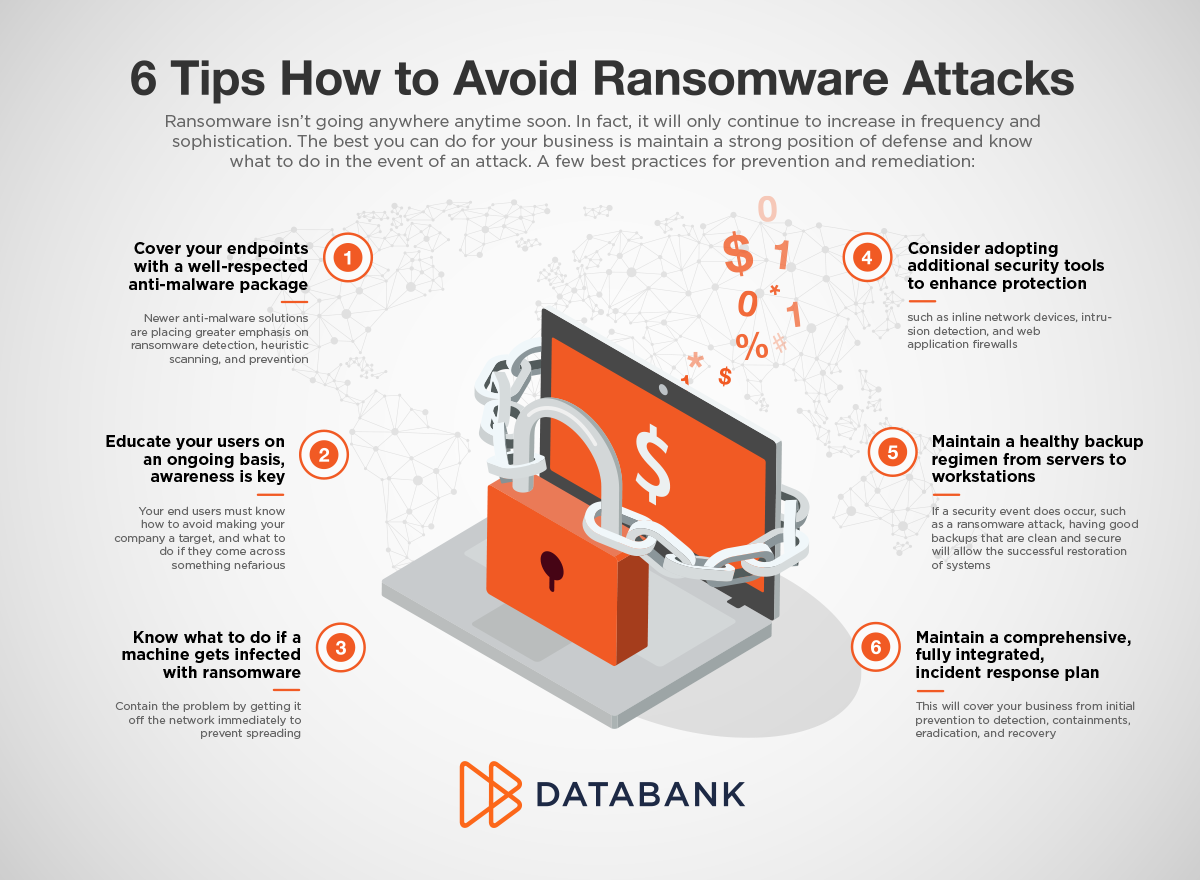
Ransomware isn’t going anywhere anytime soon. In fact, it will only continue to increase in frequency and sophistication. The best you can do for your business is to maintain a strong position of defense and know what to do in the event of an attack. A few best practices for prevention and remediation:
Key Takeaways from Recent Attacks
Security hygiene is an incredibly important and effective defensive practice, so don’t overlook its importance. If your business or agency falls victim to a ransomware attack, there are two key takeaways you should always keep in mind:
1. Do not pay the ransom. There is no guarantee for the delivery of the decryption key or the safe return of your data.
2. Involve law enforcement when appropriate to get the proper go-forward direction.
Interested in learning more? Join DataBank’s Chief Information Security Officer, Mark Houpt, for a webinar on Ransomware Defense – Understanding the threat and building intentional protection for your enterprise and data center. Watch this webinar here!
If you are looking to increase your defenses against ransomware, give DataBank a call at 800.840.7533.
DataBank’s Minneapolis MSP2 Data Center Completes Final 10,000 sqft. Data Hall
Located in Eagan, MN, DataBank East Twin Cities data center was built to leverage the city’s dense concentration of high-performance fiber. As a purpose-built multi-tenant data center, the 90,000 sqft. structure offers 20MW of power capacity, as well as access to a multitude of telecommunication providers.
After the initial opening of MSP2 in March 2015, DataBank quickly attracted a growing list of customers both within and outside of the market. In a continuous effort to keep pace with the demand for enterprise-class compliant data center space in the Twin Cities area, we’re proud to announce the fourth data hall, the final expansion on the original space is complete.
MSP2 filled up faster than anticipated, originally designed to accommodate modular builds as demand increases, with the final pod adding 10,000 sqft. The original investment was 25 million, growing to 55-60 million upon completion.
At present, the DataBank footprint is the only colocation option established on the east side of the metropolitan area, offering greater diversity for customers in other parts of the market.
Planning to Stay Ahead of Digital Transformation Initiatives and Compliance Needs Across Enterprises
Regardless of market and industry, the rising reliance on technology across enterprises will only continue to grow, calling for data center builds that can support denser processing capabilities. Though MSP2 has reached capacity for expansion, DataBank will continue to provide additional space as market demand grows.
While the pod itself offers the state-of-the-art data center technology typically delivered by DataBank, it will also soon offer FedRAMP compliance in addition to the regulatory requirements MSP2 was originally built to support.
When Migration Looms: from Business Model Changes to End of Hardware Life
Data center migrations are an inevitable part of the technology lifecycle. They can be triggered by a number of business change events including:
Current data center no long meets business needs for space and power
Data center is outdated and needs to be remodeled
Spending time and resources on the internal data center is negatively impacting the core mission
Hardware has reached end of life
There aren’t enough internal resources to manage an internal data center
Digital transformation is in process and requires a different model for IT
But no matter the cause, one thing is certain: getting equipment from one location to another can be a difficult undertaking regardless of whether you’re considering colocation or fully managed hosting services.
Luckily, DataBank can help, by drawing on a long history of migrations and deep institutional knowledge on the best practices for making a migration successful.
Avoiding the Minefields of Migrations
The potential for downtime is often the greatest cause for concern when a migration is impending. It can affect the ability of customers, employees and partners to do business, and seriously damage reputation and brand. Without a proper plan, it’s not possible to move your production site without incurring downtime.
Determining whether the migration will be a “lift and shift” or a “progressive path” is a second key step. In some cases, lift and shift is easiest. The entire environment will come down at the same time, then back up. But in other cases, a multi-staged migration may be necessary as not all businesses are able to move their entire environment at once. These progressive path scenarios involve a series of smaller migration phases and can present a number of challenges of their own. For instance, if a particular app needs to access to a database in order to function, a planned database replication and cut-over may be needed or the application will fail.
Where applications and infrastructure need to meet stringent compliance requirements, migrations can become even more complex and additional planning, process, experience, and staffing are critical. While maintaining a compliant environment is one thing, migration to and from one often requires internal resources to work outside their primary competencies. Having staff or a partner with the experience to plan each step in the migration is critical to avoiding downtime and maintaining compliance.
Tapping Experienced Partners For Migration Success
A physical equipment migration isn’t usually standard expertise for an IT professional. When it comes to a colocation environment, moving equipment on your own, especially without the proper hardware certifications, can go awry easily. It’s a whole different skillset than typical racking and stacking.
This is where a proven data center partner that specializes in migration becomes critical. It’s not just about facilities that can meet customer needs for scalability. It’s about having the mix of services to aid in a migration and the experience to de-risk one. With a full complement of colocation and cloud options, DataBank has all the bases covered from a platform standpoint. Contract and revenue portability among our services means we can deploy whatever services are needed to facilitate a migration, even if the eventual mix of services changes. Our deep mix of managed services means customers can rely on DataBank for server patches, application support, database administration or network support during a migration. And our security and compliance certifications ensure a migration is conducted the right way, with a failback plan in place.
“No one foresaw that it would be necessary to become a part of the digital world in the way that the market is demanding today. Everyone’s asking themselves, who do I work with, and where, to make the digital transformation journey?”
-Bill Pratt, VP, Managed Services & Channel Sales
DataBank’s Purpose-Built Migration Process
For both colocation and cloud migrations, DataBank has developed a proven methodology to maximize success. Colocation migrations require the physical move of equipment and often hardware vendors require certification, and sometimes insurance, for moving equipment because doing so without them can result in a voided warranty. For these migrations, DataBank enlists the help of specialized third-party providers who can provide a full team to handle the physical aspects of the migration. The process starts with a detailed equipment inventory and then the team consults with both DataBank and our customers to develop a layout of the new proposed space with rack elevation and placement. This makes it easy to pre-build the environment, from racks and cabling to power cords.
Migrating from a physical environment to cloud, or from cloud to cloud, requires a different type of skillset. For this specific purpose, DataBank has an entire team and toolset exclusively dedicated to migration. In a sense, migration is effectively a DR event in that it requires failover from one site to another. Our migration team utilizes proven DR tools and best practices for making the move which fall into five migration steps:
Plan
Design
Build
Test
Go live
“The fact that we actually have our own project management and migration teams is certainly a differentiator for our customers. Data center providers who only offer colocation aren’t going to be a good fit for a hybrid environment with 500 servers that need to be moved.”
-Justin Sevier, Director of Hosting Solutions, DataBank
Preparation and Process are the Keys to Migration Success
The most important aspect of migration, whether physical or to the cloud, is preparation. If you’re not thorough it’s practically a guarantee you will have problems. A successful migration is not just about getting from one environment to another, it’s about considering every element of the change process and the impact to every aspect of your business and applications. For instance, in what order do elements need to be activated in order for applications to come back online? If you were to boot your database server before your domain controllers are online, will your application be able to authenticate? And what are your business hours? 8-5? 24/7? When are your systems least utilized? Can you afford downtime? These are the planning factors that have to be taken into account and having a dedicated migration team results in a comprehensive understanding of the environment, as well as what’s going to be involved to make the move.
If you are facing a data center migration and you’re looking for feedback or support, give DataBank a call and we’ll show you how we leverage world-class platforms, process and people to make the move successfully.
Understanding the Unique IT Infrastructure Needs of Universities as Super Computing Becomes a Key Focus Area
The IT infrastructure needs of universities are very specific to higher education, and demand for upgrades is rising as technology continues to play a more integral role, both in the classroom and critical research initiatives. When it comes to higher education, especially engineering and scientific research, the pursuit of information is never-ending. The only way to analyze and answer complex questions that arise along the way is with high performance computing systems. Consequently, astounding amounts of data are being gathered and stored; researchers working for universities are generating billions of files and petabytes of data every day. This data often carries the progress of incredibly important initiatives: climate change, cancer research, and more.
The computing needs of scientists, engineers and researchers will only continue to grow. Fortunately, HPC is a way to effectively harness new scientific opportunities. A few examples of how HPC is impacting the world around us:
NASA Center for Climate Simulation executes on research science initiatives using HPC, giving scientists the ability to access to large data sets and powerful compute resources (Dell).
The University of Pisa built an HPC infrastructure designed to deliver the performance, storage capacity and compute power required for advanced research in numerous competitive fields (HPCwire).
HPC requires highly specialized IT infrastructure and data center designs because the performance demands are staggeringly high. Georgia Tech, for example, recently built a new HPC system that supports data-driven research in astrophysics, computational biology, health sciences, computational chemistry, materials and manufacturing, and numerous other projects. It will also be used for research that improves the energy efficiency and performance of the HPC systems themselves. This necessitates specific needs for proper heating, cooling, space and managing massive workloads. Such an endeavor is best undertaken with the support and partnership of an advanced data center provider well-versed in the IT challenges of HPC. Last fall, DataBank built a high-density solution for Georgia Tech to solve for this very issue.
Supercomputers have the potential to improve human lives through discoveries and advancements in science and research. This is why it’s so critical for universities to have access to a data center and infrastructure provider with experience in helping higher education institutions create roadmaps for their current and future demands, from configurations to reliability.
Planning for research initiatives that require super computing capabilities, like genomics or deep space analysis, are major drivers for attendance and acceptance rates, as well as attracting new professors that bring value to the institution. As such, these initiatives must be factored into planning around compute. It’s important to remember that technology is a direct tie-back to the value proposition a university can offer to its constituents.
What to Consider When You’re Developing an HPC Platform
If your university is planning to develop an HPC platform, there are several considerations that need to be made with respect to IT infrastructure and data center planning. When we partner with customers in higher education, such as Georgia Tech, we start by walking technology decision makers through existing infrastructure and evaluating a number of factors to determine the changes that need to be made.
Existing assets
Potential to repurpose
Power density needs
Reliability needs
Computing demand profile
“We help universities break through requirements and estimate their demand profile so they’re able to make a decision in terms of how much capacity they need and what type of design they should seek out. It’s a collaborative process with DataBank sharing much of its expertise.”
Adopting A New Model for Enabling HPC in Higher Education
Universities commonly operate data centers that have been built over time in an ad hoc fashion. Often, these facilities run legacy infrastructure powered by antiquated gear that supports important prospective programs. It’s time for a new model for enabling HPC in higher education, wherein universities upgrade outdated infrastructure and future proof for the next ten years. A campus data center should be an opportunity to showcase the importance a school places on science and technology.
The new computing paradigm for education institutions means abandoning aging infrastructure and embracing an entirely new approach that will drive the goals of super computing, and by extension, the university. To accomplish this, it’s necessary to solve for the challenges of heating, cooling, space, and managing massive workloads. Consider forming a partnership with an advanced data center provider well-versed in the IT challenges of higher education, HPC in particular.
Building a high-performance computing center is an expensive undertaking, requiring specialized talent in construction and operation as well as significant capital to build and operate a cutting-edge facility. By partnering with DataBank, GeorgiaTech was able to reduce the upfront costs while still achieving its goals of a world-class facility.
Working with a data center partner is also valuable in the context of higher-ed HPC initiatives because the right partner will work with you on your security and compliance concerns. Whether you handle data subject to regulatory entities or you’re trying to secure your environment to protect valuable information, it’s possible to gain the proper power, cooling, and space for your environment and secure it in one fell swoop.
Backups and disaster recovery are important considerations, too. Research moves fast, and backing it up regularly and properly will protect your findings as they evolve.
Benefits of an HPC Partnership
No need to expend capital dollars to maximize super computing capabilities
Eliminate the burden of maintaining infrastructure, redirect focus to core research activities, and extend budget as a result
Universities focused on medical or government agency research can gain access to an HPC expert with security and compliance expertise, from FedRAMP to HIPAA and HITECH
Take it from us: it’s not a small commitment to entrust critical infrastructure components that underpin research efforts, and it calls for an expert partner you can trust. If your technology team is looking to pursue high performance computing initiatives, but is struggling to figure out support and financing, consulting with a specialized data center provider is a pertinent next step.
Next Steps to Formalizing an HPC Strategy at Your University
We live in an incredible time during which scientists, engineers, and scholars around the globe continue to make progress on discoveries that are shaping our future. An HPC solution fosters research on these discoveries, and enables the ability for universities to solve complex problems. Further, many organizations outside of higher education institutions are equally invested in participating and benefiting from ground-breaking research. A new HPC model can attract and build upon these relationships.
Not to mention, it’s important to empower your research team to execute on their search for knowledge, but it’s equally important to protect the fruits of their labor. You can solve this problem by taking advantage of a data center that will give you the space, power and cooling you really need to use HPC effectively.
Fully upgrading a legacy IT infrastructure and creating a complete HPC strategy are decade-plus investment decisions, which is why the right expertise is so critical. DataBank possesses the expertise, skill, and financial strength to be able to meet the unique needs of university clients. DataBank also specializes in providing such environments and the managed services that complement them so that your university doesn’t have to lay out excessive capital for IT initiatives that would be better spent elsewhere.
If you’re seeking to identify the best way to protect your HPC technology and support your researchers, get in touch with DataBank today, or call us at 1.800.840.7533 and speak to an expert.
UPCOMING EVENT
If you would like to learn more about how DataBank can assist universities with the technology, operations and business model for an HPC facility, sign up for our webinar co-hosted with EYP Critical Facilities on Sept 26 at noon ET