You’ve made the decision to outsource some part of your IT operation. Your IT team narrows it down to three contenders, and goes as far as to complete the design phase to see who will be able to best fit your needs.You’ve got a clear picture of the technical fit, but what about the overall partnership fit? It’s during the pre-sales and sales process that you get a glimpse into more than just the quality of the technical solutions your prospective candidates offer; you also get a glimpse into the quality of their people, their values and how they’ll operate going forward.
Many providersstill foster a highly competitive, cutthroat sort of sales culture that doesn’t align well with the tenets of the modern customer experience. When technical sales reps are overly focused on meeting their numbers, or getting a signature by a certain date, it may be a sign of how provisioning, operations teams and the rest of the organization will operate. The pre-sales and sales customer experience sets the precedent for what can be expected throughout the rest of the company.
Here are some of the things businesses in search of a data centeroften struggle with in the sales process:
Lack of flexibility
Lack of responsiveness
Offering solutions that benefit the vendor, but not the client
What You Should Expect from an Honest, Customer-Centric Data Center Partner
Fortunately, the stereotypical sales representative doesn’t embody the experience you’ll have with every prospective partner, but you should know what to expect in order to have confidence in your data center’s integrity and process.
First, look for an engaged and service-oriented culture. Responsiveness throughout the entire process is key. If you’ve initiated outreach, you shouldn’t be waiting two or three weeks for someone to connect with you. Whether you make contact through an email, form or phone call, follow up should be immediate. It should be clear that solving your problems is the priority.
From there, your prospective data center should be honest about how you fit together, and manage expectations. The truth is, not every data center will be a fit for every prospect, depending on their areas of specialization, geography, and numerous other considerations. Your sales representative should be well-versed in data center solutions, clear on what they can and can’t deliver, andconversation should be transparent regarding whether they can help in a way that will fit your needs.
Next, a data center partner who’s legitimately interested in solving your problem won’t create undue pressure depending on how close you are to the end of the month. It’s not wrong to use quotas, but it’s wrong to make quotas the potential customer’s problem. Communication and courtesy should be consistent across the board.
Flexibility in pricing models and the general method for doing business is important, too. Every data center vendor has to have policy, but putting customers through needless hoops and rigidity when it’s not a big problem to make an adjustment out of courtesy is a red flag.
How DataBank Delights Customers with a Problem-Solving Sales Approach
Knowing the pitfalls of the marketplace, DataBank has gone to great lengths to develop a modern, customer-focused approach to sales that’s designed to help customers realize solutions quickly.
It all starts with unparalleled responsiveness and knowledge. For every inquiry we field, the representative who is most educated on the prospective customer’s problems will reach out immediately. It is of the utmost importance to begin customer engagements with responsiveness from the beginning and provide the right expertise upfront.
“To start from the very beginning with responsiveness and doing what we say we will, when we say we will…that plants the seed for a client who will be with us a decade. That’s how we look at it. Our biggest client started with a single cabinet. Now they exceed 7 figures in spend after they installed their last order.”
-Eric Morgan, Regional Sales Director SLC, DataBank
Flexibility is part of DataBank DNA. Our hybrid product offering and diverse footprint mean our sales teams don’t need to shoehorn any client into one particular product or location. We provide revenue portability that allows any client to switch their configuration among offerings and locations mid–contract, without penalty.
Also, while we have to run a “sales force,”we pride ourselves on serving rather than selling. We engage every prospect the same way: responding to their request, getting to the heart of what they’re trying to accomplish, and understanding their business. We approach every meeting as an opportunity to co-create the future: working shoulder-to-shoulder in front of a whiteboard, outlining technology goals,and offering the recommendations, resources and execution plan that will meet your needs. Customer relationships start with consultation and trust. At DataBank, there is no high-pressure sales approach. It’s all about understanding your challenges and the future-state you seek to achieve. Then, knowing that one size doesn’t fit all, we creatively combine colocation, cloud and managed services to engineer the solution that makes sense for you.
That’s the DataBank way: the Data Center Evolved.
“We had a meeting with a client who’s been with us for five years recently. He told us how much he appreciates thatwe’re not that organization who comes and says, ‘Can we get you to sign by the end of the month?’ He appreciates that we let him grow at his pace. The funny thing is, they were talking about expanding to 10 cabinets, but after having the discussion, he said they wanted to do 30 instead. It’s that kind of partnership, creating that relationship, that shows we want to collaborate rather than sell.”
-Jeff Swain, VP Sales, DataBank
An Evolved Data Center Experience Starts with a Well-Defined Technical Implementation Process
The reasons for partnering with a data center provider, whether simply for colocation or for a full-scale hybrid IT solution complete with managed services, are all different. Yet, they share common denominators: improving operational efficiency and removing IT problems that negatively impact your internal team.
That process starts with a consultative sales approach where your service provider gives you options for delivering on the improvements you’re looking to achieve.But what should the experience look like after you’ve nailed down the solution that will best resolve your business challenges? Here’s a high-level overview of what a successful, transparent implementation process should include:
1. Order execution
Once you’ve worked with your chosen IT partner to build the appropriate solution, your sales representative will initiate the order. From there, orders should be routed for provisioning, dependent upon what type of solution or service you’ve chosen.
2. Assign to provisioning team member
Next, the department manager will review the order and assign it to the appropriate provisioning team member. That team member should take the order, register the necessary products, and become your POC through the implementations process.
3. Coordinate final details
At this stage, yourPOC should coordinate final details, any delivery dates that weren’t predetermined, and begin solution implementation.
4.Execute on implementation
Professional coordinators will manage all moving pieces between operations and facilities teams, communicate with different vendors to deliver the environment ordered, andmanage due dates and expectations. Finally, the solution will pass through QA. Your solution will be handed off to your team, and the project will be closed out.
Beware of Process Without Planning
Before you select a data center vendor, make sure that their implementation process is a proven, repeatable, and well-documented methodology that executes on the above needs. But also be aware that the best implementation processes is worthless if there isn’t a plan to align it with the underlying infrastructure and services.
There are a number of obstacles that can accompany the implementation process when you entrust an IT partner with your technical project, and it’s why businesses are sometimes hesitant to trust an outside resource. Here are some of the things that cause problems in poorly planned, undocumented implementation methodologies:
Delivery dates & staffing
Availability of services
Connections to different carriers
Availability of power
Speed and scalability
If you have aggressive demands for delivery from internal stakeholders, choose a partner who’s capable of ramping up staff and adjusting schedules for timing on delivery. Also look for infrastructure scalability. Data center providers have to be thinking ahead; growth happens quickly. Make sure service availability is consistent, and the appropriate range of connections to outside carriers is available. Ask about long-term power supply, as well. You should never have to worry about the potential for a facility to run out of power or resources. For instance, at DataBank, it’s common practice to begin construction on substations when capacity draws near in order to meet demand at an advanced pace.
“We always look to deliver projects as quickly as possible. That’s really what we’re doing as a team. We want to get our customer projects completedcarefully, but quickly.We look at all windows of availability to deliver and beat expectations. That’s our goal.”
-Ron Driggs, Director of Provisioning, DataBank
Combine Process and Planning with the Right Attitude
Ultimately, implementation success will come from combining process and planning with the right mindset, and that’s what makes DataBank different when it comes to delivering on a project: we will stop at nothing to exceed expectations for delivery of services. We maintain strong, communicative relationships with vendors in every market and make every effort to reduce time to delivery intervals as much as possible. If it’s possible to move projects around to clear capacity with a vendor for a customer with greater urgency, we will. Implementation isn’t just about process, but exceeding expectations to build a lasting relationship. DataBank implementations are about earning a position as your ally.
In addition, DataBank either promotes from within, or seeks staff members with deep experience in the industry. Every specialist on the implementation team is required to have expertise on the nuts and bolts of what data centers offer, as well as strong communication and customer service skills; it’s not enough to be technical.
Ultimately, the goal is to initiate and complete the technical implementation for every customer without even creating awareness that it has taken place. Customers should enjoy a seamless, painless delivery, without the burden of having to understand every moving part or being pulled into coordination unnecessarily.
“Customers routinely give us positive feedback on our ability to ask the right questions. If there’s an order change, our team has experience outside of provisioning, and they know what to look for should the need to upgrade or make power changes arise. We will lead them in the right direction and adjust accordingly in a way that will benefit them most, and they see that.”
-Ron Driggs, Director of Provisioning, DataBank
On Thursday, April 11th, TMT M&A Forum USA 2019 will be taking place in NYC at New York Hilton Midtown. This year’s theme is “How Transactions Are Driving Change in Telecoms, Media, and IT Infrastructure and Services,” featuring executive keynotes, fireside chats, networking and meeting opportunities. At the conference, a number of CEOs and CFOs from the Digital Bridge portfolio will be participating in conversations focused on assessing how mergers and acquisitions will drive change in TMT M&A:
Sharif Metwalli, CFO, Vantage Data Centers
Raul Martynek, CEO, DataBank
Jim Hyde, CEO, ExteNet Systems
DataBank’s Role in the Digital Convergence of Fiber, Tower, and Data Centers
The mobile and internet infrastructure sector within the U.S. is bracing itself for the swiftly approaching 5G revolution, and there’s a great deal of discussion throughout the industry around how next generation network technology will fit into the wider commercialization of the communications ecosystem, according to TMT Finance.
In 2018, investments across the communications landscape were aggressive, bringing several of the largest ever merger valuations in addition to significant capex investments. However, it’s important to note that last year’s M&A activity was driven by smaller companies, suggesting that consolidation and scale remains a market driver. Consequently, it’s likely that telecom and media will continue to converge as the demand for end-to-end data delivery and a subsequent need for edge geography of infrastructure assets gives way to further investment and consolidation. The ultimate result is the opportunity for businesses pursuing M&As to shift business models to a changing ecosystem.
This reflects the strategy at DataBank, largely focused on functioning as a catalyst for the industry-wide consolidation. “5G is heavily influencing new investment and M&A in the US communications sector,” said Raul Martynek, CEO at DataBank. “As such, strengthening our partnerships with the other Digital Bridge companies and forming a joint strategy for operating the
TMT M&A Forum USA 2019 Event Details
If you’ve not yet registered for TMT M&A, don’t miss out.
With 70+ speakers, 24+ sessions, and 5+ session types, there’s something for everyone looking to learn more about the next steps towards telecoms, media and technology investment, not to mention the latest innovations paving the way for TMT.
If your organization is looking for guidance on how to get ready for the 5G revolution, DataBank can offer feedback on the technology strategy and solutions that will put you in the best position of preparedness. Reach out to DataBank, or call us at 1.800.840.7533.
The ever-evolving nature of IT workloads and technologies now ensures that there is no “one-size-fits-all” strategy for IT infrastructure. Running a corporate data center isn’t the best long-term strategy for most organizations, requiring tremendous capex and adding significant management and staffing complexity. Similarly, public cloud platforms haven’t proven to be the solution for every application either, especially where needs are highest for performance, compliance and control.
Enterprises still have many IT workloads located on premises, and some analysts have reported as many as 80 percent of companies have repatriated applications or data, back to collocated data centers and private clouds due to security, performance, cost or control. (Source: Hosting Journalist)
A hybrid approach provides the best option for meeting the complex and ever-changing demands of today’s IT environment.
IT leaders need to take into account several factors when designing a hybrid infrastructure strategy including application performance, internal skill sets, costs. To get started, it helps to consider three of the most common drivers of adopting a Hybrid strategy. Colocation, Capex and Support.
Colocation is one option that removes the first layer of responsibility from your IT team, including core infrastructure, network, power, and cooling. Moving an environment from an on-premise data center into a data center facility improves financial dynamics. Unless you’re running a data center of mass scale, colocation is a very efficient mechanism for maintaining similar profitability metrics for the organization. It also delivers scale and resilience that most enterprises don’t have the wherewithal to generate on their own.
2. Capex
It’s worth taking a look at workloads you don’t want to operate hardware infrastructure for. Working with a data center provider for a more hybrid approach will give you the opportunity to leverage internet, security, storage-on-demand, and backup services, taking day-to-day management off your IT team’s plate so they can focus on core initiatives.
3. Tech Support
Transferring ownership of workloads, apps, and operating systems to a data center partner are another hybrid use case. A proven partner will be able to provide the infrastructure your applications rely on. This eliminates the need to worry about patching or monitoring.
Removing support and operational burdens lessens the pressures of everyday tasks and reallocates energy into building the innovative systems, applications, and solutions of tomorrow.
Further, it’s significantly easier to manage many servers at scale. Data center partners traditionally use an operations platform that runs on a more prescriptive methodology for service management. This can be applied to 1,000s of nodes, rather than relying on sys admins to do the work.
What Does Hybrid, the DataBank Way, Look Like?
As organizations have realized the value of a hybrid approach, DataBank’s collection of capabilities and environments have become one of the most convenient pathways to deploying a hybrid strategy.
Not every application will perform best in the public cloud, so DataBank provides a range of platforms to enable your Hybrid IT strategy including colocation, private cloud and public cloud on-ramps. And across those environments, we enable public connectivity to spin up or spin down workloads, yet maintain visibility within one pane of glass for simplified management and global visibility at every level.
In addition, our customers have convenient direct access to three critical components of a Hybrid IT infrastructure:
Secure access to public cloud
Managed security
Storage
Each of these services are consumable via cross connect in your colocation cage. You simply plug right in one or two connections, and these products are available to your infrastructure that lives in your data center. Plus, within each data center, every customer has access to FedRAMP compliant IaaS, PaaS, or colocation, all on a single platform, ensuring long-term performance and viability of your IT strategy as business needs evolve. It’s our goal to be there for every step of your Hybrid IT journey, with as much or as little as needed for your unique requirements.
DataBank delivers all the building blocks of a hybrid strategy allowing you achieve cost efficiency, flexibility, scalability, and agility simultaneously. And we make embracing a Hybrid IT strategy easy and pragmatic – every customer interfaces with seasoned engineers—never inexperienced analysts. If you’re looking for a partner to work with you throughout the evolution of your hybrid IT strategy, look no further. Connect with DataBank today, or call us at 1.800.840.7533 and speak to a specialist.
An incident response plan defines how organizations detect, respond to, and recover from cybersecurity incidents to minimize operational and financial impact.
Why an Incident Response Plan is Critical in Today’s Threat Environment
Security incidents are, by their nature, unplanned and unpredictable. The one thing IT leaders can be sure of is that the threat is growing and that the actors behind those threats continue to improve in sophistication and efficiency.One of the best ways to respond to these threats is to have a fully integrated incident response plan.
AnUnpredictable But Growing Threat
Cyber threats of all types are on the rise and for virtually every organization, it’s not simply a matter of if – but when – they will encounter an incident. Consider the following statistics (Verizon):
Frequency of security incidents in 2019 alone:
53,308 security incidents
2,216 data breaches
Who you’re defending against:
73% of cyberattacks were perpetrated by outsiders
50% of breaches were executed organized criminal groups
12% of breaches involved nation-state or state-affiliated actors
28% of attacks involved insiders
What they want:
76% of breaches were financially motivated. Stealing payment card data, PII, and intellectual property are all fair game
Less than 30% of breaches were motivated by espionage or a grudge
“If you’re facing a cyberattack, you can’t predict what the attacker is going to do next, especially if it’s an APT attacker. If it’s more than just a botnet or a robot network that’s out there, and there’s a human behind it, you simply can’t predict what’ll happen next.”
-Mark Houpt, Chief Information Security Officer, DataBank
While the nature, timing and origin of an incident may be uncertain, the likelihood of one occurring demands IT leaders be prepared to respond.Having a fully–integrated and regularly-practiced incident response plan is the best way to know how to handle a cyberattack from start to finish. A well-crafted response plan will spell out communications, documentations, and who’s going to be on the team to take on responsibilities for various response processes.
Response plans are critical within an enterprise, but they are even more important when you’re working with a cloud service or colocation provider. In a corporate environment, it’s usually easier to corral all the individuals who are needed for execution, however, doing so may not be a formalized part of your plan. When you’re operating within a multi-organization environment, it becomes even more important to have a documented plan that identifies how communications go between multiple organizations, when notifications are to occur, and how much transparency is needed between entities.
For instance, as a cloud service provider, at DataBank we have the concern about how much information we give out during an incident. We always maintain transparency, but must also ensure we’re not compromising security, or that any security events that take place don’t impact customer relationships. There are many layers of complexity to address.
Regardless of the unique properties of your organization, establishing and maintaining an integrated IR plan prior to an event occurring lets everyone know where they stand and what to expect. Testing throughout the year is also important for ensuring the process is smooth when an event comes to pass.
A Real-Life Case Example: Fighting DDoS at DataBank
Let’s review a real-life case example our security team dealt with right here at DataBank.
No one’s immune to cyberattacks; that includes data center and cloud service providers. In September 2018, and later in November, a DDoS attack was launched against two of our facilities, more so in an attempt to disrupt our service than take it down entirely. The incident involved a multi-day attack, likely executed by an APT attacker.
Our security team is well-trained in incident response, so we immediately ran our IR plan and communicated to customers what was taking place. Internal tech teams as well as vendors worked together to identify the threat and where it was sourcing from, which in this case was a distributed, multi-location attack. When the attack pattern was identified, we were better prepared to defend against it.
How to Effectively Combat a Cyberattack
Effectively combating against cyberattacks starts with a single best practice: have a security response plan.One of the best places to look for a plan template and plan guideline is NIST. NIST offers a “Computer Security Incident Handling Guide,” which includes Special Publication 800-61, Revision 2 which identifies how you should work through an incident, including a template for creating your own IR plan.
Here are six steps to incident response we employ at DataBank, and frequently recommend to customers.
1. Preparation
Prepare documentation
Training personnel
2. Detection and analysis
This step takes place when the incident starts occurring. When set up properly, the appropriate alarm systems go off and alerts are generated.
3. Containment
Post-detection, the security team has to contain and stop the attack from spreading or causing other problems.
4. Eradication and recovery
Removal of threat or attack vector from systems
“NIST actually groups containment with eradication and recovery, but I like to break these steps out because I find that once your security team has everything stabilized, you then move into actual eradication and recovery.”
-Mark Houpt, Chief Information Security Officer, DataBank
5. Return systems or data center to an operational state
6. Post-incident activities
Bring team back together
Reviewed the event in detail
Determine areas of improvement for future incidents
Update documentation
“A lot of people forget about post-incident activity. Once everyone has gotten systems online and has had the chance to get some sleep, you’ve got to get your people back together so you can review what happened and figure out how to do better next time. Documentation changes could be as small as updating someone’s phone number that was incorrect when you were trying to get hold of them. Do not forget the post-incident activities!”
–Tyler Treat, Security Architect, DataBank
Post-incident activities are particularly important because it ensures no one forgets some of the smaller details that can end up costing you when another event comes to pass. This brings the cycle back to the preparation step in ensuring your security team is 100% ready for the next attack that will occur. Unfortunately, it’s a guarantee, and the best way to deal with it is having these steps firmly in place to enable the ability to recover and work forward, regardless of the event.
Benefits of NIST-Based Incident Response, DataBank-Style
One way to ensure your incident response practice is covered is to enlist a security partner. Here at DataBank, we have an extensive team dedicated exclusively to recovery, containment, and detection. In many cases, smaller or medium companies may not have the ability to staff a seven-person security team, or establish the necessary resiliency for protection.
Keep in mind: part of preparing for an incident is doing risk assessments. Know how you have your organization set up and determine whether you can sustain through an attack. Conduct a threat to vulnerability risk assessment and determine if the current location of your data, IT resources, and systems, is good enough for your company. This is a key factor.
For example, if the average medium-sized company was attacked in the same way DataBank was in September, they’d probably have been taken down. This level of force is designed to take an unprepared organization off the grid for days, whereas a provider with resilient systems is built to withstand the attack.
“When we dealt with the DDoS attacks, we had access to multiple data centers and a full staff of people who can be involved. Plus, we were able to leverage the power of vendor resources. We were able to sustain that attack with minimal downtime for our customers. That TBRA is something everyone should evaluate prior to walking into the IR process so you know what you’re dealing with.”
–Stephen Maiorca, Sr. Security Engineer, DataBank
Three Key Takeaways for Incident Response
1. Find an IR plan that’s based on an industry standard.
We recommend NIST 800-s61 revision 2. Your industry standard of choice needs be emphasized in the documentation. If you cobble together a plan, it’s harder to execute on and put together, plus it will be subject to auditing scrutiny.
2. Consider working with a redundant, resilient security partner rather than trying to tackle IR internally.
If you’re understaffed, trying to deal with a full-scale cyberattack won’t be easy, and neither will creating an incident response plan. A supporting partner such as DataBank can offer resiliency and redundancy that will allow you to remain up all of the time.
3. Always test your plan.
Test your plan and ensure it’s ready to go. Incidents occur at a moment’s notice and they certainly aren’t designed to give you and your time to sit down and figure out how to deal with it. Have your fully tested plan in place in advance so it can be effectively activated when an incident occurs.
Looking for more tips on putting together an incident response plan? DataBank can help point you in the right direction to ensure you’re prepared in the event of an attack. Reach out to DataBank, or call us at 1.800.840.7533 and speak to an incident response expert immediately.
Predict and Prevent Downtime with Proactive Monitoring
In today’s hybrid multi-cloud environments, visibility and proactivity are the keys to availability. It’s no longer sufficient for IT teams to simply react to issues. They need a proactive monitoring strategy that not only detects problems, but provides real-time visibility, data trending over time, and the ability to predict and prevent future downtime.
At DataBank, we recognize that the impacts of downtime aren’t just financial. They also affect legal liability, regulatory compliance and sheer quality of life for overburdened IT staffs. And our objective is to get our customers ahead of problems rather than just reacting to them.
Making the Shift to Proactivity
True proactivity comes from a deep understanding of your environment combined with well-documented run books and automation of incident response. It demands well-configured monitoring, comprehensive documentation, 24/7 staff and resilient design patterns applied to your applications and technology stack. Achieving this profile can be difficult for many IT organizations due to:
Costs associated with a comprehensive monitoring solution
Daily operational overload and reactivity taking away product time
Costs associated with 24/7 operations and staffing
DataBank’s portal and robust suite of monitoring tools can help IT teams achieve a truly proactive stance especially in hybrid environments.
Why Managed Monitoring & Proactive Care are Crucial for Hybrid Environments
As technology transitions from a cost center to a competitive differentiator, hybrid IT strategies are driving innovation. But hybrid cloud deployments a complex amalgamation of technologies, application stacks, multi clouds and colocation. Hybrid cloud environments introduce visibility complexity that demands proactive monitoring across all infrastructure layers. Practical guidance on how to monitor cloud services helps teams implement the proactive visibility hybrid IT demands. Ensuring that every element of your infrastructure understood is key to maintaining uptime and reliability.
“Visibility, Proactivity and Planning are the keys elements to drive application availability.”
-Vlad Friedman, CTO, DataBank
When IT doesn’t have enough resources, bringing in the right partner allows you to affordably acquire the talent, experience, technology and 24/7 operational support needed to deliver 100% uptime for complex hybrid enterprise applications.
A reliable partner will have in-depth experience in the managed services space with the ability to analyze monitoring data and generate insights that are difficult to replicate using out of the box solutions. By supporting thousands of customers and tens-of-thousands of monitored servers, a partner can often predict problems before they occur based on their deep understanding of failure points.
And they can unburden your IT staff as well. Managed service providers are staffed 24/7, and can easily assume the position of first responder, executing your run books and escalating as needed to your staff. That allows your IT team to focus on transformational projects within your business and forego the costs that come with buying technology and staff to support it.
DataBank as a First Responder: Our Take on Proactive Care
Monitoring and proactive care are a key component to DataBank managed services. Basic server monitoring is important (responding to ping, HTTP checks, etc.), but achieving the proactive half of the equation requires good systems, experienced engineers, and cross-functional monitoring from disparate yet dependent systems.
At Databank that means:
Monitoring 3x the number of checks and data points than you would get with an out of the box monitoring solution;
Opening 70% of all tickets on a customer’s behalf through proactive monitoring driving problem prevention;
Trending 120 days of data to identify patterns and trends that could lead to downtime;
Responding to 99% of alarms within the SLA window 24/7/365;
Remediating 95% of alarms without customer interaction;
Providing transparency with direct access into our monitoring systems so you see what we see;
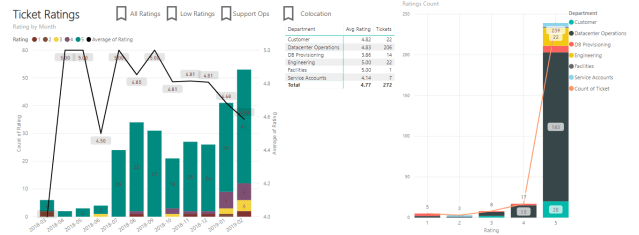
Achieving a 4.8/5 quality of service rating for monitoring.
This level of thoroughness provides a significantly deeper view into the health of individual servers, devices, and applications. The ultimate result is unmatched live visibility into how your applications are performing.
“When an application has an issue, our granular monitoring allows us to quickly identify the root cause and remediate problems.”
-Gary Dowell, IT Managed Services Engineer, DataBank
Collecting and analyzing trending data on systems, capacity, swap, CPU, disk I/O, services, event logs, running processes, services, OS configuration, resource limits, and disk space allows our team to build a profile on each server. Our methodology helps drive the detection of a problem long before it impacts service.
Choosing a partner for monitoring and proactive care isn’t just about an improvement in the SLA, or the uptime percentage; it’s about quality of life. IT people are already spread thin, and Hybrid IT strategies only add to the challenge.
Proactive Monitoring and Care is yet another way to can make life easier for your IT teams, eliminating noise, and allowing them to focus.
On March 1, 2019, Adobe released patch advisory APSB19-14 for all currently maintained and supported versions of ColdFusion (ColdFusion 11, ColdFusion 2016, and ColdFusion 2018). The critical patch addresses an issue allowing an attacker to upload a malicious file to a server by bypassing any file restrictions and then executing the attack via an HTTP request. This is actively being exploited in the wild.
Is my instance of ColdFusion affected?
Any server that is running ColdFusion 11, ColdFusion 2016, or ColdFusion 2018 is affected and should be patched immediately.
What about older versions of ColdFusion?
Older versions of ColdFusion are considered end-of-life and are not being patched by Adobe. If you are running an older version of ColdFusion, you should upgrade to a supported version.
How do I update ColdFusion?
The easiest way to update ColdFusion is to log into each CF Admin instance and navigate to Updates. From there, check for updates and apply the patches that are available. Once done, restart the ColdFusion services. Specifically, ColdFusion 11 Update 18, ColdFusion 2016 Update 10, and ColdFusion 2018 Update 3 are the patches that address this critical vulnerability.
What if I need assistance in patching ColdFusion?
As always, our engineers can assist you. Please open a ticket via the customer portal and we would be happy to assist.
Why Your Data Center Provider Needs to Be a Partner
It’s becoming more common to outsource different components of IT, and fewer enterprises are continuing to run internal data centers. Relying on third-party IT providers is a way to increase cost efficiencies, improve productivity, and reduce risk. But what does it really mean to be a data center partner?
A customer partnership is all about living up to the solution built for the customer. At DataBank, if we sold it, we provide the service continuously throughout the lifecycle of the contract. Across all components of our team, from the technical frontlines to project management behind the scenes, it’s essential for everyone to be on the same page for our customers; what we refer to as: The Data Center Evolved.
Collaboration and Relationship-Building is Vital in Today’s Market
Think about the state of the data center industry: the speed of technological advancements and the resulting complexity increase daily. The days where technology was viewed as a necessity are so far behind us; IT has to function as a revenue generator. Today, businesses are technology, but here’s what businesses are not: running data centers, troubleshooting menial IT tasks, and network upgrades. Consequently, it makes sense that hybrid environments and outsourcing IT are becoming the norm.
A partnership-oriented relationship with your chosen data center provider has never been more important. When you’re outsourcing your IT infrastructure, it can feel like a considerable risk. If the relationship isn’t cohesive, details get lost in translation. For these reasons, DataBank’s methodology for working with customers is built on remaining in sync with customers and understanding business needs, challenges, and all possible options for solutions.
“Helping customers understand their options is key to being a partner. When they’re successful, so are we.”
-Wendy Stewart, Vice President of Account Management, DataBank
Account management is an important practice area to evaluate when you’re taking the leap to outsourcing IT. Your chosen provider should treat account management as customer advocacy. You’re most likely to have a positive experience when your data center provider is flexible, and doesn’t force your organization into cookie cutter solutions. Every interaction should be custom.
Building Relationships the DataBank Way
Our customer base is very diverse. We have a great deal of high-touch customers with whom account management is involved with on a day-to-day basis. When it comes to customers who are more removed, while our network operations center is always managing the network proactively, eliminating the need for customers to notify us if there’s an issue, we have dedicated account managers for those customers, as well.
Here’s the common thread: when a business becomes a DataBank customer, we treat it as a true partnership, and we walk alongside our customers on their journeys. We don’t hire entry-level personnel for account management roles; only the brightest, most experienced in the industry who have the skillsets to navigate any issues that arise. Technical, strategic, and tactical skillsets are all requirements for making our customers comfortable.
”There was one meeting in particular with a large enterprise customer. They brought in people for a channel discussion, and someone asked the customer what made them comfortable with signing a 10-year agreement with DataBank. Their response was: ‘I was comfortable with the people that DataBank put in front of me and trust that their resume matches what they can deliver every day—that’s who they are as an organization.’
We always treat our customers as partners. If they’re having trouble, then it’s a problem for us. We own that.”
-Wendy Stewart, Vice President of Account Management, DataBank
Relationships don’t stop at IT, either. It’s about staying plugged into customer culture and celebrating successes, as well. Gestures as small as sending handwritten cards if a customer acquires a new company, or launches a new product, are equally important.
Senior Leadership on the Front Lines
It’s common for senior leadership to be detached from individual customers across the data center industry. This is not the case at DataBank. On the contrary, our executive leaders are highly in tune with our customers, their goals, and their success; they’re equally as passionate as the technologists who are building solutions. Knowledge and approachability are requirements for senior leaders at DataBank. This allows account managers to do their jobs effectively because leadership investment is part of our culture.
“I can take my CEO on appointments with me to visit customers just to say hi because we have such strong leadership. They’re not removed from our customers and what they’re doing by any stretch of the imagination.”
-Natalie Haralson, Account Manager, DataBank
We listen, learn, and lead. We know our strengths, technology, and assets, and we will always pair customer needs with our offerings to ultimately create the best possible solution. Remember, when you’re in the market to outsource components of your IT infrastructure or engage managed services, make partnership a priority.
DataBank is committed to true partnership. If you’re seeking to enlist the support of a data center, whether simply for power, ping, and pipe, or more in-depth managed services, we can help point you in the right direction for your goals. Connect with DataBank, or call us at 1.800.840.7533 and speak to an expert immediately.
Who went to HIMSS 2019? DataBank was in attendance, and we’d love to talk about some of the key topics of discussion.
To start, if you haven’t heard of the HIMSS Global Conference & Exhibition, it’s the healthcare industry’s biggest health information and technology educational program and exhibition center, led by the Healthcare Information and Management Systems Society. This year, the event focused on a rich combination of recurring and innovative healthcare topics, offering many education sessions featuring thought leaders from the industry.
Some of the main education topics covered:
Consumer, patient engagement & digital/connected health
Cybersecurity
Data science, analytics, clinical & business intelligence
Health information exchange, interoperability, data integration & standards
Telehealth
…and many more!
Three Main Themes from HIMSS 2019
1. Artificial intelligence
Artificial intelligence remains to be a key topic of interest and conversation throughout healthcare. During the event, we heard from both healthcare organizations who are on the forefront ready to go, as well as orgs who feel strongly that the industry is a long way off from integrating AI in a significantly impactful manner.
Though its development continues to advance, AI is still a new technology. At present, the main focus from the healthcare world is on predictive models. Healthcare organizations are interested in being able to analyze large data sets and use them to generate predictions, such as when certain people with particular behavioral characteristics, lifestyle choices, etc. may fall ill and/or what type of treatments they’ll need.
There’s a great deal of buzz around ML, AI, and their potential to revolutionize healthcare, but these technologies are still evolving, and will require a lot of work. Right now, AI is certainly capable of collecting information and sorting through it—eventually, it will be capable of categorization. However, true predictability models call for richer information set; from metabolic rates to lifestyle choices and genetics, a lot of variables come into play. The general consensus is that we’re a long way off before AI has a major impact on healthcare, but it’s coming.
2. Client and patient engagement
Increasingly, technology is being used to collect and provide more data on individual patients. There’s a strong focus on improving the patient experience while using data to make better organizational decisions.
Healthcare organizations are evaluating tools, technologies, and programs built to forge partnerships between patients, caregivers, & families and their providers. The ultimate goal is to enable patients to take control of their health and healthcare decisions.
Because the economy today is consumer-based, it’s important for healthcare organizations to put the emphasis on using technology to make health easier for people, including both clinicians and patients. However, even with modern advancements like telemedicine, connecting services and the data that accompanies it along the care pathway remain a challenge.
3. Interoperability
Information management remains an ongoing obstacle throughout healthcare IT. Innovators are trying to figure out how disparate systems can communicate, connect, and share exchange information between each other: interoperability.
For instance, if a patient visits a hospital to see an immunology specialist, that doctor should have the capability to pull other medical records in order to easily tie together information relative to current medical conditions.
When technology is seamlessly interoperable, the possibilities are endless. The simple transition from paper to digital health records has certainly transformed the delivery of care, however, consistently linking patient records in different locations (patient matching) is still a persistent challenge. Fortunately, new research is leading to the breakdown of the interoperability barrier, bringing healthcare closer to arming patients and providers with current, complete data.
“There’s a really strong focus on interoperability. Today, healthcare is about the client experience, and providers really need complete information to make better decisions for patients. Information has to be readily available.”
-Matt Horne, Sr. Account Executive, DataBank
DataBank is dedicated to keeping pace with the ongoing evolution of healthcare IT, and our solutions are built to empower healthcare organizations to meet their digital objectives.
FedRAMP compliant
HIPAA and PCI compliance accredited
Built to power high performance computing
If your healthcare organization is looking for guidance on your technology objectives or has questions about compliance, DataBank is here to help. Reach out to DataBank today, or call us at 1.800.840.7533 and speak to an expert.
What We Learned at PTC 2019
Did you catch PTC 2019? DataBank did, and we’d love to share what we learned.
First thing’s first: if you’re not familiar, PTC is the leading telecommunications event of the Pacific Rim, directed by the Pacific Telecommunications Council. Held over three days in Hawaii, the event has grown from a focus on Asia-US telecom to encompass the global internet infrastructure ecosystem including submarine cables, fiber, towers, data centers and their principal consumers, the hyperscale cloud and content providers. This year, the theme of the event was “From Pipes to Platforms,” with emphasis on the expansion of infrastructure globally and the inception of 5G.
A few of the topics covered:
Global submarine cables developments
Evolution and spread of OTT markets
Key considerations for the Pacific in strategies, technology, and policies
Broadband-based services and the introduction of 5G
State of the data center market
Three Key Takeaways from PTC
1. Data center operators are incorporating network strategies into their platform. They’re leveraging dark fiber within markets, and long haul wave or lit services between markets.
Slowly but surely, data center providers are building out their own networks between data centers in order to better enable hybrid environments and increase interconnection capabilities. They are also leveraging third party access networks like Megaport and PacketFabric to reach public cloud and “off-net” data center locations. With increasing frequency, data center customers will have access to all networks and services from one data center facility.
Here’s what you should know: data centers aren’t an island, they are becoming an archipelago. They’re interconnected, and as you consider disaster recovery options, connectivity to public cloud and secondary locations, there are options that are more easily consumable than others.
2. “The Continental Edge” is emerging as the furthest most point for traffic between Europe, South America, U.S. and Asia and enabling global communications for businesses throughout the world.
In the past, submarine cables were cross connected to terrestrial fiber at distant inland data centers. Now, data centers are being built at cable landing stations and allowing end users to place content and infrastructure at the edge of the continent. This “The Continental Edge” allows users to place critical infrastructure serving another continent on a familiar location but with the lowest latency. For example, if you use the cloud, and you have content going to South America, this gives you the ability to put that content at the head end of these submarine cables that put it much closer to the next continent. US and Europe are well established but US to Asia, Europe to Asia, South America to US and even South America to Africa are now happening.
3. There is still work to be done when it comes to 5G, but as it unfolds globally, it’s sure to bring unparalleled opportunities and capabilities that will drive demand for internet infrastructure.
Think about the tremendous market impacts of 4G to digital infrastructure: it enabled a wide range of digital economy platforms, like Uber, Lyft, WhatsApp and AirBnB, which drove the need for more fiber, towers, small cells and data centers. As 5G continues development, a new wave of use cases and applications will emerge to consume more compute, storage and delivery. Early in the hype cycle of any technology innovation, it can be hard to parse out the vapor from the reality. And there is a lot of vapor. But 5G will undoubtedly impact emerging use cases like IoT, deep learning and the industrial web and drive the need for significantly more internet infrastructure along every link of the chain.
“5G is coming but we don’t think that 2019 is when it’s really going to hit critical mass. That will more likely be in 2020, or even 2021. Certainly, there’s a lot of focus on it, a lot of investment, and it’s going to be a positive development for the sector.”
DataBank is dedicated to staying ahead of the curve when it comes to technology, from interconnectedness to edge computing. Our facilities are built to anticipate the innovations digitalization brings. If you’re looking to future-proof your IT strategy, get in touch with DataBank today, or call us at 1.800.840.7533 and speak to an expert.