Every compliance audit eventually arrives at the same question: Who can access what, and how do you know? For organizations managing sensitive data — cardholder information, patient records, federal contract data, proprietary systems — the answer lives in network architecture, not just in policy documents or perimeter defenses. For most organizations, that answer starts with network segmentation.
The pressure to get it right has intensified. PCI-DSS, HIPAA, FedRAMP, NIST, CMMC, and ISO 27001 all address segmentation directly, and recent framework updates have raised the bar on what “addressed” actually means. Auditors are no longer satisfied with evidence that controls exist. They want proof that controls work, that they’re tested, and that the documentation reflects the environment as it actually operates, not as it was designed three audits ago.
What Network Segmentation Does, and Why Compliance Frameworks Require It
At its most basic, network segmentation means creating boundaries within a network so that traffic between zones is subject to explicit rules. For example, a server handling payment transactions should not have open access to HR systems, or a guest wireless network should not reach production infrastructure. Segmentation enforces those separations at the network level, independent of whether individual systems or users are behaving as expected.
Organizations implement network segmentation in several ways. VLANs are the most common starting point, logically separating traffic within a physical network without requiring separate hardware for each zone. Firewalls and access control lists define what can pass between segments, and the most defensible implementations follow a deny-by-default posture: Only traffic explicitly permitted passes. More mature environments push controls to the workload or application level, limiting lateral movement even within a segment, a practice known as microsegmentation.
Compliance frameworks require segmentation for practical reasons — not because it is a perfect control, but because it shrinks the attack surface and contains the blast radius when something goes wrong. An attacker who compromises one zone should not be able to move freely into another. A misconfigured system in a development environment should not be able to reach production data. Network segmentation is what makes those boundaries enforceable.
When the Proof Doesn’t Match the Practice
Most organizations already have segmentation in place. Firewalls, VLANs, routing controls, and security groups get implemented as standard practice. The audit problem comes later, when those controls need to be explained to someone who wasn’t in the room when they were built.
Auditors don’t evaluate intentions. They evaluate evidence, and the evidence they’re typically handed doesn’t hold up: network diagrams that no longer match the production environment, firewall rules that have evolved through dozens of undocumented changes, and policies that describe segmentation differently than it is actually implemented. The architecture plan may have been sound, but the documented record of it isn’t.
The most common documentation failures auditors encounter include:
Network diagrams that reflect the original design rather than the current state
Firewall rules with no change history or rationale
Policies that describe intended segmentation but don’t map to actual configurations
Undocumented exceptions that accumulated over time without review
Closing that gap requires treating documentation as an ongoing operational record, not an audit deliverable. Organizations that automate the process, flagging configuration changes as they occur, and triggering documentation updates in real time, spend far less time in remediation and far more time in control.
What the Major Frameworks Are Actually Asking
Regulated organizations rarely answer to a single framework, and the segmentation requirements across them are not identical.
However, they share a common thread: demonstrating that sensitive systems, users, and data are appropriately isolated from less-trusted environments, and that the controls enforcing that isolation are tested, documented, and up to date.
PCI DSS v4.0 requires organizations using segmentation to reduce their cardholder data environment scope to validate and penetration-test segmentation boundaries regularly, not just assert that they exist.
FedRAMP Moderate and High require boundary protection, information flow enforcement, tenant isolation, and logical separation of systems handling federal data.
NIST SP 800-171 and CMMC focus on protecting Controlled Unclassified Information through boundary protection and controlled access between systems. CMMC adds third-party assessment requirements that make documentation accuracy a compliance dependency, not just a best practice.
HIPAA increasingly requires healthcare organizations to isolate systems containing electronic protected health information from broader corporate environments. Recent enforcement actions have made the stakes concrete.
ISO 27001 frames segmentation around trust levels, risk profiles, and business requirements — a more flexible model, but one that still demands evidence of deliberate design.
The specific requirements vary, but the burden of proof does not.
When Segmentation is Done Right
The audit question is consistent across all of them: not whether segmentation exists, but whether it can be demonstrated.
A well-designed segmentation strategy aligns business functions, security requirements, and compliance obligations around a single organizing principle: systems and data that serve different purposes, carry different risk profiles, or operate under different regulatory requirements should not share the same network trust zone.
In practice, that means firewalls operating on a deny-by-default basis, permitting only the traffic a given workflow actually requires. A database server receiving application traffic might be configured to accept only the specific protocol and port that the application uses, and nothing else gets through.
Vendors and contractors present a similar opportunity for precision. Rather than granting broad network access to outside parties, organizations can provision VPN access scoped only to the specific IP addresses and subnets a vendor needs. A field technician replacing cameras has no reason to reach a financial database, and a well-segmented network makes sure they can’t.
Firewall rules with “allow any” configurations, undocumented exceptions that accumulated through years of one-off requests, and architectures where no one can clearly explain why specific traffic is permitted are all signs that segmentation exists in name but not in practice. The test is not whether zones are defined. It is whether anyone can explain, document, and defend what moves between them.
When Engineering and Compliance Don’t Speak the Same Language
Engineering teams and compliance teams are solve different challenges, even when they’re working on the same problem. Engineers focus on implementation: Firewalls are configured, VLANs are in place, and cloud security groups are set. From a technical standpoint, the segmentation works. Compliance teams, however, need documented evidence showing what is segmented, why it is segmented, and how controls are validated.
That gap has a cost. Configuration changes go undocumented. Compliance teams discover during audit prep that the environment has drifted from what the policies describe. By then, the remediation work is unavoidable.
The organizations that avoid this tend to have one thing in common: Someone, or some function, that understands both worlds well enough to translate between them, not to own the work, but to make sure that a technical decision and its compliance implication are understood by both sides at the same time. When that relationship works, it changes the nature of audit preparation entirely, from a scramble to reconcile documentation with reality, to a process that stays current because the two were never allowed to diverge.
The Right Infrastructure Makes This Easier
The organizations that get this right treat documentation not as a deliverable but as a byproduct. Configuration changes generate audit trails automatically. Network diagrams stay current because the systems managing them keep them that way, not engineers responding to audit requests. The alternative is what most regulated organizations already know too well: technical teams pulled from real work to reconstruct documentation, and compliance teams building their case from evidence that was already outdated when they received it.
Network segmentation done well is not a one-time project. It requires architecture that was designed with isolation in mind, documentation that stays current as environments change, and the organizational alignment to make sure technical decisions and compliance obligations move together.
For mid-to-large enterprises in regulated industries, that work is hard enough without fighting the infrastructure underneath it. Colocation environments built to support complex segmentation architectures, with the technical depth to help organizations implement and validate controls across frameworks, remove a layer of friction that most compliance teams would rather not carry.
Some workplace initiatives fade after the first year. The DataBank Cares Kindness Kit program has done the opposite. Each spring, DataBank employees across multiple cities come together to assemble care packages filled with personal hygiene and household essentials, then donate them to local shelters, recovery programs, and advocacy organizations serving women, children, and individuals in need.
DataBank employee-owners in Houston, Dallas, Salt Lake City, and Denver assembled 852 Kindness Kits for organizations serving women, children, and individuals in need.
What began as a modest single-city effort has grown into one of DataBank Cares’ signature annual campaigns, reaching more volunteers, more markets, and more people with each passing year.
This spring brought the program’s strongest results yet. Across four metro markets — Houston, Dallas, Salt Lake City, and Denver — 83 DataBank volunteers assembled and donated 852 Kindness Kits, contributing 216 volunteer hours in the process. Employees also donated or helped secure nearly $2,500 in goods and financial support for partner organizations.
Three Years and Growing
Now in its third consecutive year, the DataBank Cares Kindness Kit program continues to grow. Employees assembled 340 kits in 2024, 650 in 2025, and 852 this year, representing more than 150% growth over two years.
That momentum reflects expanding participation across DataBank markets and the energy of employee resource groups (ERGs) like the Women of DataBank, one of several ERGs that channel employee passion into community action. From the Veterans Network and Volunteer Corps to the Multicultural Group and Pride at DataBank, these ERGs give employees a structured way to lead meaningful initiatives beyond the workplace.
This year’s kits reached four organizations doing vital work in their communities:
Houston Area Women’s Center (Houston): HAWC provides crisis intervention, counseling, and shelter services for survivors of domestic violence and sexual assault. This year, 22 DataBank volunteers showed up with 300 Kindness Kits and 44 hours of their time.
Children’s Advocacy Center of Collin County (Dallas): The center serves children who have experienced abuse and trauma. Dallas fielded the program’s largest volunteer turnout, with 25 employees contributing 100 hours alongside 202 donated kits.
Alpine Recovery Lodge (Salt Lake City) Alpine Recovery Lodge supports women on the path to recovery from addiction. Twenty-six Salt Lake City volunteers dedicated 52 hours and delivered 300 kits to the organization.
Hope House Colorado (Denver) Hope House empowers young mothers living in poverty through education and wraparound support services. Ten Denver volunteers contributed 20 hours and donated 50 kits to the cause.
Together, these four organizations represent the range of need that exists in the communities surrounding DataBank’s facilities. They also reflect a shared belief among DataBank employees: that showing up for neighbors matters, whether that means powering critical infrastructure or assembling a care package for someone who needs one.
Community Is Part of the Infrastructure
Kindness Kits are one expression of a larger commitment that shows up across DataBank’s markets in different forms throughout the year.
Atlanta career exploration: DataBank’s Atlanta campus hosted a career exploration event for local young people, showcasing the diverse, high-paying opportunities available in the data center industry beyond traditional college pathways.
The numbers tell part of the story. The rest belongs to the 83 DataBankers who gave their time this spring to make sure 852 people received something they needed.
Want to learn more about how DataBank is investing in the communities where we operate? Visit our Community Relations page or explore DataBank Digest for more stories about our people, our partners, and the neighborhoods we’re proud to call home. Read more about our DataBank Cares programs.
This is the second in a series of articles exploring the facts behind the data center debate. Read part one here, and download our full eBook, The Truth About Data Centers, for a deeper look at the issues covered in this series.
Data centers are in the news for reasons that make a lot of people uncomfortable. New facilities are appearing in communities that weren’t expecting them. Electricity bills are rising. Questions about water use, noise, and neighborhood impact are real and deserve straight answers.
These are legitimate concerns, and DataBank is committed to addressing them directly rather than letting the debate outpace the facts.
Your Day Is Already Running on This Infrastructure
Most people think of essential infrastructure as the things they can see: power lines, water towers, roads and bridges. Data centers belong in that same category but they’re invisible by design. What powers your phone, your bank app, and your streaming service is a building full of servers running somewhere, around the clock, every day of the year.
Think about a typical day. Your alarm goes off, you check the weather, scan your email, and order coffee through an app on your way out the door. Every one of those interactions touches a data center. So does the navigation that reroutes your commute, the video call you join at the office, the prescription your pharmacy fills automatically, and the news alert that arrives while you’re making dinner.
By the time you fall asleep, you’ve touched data center infrastructure thousands of times. This is the infrastructure required for modern life as we all know it, and stepping away from it, even for a day, isn’t really an option anymore.
Download our full eBook, The Truth About Data Centers, for a deeper look at the facts behind the concerns communities are raising.
What 24 Hours Without Them Would Look Like
Data centers aren’t a new invention. They powered the early internet, enabled Web 2.0, made smartphones possible, brought streaming into living rooms, and kept businesses running when the world went remote during the pandemic. For decades, they have been the foundation beneath every major shift in how we live and work.
AI is the latest chapter in that story, accelerating demand faster than anyone anticipated, but the dependency was already there long before the first ChatGPT query was ever typed.
Consider what a single day without data centers would actually look like:
Stock markets halt and payroll systems go offline
At the office, shared documents are inaccessible and video calls won’t connect
Cash becomes the only payment option, at lunch, at the gas station, everywhere
Hospitals work from paper records and flights are grounded
The 911 dispatch system runs on backup protocols
Weather forecasting goes dark, and GPS navigation becomes unreliable
Your bank balance is inaccessible, and online pharmacies can’t fill prescriptions
This list doesn’t stop there. Data centers are woven into the fabric of modern life in ways most people never have reason to consider.
None of this is speculation about what might happen someday. It reflects what modern life already depends on and why getting this right matters for everyone.
The demand was already substantial before AI arrived. Now it is growing faster than at any point in the history of the internet.
Growth and Responsibility Aren’t Opposites
We understand why rapid data center expansion raises questions. It’s visible, it’s fast, and it’s happening in communities already managing real pressures around energy costs and land use. Those concerns are valid, and responsible operators have an obligation to take them seriously rather than expect the public to simply accept growth as inevitable.
Understanding why the demand exists is only part of the conversation. The questions communities are raising go further, touching on electricity costs, strain on local power grids, water consumption, and the overall impact of large facilities moving into their neighborhoods. Those concerns deserve the same honest, fact-based treatment as the demand argument.
In the next article in this series, we take a closer look at one of the most frequently misunderstood pieces of that puzzle: the relationship between data centers and your electricity bill.
Want to stay ahead of the trends shaping digital infrastructure? DataBank Digest delivers analysis, insights, and the latest news from the world of colocation and digital infrastructure.
Technical teams working in a fast-paced environment now face increasing pressure to adapt quickly while maintaining the highest standards for operational excellence. Traditional approaches to leadership, such as the command-and-control model, simply can’t keep up with the speed of change now required in most modern organizations.
The good news is that there is a solution. Collaborative leadership has now emerged as a proven way to manage teams, increase productivity and efficiency, and drive innovation throughout the entire organization. Understanding what it actually looks like in practice — and why it matters more now than ever — is worth the attention of any leader responsible for a technical team.
What is Collaborative Leadership?
Simply put, it’s a model that allows managers to work alongside employees they oversee, rather than directing them from above. Collaborative leaders often contribute to projects and challenges outside their own team or department, which promotes cross-functional cooperation and a shared sense of purpose across the organization. We’ve found that it also makes decisions a team effort, as employees and managers work together in every department to find the most effective solutions for achieving their goals.
This stands in deliberate contrast to command-and-control leadership, where the manager holds information, sets direction, and evaluates outcomes largely from a distance. In that model, teams execute. In a collaborative model, teams contribute to the problem framing, the solution design, and the evaluation of results. The leader’s job becomes less about having the right answers and more about creating the conditions in which the right answers can surface.
The Need for More Agile Leadership
AI is just one example of outside factors that now force organizations to be prepared to shift and pivot faster than ever before. Consider the case of ChatGPT, and how it surprised many companies with its launch in November 2022.
ChatGPT and other generative AI models instantly made entire business processes obsolete while creating new competitive advantages virtually overnight. For example, leaders who once spent months planning years-long digital transformation initiatives suddenly found themselves racing to integrate AI tools as quickly as possible.
That dynamic has only intensified. Organizations are now navigating AI integration not as a one-time initiative, but as a continuous operational reality, and technical teams are at the center of it. Top-down leaders create bottlenecks in that environment. Collaborative leaders move faster, because their teams are already engaged as strategic partners rather than waiting for direction from above.
For sales operations teams, for example, AI represents this new reality of constant adaptation. This is especially true with how leaders must operate with their technical teams. They must change how they operate with technical teams and direct reports. This means abandoning rigid, top-down management approaches in favor of more collaborative leadership initiatives that engage teams as strategic partners in solving complex challenges.
Today’s business environment demands constant process modification and daily course correction. What worked yesterday won’t necessarily work tomorrow. Successful leaders must embrace this uncertainty through collaborative leadership, by working with their teams to set strategic direction. From there, they need to identify or develop the best tools and processes to support new efforts and drive better results.
Cross-Functional Collaboration in Action
DataBank recently went through the need for a new leadership approach with an internal asset transformation project. We used to rely on a manual process to enter customer information into our ERP, database, and other internal systems. The effort took too much time and effort and often led to inconsistent or missing information in each system. While it was challenging whenever we added a new customer, it became more of an obstacle when DataBank acquired another data center company that used different systems.
We recognized that there was an opportunity to improve this process. We worked with many other departments and assembled a cross-functional team, including development, data center operations, and sales operations. The cross-functional team collaborated to design and build an internal application that could standardize and transform this inherited data into our unified product catalog architecture.
The approach paid off dramatically. The team identified specific pain points in the manual transformation process, assembled the right resources, and developed an application to automate and streamline our asset transformation workflow. More importantly, the solution provided complete visibility across departments. Data center technicians could see everything they need in one place, creating a holistic view of customer relationships and standardized asset information.
Best of all, this project had a positive impact on DataBank’s customers, too. The new system revealed situations where customers were missing services that could enhance their operations and created new opportunities to provide better service and support. This kind of comprehensive improvement only happens when teams truly collaborate instead of working in isolated silos.
Overcoming Common Leadership Mistakes
In my experience, one of the most consistent mistakes leaders make is thinking only about their team’s specific role. By focusing only on their departmental responsibilities, they tend to overlook opportunities to contribute beyond their immediate role. Every company has similar functional groups, but too often they fail to work together effectively, missing the chance to create something greater than the sum of their individual parts.
Consider a sales operations team that identifies a recurring friction point in how customer data moves between systems. A siloed leader flags it as someone else’s problem. A collaborative leader brings the right people to the table, frames it as a shared challenge, and helps drive a solution none of them could have reached independently. That’s the trusted advisor role in practice.
This represents an underappreciated leadership skill: the ability to serve as a trusted advisor who can collaborate beyond traditional boundaries. Leaders must help their teams understand how their work connects to larger organizational goals and customer outcomes.
Successful collaborative leadership rests on cultural principles that enable trust and open communication. For example, DataBank’s culture encourages leaders to assume positive intent as a specific behavior. This means operating under the assumption that everyone is doing his best work. If things slip through the cracks, it’s more productive to believe that it’s not due to the employee’s lack of desire to get it right, but instead, the natural challenges found in fast-moving, complex environment.
Essential Skills for Technical Leadership
Partnership and collaboration are the most critical leadership skills a leader can have today, especially in technical environments. When traditional approaches aren’t working and your proverbial toolbox is empty, leaders have to get creative and find new ways to partner with others in the organization. This requires a balance of humility and resourcefulness as you acknowledge that you may not have the answers, but you’re committed to finding solutions.
Effective collaborative leadership also includes establishing a clear vision of the end result and the value it can deliver. Teams need to understand that if they execute specific actions, it will lead to meaningful benefits for internal departments and groups, and, most importantly, for customers and prospects. This vision provides the “why” behind the collaborative effort and helps sustain momentum through even the most challenging periods.
The advice for developing collaborative leadership skills can be summarized in three key principles: be fixed in what you know, flexible so you can grow, and willing to “freelance” when necessary. Sometimes you don’t know what you don’t know and have to learn on the job, but that’s part of the process.
Putting It into Practice
Developing collaborative leadership skills comes down to three essential principles:
Be fixed in what you know. Maintain confidence in your core expertise and strategic direction.
Stay flexible so you can grow. Remain open to new approaches and learning from your team.
Be willing to “freelance” when necessary. Step outside traditional management boundaries when situations demand it.
These foundational elements also support another one of DataBank’s key leadership behaviors: “collaborate before you escalate.” Rather than immediately pushing problems up the hierarchy, teams are empowered to work together to find solutions. Sometimes you don’t know what you don’t know and have to learn on the job, but that’s exactly what makes collaborative leadership so powerful.
Collaborative leadership with technical teams isn’t just a nice-to-have management approach anymore. It’s become essential for organizations that need to innovate quickly while maintaining operational excellence. Leaders who master this approach will find their teams more engaged, their processes more efficient, and their results more impactful.
The key is remembering that collaboration isn’t simply about bringing people together — it’s about creating conditions where diverse expertise combines to solve problems no individual could tackle alone. At DataBank, we’ve seen that play out in cross-functional work that improves internal efficiency, deepens customer relationships, and strengthens our culture. As AI continues reshaping what technical teams are responsible for, that approach will only matter more.
At DataBank, doing the right thing does not always mean doing the easy thing. That belief was put to the test three years ago, when construction on two of our Atlanta data center facilities turned up something unexpected and set in motion one of the most meaningful environmental initiatives in our company’s history.
When Construction Met Conservation
While breaking ground on the property, we discovered Georgia Asters growing on the site. This rare wildflower is listed as a threatened species by the State of Georgia and serves as a critical late-season food source for Monarch butterflies during their annual migration. Pollinators like the Georgia Aster play an important role in our food supply since roughly one-third of the fruits and vegetables we consume depend on a healthy pollinator ecosystem.
To protect the threatened Georgia Aster discovered on our property, DataBank partnered with Pollinator Partnership to create a thriving native habitat in its place.
When development clears large tracts of land, the ecosystems and migration pathways pollinators depend on can disappear with them. Replacing them with a protected natural habitat matters well beyond the environment. In many cases, it is essential to preserving the food systems communities depend on.
We could have cleared the flowers from the site and moved on. Instead, we carefully relocated them to a protected area of the property, even though no regulation required us to do so. It was the right call, and it planted the seed for something bigger.
Building a Pollinator Habitat from the Ground Up
That decision led us to Pollinator Partnership, the leading nonprofit dedicated to protecting pollinator habitats across North America. Working with their team, we replaced what could have been vast areas of water-intensive sod grass on the property with a native wildflower mix that is better for the local ecosystem and more sustainable to maintain.
This past week, we took that commitment a step further by planting a manicured pollinator garden at the front entrance of two of our Atlanta facilities. It was a true community effort, with Atlanta-area DataBankers, local community members, and representatives from our neighbors at the American Legion all picking up shovels.
The work was not easy. The DataBank property sits in an area known as Boulder Park for good reason, and digging more than 60 holes through dense, rock-strewn Georgia red clay meant everyone earned their keep. More than a few people took a turn with the pickaxe.
The DataBank Way
Projects like this one reflect something we think about often: what it means to be a responsible neighbor in the communities where we operate. It would have been easier, and entirely legal, to clear that original patch of Georgia Asters without a second thought. We chose a different path.
DataBank employee-owners roll up their sleeves to plant a native pollinator garden at our Atlanta data center campus, part of our ongoing environmental stewardship efforts.
What started as a small act of environmental care has grown into a model for how we approach land stewardship across our portfolio. We are grateful to our sustainability team, our construction and landscape partners at Kimley Horn and Brasfield & Gorrie, the representatives from Pollinator Partnership, and the many DataBankers and community members who showed up and got their hands dirty. This one was a team effort in every sense.
Want to learn more about how DataBank is investing in the communities where we operate? Visit our Community Relations page or explore DataBank Digest for more stories about our people, our partners, and the neighborhoods we’re proud to call home.
This past April, DataBank employee-owners across several markets stepped away from their desks and into their communities, marking Earth Day with hands-on volunteer work that ranged from environmental cleanups to sustainable farming.
Three DataBankers headed out early to volunteer at BonTon Farms Extension in Dallas, lending a hand with morning chores that included milking goats, feeding chickens, trellising new tomato plants, and weeding garden beds — a full day’s commitment that the team embraced.
A DataBank employee works on a step ladder inside a greenhouse at Bonton Farms Extension, a 40-acre urban farm in Dallas.
Bonton Farms is a South Dallas nonprofit on a mission to disrupt food insecurity in one of the city’s most underserved communities. Its Extension Farm spans 40 acres and serves as both a working farm and an educational platform, introducing volunteers to animal husbandry, sustainable gardening, and the importance of rotating fields. The farm supplies local farm-to-table restaurants while also connecting neighbors to fresh, healthy food that has historically been out of reach.
DataBankers’ efforts helped keep the farm’s daily operations running smoothly — from ensuring animals are fed and cared for on schedule to keeping garden beds productive for the season ahead. On a working farm serving a community in need, that kind of reliable volunteer support makes a tangible difference.
Cleaning Up Clear Creek in Denver
For the third consecutive year, DataBank’s Denver team joined a local Earth Day cleanup organized by Protect Our Rivers, working alongside roughly 300 volunteers to remove more than 5,000 pounds of trash from Clear Creek. That is a meaningful result for a waterway that runs through the heart of the Denver metro area.
DataBank’s Denver team gathers after removing more than 5,000 pounds of trash from Clear Creek during an Earth Day cleanup with Protect Our Rivers.
Clear Creek winds more than 60 miles from the Continental Divide through the Denver metro before joining the South Platte River, making it a popular corridor for outdoor recreation that depends on exactly this kind of community stewardship to stay healthy and accessible.
Protect Our Rivers organizes volunteer events throughout Colorado focused on restoring and protecting the state’s rivers and watersheds. For DataBank’s Denver team, showing up three years running is less a tradition than a commitment.
Hitting the Trails in Tysons, Northern Virginia
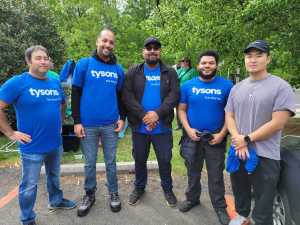
DataBank’s Northern Virginia teams marked Earth Day with a trail cleanup at Scott’s Run Trail in Tysons, Virginia, and the timing carried extra significance. The event also coincided with the 150th anniversary of the Tysons area, making it a community moment as much as an environmental one. For many on the team, it was their first volunteer outing together.
Among the more interesting finds along the trail: baseballs, a lawn chair, old street signs, and what appeared to be the remains of a campsite. The team made a day of it, with lunch together afterward.
Five DataBank employees prepare to clean up Scott’s Run Trail in Tysons, Virginia, as part of an Earth Day volunteer outing.
Scott’s Run Trail is part of the Scotts Run Stream Valley Park system in Fairfax County, offering a green corridor in one of the most densely developed areas of Northern Virginia. It is a good reminder that preserving that kind of space requires ongoing care from the people and organizations that call the area home.
Coming Up in May
This month, DataBank will once again bring its Kindness in Action campaign to life as employee-owners, customers, and community partners come together to assemble Kindness Kits for women and people experiencing homelessness. The kits are distributed to local shelters across multiple DataBank markets — a hands-on effort organized by the Women of DataBank employee resource group that grows in participation each year.
Also in May, DataBank will serve as a community sponsor of the 4th Annual 7×24 Cloud Run on Saturday, May 30, in Ashburn, Virginia. The race route runs alongside DataBank’s Northern Virginia data centers, and the event brings together data center professionals, families, and neighbors for a fun, casual day in the community. Options include a 4.999K race and a one-mile fun run. More information and registration are available here.
DataBank Cares: Giving Back Is What We Do
From blood drives and food donations to assembling Kindness Kits, writing letters to deployed troops, and supporting STEM education in underserved communities, DataBankers across the country have consistently shown up for the people and places around them. That commitment does not stop after these events.
To learn more about DataBank’s community partnerships and employee volunteer initiatives, visit our Community Relations page.
Want to learn more about how DataBank is investing in the communities where we operate? Visit our Community Relations page or explore DataBank Digest for more stories about our people, our partners, and the neighborhoods we’re proud to call home.
In a recent webinar, DataBank’s cloud team examined the market forces reshaping enterprise infrastructure decisions and made the case for why a choice-based cloud strategy now represents the most resilient path forward. Watch the full webinar here.
Something shifted in enterprise IT over the past two years that goes beyond a typical market cycle. Equipment costs have risen three to four times in the span of roughly four months, VMware licensing has gone from a stable line item to a budget-breaking variable, and the hyperscaler bills that organizations once accepted as the price of flexibility are now drawing hard scrutiny from finance teams who want to understand what, exactly, they are getting for the spend.
The disruption is real, but what makes this moment particularly difficult for IT leaders is not just the increased cost. It is that the pressure has arrived without a clear resolution in sight, leaving organizations to navigate a complex set of strategic and operational questions that most were not expecting to face on this timeline.
For most of its history, VMware was the default answer to enterprise virtualization, not always because organizations made a deliberate choice but because it was so deeply embedded in infrastructure, integrations, and institutional knowledge that it functioned more like assumed infrastructure than a vendor relationship. Deep third-party support, a mature ecosystem, and a generation of IT professionals trained on its platforms reinforced that position year after year.
Broadcom’s acquisition of VMware in 2023 changed the terms of that relationship in ways most enterprises were not prepared for.
The transition from perpetual licenses to a per-core subscription model, combined with the consolidation of VMware’s reseller program, sent licensing costs sharply higher for organizations that had built their infrastructure around a pricing model they expected to remain stable. What had been a known, manageable cost became an unpredictable one, and in some cases, a prohibitive one.
That shift arrived alongside an unrelated but equally disruptive spike in equipment costs. Hardware that enterprises refreshed on predictable cycles is now three to four times more expensive than it was just months ago, and the math that once validated on-premises infrastructure, colocation strategies, and hyperscaler commitments no longer holds in the same way.
More Than a Cost Problem
While cost pressure gets the bulk of the attention, it is not the whole story. What makes this moment genuinely difficult for IT leaders is that the disruption has no obvious resolution. Today, enterprises are wrestling with a wide range of unresolved questions:
Whether moving workloads off hyperscalers will actually reduce costs, or simply swap one set of tradeoffs for another
How to evaluate alternative hypervisor vendors — Nutanix, Proxmox, KVM-based options, Hyper-V — without lab environments to test them against production workloads
How to rationalize OpEx versus CapEx decisions when neither model carries a clear advantage
How to address security and compliance requirements that add complexity to every platform conversation
Through all of it, enterprises are trying to avoid deepening the vendor lock-in that created their current exposure. Yet it’s important to note that doing nothing is not a neutral position. It means continuing to absorb rising licensing costs and escalating equipment expenses while the window for proactive planning slowly closes.
Those concerns were reflected during the webinar, where a live audience poll asked attendees to identify their top cloud-related challenge. Rising infrastructure costs, hypervisor licensing increases, and security and compliance pressures all tied for the top spot.
Choice ensures the right platform for every workload, without compromise, where your performance needs, licensing impacts, support models, budget expectations, and future scaling plans all align.
Choice Is the New Enterprise Cloud Strategy
The enterprises navigating this environment most effectively share a common orientation. Rather than making a single large bet on one vendor or one cloud model, they are building infrastructure strategies designed for optionality, placing each workload on the platform where it performs best while preserving the ability to evolve as conditions change.
This is the principle DataBank explored in a recent webinar of the same name. The central argument is that choice delivers lower risk, lower cost, higher control, and no lock-in. More specifically, choice ensures the right platform for every workload without compromise, where performance needs, licensing impacts, support models, budget expectations, and future scaling plans all align.
The era of defaulting to a single hypervisor or cloud model is not over because those models were wrong. It is over because the market has changed in ways that reward flexibility and penalize lock-in. Organizations now need infrastructure partners capable of helping them adapt, not just absorb the impact.
DataBank’s recent webinar breaks down the market forces reshaping enterprise infrastructure decisions — and what a choice-based approach looks like in practice. Watch the replay now.
The Right Platform for Every Workload
The DataBank Cloud platform gives enterprises four distinct options: Multi-Tenant Cloud, Private Cloud, Bare Metal, and FedRAMP Cloud. Across those platforms, customers can mix and match hypervisors — VMware, Nutanix, and Proxmox — based on what each workload actually requires, without re-architecture, disruption, or lock-in.
To illustrate what that flexibility means in practice, DataBank’s team walked through a specific cost comparison during the webinar. An energy company running its entire environment on VMware was spending $18,000 per month. By migrating appropriate workloads to Proxmox while keeping its ERP system on VMware, where the integrations justified the licensing cost, the company could reduce monthly spend to $12,200 — a reduction of nearly 32 percent.
Watch the Webinar
If your organization is wrestling with rising VMware licensing costs, uncertainty about the right cloud direction, security and compliance pressures, or the need to align infrastructure strategy with budget constraints, the webinar offers a practical framework for thinking through each of them. Watch the replay: Choice Is the New Enterprise Cloud Strategy now.
Stay current on the latest thinking around enterprise cloud strategy, infrastructure flexibility, and the evolving hypervisor landscape. Visit DataBank Digest for analysis, insights, and the latest news from the world of colocation and digital infrastructure.
DataBank recently partnered with the Culpeper Technical Education Center (CTEC) in Culpeper, Virginia, as part of its ongoing commitment to engage and support the communities where we operate Over two days, this hands-on program gave 40 electrical students an up-close look at the data center industry and the career opportunities it holds.
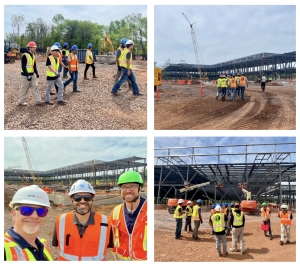
CTEC electrical students and DataBank team members tour the Culpeper campus currently under construction during a two-day career exploration program.
The Culpeper program is part of the same commitment: The view that being a good neighbor means investing in the people and places where we build and operate.
A Community Partnership Takes Shape
CTEC is a career and technical education school located directly across the street from our new Culpeper data centers currently under construction. Its electrical program students had built an impressive lab model of a data center data hall, complete with raised floors, electrical power and distribution systems, low-voltage and network cabling and conduit, backup power, cages, servers, and more.
DataBank wanted to support CTEC students and help expand their understanding of the data center industry. We saw an opportunity to do what good neighbors do: Open our doors, share what we know, and give these students a firsthand look at an industry that needs their talents.
Day One: Meeting the Students and the Site
On the first day, we brought together a team spanning operations and construction to make the trip to CTEC. Matthew Uveges, Regional Director of Data Center Operations for the Mid-Atlantic Region, and Thomas Barrett, Project Manager for our Culpeper campus, represented the hands-on expertise these students were hungry to learn from. We were welcomed by CTEC Principal Shaun Summerscales, Electrical Instructor Doug Keaton, and Bryan Rothamel, Director of Economic Development at Culpeper County and the Culpeper Tech Zone.
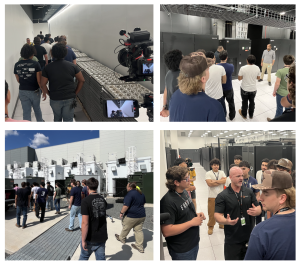
CTEC electrical students get an inside look at a fully operational DataBank facility in Ashburn, Virginia, during the second day of their career exploration program.
The DataBank team met with 40 Level 1 and Level 2 electrical students ranging in age from 16 to 18. After an overview of the data center business, Uveges and Barrett evaluated the students’ data hall model, offering feedback and noting how closely their work reflected a real-world facility.
The group then boarded a bus across the street to tour the Culpeper campus, where they met with construction teams and contractors, walked the site, and took in the scale of two facilities under development: a 72MW building currently under construction as well as planned 120MW data center.
Day Two: Seeing the Finished Product
On the second day, the older Level 2 students, those nearing graduation, traveled by bus to Ashburn to visit two of our operational facilities, IAD1 and IAD3, and see what a completed, fully operational data center looks like.
They met with Patrick Greene (Data Center Manager, IAD3), James Mathes (Data Center Manager, IAD1), and Mike Ocampo and Isaiah Benjamin (Data Center Technicians, IAD3), who shared their experiences and offered firsthand perspective on careers in data center operations. The conversations covered everything from day-to-day responsibilities and shift work to career progression, certifications, and what employers actually look for when hiring technicians.
Students also got a candid look at how their electrical training maps directly to the skills needed on the data center floor, and how quickly that training can translate into a stable, well-paying career.
From Blueprint to Operations: A Complete Picture in 48 Hours
In just two days, these students experienced the full arc of a data center: from a 30-foot-long lab model, to a 100-acre campus under construction, to a fully operational 40MW facility. They heard directly from construction and operations professionals about how their electrical training translates into immediate, well-paying careers in a growing industry.
That kind of end-to-end experience is rare, and it doesn’t happen without the right people saying yes. We’re grateful to the CTEC faculty and Culpeper County leadership for making this partnership possible, and proud of the DataBank team members who gave their time and expertise to make it meaningful.
Culpeper is one of more than 25 markets where DataBank operates across the United States, and programs like this reflect how we think about our role in each of them. Building data centers is what we do. Being a good neighbor is who we are. Whether that means opening our doors to students in Atlanta, bringing 3D printers to a library in Red Oak, or spending two days with 40 young people in Culpeper who are about to launch their careers, we believe the communities we operate in deserve more than our infrastructure. They deserve our investment.
We look forward to continuing our relationship with CTEC and finding new ways to support workforce development, STEM education, and career opportunity in Culpeper and beyond.
Want to learn more about how DataBank is investing in the communities where we operate? Visit our Community Relations page or explore DataBank Digest for more stories about our people, our partners, and the neighborhoods we’re proud to call home.
AI is reshaping nearly every corner of the technology industry, and its relationship with energy is one of the most consequential examples. The same technology driving unprecedented growth in power demand is also one of the most powerful tools available for managing that demand more intelligently.
According to the International Energy Agency, global data center electricity consumption is projected to nearly double by 2030, reaching close to 945 terawatt-hours, which is roughly equivalent to Japan’s entire annual electricity use. AI is the primary driver of that growth. It’s also one of the best tools we have for managing it.
For IT leaders and infrastructure decision-makers, the opportunity may outweigh the challenge. AI is already helping operators run leaner, smarter networks, and the organizations that get ahead of that curve will have a real advantage as energy costs and infrastructure demands continue to rise.
The Problem Side: AI’s Growing Energy Appetite
The scale of AI’s energy demand is difficult to overstate. Training and running large AI models requires massive amounts of compute, and that compute lives in data centers that run around the clock. AI is accelerating electricity consumption at a pace the industry has not seen before. For networking infrastructure specifically, higher-density AI workloads mean more data moving faster between more devices.
The same capabilities that make AI so compute-intensive also make it remarkably effective at finding inefficiencies that humans would never catch. For example, operators are now using AI-driven monitoring tools to analyze network traffic patterns in real time, dynamically rerouting workloads to reduce congestion, lower latency, and cut unnecessary power draw. The result is a network that adjusts itself continuously rather than running at static capacity.
The following examples illustrate where AI-driven efficiency gains are showing up most clearly across networking, cooling, and interconnection infrastructure.
Network Traffic and SD-WAN
Software-Defined Networking, intent-based routing, and AI-assisted telemetry are increasingly central to this approach, giving operators the ability to automate routing and bandwidth allocation across both on-premises and cloud infrastructure.
SD-WAN is one area where efficiency gains are becoming particularly tangible. Traditional wide-area networks were built for predictable, centralized traffic patterns that no longer reflect how enterprises actually operate. AI-enhanced SD-WAN platforms prioritize traffic dynamically, routing performance-sensitive workloads through the lowest-latency paths while deprioritizing less time-sensitive traffic.
As enterprises lean into multi-cloud and hybrid cloud environments, AI-based traffic optimization is emerging as one of the defining trends driving SD-WAN adoption, with the market projected to reach $35 billion by 2030. The practical result is not just better performance — it is less wasted bandwidth and lower energy consumption across the network fabric.
Cooling Optimization
AI is also transforming how data centers manage cooling, historically one of the largest energy drains in any facility. Machine learning models can predict thermal loads before they occur and adjust cooling systems proactively rather than reactively. That approach works by training neural networks on thousands of sensor data points to predict temperature and pressure conditions up to an hour in advance.
As operators adopt direct liquid cooling for high-density AI compute racks, the physical network topology shifts alongside it — denser rack configurations, shorter interconnect distances, and a re-evaluation of optical versus copper trade-offs at the rack and row level. These topology changes carry their own energy implications, which means cooling infrastructure decisions and network architecture decisions can no longer be made in isolation.
Interconnection and Network Slicing
On the interconnection side, AI-driven network slicing allows operators to dynamically allocate and reconfigure resources on demand rather than provisioning for peak capacity that sits idle most of the time. Predictive maintenance is adding another dimension to this efficiency story. AI models continuously monitor telemetry from network switches, routers, and optical transceivers to detect performance degradation before failure occurs.
By flagging at-risk hardware early, operators can schedule replacements during planned maintenance windows rather than responding to emergencies — avoiding the unplanned load spikes and inefficient power draw that reactive fixes typically cause. Together, these approaches are reframing network efficiency as an ongoing operational discipline rather than a one-time design decision, and one that improves continuously as AI systems learn.
These efficiency gains do not exist in isolation. Where enterprises choose to run their workloads plays an equally important role in determining how well their infrastructure strategy holds up as AI demands continue to grow.
Infrastructure Strategy is the New Competitive Advantage
The next few years will likely bring a sharper divide between organizations that treat energy efficiency as an afterthought and those that build it into their infrastructure strategy from the start. A significant part of that strategy is deciding where workloads run. Legacy enterprise data centers are often not designed for today’s power densities, and retrofitting them is rarely practical or cost-effective.
Modern colocation facilities offer a purpose-built alternative, combining high-density power capacity, advanced cooling infrastructure, and the network connectivity AI workloads require, without the capital burden of building and operating it yourself. For IT and sustainability leaders balancing growing compute needs with ESG commitments, that environment is increasingly difficult to replicate independently.
Hardware improvements will help, as newer GPU architectures are delivering more compute per watt than their predecessors, but they will not be enough to offset the volume of AI workloads coming online. Software-level approaches like model distillation are gaining traction as a practical way to reduce inference energy costs at scale. Organizations that get ahead of these approaches now will be better positioned as energy costs and sustainability scrutiny continue to rise.
The Path Forward Starts with Infrastructure Strategy
AI’s relationship with energy efficiency is genuinely complicated, and anyone claiming it is purely a problem or purely a solution is not seeing the full picture. The demand side is real and growing. So is the opportunity to use AI as a tool for smarter, leaner infrastructure operations.
The organizations best positioned to navigate this are those that take both sides seriously, investing in the right infrastructure partnerships, staying current on efficiency innovations, and treating energy strategy as part of their broader technology roadmap rather than a facilities problem to address later.
This is the first in a multi-part series separating fact from misinformation in the national debate over data centers. Read the eBook, The Truth About Data Centers, for a deeper look.
Data centers have spent decades as invisible infrastructure, powering nearly everything we do online while attracting almost no public attention.
The questions driving that reaction are legitimate, and they deserve straight answers. This series — and our engagement with the communities where we operate — is our attempt to provide them.
The Infrastructure You Use Every Day
Data centers are not a new invention. The concept of centralized computing infrastructure predates the commercial internet. Yet for most people, their relevance became personal much later: when online banking went mainstream in the mid-2000s, when smartphones became universal around 2010, and when the world went remote practically overnight in 2020. Every time you stream a show, check the weather, use GPS to navigate, or place a call to 911, that interaction runs through a data center.
What is new is the scale. AI has fundamentally accelerated demand for this infrastructure, and that acceleration is real and worth taking seriously:
That level of growth has implications for the power grids, water supplies, and the communities where this infrastructure gets built. The concerns being raised are not imaginary, and they deserve a serious look at the facts behind them.
Communities deserve better than headlines built on incomplete information. DataBank’s eBook, The Truth About Data Centers, covers the facts behind the debate in full. Download your copy now.
Separating Fact from Fear
Many of the specific claims driving the current backlash are incomplete, outdated, or simply wrong. When policy gets made on inaccurate information, communities end up with worse outcomes than they would have gotten from a more honest conversation.
A few examples worth examining:
Electricity rate increases in Maine and elsewhere have root causes — natural gas volatility, aging infrastructure, inflation, and decades of deferred grid investment — that predate the current wave of data center construction.
Water consumption figures cited in community meetings often reflect older evaporative cooling systems that the industry has largely discontinued. Modern closed-loop cooling technology uses a fraction of that water, and the most advanced facilities operate with near-zero ongoing consumption.
Generator testing, the activity that draws the most neighborhood complaints, typically amounts to about 30 minutes per month.
Data centers are frequently characterized as taking more from communities than they give back. The reality — in tax revenue, local jobs, and positive community investments — tells a more complete story.
We’ll cover each of these topics in more detail in the next articles in this series.
A Better Debate
Our goal is not to defend the data center industry. It is to give communities, policymakers, and anyone following this debate the clearest possible picture of what these facilities are, what they require, and what they contribute. After all, we live and work in the communities where we operate. These issues affect us and our families as well.
There is a better conversation to be had about data centers than the one currently taking place. We would like to start having it.
The facts behind each of these topics are covered in full in DataBank’s eBook, The Truth About Data Centers. Download it now.
Stay current on the trends and developments shaping the data center industry. VisitDataBank Digest for analysis, insights, and the latest news from the world of colocation and digital infrastructure.