Scalable and secure internet connectivity is now mission-critical as enterprises re-architect their business models and migrate to hybrid cloud infrastructures. To help our customers take on this challenge, DataBank partners with the leading global carriers, including Arelion (formerly Telia Carrier). Throughout North America, Europe, and Asia, Arelion provides IP transit services, cloud connectors, and dense wavelength division multiplexing to increase the bandwidth of fiber networks.
For DataBank customers, Arelion currently provides services within six of our markets—Cleveland, Dallas, Indianapolis, Philadelphia, Pittsburgh, and Salt Lake City. We also work in tandem in other markets and we are looking to connect more facilities in the future as customer demand guides our ongoing expansion of this partnership.
“Our partnership with Arelion is driven by their continual investments in major U.S. cities and key edge markets,” says Michael Ward, director of network architecture for DataBank. “This helps drive connectivity and network diversity while also providing enterprises with more scalability options and additional connectivity choices.”
Top-Ranked Global Backbone
With more than 2,000 customers worldwide, the Arelion private Cloud Connect service links directly to Amazon Web Services, Microsoft Azure, Google Cloud Platform, IBM Cloud, and Oracle Cloud. Arelion IP transit services—featuring one of the world’s leading global IP backbones—ensure reliability and uptime for direct routes between content and end-users.
“Currently, our customer base accounts for 65% of all internet routes,” says Art Kazmierczak, Arelion director of business & network development. “Our Tier 1 peering ecosystem provides dedicated, high-capacity transport to carry high volumes of traffic across long-haul stretches with direct connectivity that enhances user experiences throughout more than 125 countries.”
Through DataBank’s partnership with Arelion, customers also enjoy direct access to a unique ecosystem of more than 700 networks, content, and cloud application service providers. These systems feature high-quality connectivity and low latency for optimal end-user experiences.
Strong Protection Against DDoS Attacks
With security, a key concern among enterprise customers, Distributed Denial of Service (DDoS) mitigation is crucial to maintain business continuity. Arelion takes on this challenge within its global IP backbone.
The platform proactively manages terabit-scale attacks before they cause service disruption at customer aggregation points. With Arelion’s simplified architecture, automatic mitigation, multi-homed coverage, and detailed analytics, customers can be confident their applications are well-protected.
Real-Time Provisioning to Improve Connectivity Experiences
For private cloud connectivity needs, DataBank customers can connect with Arelion to leverage the same scalable network infrastructure trusted by large public cloud providers. They also can quickly configure private bandwidth links connecting global data centers and cloud instances.
“DataBank’s partnership with Arelion also enables us to deliver in locations where they provide services as cloud on-ramps,” said Ward. That current list of locations includes:
DFW1
DFW2
DFW3, as an extended cross-connect
SLC1 and the SLC Campus
IND1
IND2
PHL1
CLE1
PIT1
PIT2, as an extended cross-connect
“We also use an open optical layer that allows customers to provision equipment from multiple vendors,” Kazmierczak explains. “This accelerates core backbone expansions and maintains expected delivery intervals. It also solves delivery challenges associated with supply chain dependence on private fixed transport networks.”
“Arelion’s network services greatly benefit any company looking to improve user connectivity experiences,” adds Ward. “They facilitate business operations through fast delivery intervals and transparency—along with secure, automated self-serve capability. This is all achievable through the Arelion portal and APIs, which enable real-time service provisioning and reporting.”
For more information on how your company can take advantage of Arelion connectivity services, contact your DataBank account manager or visit www.databank.com. You can also find out more at the Arelion website—www.arelion.com.
After extensive planning and a lot of effort, we are excited to officially unveil DataBank’s brand-new website.
Interested in learning more and how this new site can improve your experience as a DataBank customer, partner, or prospect? In this article, we’ll give you a quick tour of some of the biggest changes and important new resources that may be helpful to you.
Website Themes
As we developed the overall strategy for the new website, we wanted to make sure it addressed a few important themes. This would be critical to helping any visitor get exactly what you need out of the new site.
These themes include:
Data Center Footprint: The new site now does more to communicate the total scope and scale of our data center footprint. DataBank now has more data centers in more U.S. metros than any other provider, public or private. Now, anyone visiting the site can quickly see exactly where our data centers are and learn more about each one.
Edge Focus: The new site also communicates new details about DataBank’s edge strategy. This is important for companies looking to make the best decisions possible to move data, applications, and workloads as close as possible to end users.
Customer Portal: Our software-driven infrastructure management capabilities are available in the DataBank Customer Portal, now more prominently displayed. Customers use this to manage all aspects of their IT infrastructure.
Hybrid IT Solutions: DataBank provides a flexible, customer-centric approach to hybrid IT, and the website’s Solutions page highlights the many options customers have to easily build, scale, and adapt a hybrid IT infrastructure that truly works for them.
DataBank Employees and Culture: We also wanted to shine a light on our employees—not just our data centers or technology—because our talent, diversity, and culture all give us our most durable competitive advantage. To this end, we expanded the Culture section of the website to emphasize our exceptional people.
Thought Leadership Content: Technical and Executive professionals can stay current about the industry through DataBank blogs, case studies, webinars, podcasts, and white papers. You can browse or search for relevant topics in the Resources section.
By focusing on these themes and making them as prominent as possible on the new site, we hope to help any visitor quickly find exactly what you’re looking for as well as understand the wide range of solutions and services DataBank offers.
New Content and Functionality
The new website also features many new design elements, including content and functionality updates that support the themes described above. For example, both the home page and the main data center page feature an interactive map that conveys the scope of DataBank’s footprint and the populations we reach at a glance. The map allows visitors to toggle various features available in each metro—such as cloud nodes, carrier hotels, and 100% renewable power—for a highly relevant experience.
The new site also includes maps of each metro to show exactly where our data centers are located relative to each other as well as to major highways in the metro. It also shows our nine (so far) specific campuses where our data centers have room to expand. The website provides diagrams of each campus that highlight current facilities and potential future expansion space.
As part of the site re-design, we created specific sub-pages in the data center section that expand on our Edge strategy and our approach to data center design.
Let Us Know What You Think
Our refreshed website was designed with DataBank customers and other visitors in mind.
We’re not done yet. We will continue to evolve and make new updates, so please let us know what you think about the new site. If you have any feedback or suggestions to make the DataBank website even better, please let us know.
DataBank’s 2022 food drive, managed by the newly formed CultureCorps, took place in late June and early July. Food banks nationwide report their lowest donation levels in the summer, meaning the DataBank drive had a great impact in helping people in need. We want to share some of the results of that effort.
Collection Sites for Canned Goods
More than 20 data centers in 12 metros set up collection sites including Dallas, Atlanta, Denver, Houston, Austin, Minneapolis, Salt Lake City, and others. Employees, customers, and even family members participated in the food drive.
With so much interest, many sites kept their donation bins up an extra week and, ultimately, all the participation and awareness generated from the food drive resulted in over 1,000 pounds of donated canned goods that were delivered to various local food banks.
Other Ways DataBankers Participated
For staff members who could not get to a data center collection point physically, DataBank set up an option to donate via Amazon and have those goods delivered to the DFW1 data center. These Amazon donations accounted for almost half the 408 pounds of food collected in DFW1 alone.
Some DataBankers chose to participate in other ways, including a group of nearly a dozen Denver area staff members who used the company’s Volunteer Time-Off (VTO) program to work at Food Bank of the Rockies, preparing meals for underprivileged kids who are provided free breakfast and lunch.
Check out our slide show to get a closer look at this successful volunteer effort, and get ready for our next volunteer program later this year.
In this second article in an ongoing series, we continue to present the DataBank Customer Portal and how it provides real-time visibility and self-service control. This article highlights the portal’s capabilities for managing physical access. Stay tuned for additional articles, or learn more about the DataBank Customer Portal now.
The security of your colocation environment is one of the principal responsibilities in our partnership with you. There’s no need to submit a service ticket and wait on a response — it all happens instantly. Having said that, if you’d prefer we make changes to your or your users’ badges and Portal users for you, we’re happy to do so – simply open a ticket requesting a change and we’re always here to help. When building a portal to enable real-time visibility and access control, you spoke, and we listened. With our latest update, we’ve now enabled over 57 data center locations with the features our customers requested most:
Define which users have permissions to grant access
Review my list of badge holders and what they may access
Request a new badge for a user with predefined access rights and have it ready upon arrival
Alter, grant, and revoke access to specific locations in real-time
Disable and enable users at your convenience
Create both permanent and temporary badges for contractors
Review and download your logs and compliance reports in real-time to review successful and failed attempts access attempts
For an overview of these features, please review our how-to videos
Define which users have permissions to grant access
To manage your users and their roles, the Customer Portal provides three default roles: administrator, billing, and support. You also have the option to create custom roles.
Administrators are the only people who can manage users (add, edit, delete profiles and roles) and they can authorize orders, including new services and changes to existing services. The Customer Portal makes it possible for administrators to limit what users can see by tagging them to a specific service, so that when users log in all they see is information specific to that service. Other helpful options include two-factor authentication, which can be applied to all users or specific users, such as those who travel frequently.
Administrators also control the password expiration cadence—ranging from never (which we strongly advise against) to every 30, 60, 90, or 180 days. The Customer Portal will allow you to adopt any password expiration cadence you require.
Physical Access Administrators can grant and remove permanent access in real time for your badge holders.
Temporary Access Administrators can grant temporary access in real time. Each of these require both a start date and end date.
Users assigned to Billing roles can view billing data, make payments, and change the organization’s billing address.
Support users can review services, pull reports regarding services, and create service tickets and view the status of incidents.
Additionally, Custom roles can be created to specify exactly what information and processes a given user may engage in the Portal.
To change and apply roles to a user, head over to the Managed Users section of our Customer Portal. Click the Pencil next to the user to edit the records, and click on the permissions tab.
Ensuring Proper Access to Your Environment
Your account users are the only people in your company who are authorized to communicate with DataBank and receive Customer Portal notifications about your colocation services, billing, and support. The profiles you create will dictate which notifications (i.e., invoices, patching, system maintenance, support tickets) they receive and which information DataBank will discuss. You can be as specific as you like to determine exactly what users in your company can see and what they can control.
Our preference is for users to submit service and support requests through the Customer Portal so the user is automatically authenticated and we can immediately respond. However, if an authorized user on the account calls DataBank, we validate that person through our authentication process. We then look at which rights the user has, and our support team will explain what that person can discuss based on his or her role. If the user wants to talk about something outside of the user’s profile rights, we check with your organization’s administrator contact(s) for permission to maintain the security of your environment.
Review My List of Badge Holders to See What They Can Access
One of the most common questions we fields is to provide a list of badge access holders and a list of what they can access. This information is now available to you 24×7 in the card holder access list. Click the pencil to review which badge readers a user can access.
Request a New Badge for a User with Pre-Defined Access Rights and Have It Available Upon The User’s Arrival
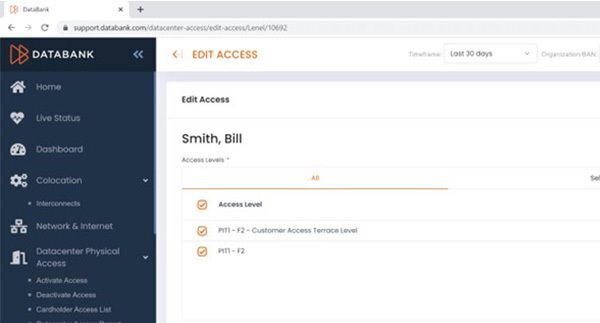
The Physical Access section of the Customer Portal integrates with badge readers at our data centers, applying changes in real time to ensure only employees and vendors you’ve authorized can access your infrastructure. To activate Permanent or Temporary access for a user, click on the Active Access link in our Customer Portal, then complete the form, A badge will be waiting for pickup at the selected location and will be provided after identity verification. You will be able to grant access only to the locations to which you have access.
Need to change and deny access quickly? Do so in real time or at a scheduled date via the Customer Portal.
Alter, Grant, and Revoke Access to Specific Locations in Real Time
Do you have multiple cages, suites, and locations? Manage physical access permissions on one screen across all of your locations. In addition, customers who have vendors visiting the data center periodically for system maintenance but don’t require permanent access can toggle vendor badges on and off. You control access at all times.
Review and Download Your logs and Compliance Reports in Real Time to See Successful and Failed Access Attempts
Another important feature is the ability to pull logs of who has visited your data centers and see exactly what each person accessed. Our customers appreciate the ability to export monthly log reports to demonstrate controlled access to regulatory assessors and auditors. The log reports also show the history of activating and deactivating badge access.
Proving Compliance and Security to Key Stakeholders
The list of users to which you grant physical and digital access — and the history logs showing when they access the physical environment and the Customer Portal — will play a vital role in your compliance efforts. Whether it’s for HIPAA, PCI DSS, FedRAMP, or another regulation, you can export reports of all user activities for assessors to validate.
This information is also helpful in demonstrating your deployed security measures to your financial partners, investors, company executives, and board of directors. In today’s cybersecurity-conscious world, all these stakeholders are keenly interested in the physical and digital control you have over your colocation environment, and the DataBank Customer Portal can be a key tool in meeting their requirements.
Ultimately, the DataBank Customer Portal is yours, not ours. Its features are driven by our customers’ feedback, and updates meeting those requirements are rolled out as quickly as possibly by our in-house development team. We’re committed to ensuring the Customer Portal meets your needs and provides the best possible experience, facilitating user access based on your requirements.
By JP Laqueur, Senior Vice President of Marketing, DataBank
DataBank is excited to announce that we’ll be holding a two-week food drive this June 20-July 1 and will be accepting food donations at many different DataBank data centers. Our employees are already getting ready to contribute, but DataBank customers (as well as anyone else) are also welcome to participate.
Why are we holding this food drive, and why are we doing it now? More than 42 million Americans face hunger each and every day, a number that includes one out of every six children. Unfortunately, this problem could grow worse as our country continues to deal with supply chain issues and rising inflation that threatens to make even common goods and staples too expensive for some consumers.
The best solution is straightforward: Get food to the people who don’t have enough, when they need it. The last part is important because many people simply don’t think of donating at this time of year. During the holiday season, donors tend to flood food banks with contributions. Yet, unfortunately, in the spring and summer, this level declines dramatically. In fact, this is the time of year when food banks need donations the most.
How You Can Help
Donating is easy. Anyone can use the designated donation bins at the DataBank data centers listed below to drop off dry and canned goods, such as a peanut butter, canned soup, fruit, vegetables, pasta, and rice.
We will be accepting donations at the following DataBank facilities:
Atlanta: ATL1 (in the lobby of the Coda high rise)
You’re not close to one of our data centers? No problem. Even if you can’t donate in person, you can still make a contribution with Amazon. All you have to do is use your personal Amazon account and choose to ship any items to DataBank headquarters:
DataBank
400 South Akard
Suite 100
Dallas, Texas 75202
Our Tradition—and Commitment—to Giving Back
This summer’s food drive is just one example of DataBank’s commitment to being a good corporate citizen and contributing to the well-being our of communities. The food drive is made possible by DataBank’s Volunteer Time Off program, which gives all employees paid time off for volunteer activities, and its CultureCorp Ambassador program, a group of internal ambassadors assembled from a wide range of departments and markets in DataBank who have one goal in mind: helping others. For this food drive, our CultureCorps Ambassadors are helping set up donation bins, collecting all the contributions, and taking pictures from their market to document—and celebrate—donors’ generosity.
Join Us to Make a Difference
The DataBank team is ready to help those in need, when they need it most. Join us this summer by dropping off dry or canned goods at the closest DataBank data center (or via Amazon), volunteering at a local food bank, or even donating canned goods at your local grocery store.
If you have any questions, please reach out to JP Laqueur, Senior Vice President of Marketing.
Infrastructure providers who over-emphasize the importance of cell tower locations miss the point of true edge computing. Workload deployments are driven by a range of requirements, not just tower locations. Raul Martynek, CEO of DataBank and a leader in IT infrastructure shares his perspective on AMT’s acquisition of CoreSite.
Last week, the CFO of American Tower spoke at the NAREIT conference and was asked about their CoreSite acquisition and the rationale for AMT acquiring a data center company. A couple of segments of his response caught my attention.
“We’ve got the towers. We didn’t have the cloud on-ramps and the direct commercial relationships with cloud companies and all these other landline networking companies. That’s what we pick up with CoreSite, so we can hopefully kind of bring these puzzle pieces together in a way that you get cloud on-ramps at the tower site it satisfies the lower latency requirements and wireless 5G networks. It gives on-ramps and compute power close proximity to base radios.” –AMT
Let’s talk about that a bit, but first, some context. When I heard the news of AMT buying CoreSite, I was a bit surprised. Being part of the DigitalBridge ecosystem, I regularly dialogue with my CEO peers at Vertical Bridge, Vantage, Extenet, Zayo, and the other companies in the group. This gives one the benefit of having a “360 degree view” of the internet infrastructure sector and insight into the important trends happening in towers, small cells, hyperscale colocation, and fiber. Because we are independent companies with independent boards and different investors group — but with a common shareholder in DigitalBridge — we have the opportunity to focus on our core business but also the incentive to collaborate and explore areas of synergy where it makes mutual sense.
When “The Edge” started to gain currency a few years ago, and (if you recall) took the form of modular data centers at the base of cell towers, I immediately called Alex Gellman, the CEO of Vertical Bridge to compare notes and thoughts on the topic. After months of conversations with a wide range of people investigating this topic, I was skeptical, and expressed my views in a blog post at that time. Since then, Vertical Bridge and DataBank have had a regular dialogue about the Edge and how we see it evolving in our respective sectors and with a keen interest on where our paths might be converging.
I continued to track the space and in 2020 identified a number of use cases where the Vertical Bridge tower sites (or other land sites they own or control- not all RF sites sit on a macro tower) and the DataBank colocation solution could align. In late 2020 we began to test modular data centers as a way to capture those use cases. What we have learned is that tower sites are helpful for modular deployments because they are already entitled for telecom infrastructure and, typically, have available power and fiber.
“…tower sites are helpful for modular deployments because they are already entitled for telecom infrastructure and, typically, have available power and fiber.”
What we also learned, is that the tower itself is not the driver of site selection, but instead some other customer requirement, like proximity to a set of network assets, or the requirement for highly localized compute, or distance from a particular collection of infrastructure assets. We believe modular is an excellent solution for geographically specific workloads, with the workload driving the site selection, not the location of the tower site. Sometimes the tower site is a good location, and sometimes it’s not. We have deployed about half a dozen sites in support of one such geographically specific workload. We are using a combination of tower sites and straight ground leases because we are letting the workload dictate the location, not the location of the tower site.
“The tower itself is not the driver of site selection…Sometimes it’s in a good location, and sometimes it’s not.”
Now back to CoreSite and AMT. In another part of the interview the AMT CFO stated:
“So, we bought CoreSite, it’s a combination of about 24 buildings that spread across eight different markets. So, the geographic location of these assets is important to us. They’re in the Silicon Valley, down in LA, in Chicago, down in Denver, they’re in Boston, New York, Northern Virginia, and down into Miami. So, they’re well distributed throughout the U.S.” –AMT
We completely agree that “the geographic location of these assets is important.” In fact, we believe the Edge is all about geography. The Edge is fundamentally the decentralization of internet infrastructure and the compute, storage, and delivery of applications and data. As customers evolve their infrastructure stack to be more decentralized, they will naturally seek out a wider range of geographic locations in which to place their workloads. That is exactly what DataBank customers have told us and why we have built — through our acquisitions and organic builds — the largest geographic footprint of any data center operator in the US, public or private: over 65 data centers in 27+ metro markets. In fact, DataBank’s geographic footprint puts critical infrastructure within 50 miles of half the U.S. population.
Yes, the Edge is geography. We call that the “Metro Edge”, and it is where today the largest technology companies and hyperscalers are deploying infrastructure. Those deployments are occurring in traditional brick and mortar data centers because of the scale of the workloads these customers require, and that scale is not available with a modular data center solution. I don’t think you can be an Edge data center provider and be in only the top 8-10 metros; it’s an oxymoron. Yes, there will be so called “Edge” workloads in markets like Chicago, New York and Los Angeles, but those markets alone are insufficient for customers’ true edge deployment needs. Rather, having the widest geographic reach will enable an infrastructure provider to deliver the most comprehensive solution to your customers.
“We see both the Metro Edge and Mobile Edge as a combination of modular and traditional data centers depending on the workload requirements and geographic specificity of the application.”
We think the “Mobile Edge” will evolve in a similar way for similar reasons and that aggregation will occur at the metro level as 5G networks are built and evolve to Standalone core and vRAN standards. We see both the Metro Edge and Mobile Edge as a combination of modular and traditional data centers depending on the workload requirements and geographic specificity of the application. We intend to continue to expand our geography, as we did recently with the acquisition of CyrusOne’s data center assets in Houston, bringing us to the 5th largest metro market in the country, and through organic development like our recent acquisitions of land in the New York, Denver, and Atlanta markets.
We also intend to collaborate with Vertical Bridge to identify those specific workloads where a modular data center solution is a better answer than a traditional brick and mortar data center. That can be anywhere in a metro market, not just where the VB tower sites are. That is precisely why Vertical Bridge coined the phrase, “Edge to Suit”, and we believe that is the right way to think about the interplay between towers and edge.
Kansas City—where DataBank operates three state-of-the-art colocation facilities—stands at the center of the growing national market for data center services and solutions. The area is home to AMC Theaters, Hallmark Cards, American Century Investments, H&R Block, and Black & Veatch.
Kansas City’s continuing growth
In the KC Tech Council report, KC Tech Spec V4, analyst firm RMS noted, “Kansas City has a growing technology ecosystem that is a critical component of the region’s overall vitality. As the region emerges from the pandemic, its recovery has outpaced the overall US recovery rate.”
According to Carla Ball, DataBank director of product management, “Kansas City is poised for strong growth which is why we continue to expand our presence in the region. Its strong economy and relatively low cost of doing business make it an ideal tech hub.”
As these observations suggest, enterprises that put their stake in Kansas City enjoy increased opportunities for growth and a business-friendly government that offers numerous business incentives. Ranked in a CNBC study as one of the Top States for Business, Kansas is the heart of Silicon Prairie and an excellent location for organizations in search of the right data center.
An Expanding Midwest Presence
DataBank recently announced the construction of a new data hall, set to open by early 2023. With these data centers, we offer ideal failover opportunities for Chicago and Minneapolis, providing enough geographic distance without being too far away. We also offer a prime gateway for establishing low-latency interconnections across America to link east coast and west coast data centers.
Leading off in our KC data center line-up is our South Lake facility (MCI1), situated in the tech-forward suburb of Lenexa, just south of Kansas City. This data center features direct, on-site connectivity to several Tier 1 carriers. Powered by two separate substations with on-site, diesel-powered generators for backup, the data center includes 6,000 raised square feet of space for customer equipment and advanced cooling technology.
Up next is the Pine Ridge data center (MCI2) in the technology-rich Overland Park suburb. The site houses more than 12,000 raised square feet of data center space and three independent data halls with direct connectivity to multiple top-tier carriers.
Finally, MCI3, our newest facility, is the keystone of our South Lake Data Center Campus. This 25,000 square-foot data center augments the innovative and growing Kansas City market with a full range of colocation, cloud, and connectivity solutions. A Tier III design along with diverse utility power feeds, multiple network entry points, and multiple fiber providers all contribute to this data center’s robust resiliency.
Compute Resources That Offer Scalability, Reliability, Security, and Compliance
With a longstanding history of service and support in the area, DataBank continues to invest in expanding our footprint and capabilities to meet the growing demand. Thanks to multiple diverse sources for local energy generation—including coal, nuclear, and wind—the area offers reliable, low-cost energy.
That’s something DataBank plans to pass along so our customers can cost-optimize their use of our reliable, scalable, secure, and compliant compute and connectivity resources. To learn more, take a closer look at our Kansas City data centers or request a no-obligation quote today.
DataBank’s Kansas City Metro by the Numbers
3
Data Centers
7.8
Total Megawatts Critical IT Load
20+
Total Carriers
43,000
Total Square Feet
DataBank’s Kansas City Metro Data Centers
MCI2: Pine Ridge Data Center
10605 W. 84th Terrace, Overland Park, KS
Episode Topics: CISO Podcast – Hackers have demanded ransom. Now what? Featuring: Mark Houpt, DataBank’s Chief Information Security Officer
Listen to Mark Houpt, DataBank’s Chief Information Security Officer, as he answers and discusses the circumstances that make an IT environment more susceptible to a ransomware attack as well as 4 key questions:
• Have you seen situations where an IT department seems to be doing everything right but still gets hacked?
• What would you recommend to the head of an enterprise IT department when he or she receives a ransom demand? What should happen in the first minutes and then in the following hours?
• Are there guidelines for when it does or does not make sense to pay the ransom?
• Can you share a success story where the hackers were the losers in the scenario?
Run Time: 11 minutes
DataBank’s CISO Corner is for CISOs and security practitioners, where we discuss a variety of cybersecurity topics and current events from the CISO’s perspective. Our broadcast is designed for those who want to hear from security and compliance experts on the front lines.
Known for fast cars, blockbuster events, and one of the Crossroads of America, Indianapolis is among the fastest-growing tech ecosystems in the Midwest. Also known as Indy, the city is #5 for creating the most tech jobs according to Forbes and one of the 20 hottest cities within the technology industry, according to Money.
Given all the skilled technology talent, it’s a fertile area for companies that want to grow. That’s why increasing numbers of large technology companies continue to establish operations in Indy. The business-friendly environment—coupled with the relatively low cost of living and utility power—drives the need for colocation, connectivity, and cloud services.
With these attributes, Indy is a prime location for enterprise-class data centers, and that’s where DataBank is ready to help clients seize the opportunity. Our two data centers, located on West Henry Street in the heart of downtown Indianapolis, are just a two-minute walk away from each other. They anchor buildings powering fiber and telecommunications for the State of Indiana.
An Expanding Data Center Footprint
Both DataBank facilities in Indianapolis are carrier hotels and combine for more than 46,500 square feet of data center space. The data centers each feature an N+1 power design with raised flooring for cages, cabinets, and overhead networks along with generators to support utility feeds and ensure uninterrupted service. Both also provide local access to 17+ top-tier carriers, and through DataBank’s proprietary fiber ring, they connect to each other—giving our clients a flexible path to scale compute resources.
IND1, which expanded its footprint in 2021, provides 2.1MW of on-site power spanning 16,000 square feet of raised floor space. The IND2 facility offers 31,500 square feet of raised floor space along with 5.5MW of on-site power. There are also cooling systems with a capacity of 35KW per cabinet, ideal for high-density workloads.
Both IND1 and IND2 give DataBank clients multi-level physical security that includes 7×24 on-site staff and monitoring. Additional security measures include full perimeter fencing, round-the-clock on-site security personnel, and dual-factor authentication on exterior entry and data center entrances. The facilities also meet key compliance standards, including HIPAA, SOC, PCI DSS, and GDPR.
Regional and Coast-to-Coast Connectivity
DataBank’s 2021 expansion in Indianapolis affirms the city’s growing importance in the data center market. The region’s accessibility, quality of life, and business-friendly climate are attracting technology companies and talent, making it a natural data center location option for those in the Midwest. Our heavy investment in the West Henry Street area also demonstrates our commitment to metro Indianapolis. If the initial market response is any indication, we will continue to expand our footprint in Indianapolis.
For companies with on-premises or colocation data centers in Chicago, Minneapolis, and Kansas, the two DataBank facilities in Indianapolis offer a prime location for regional failover data centers. The city also offers a connection point for enterprises with operations on the east and west coasts. To learn more, take a closer look at our Indianapolis data centers or request a no-obligation quote today.
100% Renewable Power
Both of DataBank’s Indianapolis data centers have moved 100% of their combined electricity usage into a voluntary program directing Indianapolis Power and Light to purchase renewable energy from wind farms and other midwestern facilities. This offset equals the carbon dioxide emissions equivalent of 3,321 passenger cars driven for one year. DataBank’s participation in this program also supports development of additional renewable energy sources.
DataBank recently strengthened the carrier access we offer to our customers by joining forces with Console Connect. The partnership brings the Console Connect Software Defined Interconnection® platform to more than 40 of our data centers across the U.S.
On demand, our customers can access the platform to link with SaaS providers and the 750+ data centers across the globe that are enabled by Console Connect. With an extensive and growing choice of cloud on-ramps in the US, the platform also directly integrates with the world’s largest cloud platforms—including Amazon Web Services, Google Cloud, IBM Cloud, Microsoft Azure, and Oracle Cloud.
Jeremy Pease, DataBank’s senior vice president of managed service operations, and Michael Glynn, vice president of digital automated innovation for Console Connect, point out how the platform addresses the primary networking challenges of security, speed, and agility.
“Using the Console Connect platform, DataBank customers can self-provision private, high-performance connections among a global ecosystem of enterprises, networks, clouds, SaaS providers, and IoT providers,” said Pease. According to Glynn, “What makes our platform different is the underlying network infrastructure, which we own and operate globally. This provides on-demand connectivity among all major metro areas and key markets across North America as well as international capacity to more than 50 countries.”
Benefits for DataBank and Console Connect Customers
Using the Console Connect web application or an open API, DataBank customers can manage and monitor multiple network connections and services in real time. This approach bypasses traditional manual service-delivery processes and shrinks connection timeframes from weeks to minutes.
The partnership also helps DataBank customers embrace hybrid ways of working as they increasingly rely on their networks to make it easier to securely access applications from both corporate and home-based offices. For example, within seconds, customers can self-provision Tier 1 IP transit connections. The Console Connect CloudRouter® also creates private and secure meshed networks instantly for multi-cloud environments—by connecting any cloud or any location without dedicated hardware.
“Our collaboration with DataBank allows customers in the U.S. to build their digital ecosystems and interconnect with a larger number of digital service providers,” Glynn adds. “This is key given the surge in demand for cloud solutions and the massive shift to hybrid working models. This accelerates the need for high-performance networking that can support mission-critical workloads.”
For Console Connect customers, the partnership expands their reach to DataBank’s key metro hubs such as Atlanta, Boston, Chicago, Dallas, Miami, New York, and Seattle. They can tap into our range of colocation solutions to access remote peering and colocation services for business applications.
Console Connect Software Defined Interconnection® Platform Highlights
Layer 2 MPLS network
Metro, regional, and international connectivity among more than 50 countries worldwide
Instant reach to more than 750 data centers
Direct connections with platform customers: enterprises, carriers, cloud providers, SaaS providers, IoT providers, and application providers
Direct remote peering interconnections to Internet Exchanges worldwide
Tier 1 global IP transit (AS3491) service (ranked in the top 10 for IPv4 and IPv6 peering)
Private Connections to Any Service Provider
With many of the world’s leading cloud and SaaS providers headquartered or located across the U.S., Console Connect helps businesses create private, dedicated connections to their service provider of choice. The platform is currently available to DataBank customers in more than 40 data center locations across the US, and Console Connect will be introduced to more facilities later this year.
To engage the Console Connect network, DataBank customers can order an access port at any enabled data center and then launch private connectivity on demand. Customers pay only for the bandwidth they need, even if it is just for a day. For more information, contact DataBank today.